2021 Edition
CIA World Factbook 2021 (factbook.json @ e0d5604b9e27)
Introduction
Background
Timor was actively involved in Southeast Asian trading networks for centuries and by the 14th century exported aromatic sandalwood, slaves, honey, and wax. A number of local chiefdoms ruled the island in the early 16th century when Portuguese traders arrived, chiefly attracted by the relative abundance of sandalwood on Timor; by mid century, the Portuguese had colonized the island. Skirmishing with the Dutch in the region eventually resulted in an 1859 treaty in which Portugal ceded the western portion of the island. Imperial Japan occupied Portuguese Timor from 1942 to 1945, but Portugal resumed colonial authority after the Japanese defeat in World War II. East Timor declared itself independent from Portugal on 28 November 1975 and was invaded and occupied by Indonesian forces nine days later. It was incorporated into Indonesia in July 1976 as the province of Timor Timur (East Timor). An unsuccessful campaign of pacification followed over the next two decades, during which an estimated 100,000 to 250,000 people died. In an August 1999 UN-supervised popular referendum, an overwhelming majority of the people of Timor-Leste voted for independence from Indonesia. However, in the next three weeks, anti-independence Timorese militias - organized and supported by the Indonesian military - commenced a large-scale, scorched-earth campaign of retribution. The militias killed approximately 1,400 Timorese and displaced nearly 500,000. Most of the country's infrastructure, including homes, irrigation systems, water supply systems, and schools, and nearly all of the country's electrical grid were destroyed. On 20 September 1999, Australian-led peacekeeping troops deployed to the country and brought the violence to an end. On 20 May 2002, Timor-Leste was internationally recognized as an independent state. In 2006, internal tensions threatened the new nation's security when a military strike led to violence and a breakdown of law and order. At Dili's request, an Australian-led International Stabilization Force (ISF) deployed to Timor-Leste, and the UN Security Council established the UN Integrated Mission in Timor-Leste (UNMIT), which included an authorized police presence of over 1,600 personnel. The ISF and UNMIT restored stability, allowing for presidential and parliamentary elections in 2007 in a largely peaceful atmosphere. In February 2008, a rebel group staged an unsuccessful attack against the president and prime minister. The ringleader was killed in the attack, and most of the rebels surrendered in April 2008. Since the attack, the government has enjoyed one of its longest periods of post-independence stability, including successful 2012 elections for both the parliament and president and a successful transition of power in February 2015. In late 2012, the UN Security Council ended its peacekeeping mission in Timor-Leste and both the ISF and UNMIT departed the country.
Geography
Area
- land
- 14,874 sq km
- total
- 14,874 sq km
- water
- 0 sq km
Area - comparative
slightly larger than Connecticut; almost half the size of Maryland
Climate
tropical; hot, humid; distinct rainy and dry seasons
Coastline
706 km
Elevation
- highest point
- Foho Tatamailau 2,963 m
- lowest point
- Timor Sea, Savu Sea, and Banda Sea 0 m
Geographic coordinates
8 50 S, 125 55 E
Geography - note
Timor comes from the Malay word for "east"; the island of Timor is part of the Malay Archipelago and is the largest and easternmost of the Lesser Sunda Islands; the district of Oecussi is an exclave separated from Timor-Leste proper by Indonesia; Timor-Leste has the unique distinction of being the only Asian country located completely in the Southern Hemisphere
Irrigated land
350 sq km (2012)
Land boundaries
- border countries
- Indonesia 253 km
- total
- 253 km
Land use
- agricultural land
- 25.1% (2018 est.)
- agricultural land: arable land
- arable land: 10.1% (2018 est.)
- agricultural land: permanent crops
- permanent crops: 4.9% (2018 est.)
- agricultural land: permanent pasture
- permanent pasture: 10.1% (2018 est.)
- forest
- 49.1% (2018 est.)
- other
- 25.8% (2018 est.)
Location
Southeastern Asia, northwest of Australia in the Lesser Sunda Islands at the eastern end of the Indonesian archipelago; note - Timor-Leste includes the eastern half of the island of Timor, the Oecussi (Ambeno) region on the northwest portion of the island of Timor, and the islands of Pulau Atauro and Pulau Jaco
Map references
Southeast Asia
Maritime claims
- contiguous zone
- 24 nm
- exclusive fishing zone
- 200 nm
- territorial sea
- 12 nm
Natural hazards
floods and landslides are common; earthquakes; tsunamis; tropical cyclones
Natural resources
gold, petroleum, natural gas, manganese, marble
Population distribution
most of the population concentrated in the western third of the country, particularly around Dili
Terrain
mountainous
People and Society
Age structure
- 0-14 years
- 39.96% (male 284,353/female 268,562)
- 15-24 years
- 20.32% (male 142,693/female 138,508)
- 25-54 years
- 30.44% (male 202,331/female 218,914)
- 55-64 years
- 5.22% (male 34,956/female 37,229)
- 65 years and over
- 4.06% (male 27,153/female 29,024) (2020 est.)
Birth rate
31.45 births/1,000 population (2021 est.)
Children under the age of 5 years underweight
37.5% (2013)
Contraceptive prevalence rate
26.1% (2016)
Current Health Expenditure
4.3% (2018)
Death rate
5.67 deaths/1,000 population (2021 est.)
Demographic profile
Timor-Leste’s high fertility and population growth rates sustain its very youthful age structure – approximately 40% of the population is below the age of 15 and the country’s median age is 20. While Timor-Leste’s total fertility rate (TFR) – the average number of births per woman – decreased significantly from over 7 in the early 2000s, it remains high at 4.3 in 2021 and will probably continue to decline slowly. The low use of contraceptives and the traditional preference for large families is keeping fertility elevated. The high TFR and falling mortality rates continue to fuel a high population growth rate of nearly 2.2%, which is the highest in Southeast Asia. The country’s high total dependency ratio – a measure of the ratio of dependents to the working-age population – could divert more government spending toward social programs. Timor-Leste’s growing, poorly educated working-age population and insufficient job creation are ongoing problems. Some 70% of the population lives in rural areas, where most of people are dependent on the agricultural sector. Malnutrition and poverty are prevalent, with 42% of the population living under the poverty line as of 2014. During the Indonesian occupation (1975-1999) and Timor-Leste’s fight for independence, approximately 250,000 Timorese fled to western Timor and, in lesser numbers, Australia, Portugal, and other countries. Many of these emigrants later returned. Since Timor-Leste’s 1999 independence referendum, economic motives and periods of conflict have been the main drivers of emigration. Bilateral labor agreements with Australia, Malaysia, and South Korea and the presence of Timorese populations abroad, are pull factors, but the high cost prevents many young Timorese from emigrating. Timorese communities are found in its former colonizers, Indonesia and Portugal, as well as the Philippines and the UK. The country has also become a destination for migrants in the surrounding region, mainly men seeking work in construction, commerce, and services in Dili.
Dependency ratios
- elderly dependency ratio
- 6.6
- potential support ratio
- 15.2 (2020 est.)
- total dependency ratio
- 90.3
- youth dependency ratio
- 83.7
Drinking water source
- improved: rural
- rural: 72.3% of population
- improved: total
- total: 80.7% of population
- improved: urban
- urban: 100% of population
- unimproved: rural
- rural: 27.7% of population
- unimproved: total
- total: 19.3% of population (2017 est.)
- unimproved: urban
- urban: 0% of population
Education expenditures
6.8% of GDP (2018)
Ethnic groups
Austronesian (Malayo-Polynesian) (includes Tetun, Mambai, Tokodede, Galoli, Kemak, Baikeno), Melanesian-Papuan (includes Bunak, Fataluku, Bakasai), small Chinese minority
HIV/AIDS - adult prevalence rate
0.2% (2020)
HIV/AIDS - people living with HIV/AIDS
1,200 (2020)
Infant mortality rate
- female
- 30.86 deaths/1,000 live births (2021 est.)
- male
- 37.85 deaths/1,000 live births
- total
- 34.47 deaths/1,000 live births
Languages
- Tetun Prasa 30.6%, Mambai 16.6%, Makasai 10.5%, Tetun Terik 6.1%, Baikenu 5.9%, Kemak 5.8%, Bunak 5.5%, Tokodede 4%, Fataluku 3.5%, Waima'a 1.8%, Galoli 1.4%, Naueti 1.4%, Idate 1.2%, Midiki 1.2%, other 4.5% (2015 est.)
- note
- note: data represent population by mother tongue; Tetun and Portuguese are official languages; Indonesian and English are working languages; there are about 32 indigenous languages
Life expectancy at birth
- female
- 71.41 years (2021 est.)
- male
- 67.94 years
- total population
- 69.62 years
Literacy
- definition
- age 15 and over can read and write
- female
- 64.2% (2018)
- male
- 71.9%
- total population
- 68.1%
Major infectious diseases
- degree of risk
- very high (2020)
- food or waterborne diseases
- bacterial diarrhea, hepatitis A, and typhoid fever
- vectorborne diseases
- dengue fever and malaria
Major urban areas - population
281,000 DILI (capital) (2018)
Maternal mortality ratio
142 deaths/100,000 live births (2017 est.)
Median age
- female
- 20.2 years (2020 est.)
- male
- 18.9 years
- total
- 19.6 years
Mother's mean age at first birth
- 23 years (2016 est.)
- note
- note: median age at first birth among women 25-49
Nationality
- adjective
- Timorese
- noun
- Timorese
Net migration rate
-3.84 migrant(s)/1,000 population (2021 est.)
Obesity - adult prevalence rate
3.8% (2016)
People - note
one of only two predominantly Christian nations in Southeast Asia, the other being the Philippines
Physicians density
0.72 physicians/1,000 population (2018)
Population
1,413,958 (July 2021 est.)
Population distribution
most of the population concentrated in the western third of the country, particularly around Dili
Population growth rate
2.19% (2021 est.)
Religions
Roman Catholic 97.6%, Protestant/Evangelical 2%, Muslim 0.2%, other 0.2% (2015 est.)
Sanitation facility access
- improved: rural
- rural: 50.3% of population
- improved: total
- total: 62.6% of population
- improved: urban
- urban: 90.9% of population
- unimproved: rural
- rural: 49.7% of population
- unimproved: total
- total: 57.4% of population (2017 est.)
- unimproved: urban
- urban: 9.1% of population
Sex ratio
- 0-14 years
- 1.06 male(s)/female
- 15-24 years
- 1.03 male(s)/female
- 25-54 years
- 0.92 male(s)/female
- 55-64 years
- 0.94 male(s)/female
- 65 years and over
- 0.94 male(s)/female
- at birth
- 1.07 male(s)/female
- total population
- 1 male(s)/female (2020 est.)
Total fertility rate
4.32 children born/woman (2021 est.)
Unemployment, youth ages 15-24
- female
- 15.9% (2016 est.)
- male
- 10.9%
- total
- 13.2%
Urbanization
- rate of urbanization
- 3.31% annual rate of change (2020-25 est.)
- urban population
- 31.7% of total population (2021)
Government
Administrative divisions
- 12 municipalities (municipios, singular municipio) and 1 special adminstrative region* (regiao administrativa especial); Aileu, Ainaro, Baucau, Bobonaro (Maliana), Covalima (Suai), Dili, Ermera (Gleno), Lautem (Lospalos), Liquica, Manatuto, Manufahi (Same), Oe-Cusse Ambeno* (Pante Macassar), Viqueque
- note
- note: administrative divisions have the same names as their administrative centers (exceptions have the administrative center name following in parentheses)
Capital
- geographic coordinates
- 8 35 S, 125 36 E
- name
- Dili
- time difference
- UTC+9 (14 hours ahead of Washington, DC, during Standard Time)
Citizenship
- citizenship by birth
- no
- citizenship by descent only
- at least one parent must be a citizen of Timor-Leste
- dual citizenship recognized
- no
- residency requirement for naturalization
- 10 years
Constitution
- amendments
- proposed by Parliament and parliamentary groups; consideration of amendments requires at least four-fifths majority approval by Parliament; passage requires two-thirds majority vote by Parliament and promulgation by the president of the republic; passage of amendments to the republican form of government and the flag requires approval in a referendum
- history
- drafted 2001, approved 22 March 2002, entered into force 20 May 2002
Country name
- conventional long form
- Democratic Republic of Timor-Leste
- conventional short form
- Timor-Leste
- etymology
- timor" derives from the Indonesian and Malay word "timur" meaning "east"; "leste" is the Portuguese word for "east", so "Timor-Leste" literally means "Eastern-East"; the local [Tetum] name "Timor Lorosa'e" translates as "East Rising Sun"
- former
- East Timor, Portuguese Timor
- local long form
- Republika Demokratika Timor Lorosa'e [Tetum]; Republica Democratica de Timor-Leste [Portuguese]
- local short form
- Timor Lorosa'e [Tetum]; Timor-Leste [Portuguese]
- note
- note: pronounced TEE-mor LESS-tay
Diplomatic representation from the US
- chief of mission
- Ambassador (vacant), Charge d'Affaires Thomas DALEY (since August 2021)
- email address and website
- ConsDili@state.govhttps://tl.usembassy.gov/
- embassy
- Avenida de Portugal, Praia dos Coqueiros, Dili
- FAX
- (670) 331-3206
- mailing address
- 8250 Dili Place, Washington, DC 20521-8250
- telephone
- (670) 332-4684, (670) 330-2400
Diplomatic representation in the US
- chancery
- 4201 Connecticut Avenue NW, Suite 504, Washington, DC 20008
- chief of mission
- Ambassador Isilio Antonio De Fatima COELHO DA SILVA (since 6 January 2020)
- email address and website
- info@timorlesteembassy.orghttp://www.timorlesteembassy.org/
- FAX
- [1] (202) 966-3205
- telephone
- [1] (202) 966-3202
Executive branch
- cabinet
- the governing coalition in the Parliament proposes cabinet member candidates to the Prime Minister, who presents these recommendations to the President of the Republic for swearing in
- chief of state
- President Francisco GUTERRES (since 20 May 2017); note - the president is commander in chief of the military and is able to veto legislation, dissolve parliament, and call national elections
- election results
- Francisco GUTERRES elected president; percent of vote - Francisco GUTERRES (FRETILIN) 57.1%, Antonio DA CONCEICAO (PD) 32.5%, Jose Luis GUTERRES (Frenti-Mudanca) 2.6%, Jose NEVES (independent) 2.3%, Luis Alves TILMAN (independent) 2.2%, other 3.4%
- elections/appointments
- president directly elected by absolute majority popular vote in 2 rounds if needed for a 5-year term (eligible for a second term); election last held on 20 March 2017 (next to be held in 2022); following parliamentary elections, the president appoints the leader of the majority party or majority coalition as the prime minister
- head of government
- Prime Minister Taur Matan RUAK (since 22 June 2018)
Flag description
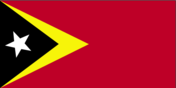
red with a black isosceles triangle (based on the hoist side) superimposed on a slightly longer yellow arrowhead that extends to the center of the flag; a white star - pointing to the upper hoist-side corner of the flag - is in the center of the black triangle; yellow denotes the colonialism in Timor-Leste's past, black represents the obscurantism that needs to be overcome, red stands for the national liberation struggle; the white star symbolizes peace and serves as a guiding light
Government type
semi-presidential republic
Independence
20 May 2002 (from Indonesia); note - 28 November 1975 was the date independence was proclaimed from Portugal; 20 May 2002 was the date of international recognition of Timor-Leste's independence from Indonesia
International law organization participation
accepts compulsory ICJ jurisdiction with reservations; accepts ICCt jurisdiction
International organization participation
ACP, ADB, AOSIS, ARF, ASEAN (observer), CPLP, EITI (compliant country), FAO, G-77, IBRD, ICAO, ICCt, ICRM, IDA, IFAD, IFC, IFRCS, ILO, IMF, IMO, Interpol, IOC, IOM, IPU, ITU, MIGA, NAM, OPCW, PIF (observer), UN, UNCTAD, UNESCO, UNIDO, Union Latina, UNWTO, UPU, WCO, WHO, WMO
Judicial branch
- highest courts
- Court of Appeals (consists of the court president and NA judges)
- judge selection and term of office
- court president appointed by the president of the republic from among the other court judges to serve a 4-year term; other court judges appointed - 1 by the Parliament and the others by the Supreme Council for the Judiciary, a body chaired by the court president and that includes mostly presidential and parliamentary appointees; other judges serve for life
- note
- note: the UN Justice System Programme, launched in 2003 and being rolled out in 4 phases through 2018, is helping strengthen the country's justice system; the Programme is aligned with the country's long-range Justice Sector Strategic Plan, which includes legal reforms
- subordinate courts
- Court of Appeal; High Administrative, Tax, and Audit Court; district courts; magistrates' courts; military courts
Legal system
civil law system based on the Portuguese model; note - penal and civil law codes to replace the Indonesian codes were passed by Parliament and promulgated in 2009 and 2011, respectively
Legislative branch
- description
- unicameral National Parliament (65 seats; members directly elected in a single nationwide constituency by proportional representation vote to serve 5-year terms)
- election results
- percent of vote by party - AMP - 49.6%, FRETILIN 34.2%, PD 8.1%, DDF 5.5%, other 2.6%; seats by party - AMP 34, FRETILIN 23, PD 5, DDF 3; composition - men 39, women 26, percent of women 40%
- elections
- last held on 12 May 2018 (next to be held in July 2023)
National anthem
- lyrics/music
- Fransisco Borja DA COSTA/Afonso DE ARAUJO
- name
- "Patria" (Fatherland)
- note
- note: adopted 2002; the song was first used as an anthem when Timor-Leste declared its independence from Portugal in 1975; the lyricist, Francisco Borja DA COSTA, was killed in the Indonesian invasion just days after independence was declared
National holiday
Restoration of Independence Day, 20 May (2002); Proclamation of Independence Day, 28 November (1975)
National symbol(s)
Mount Ramelau; national colors: red, yellow, black, white
Political parties and leaders
Alliance for Change and Progress or AMP [Xanana GUSMAO] (collapsed in 2020; alliance included CNRT, KHUNTO, PLP)Democratic Development Forum or DDFDemocratic Party or PD [Mariano Assanami SABINO]Frenti-Mudanca [Jose Luis GUTERRES]Kmanek Haburas Unidade Nasional Timor Oan or KHUNTO [Jose do Santos NAIMORI Bucar]National Congress for Timorese Reconstruction or CNRT [Kay Rala Xanana GUSMAO]People's Liberation Party or PLP [Taur Matan RUAK]Revolutionary Front of Independent Timor-Leste or FRETILIN [Mari ALKATIRI]
Suffrage
17 years of age; universal
Economy
Agricultural products
rice, maize, vegetables, coffee, roots/tubers nes, other meats, cassava, pork, beans, mangoes/guavas
Budget
- expenditures
- 2.4 billion (2017 est.)
- revenues
- 300 million (2017 est.)
Budget surplus (+) or deficit (-)
-75.7% (of GDP) (2017 est.)
Current account balance
- Current account balance 2016
- -$544 million (2016 est.)
- Current account balance 2017
- -$284 million (2017 est.)
Debt - external
- Debt - external 31 December 2013
- $687 million (31 December 2013 est.)
- Debt - external 31 December 2014
- $311.5 million (31 December 2014 est.)
Economic overview
Since independence in 1999, Timor-Leste has faced great challenges in rebuilding its infrastructure, strengthening the civil administration, and generating jobs for young people entering the work force. The development of offshore oil and gas resources has greatly supplemented government revenues. This technology-intensive industry, however, has done little to create jobs in part because there are no production facilities in Timor-Leste. Gas is currently piped to Australia for processing, but Timor-Leste has expressed interest in developing a domestic processing capability.In June 2005, the National Parliament unanimously approved the creation of the Timor-Leste Petroleum Fund to serve as a repository for all petroleum revenues and to preserve the value of Timor-Leste's petroleum wealth for future generations. The Fund held assets of $16 billion, as of mid-2016. Oil accounts for over 90% of government revenues, and the drop in the price of oil in 2014-16 has led to concerns about the long-term sustainability of government spending. Timor-Leste compensated for the decline in price by exporting more oil. The Ministry of Finance maintains that the Petroleum Fund is sufficient to sustain government operations for the foreseeable future.Annual government budget expenditures increased markedly between 2009 and 2012 but dropped significantly through 2016. Historically, the government failed to spend as much as its budget allowed. The government has focused significant resources on basic infrastructure, including electricity and roads, but limited experience in procurement and infrastructure building has hampered these projects. The underlying economic policy challenge the country faces remains how best to use oil-and-gas wealth to lift the non-oil economy onto a higher growth path and to reduce poverty.
Exchange rates
the US dollar is used
Exports
- Exports 2018
- $120 million note: data are in current year dollars (2018 est.)
- Exports 2019
- $120 million note: data are in current year dollars (2019 est.)
- Exports 2020
- $60 million note: data are in current year dollars (2020 est.)
Exports - commodities
crude petroleum, natural gas, coffee, various vegetables, scrap iron (2019)
Exports - partners
Singapore 51%, China 20%, Japan 9%, Indonesia 6% (2019)
Fiscal year
calendar year
GDP - composition, by end use
- exports of goods and services
- 78.4% (2017 est.)
- government consumption
- 30% (2017 est.)
- household consumption
- 33% (2017 est.)
- imports of goods and services
- -52% (2017 est.)
- investment in fixed capital
- 10.6% (2017 est.)
- investment in inventories
- 0% (2017 est.)
GDP - composition, by sector of origin
- agriculture
- 9.1% (2017 est.)
- industry
- 56.7% (2017 est.)
- services
- 34.4% (2017 est.)
GDP (official exchange rate)
- $2.775 billion (2017 est.)
- note
- note: non-oil GDP
Gini Index coefficient - distribution of family income
- Gini Index coefficient - distribution of family income 2002
- 38 (2002 est.)
- Gini Index coefficient - distribution of family income 2014
- 28.7 (2014 est.)
Household income or consumption by percentage share
- highest 10%
- 27% (2007)
- lowest 10%
- 4%
Imports
- Imports 2018
- $1.06 billion note: data are in current year dollars (2018 est.)
- Imports 2019
- $1.04 billion note: data are in current year dollars (2019 est.)
- Imports 2020
- $850 million note: data are in current year dollars (2020 est.)
Imports - commodities
refined petroleum, cars, cement, delivery trucks, motorcycles (2019)
Imports - partners
Indonesia 39%, China 27%, Singapore 10%, Malaysia 5% (2019)
Industrial production growth rate
2% (2017 est.)
Industries
printing, soap manufacturing, handicrafts, woven cloth
Inflation rate (consumer prices)
- Inflation rate (consumer prices) 2016
- -1.3% (2016 est.)
- Inflation rate (consumer prices) 2017
- 0.6% (2017 est.)
Labor force
286,700 (2016 est.)
Labor force - by occupation
- agriculture
- 41%
- industry
- 13%
- services
- 45.1% (2013)
Population below poverty line
41.8% (2014 est.)
Public debt
- Public debt 2016
- 3.1% of GDP (2016 est.)
- Public debt 2017
- 3.8% of GDP (2017 est.)
Real GDP (purchasing power parity)
- note
- note: data are in 2017 dollars
- Real GDP (purchasing power parity) 2018
- $3.87 billion note: data are in 2017 dollars (2018 est.)
- Real GDP (purchasing power parity) 2019
- $4.59 billion note: data are in 2017 dollars (2019 est.)
- Real GDP (purchasing power parity) 2020
- $4.19 billion note: data are in 2017 dollars (2020 est.)
Real GDP growth rate
- Real GDP growth rate 2015
- 4% (2015 est.)
- Real GDP growth rate 2016
- 5.3% (2016 est.)
- Real GDP growth rate 2017
- -4.6% (2017 est.)
Real GDP per capita
- note
- note: data are in 2017 dollars
- Real GDP per capita 2018
- $3,100 note: data are in 2017 dollars (2018 est.)
- Real GDP per capita 2019
- $3,600 note: data are in 2017 dollars (2019 est.)
- Real GDP per capita 2020
- $3,200 note: data are in 2017 dollars (2020 est.)
Reserves of foreign exchange and gold
- note
- note: excludes assets of approximately $9.7 billion in the Petroleum Fund (31 December 2010)
- Reserves of foreign exchange and gold 31 December 2015
- $437.8 million (31 December 2015 est.)
- Reserves of foreign exchange and gold 31 December 2017
- $544.4 million (31 December 2017 est.)
Taxes and other revenues
10.8% (of GDP) (2017 est.)
Unemployment rate
- Unemployment rate 2010
- 3.9% (2010 est.)
- Unemployment rate 2014
- 4.4% (2014 est.)
Unemployment, youth ages 15-24
- female
- 15.9% (2016 est.)
- male
- 10.9%
- total
- 13.2%
Energy
Crude oil - exports
62,060 bbl/day (2015 est.)
Crude oil - imports
0 bbl/day (2015 est.)
Crude oil - production
33,000 bbl/day (2018 est.)
Crude oil - proved reserves
0 bbl (1 January 2018 est.)
Electricity - consumption
0 kWh (2016 est.)
Electricity - exports
0 kWh (2017 est.)
Electricity - from fossil fuels
100% of total installed capacity (2018 est.)
Electricity - from hydroelectric plants
0% of total installed capacity (2017 est.)
Electricity - from nuclear fuels
0% of total installed capacity (2017 est.)
Electricity - from other renewable sources
0% of total installed capacity (2018 est.)
Electricity - imports
0 kWh (2016 est.)
Electricity - installed generating capacity
600 kW NA (2016 est.)
Electricity - production
0 kWh NA (2016 est.)
Electricity access
- electrification - rural areas
- 79.2% (2018)
- electrification - total population
- 85.6% (2018)
- electrification - urban areas
- 100% (2018)
Natural gas - consumption
0 cu m (2017 est.)
Natural gas - exports
5.776 billion cu m (2017 est.)
Natural gas - imports
0 cu m (2017 est.)
Natural gas - production
5.776 billion cu m (2017 est.)
Natural gas - proved reserves
200 billion cu m (1 January 2006 est.)
Refined petroleum products - consumption
3,500 bbl/day (2016 est.)
Refined petroleum products - exports
0 bbl/day (2015 est.)
Refined petroleum products - imports
3,481 bbl/day (2015 est.)
Refined petroleum products - production
0 bbl/day (2015 est.)
Communications
Broadband - fixed subscriptions
- subscriptions per 100 inhabitants
- less than 1 (2020 est.)
- total
- 75 (2020)
Broadcast media
7 TV stations (3 nationwide satellite coverage; 2 terrestrial coverage, mostly in Dili; 2 cable) and 21 radio stations (3 nationwide coverage) (2019)
Internet country code
.tl
Internet users
- percent of population
- 27.49% (2019 est.)
- total
- 599,700 (2021 est.)
Telecommunication systems
- domestic
- system suffered significant damage during the violence associated with independence; limited fixed-line services, less than 1 per 100 and mobile-cellular services have been expanding and are now available in urban and most rural areas with teledensity of 110 per 100 (2019)
- general assessment
- following years of civil unrest, the government and operators are working toward rebuilding key infrastructure, including telecommunications networks; service in urban and some rural areas expanding with competition; most of the population has access to 4G LTE service; increase in mobile-broadband penetration; government aims to boost e-government services with new national terrestrial fiber-optic network; launch of satellite and approval for submarine cable link to Australia will boost sector growth; importer of broadcasting equipment from Indonesia and China (2020)
- international
- country code - 670; international service is available; partnership with Australia telecom companies for potential deployment of a submarine fiber-optic link (NWCS); geostationary earth orbit satellite
- note
- note: the COVID-19 pandemic continues to have a significant impact on production and supply chains globally; since 2020, some aspects of the telecom sector have experienced downturn, particularly in mobile device production; many network operators delayed upgrades to infrastructure; progress towards 5G implementation was postponed or slowed in some countries; consumer spending on telecom services and devices was affected by large-scale job losses and the consequent restriction on disposable incomes; the crucial nature of telecom services as a tool for work and school from home became evident, and received some support from governments
Telephones - fixed lines
- subscriptions per 100 inhabitants
- less than 1 (2020 est.)
- total subscriptions
- 2,012 (2020)
Telephones - mobile cellular
- subscriptions per 100 inhabitants
- 104.5 (2020 est.)
- total subscriptions
- 1,377,915 (2020)
Transportation
Airports
- total
- 6 (2013)
Airports - with paved runways
- 1,524 to 2,437 m
- 1 (2013)
- 2,438 to 3,047 m
- 1
- total
- 2
Airports - with unpaved runways
- 914 to 1,523 m
- 2
- total
- 4
- under 914 m
- 2 (2013)
Civil aircraft registration country code prefix
4W
Heliports
8 (2013)
Merchant marine
- by type
- other 1 (2021)
- total
- 1
National air transport system
- inventory of registered aircraft operated by air carriers
- 2
- number of registered air carriers
- 2 (2020)
Ports and terminals
- major seaport(s)
- Dili
Roadways
- paved
- 2,600 km (2008)
- total
- 6,040 km (2008)
- unpaved
- 3,440 km (2008)
Military and Security
Military - note
since achieving independence, Timor-Leste has received security assistance from or has made defense cooperation arrangements with Australia, China, Indonesia, Malaysia, New Zealand, the Philippines, Portugal, the UN, and the US; some F-FDTL personnel train with the Indonesian military and the two countries maintain a joint Border Security Task Force to jointly monitor and patrol the border, particularly the Oecussi exclave area where smuggling and trafficking are prevalent the F-FDTL is a small force comprised of 2 infantry battalions and operates fewer than 10 patrol boats; it does not have any combat aircraft
Military and security forces
Timor-Leste Defense Force (Falintil-Forcas de Defesa de Timor-L'este, Falintil (F-FDTL)): Joint Headquarters with Land, Air, Naval, Service Support, and Education/Training components; National Police (Polícia Nacional de Timor-Leste, PNTL) (2021)
Military and security service personnel strengths
the Timor-Leste Defense Force is comprised of approximately 2,000 personnel (2021)
Military equipment inventories and acquisitions
Timor-Leste Defense Force's limited inventory consists of equipment donated by other countries; the only recorded deliveries of major arms to Timor-Leste since 2010 are naval patrol craft from China and South Korea (2021)
Military expenditures
- Military Expenditures 2016
- 1% of GDP (2016)
- Military Expenditures 2017
- 0.9% of GDP (2017)
- Military Expenditures 2018
- 0.7% of GDP (2018)
- Military Expenditures 2019
- 1% of GDP (2019)
- Military Expenditures 2020
- 1.2% of GDP (2020 est.)
Military service age and obligation
18 years of age for voluntary military service; 18-month service obligation (2021)
Transnational Issues
Disputes - international
three stretches of land borders with Indonesia have yet to be delimited, two of which are in the Oecussi exclave area, and no maritime or Economic Exclusion Zone boundaries have been established between the countries; maritime boundaries with Indonesia remain unresolved; Timor-Leste and Australia reached agreement on a treaty delimiting a permanent maritime boundary in March 2018; the treaty will enter into force once ratified by the two countries' parliaments
Illicit drugs
NA
Trafficking in persons
- current situation
- human traffickers exploit domestic and foreign victims in Timor-Leste, and traffickers exploit victims from Timor-Leste abroad; traffickers exploit Timorese women, girls, and occasionally young men and boys from rural areas in sex trafficking or domestic servitude; Timorese men are exploited in forced labor in agriculture, construction, and mining; families place children in bonded domestic and agricultural labor to pay debts; traffickers deceive young men and women with promises of a scholarship or employment opportunities in Indonesia, Malaysia, and other countries in the region only taking them to a different county, taking their passports, and forcing them into labor, including domestic servitude; sex traffickers in Timor-Leste prey on foreign women from East and Southeast Asia; traffickers also recruit Timorese women to send them to China, Indonesia, or Malaysia for commercial sex
- tier rating
- Tier 2 Watch List — Timor-Leste does not fully meet the minimum standards for the elimination of trafficking but is making significant efforts to do so; efforts include re-establishing funding to NGOs for victim services and integrating an anti-trafficking curriculum for officials; however, authorities decreased investigations and convictions; victim protection services were inadequate, and no government-wide standard operating procedures for victim identification were implemented; understanding of trafficking remains low among officials (2020)
Environment
Air pollutants
- carbon dioxide emissions
- 0.5 megatons (2016 est.)
- methane emissions
- 4.74 megatons (2020 est.)
- particulate matter emissions
- 17.88 micrograms per cubic meter (2016 est.)
Climate
tropical; hot, humid; distinct rainy and dry seasons
Environment - current issues
air pollution and deterioration of air quality; greenhouse gas emissions; water quality, scarcity, and access; land and soil degradation; forest depletion; widespread use of slash and burn agriculture has led to deforestation and soil erosion; loss of biodiversity
Environment - international agreements
- party to
- Biodiversity, Climate Change, Climate Change-Kyoto Protocol, Climate Change-Paris Agreement, Desertification, Law of the Sea, Ozone Layer Protection
- signed, but not ratified
- Comprehensive Nuclear Test Ban
Land use
- agricultural land
- 25.1% (2018 est.)
- agricultural land: arable land
- arable land: 10.1% (2018 est.)
- agricultural land: permanent crops
- permanent crops: 4.9% (2018 est.)
- agricultural land: permanent pasture
- permanent pasture: 10.1% (2018 est.)
- forest
- 49.1% (2018 est.)
- other
- 25.8% (2018 est.)
Major infectious diseases
- degree of risk
- very high (2020)
- food or waterborne diseases
- bacterial diarrhea, hepatitis A, and typhoid fever
- vectorborne diseases
- dengue fever and malaria
Revenue from coal
- coal revenues
- 0% of GDP (2018 est.)
Revenue from forest resources
- forest revenues
- 0.13% of GDP (2018 est.)
Total renewable water resources
8.215 billion cubic meters (2017 est.)
Total water withdrawal
- agricultural
- 1.071 billion cubic meters (2017 est.)
- industrial
- 2 million cubic meters (2017 est.)
- municipal
- 99 million cubic meters (2017 est.)
Urbanization
- rate of urbanization
- 3.31% annual rate of change (2020-25 est.)
- urban population
- 31.7% of total population (2021)
Waste and recycling
- municipal solid waste generated annually
- 63,875 tons (2016 est.)