2008 Edition
CIA World Factbook 2008 (Project Gutenberg)
Introduction
Background
Great Britain formally acquired possession of Malta in 1814. The island staunchly supported the UK through both World Wars and remained in the Commonwealth when it became independent in 1964. A decade later Malta became a republic. Since about the mid-1980s, the island has transformed itself into a freight transshipment point, a financial center, and a tourist destination. Malta became an EU member in May 2004 and began to use the euro as currency in 2008.
Geography
Area
total: 316 sq km land: 316 sq km water: 0 sq km
Area - comparative
slightly less than twice the size of Washington, DC
Climate
Mediterranean; mild, rainy winters; hot, dry summers
Coastline
196.8 km (does not include 56.01 km for the island of Gozo)
Elevation extremes
lowest point: Mediterranean Sea 0 m highest point: Ta'Dmejrek 253 m (near Dingli)
Environment - current issues
limited natural fresh water resources; increasing reliance on desalination
Environment - international agreements
party to: Air Pollution, Biodiversity, Climate Change, Climate Change-Kyoto Protocol, Desertification, Endangered Species, Hazardous Wastes, Law of the Sea, Marine Dumping, Ozone Layer Protection, Ship Pollution, Wetlands signed, but not ratified: none of the selected agreements
Freshwater withdrawal (domestic/industrial/agricultural)
total: 0.02 cu km/yr (74%/1%/25%) per capita: 50 cu m/yr (2000)
Geographic coordinates
35 50 N, 14 35 E
Geography - note
the country comprises an archipelago, with only the three largest islands (Malta, Ghawdex or Gozo, and Kemmuna or Comino) being inhabited; numerous bays provide good harbors; Malta and Tunisia are discussing the commercial exploitation of the continental shelf between their countries, particularly for oil exploration
Irrigated land
20 sq km (2003)
Land boundaries
0 km
Land use
arable land: 31.25% permanent crops: 3.13% other: 65.62% (2005)
Location
Southern Europe, islands in the Mediterranean Sea, south of Sicily (Italy)
Map references
Europe
Maritime claims
territorial sea: 12 nm contiguous zone: 24 nm continental shelf: 200 m depth or to the depth of exploitation exclusive fishing zone: 25 nm
Natural hazards
NA
Natural resources
limestone, salt, arable land
Terrain
mostly low, rocky, flat to dissected plains; many coastal cliffs
Total renewable water resources
0.07 cu km (2005)
People and Society
Age structure
0-14 years: 16.4% (male 33,954/female 32,158) 15-64 years: 69.7% (male 142,338/female 138,792) 65 years and over: 13.9% (male 24,240/female 32,050) (2008 est.)
Birth rate
10.33 births/1,000 population (2008 est.)
Death rate
8.29 deaths/1,000 population (2008 est.)
Education expenditures
5.1% of GDP (2004)
Ethnic groups
Maltese (descendants of ancient Carthaginians and Phoenicians with strong elements of Italian and other Mediterranean stock)
HIV/AIDS - adult prevalence rate
0.2% (2001 est.)
HIV/AIDS - deaths
fewer than 100 (2003 est.)
HIV/AIDS - people living with HIV/AIDS
fewer than 500 (2003 est.)
Infant mortality rate
total: 3.79 deaths/1,000 live births male: 4.25 deaths/1,000 live births female: 3.3 deaths/1,000 live births (2008 est.)
Languages
Maltese (official) 90.2%, English (official) 6%, multilingual 3%, other 0.8% (2005 census)
Life expectancy at birth
total population: 79.3 years male: 77.08 years female: 81.64 years (2008 est.)
Literacy
definition: age 10 and over can read and write total population: 92.8% male: 92% female: 93.6% (2003 est.)
Median age
total: 39.2 years male: 37.9 years female: 40.6 years (2008 est.)
Nationality
noun: Maltese (singular and plural) adjective: Maltese
Net migration rate
2.03 migrant(s)/1,000 population (2008 est.)
Population
403,532 (July 2008 est.)
Population growth rate
0.407% (2008 est.)
Religions
Roman Catholic 98%
School life expectancy (primary to tertiary education)
total: 15 years male: 15 years female: 15 years (2005)
Sex ratio
at birth: 1.06 male(s)/female under 15 years: 1.06 male(s)/female 15-64 years: 1.03 male(s)/female 65 years and over: 0.76 male(s)/female total population: 0.99 male(s)/female (2008 est.)
Total fertility rate
1.51 children born/woman (2008 est.)
Government
Administrative divisions
none (administered directly from Valletta); note - local councils carry out administrative orders
Capital
name: Valletta geographic coordinates: 35 53 N, 14 30 E time difference: UTC+1 (6 hours ahead of Washington, DC during Standard Time) daylight saving time: +1hr, begins last Sunday in March; ends last Sunday in October
Constitution
1964 constitution; amended many times
Country name
conventional long form: Republic of Malta conventional short form: Malta local long form: Repubblika ta' Malta local short form: Malta
Diplomatic representation from the US
chief of mission: Ambassador Molly BORDONARO embassy: 3rd Floor, Development House, Saint Anne Street, Floriana, VLT 01 mailing address: P. O. Box 535, Valletta, CMR01 telephone: [356] 2561 4000
Diplomatic representation in the US
chief of mission: Ambassador Mark MICELI-FARRUGIA chancery: 2017 Connecticut Avenue NW, Washington, DC 20008 telephone: [1] (202) 462-3611, 3612
Executive branch
chief of state: President Edward FENECH ADAMI (since 4 April 2004) head of government: Prime Minister Lawrence GONZI (since 23 March 2004) cabinet: Cabinet appointed by the president on the advice of the prime minister elections: president elected by the House of Representatives for a five-year term (eligible for a second term); election last held on 29 March 2004 (next to be held by April 2009); following legislative elections, the leader of the majority party or leader of a majority coalition is usually appointed prime minister by the president for a five-year term; the deputy prime minister is appointed by the president on the advice of the prime minister election results: Eddie FENECH ADAMI elected president; House of Representatives vote - 33 out of 65 votes
FAX
- [1] (202) 387-5470 consulate(s): New York
- [356] 21 243229
Flag description
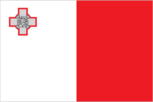
two equal vertical bands of white (hoist side) and red; in the upper hoist-side corner is a representation of the George Cross, edged in red
Government type
republic
Independence
21 September 1964 (from UK)
International organization participation
Australia Group, C, CE, EAPC, EBRD, EIB, EMU, EU, FAO, IAEA, IBRD, ICAO, ICCt, ICRM, IFAD, IFC, IFRCS, ILO, IMF, IMO, IMSO, Interpol, IOC, IOM, IPU, ISO, ITSO, ITU, ITUC, MIGA, NSG, OPCW, OSCE, PCA, PFP, Schengen Convention, UN, UNCTAD, UNESCO, UNIDO, UNWTO, UPU, WCL, WCO, WFTU, WHO, WIPO, WMO, WTO
Judicial branch
Constitutional Court; Court of Appeal; judges for both courts are appointed by the president on the advice of the prime minister
Legal system
based on English common law and Roman civil law; accepts compulsory ICJ jurisdiction with reservations
Legislative branch
unicameral House of Representatives (usually 65 seats; members are elected by popular vote on the basis of proportional representation to serve five-year terms; note - additional seats are given to the party with the largest popular vote to ensure a legislative majority) elections: last held on 8 March 2008 (next to be held by March 2013) election results: percent of vote by party - PN 49.3%, MLP 48.8%, other 1.9%; seats by party - PN 35, MLP 34
National holiday
Independence Day, 21 September (1964)
Political parties and leaders
Alternativa Demokratika/Alliance for Social Justice or AD [Harry VASSALLO]; Malta Labor Party or MLP [acting leader Charles MANGION]; Nationalist Party or PN [Lawrence GONZI]
Political pressure groups and leaders
Alleanza Liberal-Demokratika Maltra ro ALDM (against illegal immigration); Alleanza Nazzionali Repubblikana or ANR (encourages tourism); Alternattiva Demokratika (campaign to reform rent law, and other campaigns); Azzjoni Nazzjonali or AN (freedom to participate in democratic government); Ghazdatal-Konsumaturi (consumer rights); Nazi Watch Malta (exposing Nazis) other: environmentalists
Suffrage
18 years of age; universal
Economy
Agriculture - products
potatoes, cauliflower, grapes, wheat, barley, tomatoes, citrus, cut flowers, green peppers; pork, milk, poultry, eggs
Budget
revenues: $3.485 billion expenditures: $3.554 billion (2007 est.)
Central bank discount rate
NA (31 December 2007)
Commercial bank prime lending rate
6.24% (31 December 2007)
Currency (code)
euro (EUR) as of 1 January 2008; Maltese lira (MTL) before then
Currency code
MTL
Current account balance
-$424.5 million (2007 est.)
Debt - external
$188.8 million (2005)
Distribution of family income - Gini index
28 (2005)
Economic aid - recipient
$6.19 million (2004)
Economy - overview
Major resources are limestone, a favorable geographic location, and a productive labor force. Malta produces only about 20% of its food needs, has limited fresh water supplies, and has few domestic energy sources. The economy is dependent on foreign trade, manufacturing (especially electronics and pharmaceuticals), and tourism. Economic recovery of the European economy has lifted exports, tourism, and overall growth. Malta adopted the euro on 1 January 2008.
Electricity - consumption
1.85 billion kWh (2006 est.)
Electricity - exports
0 kWh (2007 est.)
Electricity - imports
0 kWh (2007 est.)
Electricity - production
2.146 billion kWh (2007 est.)
Electricity - production by source
fossil fuel: 100% hydro: 0% nuclear: 0% other: 0% (2001)
Exchange rates
euros (EUR) per US dollar - 0.6795 (January 2008), Maltese liri per US dollar - 0.3106 (2007), 0.37 (2006), 0.34578 (2005), 0.34466 (2004), 0.37723 (2003)
Exports
$3.238 billion f.o.b. (2007 est.)
Exports - commodities
machinery and transport equipment, manufactures
Exports - partners
Singapore 14.4%, Germany 13.7%, France 12.6%, US 11.3%, UK 10%, Hong Kong 6.1%, Japan 4.9%, Italy 4% (2007)
Fiscal year
calendar year
GDP - composition by sector
agriculture: 2.7% industry: 22.3% services: 74.9% (2003 est.)
GDP - per capita (PPP)
$23,400 (2007 est.)
GDP - real growth rate
3.8% (2007 est.)
GDP (official exchange rate)
$7.419 billion (2007 est.)
GDP (purchasing power parity)
$9.4 billion (2007 est.)
Household income or consumption by percentage share
lowest 10%: NA% highest 10%: NA%
Imports
$4.541 billion f.o.b. (2007 est.)
Imports - commodities
machinery and transport equipment, manufactured and semi-manufactured goods; food, drink, tobacco
Imports - partners
Italy 26%, UK 15%, France 9.5%, Germany 8.8%, Singapore 5.2% (2007)
Industrial production growth rate
NA%
Industries
tourism, electronics, ship building and repair, construction, food and beverages, pharmaceuticals, footwear, clothing, tobacco
Inflation rate (consumer prices)
1.3% (2007 est.)
Investment (gross fixed)
18.9% of GDP (2007 est.)
Labor force
166,000 (2007 est.)
Labor force - by occupation
agriculture: 3% industry: 22% services: 75% (2005 est.)
Market value of publicly traded shares
$4.097 billion (2005)
Natural gas - consumption
0 cu m (2007 est.)
Natural gas - exports
0 cu m (2007 est.)
Natural gas - imports
0 cu m (2007 est.)
Natural gas - production
0 cu m (2007 est.)
Natural gas - proved reserves
0 cu m (1 January 2006 est.)
Oil - consumption
18,680 bbl/day (2006 est.)
Oil - exports
0 bbl/day (2005)
Oil - imports
18,910 bbl/day (2005)
Oil - production
0 bbl/day (2007 est.)
Oil - proved reserves
0 bbl (1 January 2006 est.)
Population below poverty line
NA%
Reserves of foreign exchange and gold
$3.798 billion (31 December 2007 est.)
Stock of direct foreign investment - abroad
$NA
Stock of direct foreign investment - at home
$NA
Stock of domestic credit
$10.99 billion (31 December 2007)
Stock of money
$4.603 billion note: see entry for the European Union for money supply in the Euro Area; the European Central Bank (ECB) controls monetary policy for the 15 members of the Economic and Monetary Union (EMU); individual members of the EMU do not control the quantity of money and quasi money circulating within their own borders (31 December 2007)
Stock of quasi money
$7.645 billion (31 December 2007)
Unemployment rate
6.4% (2007 est.)
Communications
Internet country code
.mt
Internet hosts
26,494 (2008)
Internet Service Providers (ISPs)
6 (2002)
Internet users
158,000 (2007)
Radio broadcast stations
AM 1, FM 18, shortwave 6 (1999)
Radios
255,000 (1997)
Telephone system
general assessment: automatic system satisfies normal requirements; fixed-line teledensity 50 per 100 persons; mobile-cellular teledensity about 90 per 100 persons domestic: submarine cable and microwave radio relay between islands international: country code - 356; submarine cable connects to Italy; satellite earth station - 1 Intelsat (Atlantic Ocean) (2007)
Telephones - main lines in use
198,100 (2007)
Telephones - mobile cellular
371,500 (2007)
Television broadcast stations
5 (2006)
Televisions
280,000 (1997)
Transportation
Airports
1 (2007)
Airports - with paved runways
total: 1 over 3,047 m: 1 (2007)
Merchant marine
total: 1,438 by type: bulk carrier 459, cargo 411, carrier 2, chemical tanker 171, container 80, liquefied gas 25, passenger 29, passenger/cargo 15, petroleum tanker 159, refrigerated cargo 32, roll on/roll off 37, specialized tanker 1, vehicle carrier 17 foreign-owned: 1,343 (Austria 1, Azerbaijan 2, Bangladesh 2, Belgium 15, Bulgaria 5, Canada 1, China 12, Croatia 9, Cyprus 31, Denmark 30, Egypt 1, Estonia 11, France 5, Germany 91, Greece 452, Hong Kong 1, Iceland 5, India 2, Iran 79, Israel 18, Italy 50, Japan 8, South Korea 2, Latvia 19, Lebanon 11, Libya 3, Lithuania 1, Norway 93, Pakistan 2, Poland 24, Portugal 3, Romania 8, Russia 58, Slovenia 4, Spain 3, Sweden 2, Switzerland 20, Syria 6, Turkey 176, Ukraine 30, UAE 5, UK 19, US 23) registered in other countries: 3 (Panama 3) (2008)
Ports and terminals
Marsaxlokk (Malta Freeport), Valletta
Roadways
total: 2,227 km paved: 2,014 km unpaved: 213 km (2005)
Military and Security
Manpower available for military service
males age 16-49: 96,309 females age 16-49: 92,242 (2008 est.)
Manpower fit for military service
males age 16-49: 80,227 females age 16-49: 76,623 (2008 est.)
Manpower reaching militarily significant age annually
male: 2,815 female: 2,657 (2008 est.)
Military branches
Armed Forces of Malta (AFM; includes air and maritime elements) (2007)
Military expenditures
0.7% of GDP (2006 est.)
Military service age and obligation
17 years 6 months of age for voluntary military service; no conscription (2008)
Transnational Issues
Disputes - international
none
Illicit drugs
minor transshipment point for hashish from North Africa to Western Europe This page was last updated on 18 December, 2008