1995 Edition
CIA World Factbook 1995 (Project Gutenberg)
Geography
Area
total area: 10,990 sq km land area: 10,830 sq km comparative area: slightly smaller than Connecticut
Climate
tropical; hot, humid; temperate interior
Coastline
1,022 km
Environment
current issues: deforestation; coastal waters polluted by industrial waste, sewage, and oil spills; damage to coral reefs; air pollution in Kingston results from vehicle emissions natural hazards: hurricanes (especially July to November) international agreements: party to - Biodiversity, Climate Change, Law of the Sea, Marine Dumping, Marine Life Conservation, Nuclear Test Ban, Ozone Layer Protection, Ship Pollution
International disputes
none
Irrigated land
350 sq km (1989 est.)
Land boundaries
0 km
Land use
arable land: 19% permanent crops: 6% meadows and pastures: 18% forest and woodland: 28% other: 29%
Location
Caribbean, island in the Caribbean Sea, south of Cuba
Map references
Central America and the Caribbean
Maritime claims
continental shelf: 200-m depth or to the depth of exploitation exclusive economic zone: 200 nm territorial sea: 12 nm
Natural resources
bauxite, gypsum, limestone
Note
strategic location between Cayman Trench and Jamaica Channel, the main sea lanes for Panama Canal
Terrain
mostly mountains with narrow, discontinuous coastal plain
People and Society
Age structure
0-14 years: 33% (female 412,565; male 431,043) 15-64 years: 60% (female 786,700; male 770,681) 65 years and over: 7% (female 96,348; male 76,954) (July 1995 est.)
Birth rate
22.03 births/1,000 population (1995 est.)
Death rate
5.62 deaths/1,000 population (1995 est.)
Ethnic divisions
African 76.3%, Afro-European 15.1%, East Indian and Afro-East Indian 3%, white 3.2%, Chinese and Afro-Chinese 1.2%, other 1.2%
Infant mortality rate
16.1 deaths/1,000 live births (1995 est.)
Labor force
1,062,100 by occupation: services 41%, agriculture 22.5%, industry 19%, unemployed 17.5% (1989)
Languages
English, Creole
Life expectancy at birth
total population: 74.65 years male: 72.39 years female: 77.01 years (1995 est.)
Literacy
age 15 and over has ever attended school (1987) total population: 82% male: 77% female: 86%
Nationality
noun: Jamaican(s) adjective: Jamaican
Net migration rate
-8.65 migrant(s)/1,000 population (1995 est.)
Population
2,574,291 (July 1995 est.)
Population growth rate
0.78% (1995 est.)
Religions
Protestant 55.9% (Church of God 18.4%, Baptist 10%, Anglican 7.1%, Seventh-Day Adventist 6.9%, Pentecostal 5.2%, Methodist 3.1%, United Church 2.7%, other 2.5%), Roman Catholic 5%, other, including some spiritual cults 39.1% (1982)
Total fertility rate
2.42 children born/woman (1995 est.)
Government
Administrative divisions
14 parishes; Clarendon, Hanover, Kingston, Manchester, Portland, Saint Andrew, Saint Ann, Saint Catherine, Saint Elizabeth, Saint James, Saint Mary, Saint Thomas, Trelawny, Westmoreland
Capital
Kingston
Constitution
6 August 1962
Digraph
JM
Diplomatic representation in US
chief of mission: Ambassador Richard Leighton BERNAL chancery: 1520 New Hampshire Avenue NW, Washington, DC 20036 telephone: [1] (202) 452-0660
Executive branch
chief of state: Queen ELIZABETH II (since 6 February 1952), represented by Governor General Sir Howard COOKE (since 1 August 1991) head of government: Prime Minister P. J. PATTERSON (since 30 March 1992); Deputy Prime Minister Seymour MULLINGS (since NA 1993) cabinet: Cabinet; appointed by the governor general on the advice of the prime minister
FAX
- [1] (202) 452-0081 consulate(s) general: Miami and New York
- [1] (809) 926-6743
Flag
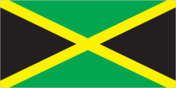
diagonal yellow cross divides the flag into four triangles - green (top and bottom) and black (hoist side and fly side)
House of Representatives
elections last held 30 March 1993 (next to be held by March 1998); results - percent of vote by party NA; seats - (60 total) PNP 52, JLP 8
Independence
6 August 1962 (from UK)
Judicial branch
Supreme Court
Legal system
based on English common law; has not accepted compulsory ICJ jurisdiction
Legislative branch
bicameral Parliament
Member of
ACP, C, CARICOM, CCC, CDB, ECLAC, FAO, G-15, G-19, G-77, GATT, IADB, IAEA, IBRD, ICAO, ICFTU, ICRM, IFAD, IFC, IFRCS, ILO, IMF, IMO, INTELSAT, INTERPOL, IOC, ISO, ITU, LAES, NAM, OAS, OPANAL, UN, UNCTAD, UNESCO, UNIDO, UNITAR, UPU, WCL, WFTU, WHO, WIPO, WMO, WTO
Names
conventional long form: none conventional short form: Jamaica
National holiday
Independence Day (first Monday in August) (1962)
Other political or pressure groups
Rastafarians (black religious/racial cultists, pan-Africanists); New Beginnings Movement (NBM)
Political parties and leaders
People's National Party (PNP) P. J. PATTERSON; Jamaica Labor Party (JLP), Edward SEAGA
Senate
consists of a 21-member body appointed by the governor general
Suffrage
18 years of age; universal
Type
parliamentary democracy
US diplomatic representation
chief of mission: Ambassador J. Gary COOPER (since October 1994) embassy: Jamaica Mutual Life Center, 2 Oxford Road, 3rd floor, Kingston mailing address: use embassy street address telephone: [1] (809) 929-4850 through 4859
Economy
Agriculture
accounts for about 7% of GDP, 22% of work force, and 17% of exports; commercial crops - sugarcane, bananas, coffee, citrus, potatoes, vegetables; livestock and livestock products include poultry, goats, milk; not self-sufficient in grain, meat, and dairy products
Budget
revenues: $600 million expenditures: $736 million, including capital expenditures of $NA (FY90/91 est.)
Currency
1 Jamaican dollar (J$) = 100 cents
Economic aid
recipient: US commitments, including Ex-Im (FY70-89), $1.2 billion; other countries, ODA and OOF bilateral commitments (1970-89), $1.6 billion
Electricity
capacity: 730,000 kW production: 2.6 billion kWh consumption per capita: 988 kWh (1993)
Exchange rates
Jamaican dollars (J$) per US$1 - 33.195 (December 1994), 33.986 (1994), 24.949 (1993), 22.960 (1992), 12.116 (1991), 7.184 (1990)
Exports
$1.2 billion (f.o.b., 1994 est.) commodities: alumina, bauxite, sugar, bananas, rum partners: US 47%, UK 11%, Canada 9%, Norway 7%; France 4% (1993)
External debt
$3.6 billion (1994 est.)
Fiscal year
1 April - 31 March
Illicit drugs
transshipment point for cocaine from Central and South America to North America and Europe; illicit cultivation of cannabis; government has an active cannabis eradication program
Imports
$2.2 billion (f.o.b., 1994 est.) commodities: machinery and transport equipment, construction materials, fuel, food, chemicals partners: US 54%, Japan 4.0%, Mexico 6%, UK 4%, Venezuela 3% (1993)
Industrial production
growth rate 0.4% (1992); accounts for almost 30% of GDP
Industries
bauxite mining, tourism, textiles, food processing, light manufactures
Inflation rate (consumer prices)
26.7% (1994)
National product
GDP - purchasing power parity - $7.8 billion (1994 est.)
National product per capita
$3,050 (1994 est.)
National product real growth rate
2% (1994 est.)
Overview
Key sectors in this island economy are bauxite (alumina and bauxite account for more than half of exports) and tourism. The government's tight fiscal and monetary policies, which have been partially successful in curbing inflation, have held growth to 1.2% in 1993 and 2.0% in 1994.
Unemployment rate
15.7% (1992)
Communications
Radio
broadcast stations: AM 10, FM 17, shortwave 0 radios: NA
Telephone system
127,000 telephones; fully automatic domestic telephone network local: NA intercity: NA international: 2 INTELSAT (Atlantic Ocean) earth stations; 3 coaxial submarine cables
Television
broadcast stations: 8 televisions: NA
Transportation
Airports
total: 41 with paved runways 2,438 to 3,047 m: 2 with paved runways 1,524 to 2,437 m: 1 with paved runways 914 to 1,523 m: 3 with paved runways under 914 m: 31 with unpaved runways 914 to 1,523 m: 4
Highways
total: 18,200 km paved: 12,600 km unpaved: gravel 3,200 km; improved earth 2,400 km
Merchant marine
total: 3 ships (1,000 GRT or over) totaling 5,931 GRT/10,545 DWT ships by type: bulk 1, oil tanker 1, roll-on/roll-off cargo 1
Pipelines
petroleum products 10 km
Ports
Alligator Pond, Discovery Bay, Kingston, Montego Bay, Ocho Rios, Port Antonio, Longs Wharf, Rocky Point
Railroads
total: 370 km standard gauge: 370 km 1.435-m gauge
Military and Security
Branches
Jamaica Defense Force (includes Ground Forces, Coast Guard and Air Wing), Jamaica Constabulary Force
Defense expenditures
exchange rate conversion - $19.3 million, 1% of GDP (FY91/92) ________________________________________________________________________ JAN MAYEN (territory of Norway)
Manpower availability
males age 15-49 670,958; males fit for military service 475,235; males reach military age (18) annually 26,244 (1995 est.)