1990 Edition
CIA World Factbook 1990 (Project Gutenberg)
Geography
Climate
tropical along coast and eastern plains; cooler in highlands
Coastline
3,208 km total (1,448 km North Pacific Ocean; 1,760 Caribbean Sea)
Comparative area
slightly less than three times the size of Montana
Continental shelf
not specified;
Disputes
maritime boundary dispute with Venezuela in the Gulf of Venezuela; territorial dispute with Nicaragua over Archipelago de San Andres y Providencia and Quita Sueno Bank
Environment
highlands subject to volcanic eruptions; deforestation; soil damage from overuse of pesticides; periodic droughts
Extended economic zone
200 nm;
Land boundaries
7,408 km total; Brazil 1,643 km, Ecuador 590 km, Panama 225 km, Peru 2,900, Venezuela 2,050 km
Land use
4% arable land; 2% permanent crops; 29% meadows and pastures; 49% forest and woodland; 16% other; includes NEGL% irrigated
Natural resources
crude oil, natural gas, coal, iron ore, nickel, gold, copper, emeralds
Note
only South American country with coastlines on both North Pacific Ocean and Caribbean Sea
Terrain
mixture of flat coastal lowlands, plains in east, central highlands, some high mountains
Territorial sea
12 nm
Total area
1,138,910 km2; land area: 1,038,700 km2; includes Isla de Malpelo, Roncador Cay, Serrana Bank, and Serranilla Bank
People and Society
Birth rate
27 births/1,000 population (1990)
Death rate
5 deaths/1,000 population (1990)
Ethnic divisions
58% mestizo, 20% white, 14% mulatto, 4% black, 3% mixed black-Indian, 1% Indian
Infant mortality rate
38 deaths/1,000 live births (1990)
Labor force
11,000,000 (1986); 53% services, 26% agriculture, 21% industry (1981)
Language
Spanish
Life expectancy at birth
68 years male, 73 years female (1990)
Literacy
88% (1987 est.), Indians about 40%
Nationality
noun--Colombian(s); adjective--Colombian
Net migration rate
NEGL migrants/1,000 population (1990)
Organized labor
1,400,000 members (1987), about 12% of labor force; the Communist-backed Unitary Workers Central or CUT is the largest labor organization, with about 725,000 members (including all affiliate unions)
Population
33,076,188 (July 1990), growth rate 2.1% (1990)
Religion
95% Roman Catholic
Total fertility rate
2.9 children born/woman (1990)
Government
Administrative divisions
23 departments (departamentos, singular--departamento), 5 commissariats* (comisarias, singular--comisaria), and 4 intendancies** (intendencias, singular--intendencia); Amazonas*, Antioquia, Arauca**, Atlantico, Bolivar, Boyaca, Caldas, Caqueta, Casanare**, Cauca, Cesar, Choco, Cordoba, Cundinamarca, Guainia*, Guaviare*, Huila, La Guajira, Magdalena, Meta, Narino, Norte de Santander, Putumayo**, Quindio, Risaralda, San Andres y Providencia**, Santander, Sucre, Tolima, Valle del Cauca, Vaupes*, Vichada*; note--there may be a new special district (distrito especial) named Bogota
Capital
Bogota
Communists
18,000 members (est.), including Communist Party Youth Organization (JUCO)
Constitution
4 August 1886, with amendments codified in 1946 and 1968
Diplomatic representation
Ambassador Victor MOSQUERA; Chancery at 2118 Leroy Place NW, Washington DC 20008; telephone (202) 387-8338; there are Colombian Consulates General in Chicago, Houston, Miami, New Orleans, New York, San Francisco, and San Juan (Puerto Rico), and Consulates in Atlanta, Boston, Detroit, Ft. Lauderdale, Los Angeles, San Diego, and Tampa; US--Ambassador Thomas E. McNAMARA; Embassy at Calle 38, No.8-61, Bogota (mailing address is APO Miami 34038); telephone [57] (1) 285-1300 or 1688; there is a US Consulate in Barranquilla
Elections
President--last held 27 May 1990 (next to be held May 1994); results--Cesar Gaviria Trujillo (Liberal) 47%, Alvaro Gomez Hurtado (Conservative) 24%, Antonio Novarro Wolff (Conservative) 13%, Rodrigo Lloreda (M-19) 12%; Senate--last held 11 March 1990 (next to be held March 1994); results--percent of vote by party NA; seats--(114 total) Liberal 68, Conservative 45, UP 1; House of Representatives last held 11 March 1990 (next to be held March 1994); results--percent of vote by party NA; seats--(199 total) Liberal 107, Conservative 82, UP 10
Executive branch
president, presidential designate, cabinet
Flag
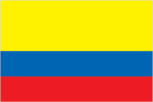
three horizontal bands of yellow (top, double-width), blue, and red; similar to the flag of Ecuador which is longer and bears the Ecuadorian coat of arms superimposed in the center
Independence
20 July 1810 (from Spain)
Judicial branch
Supreme Court of Justice (Corte Suprema de Justica)
Leaders
Chief of State and Head of Government--Virgilio BARCO Vargas (since 7 August 1986; term ends August 1990); Presidential Designate Victor MOSQUERA Chaux (since 13 October 1986); President-elect Cesar GAVIRIA Trujillo (since 27 May 1990, takes office 7 August 1990)
Legal system
based on Spanish law; judicial review of legislative acts in the Supreme Court; accepts compulsory ICJ jurisdiction, with reservations
Legislative branch
bicameral Congress (Congreso) consists of an upper chamber or Senate (Senado) and a lower chamber or Chamber of Representatives
Long-form name
Republic of Colombia
Member of
FAO, G-77, GATT, Group of Eight, IADB, IAEA, IBRD, ICAC, ICAO, ICO, IDA, IDB--Inter-American Development Bank, IFAD, IFC, IHO, ILO, IMF, IMO, INTELSAT, INTERPOL, IRC, ISO, ITU, LAIA, NAM, OAS, PAHO, SELA, UN, UNESCO, UPEB, UPU, WFTU, WHO, WIPO, WMO, WSG, WTO
National holiday
Independence Day, 20 July (1810)
Other political or pressure groups
Colombian Communist Party (PCC), Gilberto Vieira White; Communist Party/Marxist-Leninist (PCC/ML), Chinese-line Communist Party; Revolutionary Armed Forces of Colombia (FARC); National Liberation Army (ELN); People's Liberation Army (EPL)
Political parties and leaders
Liberal Party--Cesar Gaviria Trujillo, Virgilio Barco Vargas, Alfonso Lopez Michelson, Julio Cesar Turbay; Conservative Party--Misael Pastrana Borrero, Alvaro Gomez Hurtado; Patriotic Union (UP), is a legal political party formed by Revolutionary Armed Forces of Colombia (FARC) and Colombian Communist Party (PCC), Bernardo Jaramillo Ossa; 19th of April Movement (M-19), Rodrigo Lloreda
Suffrage
universal at age 18
Type
republic; executive branch dominates government structure
Economy
Agriculture
accounts for 22% of GDP; crops make up two-thirds and livestock one-third of agricultural output; climate and soils permit a wide variety of crops, such as coffee, rice, tobacco, corn, sugarcane, cocoa beans, oilseeds, vegetables; forest products and shrimp farming are becoming more important
Aid
US commitments, including Ex-Im (FY70-88), $1.6 billion; Western (non-US) countries, ODA and OOF bilateral commitments (1970-87), $2.9 billion; Communist countries (1970-88), $399 million
Budget
revenues $4.39 billion; current expenditures $3.93 billion, capital expenditures $l.03 billion (1989 est.)
Currency
Colombian peso (plural--pesos); 1 Colombian peso (Col$) = 100 centavos
Electricity
9,250,000 kW capacity; 35,364 million kWh produced, 1,110 kWh per capita (1989)
Exchange rates
Colombian pesos (Col$) per US$1--439.68 (January 1990), 382.57 (1989), 299.17 (1988), 242.61 (1987), 194.26 (1986), 142.31 (1985)
Exports
$5.76 billion (f.o.b., 1989 est.); commodities--coffee 30%, petroleum 24%, coal, bananas, fresh cut flowers; partners--US 36%, EC 21%, Japan 5%, Netherlands 4%, Sweden 3%
External debt
$17.5 billion (1989)
Fiscal year
calendar year
GDP
$35.4 billion, per capita $1,110; real growth rate 3.7% (1988)
Illicit drugs
major illicit producer of cannabis and coca for the international drug trade; key supplier of marijuana and cocaine to the US and other international drug markets; drug production and trafficking accounts for an estimated 4% of GDP and 28% of foreign exchange earnings
Imports
$5.02 billion (c.i.f., 1989 est.); commodities--industrial equipment, transportation equipment, foodstuffs, chemicals, paper products; partners--US 34%, EC 16%, Brazil 4%, Venezuela 3%, Japan 3%
Industrial production
growth rate 2.0% (1989 est.)
Industries
textiles, food processing, oil, clothing and footwear, beverages, chemicals, metal products, cement; mining--gold, coal, emeralds, iron, nickel, silver, salt
Inflation rate (consumer prices)
27% (1989 est.)
Overview
Economic activity has slowed gradually since 1986, but growth rates remain high by Latin American standards. Conservative economic policies have encouraged investment and kept inflation and unemployment under 30% and 10%, respectively. The rapid development of oil, coal, and other nontraditional industries over the past four years has helped to offset the decline in coffee prices--Colombia's major export. The collapse of the International Coffee Agreement in the summer of 1989, a troublesome rural insurgency, and drug-related violence dampen prospects for future growth.
Unemployment rate
9.0% (1989 est.)
Communications
Airports
673 total, 622 usable; 66 with permanent-surface runways; 1 with runways over 3,659 m; 10 with runways 2,440-3,659 m; 124 with runways 1,220-2,439 m
Civil air
106 major transport aircraft
Highways
75,450 km total; 9,350 km paved, 66,100 km earth and gravel surfaces
Inland waterways
14,300 km, navigable by river boats
Merchant marine
34 ships (1,000 GRT or over) totaling 334,854 GRT/487,438 DWT; includes 23 cargo, 1 chemical tanker, 1 petroleum, oils, and lubricants (POL) tanker, 9 bulk
Pipelines
crude oil, 3,585 km; refined products, 1,350 km; natural gas, 830 km; natural gas liquids, 125 km
Ports
Barranquilla, Buenaventura, Cartagena, Covenas, San Andres, Santa Marta, Tumaco
Railroads
3,563 km, all 0.914-meter gauge, single track
Telecommunications
nationwide radio relay system; 1,890,000 telephones; stations--413 AM, no FM, 33 TV, 28 shortwave 2 Atlantic Ocean INTELSAT earth stations with 2 antennas and 11 domestic satellite stations
Military and Security
Branches
armed forces include Police (Policia Nacional) and military--Army (Ejercito Nacional), Air Force (Fuerza Aerea de Colombia), Navy (Armada Nacional)
Defense expenditures
1.9% of GDP, or $700 million (1990 est.)
Military manpower
males 15-49, 8,768,072; 5,953,729 fit for military service; 354,742 reach military age (18) annually