2016 Edition
CIA World Factbook 2016 Archive (HTML)
Introduction
Background
Formerly the British protectorate of Bechuanaland, Botswana adopted its new name at independence in 1966. More than four decades of uninterrupted civilian leadership, progressive social policies, and significant capital investment have created one of the most stable economies in Africa. The ruling Botswana Democratic Party has won every election since independence; President Ian KHAMA was reelected for a second term in 2014. Mineral extraction, principally diamond mining, dominates economic activity, though tourism is a growing sector due to the country's conservation practices and extensive nature preserves. Botswana has one of the world's highest known rates of HIV/AIDS infection, but also one of Africa's most progressive and comprehensive programs for dealing with the disease.
Geography
Area
- 581,730 sq km 566,730 sq km 15,000 sq km
- land
- 566,730 sq km
- total
- 581,730 sq km
- water
- 15,000 sq km
Area - comparative
slightly smaller than Texas
Climate
semiarid; warm winters and hot summers
Coastline
0 km (landlocked)
Elevation
- 1,013 m lowest point: junction of the Limpopo and Shashe Rivers 513 m highest point: Tsodilo Hills 1,489 m
- elevation extremes
- lowest point: junction of the Limpopo and Shashe Rivers 513 m
- highest point
- Tsodilo Hills 1,489 m
- mean elevation
- 1,013 m
Environment - current issues
overgrazing; desertification; limited freshwater resources
Environment - international agreements
- Biodiversity, Climate Change, Climate Change-Kyoto Protocol, Desertification, Endangered Species, Hazardous Wastes, Law of the Sea, Ozone Layer Protection, Wetlands none of the selected agreements
- party to
- Biodiversity, Climate Change, Climate Change-Kyoto Protocol, Desertification, Endangered Species, Hazardous Wastes, Law of the Sea, Ozone Layer Protection, Wetlands
- signed, but not ratified
- none of the selected agreements
Geographic coordinates
22 00 S, 24 00 E
Geography - note
landlocked; population concentrated in eastern part of the country
Irrigated land
20 sq km (2012)
Land boundaries
- 4,347.15 km Namibia 1,544 km, South Africa 1,969 km, Zambia 0.15 km, Zimbabwe 834 km
- border countries (4)
- Namibia 1,544 km, South Africa 1,969 km, Zambia 0.15 km, Zimbabwe 834 km
- total
- 4,347.15 km
Land use
- 45.8% arable land 0.6%; permanent crops 0%; permanent pasture 45.2% 19.8% 34.4% (2011 est.)
- agricultural land
- 45.8%
- forest
- 19.8%
- other
- 34.4% (2011 est.)
Location
Southern Africa, north of South Africa
Map references
Africa
Maritime claims
none (landlocked)
Natural hazards
periodic droughts; seasonal August winds blow from the west, carrying sand and dust across the country, which can obscure visibility
Natural resources
diamonds, copper, nickel, salt, soda ash, potash, coal, iron ore, silver
Terrain
predominantly flat to gently rolling tableland; Kalahari Desert in southwest
People and Society
Age structure
- 32.4% (male 364,807/female 350,888) 21.32% (male 234,251/female 236,650) 37.61% (male 444,290/female 386,622) 4.55% (male 45,186/female 55,272) 4.13% (male 36,216/female 55,026) (2016 est.)
- 0-14 years
- 32.4% (male 364,807/female 350,888)
- 15-24 years
- 21.32% (male 234,251/female 236,650)
- 25-54 years
- 37.61% (male 444,290/female 386,622)
- 55-64 years
- 4.55% (male 45,186/female 55,272)
- 65 years and over
- 4.13% (male 36,216/female 55,026) (2016 est.)
Birth rate
20.7 births/1,000 population (2016 est.)
Child labor - children ages 5-14
- 45,036 9% data represent children ages 7-17 (2006 est.)
- note
- data represent children ages 7-17 (2006 est.)
- percentage
- 9%
- total number
- 45,036
Children under the age of 5 years underweight
11.2% (2008)
Contraceptive prevalence rate
- 52.8% percent of women aged 12-49 (2007/08)
- note
- percent of women aged 12-49 (2007/08)
Death rate
13.3 deaths/1,000 population (2016 est.)
Demographic profile
Botswana has experienced one of the most rapid declines in fertility in sub-Saharan Africa. The total fertility rate has fallen from more than 5 children per woman in the mid 1980s to approximately 2.4 in 2013. The fertility reduction has been attributed to a host of factors, including higher educational attainment among women, greater participation of women in the workforce, increased contraceptive use, later first births, and a strong national family planning program. Botswana was making significant progress in several health indicators, including life expectancy and infant and child mortality rates, until being devastated by the HIV/AIDs epidemic in the 1990s. Today Botswana has the third highest HIV/AIDS prevalence rate in the world at approximately 22%, however comprehensive and effective treatment programs have reduced HIV/AIDS-related deaths. The combination of declining fertility and increasing mortality rates because of HIV/AIDS is slowing the population aging process, with a narrowing of the youngest age groups and little expansion of the oldest age groups. Nevertheless, having the bulk of its population (about 60%) of working age will only yield economic benefits if the labor force is healthy, educated, and productively employed. Batswana have been working as contract miners in South Africa since the 19th century. Although Botswana’s economy improved shortly after independence in 1966 with the discovery of diamonds and other minerals, its lingering high poverty rate and lack of job opportunities continued to push workers to seek mining work in southern African countries. In the early 1970s, about a third of Botswana’s male labor force worked in South Africa (lesser numbers went to Namibia and Zimbabwe). Not until the 1980s and 1990s, when South African mining companies had reduced their recruitment of foreign workers and Botswana’s economic prospects had improved, were Batswana increasingly able to find job opportunities at home. Most Batswana prefer life in their home country and choose cross-border migration on a temporary basis only for work, shopping, visiting family, or tourism. Since the 1970s, Botswana has pursued an open migration policy enabling it to recruit thousands of foreign workers to fill skilled labor shortages. In the late 1990s, Botswana’s prosperity and political stability attracted not only skilled workers but small numbers of refugees from neighboring Angola, Namibia, and Zimbabwe.
Dependency ratios
- 55.3% 49.7% 5.6% 17.9% (2015 est.)
- elderly dependency ratio
- 5.6%
- potential support ratio
- 17.9% (2015 est.)
- total dependency ratio
- 55.3%
- youth dependency ratio
- 49.7%
Drinking water source
- urban: 99.2% of population rural: 92.3% of population total: 96.2% of population urban: 0.8% of population rural: 7.7% of population total: 3.8% of population (2015 est.)
- rural
- 7.7% of population
- total
- 3.8% of population (2015 est.)
- urban
- 0.8% of population
Education expenditures
9.6% of GDP (2009)
Ethnic groups
Tswana (or Setswana) 79%, Kalanga 11%, Basarwa 3%, other, including Kgalagadi and white 7%
Health expenditures
5.4% of GDP (2014)
HIV/AIDS - adult prevalence rate
22.21% (2015 est.)
HIV/AIDS - deaths
3,200 (2015 est.)
HIV/AIDS - people living with HIV/AIDS
348,900 (2015 est.)
Hospital bed density
1.8 beds/1,000 population (2010)
Infant mortality rate
- 8.6 deaths/1,000 live births 8.9 deaths/1,000 live births 8.3 deaths/1,000 live births (2016 est.)
- female
- 8.3 deaths/1,000 live births (2016 est.)
- male
- 8.9 deaths/1,000 live births
- total
- 8.6 deaths/1,000 live births
Languages
Setswana 77.3%, Sekalanga 7.4%, Shekgalagadi 3.4%, English (official) 2.8%, Zezuru/Shona 2%, Sesarwa 1.7%, Sembukushu 1.6%, Ndebele 1%, other 2.8% (2011 est.)
Life expectancy at birth
- 54.5 years 56.3 years 52.6 years (2016 est.)
- female
- 52.6 years (2016 est.)
- male
- 56.3 years
- total population
- 54.5 years
Literacy
- age 15 and over can read and write 88.5% 88% 88.9% (2015 est.)
- definition
- age 15 and over can read and write
- female
- 88.9% (2015 est.)
- male
- 88%
- total population
- 88.5%
Major infectious diseases
- high bacterial diarrhea, hepatitis A, and typhoid fever malaria (2016)
- degree of risk
- high
- food or waterborne diseases
- bacterial diarrhea, hepatitis A, and typhoid fever
- vectorborne disease
- malaria (2016)
Major urban areas - population
GABORONE (capital) 247,000 (2014)
Maternal mortality rate
129 deaths/100,000 live births (2015 est.)
Median age
- 23.2 years 23.4 years 23.1 years (2016 est.)
- female
- 23.1 years (2016 est.)
- male
- 23.4 years
- total
- 23.2 years
Mother's mean age at first birth
19 (2007 est.)
Nationality
- Motswana (singular), Batswana (plural) Motswana (singular), Batswana (plural)
- adjective
- Motswana (singular), Batswana (plural)
- noun
- Motswana (singular), Batswana (plural)
Net migration rate
4.5 migrant(s)/1,000 population (2016 est.)
Obesity - adult prevalence rate
19.5% (2014)
Physicians density
0.4 physicians/1,000 population (2009)
Population
- 2,209,208 estimates for this country explicitly take into account the effects of excess mortality due to AIDS; this can result in lower life expectancy, higher infant mortality, higher death rates, lower population growth rates, and changes in the distribution of population by age and sex than would otherwise be expected (July 2016 est.)
- note
- estimates for this country explicitly take into account the effects of excess mortality due to AIDS; this can result in lower life expectancy, higher infant mortality, higher death rates, lower population growth rates, and changes in the distribution of population by age and sex than would otherwise be expected (July 2016 est.)
Population growth rate
1.19% (2016 est.)
Religions
Christian 79.1%, Badimo 4.1%, other 1.4% (includes Baha'i, Hindu, Muslim, Rastafarian), none 15.2%, unspecified 0.3% (2011 est.)
Sanitation facility access
- urban: 78.5% of population rural: 43.1% of population total: 63.4% of population urban: 21.5% of population rural: 56.9% of population total: 36.6% of population (2015 est.)
- rural
- 56.9% of population
- total
- 36.6% of population (2015 est.)
- urban
- 21.5% of population
School life expectancy (primary to tertiary education)
- 13 years 13 years 13 years (2013)
- female
- 13 years (2013)
- male
- 13 years
- total
- 13 years
Sex ratio
- 1.03 male(s)/female 1.04 male(s)/female 0.99 male(s)/female 1.15 male(s)/female 0.82 male(s)/female 0.66 male(s)/female 1.04 male(s)/female (2016 est.)
- 0-14 years
- 1.04 male(s)/female
- 15-24 years
- 0.99 male(s)/female
- 25-54 years
- 1.15 male(s)/female
- 55-64 years
- 0.82 male(s)/female
- 65 years and over
- 0.66 male(s)/female
- at birth
- 1.03 male(s)/female
- total population
- 1.04 male(s)/female (2016 est.)
Total fertility rate
2.3 children born/woman (2016 est.)
Unemployment, youth ages 15-24
- 36% 29.6% 43.5% (2010 est.)
- female
- 43.5% (2010 est.)
- male
- 29.6%
- total
- 36%
Urbanization
- 57.4% of total population (2015) 1.29% annual rate of change (2010-15 est.)
- rate of urbanization
- 1.29% annual rate of change (2010-15 est.)
- urban population
- 57.4% of total population (2015)
Government
Administrative divisions
10 districts and 6 town councils*; Central, Chobe, Francistown*, Gaborone*, Ghanzi, Jwaneng*, Kgalagadi, Kgatleng, Kweneng, Lobatse*, North East, North West, Selebi-Phikwe*, South East, Southern, Sowa Town*
Capital
- Gaborone 24 38 S, 25 54 E UTC+2 (7 hours ahead of Washington, DC, during Standard Time)
- geographic coordinates
- 24 38 S, 25 54 E
- name
- Gaborone
- time difference
- UTC+2 (7 hours ahead of Washington, DC, during Standard Time)
Citizenship
- no at least one parent must be a citizen of Botswana no 10 years
- citizenship by birth
- no
- citizenship by descent only
- at least one parent must be a citizen of Botswana
- dual citizenship recognized
- no
- residency requirement for naturalization
- 10 years
Constitution
previous 1960 (preindependence); latest adopted March 1965, effective 30 September 1966; amended several times, last in 2006 (2016)
Country name
- Republic of Botswana Botswana Republic of Botswana Botswana Bechuanaland the name Botswana means "Land of the Tswana" - referring to the country's major ethnic group
- conventional long form
- Republic of Botswana
- conventional short form
- Botswana
- etymology
- the name Botswana means "Land of the Tswana" - referring to the country's major ethnic group
- former
- Bechuanaland
- local long form
- Republic of Botswana
- local short form
- Botswana
Diplomatic representation from the US
- Ambassador Earl R. MILLER (since 30 January 2015) Embassy Drive, Government Enclave (off Khama Crescent), Gaborone Embassy Enclave, P. O. Box 90, Gaborone [267] 395-3982 [267] 318-0232
- chief of mission
- Ambassador Earl R. MILLER (since 30 January 2015)
- embassy
- Embassy Drive, Government Enclave (off Khama Crescent), Gaborone
- FAX
- [267] 318-0232
- mailing address
- Embassy Enclave, P. O. Box 90, Gaborone
- telephone
- [267] 395-3982
Diplomatic representation in the US
- Ambassador David John NEWMAN (since 3 August 2015) 1531-1533 New Hampshire Avenue NW, Washington, DC 20036 [1] (202) 244-4990 [1] (202) 244-4164 Atlanta
- chancery
- 1531-1533 New Hampshire Avenue NW, Washington, DC 20036
- chief of mission
- Ambassador David John NEWMAN (since 3 August 2015)
- consulate(s) general
- Atlanta
- FAX
- [1] (202) 244-4164
- telephone
- [1] (202) 244-4990
Executive branch
- President Seretse Khama Ian KHAMA (since 1 April 2008); Vice President Mokgweetsi Eric MASISI (since 12 November 2014); note - the president is both chief of state and head of government President Seretse Khama Ian KHAMA (since 1 April 2008); Vice President Mokgweetsi Eric MASISI (since 12 November 2014) Cabinet appointed by the president president indirectly elected by the National Assembly for a 5-year term (eligible for a second term); election last held on 24 October 2014 (next to be held in October 2019); vice president appointed by the president Seretse Khama Ian KHAMA elected president; percent of National Assembly vote - NA
- cabinet
- Cabinet appointed by the president
- chief of state
- President Seretse Khama Ian KHAMA (since 1 April 2008); Vice President Mokgweetsi Eric MASISI (since 12 November 2014); note - the president is both chief of state and head of government
- election results
- Seretse Khama Ian KHAMA elected president; percent of National Assembly vote - NA
- elections/appointments
- president indirectly elected by the National Assembly for a 5-year term (eligible for a second term); election last held on 24 October 2014 (next to be held in October 2019); vice president appointed by the president
- head of government
- President Seretse Khama Ian KHAMA (since 1 April 2008); Vice President Mokgweetsi Eric MASISI (since 12 November 2014)
Flag description
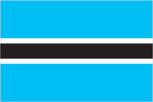
light blue with a horizontal white-edged black stripe in the center; the blue symbolizes water in the form of rain, while the black and white bands represent racial harmony
Government type
parliamentary republic
Independence
30 September 1966 (from the UK)
International law organization participation
accepts compulsory ICJ jurisdiction with reservations; accepts ICCt jurisdiction
International organization participation
ACP, AfDB, AU, C, CD, FAO, G-77, IAEA, IBRD, ICAO, ICCt, ICRM, IDA, IFAD, IFC, IFRCS, ILO, IMF, Interpol, IOC, IOM, IPU, ISO, ITSO, ITU, ITUC (NGOs), MIGA, NAM, OPCW, SACU, SADC, UN, UNCTAD, UNESCO, UNIDO, UNWTO, UPU, WCO, WFTU (NGOs), WHO, WIPO, WMO, WTO
Judicial branch
- Court of Appeal, High Court (each consists of a chief justice and a number of other judges as prescribed by the Parliament) Court of Appeal and High Court chief justices appointed by the president and other judges appointed by the president upon the advice of the Judicial Service Commission; all judges appointed to serve until age 70 Industrial Court (with circuits scheduled monthly in the capital city and in 3 districts); Magistrates Courts (1 in each district); Customary Court of Appeal; Paramount Chief's Court/Urban Customary Court; Senior Chief's Representative Court; Chief's Representative’s Court; Headman's Court
- highest court(s)
- Court of Appeal, High Court (each consists of a chief justice and a number of other judges as prescribed by the Parliament)
- judge selection and term of office
- Court of Appeal and High Court chief justices appointed by the president and other judges appointed by the president upon the advice of the Judicial Service Commission; all judges appointed to serve until age 70
- subordinate courts
- Industrial Court (with circuits scheduled monthly in the capital city and in 3 districts); Magistrates Courts (1 in each district); Customary Court of Appeal; Paramount Chief's Court/Urban Customary Court; Senior Chief's Representative Court; Chief's Representative’s Court; Headman's Court
Legal system
mixed legal system of civil law influenced by the Roman-Dutch model and also customary and common law
Legislative branch
- unicameral Parliament consists of the National Assembly (63 seats; 57 members directly elected in single-seat constituencies by simple majority vote, 4 nominated by the president and indirectly elected by simple majority vote by the rest of the National Assembly, and 2 ex-officio members - the president and attorney general; elected members serve 5-year terms); note - the House of Chiefs (Ntlo ya Dikgosi), an advisory body to the National Assembly, consists of 35 members - 8 hereditary chiefs from Botswana's principal tribes, 22 indirectly elected by the chiefs, and 5 appointed by the president; the House of Chiefs consults on issues including powers of chiefs, customary courts, customary law, tribal property, and constitutional amendments National Assembly elections last held on 24 October 2014 (next to be held in October 2019) percent of vote by party - BDP 46.5%, UDC 30.0%, BCP 20.4%, independent 3.1%; seats by party - BDP 37, UDC 17, BCP 3
- description
- unicameral Parliament consists of the National Assembly (63 seats; 57 members directly elected in single-seat constituencies by simple majority vote, 4 nominated by the president and indirectly elected by simple majority vote by the rest of the National Assembly, and 2 ex-officio members - the president and attorney general; elected members serve 5-year terms); note - the House of Chiefs (Ntlo ya Dikgosi), an advisory body to the National Assembly, consists of 35 members - 8 hereditary chiefs from Botswana's principal tribes, 22 indirectly elected by the chiefs, and 5 appointed by the president; the House of Chiefs consults on issues including powers of chiefs, customary courts, customary law, tribal property, and constitutional amendments
- election results
- percent of vote by party - BDP 46.5%, UDC 30.0%, BCP 20.4%, independent 3.1%; seats by party - BDP 37, UDC 17, BCP 3
- elections
- National Assembly elections last held on 24 October 2014 (next to be held in October 2019)
National anthem
- "Fatshe leno la rona" (Our Land) Kgalemang Tumedisco MOTSETE adopted 1966
- lyrics/music
- Kgalemang Tumedisco MOTSETE
- name
- "Fatshe leno la rona" (Our Land)
- note
- adopted 1966
National holiday
Independence Day (Botswana Day), 30 September (1966)
National symbol(s)
- zebra; national colors: blue, white, black
- zebra; national colors
- blue, white, black
Political parties and leaders
Botswana Alliance Movement or BAM [Ephraim Lepetu SETSHWAELO] Botswana Congress Party or BCP [Dumelang SALESHANDO] Botswana Democratic Party or BDP [Ian KHAMA] Botswana Movement for Democracy or BMD [Ndaba GAOLATLHE] Botswana National Front or BNF [Duma BOKO] Botswana Peoples Party or BPP [Motlatsi MOLAPISI] Umbrella for Democratic Change or UDC [Duma BOKO] (includes BMD, BPP, and BNF)
Political pressure groups and leaders
- First People of the Kalahari (Bushman organization) Pitso Ya Ba Tswana Society for the Promotion of Ikalanga Language (Kalanga elites) diamond mining companies
- other
- diamond mining companies
Suffrage
18 years of age; universal
Economy
Agriculture - products
livestock, sorghum, maize, millet, beans, sunflowers, groundnuts
Budget
- $5.112 billion $5.526 billion (2015 est.)
- expenditures
- $5.526 billion (2015 est.)
- revenues
- $5.112 billion
Budget surplus (+) or deficit (-)
-3.2% of GDP (2015 est.)
Central bank discount rate
6% (31 December 2015) 7.5% (31 December 2014)
Commercial bank prime lending rate
7.95% (31 December 2015 est.) 9% (31 December 2014 est.)
Current account balance
$1.202 billion (2015 est.) $2.496 billion (2014 est.)
Debt - external
$2.221 billion (31 December 2015 est.) $2.384 billion (31 December 2014 est.)
Distribution of family income - Gini index
60.5 (2009)
Economy - overview
Botswana has maintained one of the world's highest economic growth rates since independence in 1966. Diamond mining has fueled much of the expansion and currently accounts for one quarter of GDP, approximately 85% of export earnings, and about one-third of the government's revenues. Tourism is the secondary earner of foreign exchange and many Batswana engage in subsistence farming and cattle raising. Through fiscal discipline and sound management, Botswana transformed itself from one of the poorest countries in the world to a middle-income country with a per capita GDP of $17,700 in 2015. Two major investment services rank Botswana as the best credit risk in Africa. Botswana's economy is highly correlated with global economic trends because of its heavy reliance on a single luxury export. According to official government statistics, unemployment is 19.5%, but unofficial estimates run much higher. De Beers, a major international diamond company, signed a 10-year deal with Botswana in 2012 and moved its rough stone sorting and trading division from London to Gaborone in 2013. The move was geared to support the development of Botswana's nascent downstream diamond industry. Following the 2008 global recession Botswana’s economy recovered in 2010. However, the Government of Botswana estimates the economy grew by only 1% in 2015. This was primarily due to the downturn in the global diamond market; water and power shortages also played a role. In October 2015 President Ian KHAMA announced a stimulus plan to boost the economy through projects in agricultural production, construction, manufacturing, and tourism development. In 2016, Botswana entered its fourth year of drought, detrimental to Botswana’s small, but vital agriculture sector. The prevalence of HIV/AIDS is second highest in the world and threatens the country's impressive economic gains.
Exchange rates
pulas (BWP) per US dollar - 10.1263 (2015 est.) 8.9761 (2014 est.) 8.9761 (2013 est.) 7.62 (2012 est.) 6.8382 (2011 est.)
Exports
$6.274 billion (2015 est.) $8.514 billion (2014 est.)
Exports - commodities
diamonds, copper, nickel, soda ash, meat, textiles
Fiscal year
1 April - 31 March
GDP - composition, by end use
- 47.2% 17.4% 29.5% 7.2% 52.3% -53.6% (2015 est.)
- exports of goods and services
- 52.3%
- government consumption
- 17.4%
- household consumption
- 47.2%
- imports of goods and services
- -53.6% (2015 est.)
- investment in fixed capital
- 29.5%
- investment in inventories
- 7.2%
GDP - composition, by sector of origin
- 1.9% 30.2% 67.9% (2015 est.)
- agriculture
- 1.9%
- industry
- 30.2%
- services
- 67.9% (2015 est.)
GDP - per capita (PPP)
- $16,400 (2015 est.) $16,600 (2014 est.) $16,300 (2013 est.) data are in 2015 US dollars
- note
- data are in 2015 US dollars
GDP - real growth rate
-0.3% (2015 est.) 3.2% (2014 est.) 9.9% (2013 est.)
GDP (official exchange rate)
$12.86 billion (2015 est.)
GDP (purchasing power parity)
- $34.84 billion (2015 est.) $34.96 billion (2014 est.) $33.88 billion (2013 est.) data are in 2015 US dollars
- note
- data are in 2015 US dollars
Gross national saving
38.9% of GDP (2015 est.) 46.2% of GDP (2014 est.) 42.2% of GDP (2013 est.)
Household income or consumption by percentage share
- NA% NA%
- highest 10%
- NA%
- lowest 10%
- NA%
Imports
$7.09 billion (2015 est.) $7.991 billion (2014 est.)
Imports - commodities
foodstuffs, machinery, electrical goods, transport equipment, textiles, fuel and petroleum products, wood and paper products, metal and metal products
Industrial production growth rate
-10.6% (2015 est.)
Industries
diamonds, copper, nickel, salt, soda ash, potash, coal, iron ore, silver; livestock processing; textiles
Inflation rate (consumer prices)
3.1% (2015 est.) 4.4% (2014 est.)
Labor force
1.155 million (2015 est.)
Labor force - by occupation
- NA% NA% NA%
- agriculture
- NA%
- industry
- NA%
- services
- NA%
Market value of publicly traded shares
$4.588 billion (31 December 2012 est.) $4.107 billion (31 December 2011 est.) $4.076 billion (31 December 2010 est.)
Population below poverty line
30.3% (2003 est.)
Public debt
19.6% of GDP (2015 est.) 16.6% of GDP (2014 est.)
Reserves of foreign exchange and gold
$7.546 billion (31 December 2015 est.) $8.323 billion (31 December 2014 est.)
Stock of broad money
$8.293 billion (31 December 2013 est.) $7.635 billion (31 December 2012 est.)
Stock of domestic credit
$1.614 billion (31 December 2015 est.) $1.272 billion (31 December 2014 est.)
Stock of narrow money
$1.223 billion (31 December 2015 est.) $1.388 billion (31 December 2014 est.)
Taxes and other revenues
39.7% of GDP (2015 est.)
Unemployment rate
20% (2013 est.) 17.8% (2009 est.)
Energy
Carbon dioxide emissions from consumption of energy
4.4 million Mt (2013 est.)
Crude oil - exports
0 bbl/day (2013 est.)
Crude oil - imports
0 bbl/day (2013 est.)
Crude oil - production
0 bbl/day (2015 est.)
Crude oil - proved reserves
0 bbl (1 January 2016 es)
Electricity - consumption
3.7 billion kWh (2014 est.)
Electricity - exports
0 kWh (2013 est.)
Electricity - from fossil fuels
100% of total installed capacity (2012 est.)
Electricity - from hydroelectric plants
0% of total installed capacity (2012 est.)
Electricity - from nuclear fuels
0% of total installed capacity (2012 est.)
Electricity - from other renewable sources
0% of total installed capacity (2012 est.)
Electricity - imports
1.7 billion kWh (2014 est.)
Electricity - installed generating capacity
100,000 kW (2014 est.)
Electricity - production
2.2 billion kWh (2014 est.)
Electricity access
- 700,000 66% 75% 54% (2013)
- electrification - rural areas
- 54% (2013)
- electrification - total population
- 66%
- electrification - urban areas
- 75%
- population without electricity
- 700,000
Natural gas - consumption
0 cu m (2013 est.)
Natural gas - exports
0 cu m (2013 est.)
Natural gas - imports
0 cu m (2013 est.)
Natural gas - production
0 cu m (2013 est.)
Natural gas - proved reserves
0 cu m (1 January 2014 es)
Refined petroleum products - consumption
23,000 bbl/day (2014 est.)
Refined petroleum products - exports
0 bbl/day (2013 est.)
Refined petroleum products - imports
22,400 bbl/day (2013 est.)
Refined petroleum products - production
0 bbl/day (2013 est.)
Communications
Broadcast media
2 TV stations - 1 state-owned and 1 privately owned; privately owned satellite TV subscription service is available; 2 state-owned national radio stations; 3 privately owned radio stations broadcast locally (2007)
Internet country code
.bw
Internet users
- 600,000 27.5% (July 2015 est.)
- percent of population
- 27.5% (July 2015 est.)
- total
- 600,000
Telephone system
- Botswana is participating in regional development efforts; expanding fully digital system with fiber-optic cables linking the major population centers in the east as well as a system of open-wire lines, microwave radio relays links, and radiotelephone communication stations fixed-line teledensity has declined in recent years and now stands at roughly 7 telephones per 100 persons; mobile-cellular teledensity now pushing 160 telephones per 100 persons country code - 267; international calls are made via satellite, using international direct dialing; 2 international exchanges; digital microwave radio relay links to Namibia, Zambia, Zimbabwe, and South Africa; satellite earth station - 1 Intelsat (Indian Ocean) (2015)
- domestic
- fixed-line teledensity has declined in recent years and now stands at roughly 7 telephones per 100 persons; mobile-cellular teledensity now pushing 160 telephones per 100 persons
- general assessment
- Botswana is participating in regional development efforts; expanding fully digital system with fiber-optic cables linking the major population centers in the east as well as a system of open-wire lines, microwave radio relays links, and radiotelephone communication stations
- international
- country code - 267; international calls are made via satellite, using international direct dialing; 2 international exchanges; digital microwave radio relay links to Namibia, Zambia, Zimbabwe, and South Africa; satellite earth station - 1 Intelsat (Indian Ocean) (2015)
Telephones - fixed lines
- 160,490 7 (July 2015 est.)
- subscriptions per 100 inhabitants
- 7 (July 2015 est.)
- total subscriptions
- 160,490
Telephones - mobile cellular
- 3.475 million 159 (July 2015 est.)
- subscriptions per 100 inhabitants
- 159 (July 2015 est.)
- total
- 3.475 million
Transportation
Airports
74 (2013)
Airports - with paved runways
- 1 (2013)
- 1,524 to 2,437 m
- 6
- 2,438 to 3,047 m
- 1
- 914 to 1,523 m
- 1 (2013)
- over 3,047 m
- 2
- total
- 10
Airports - with unpaved runways
- 13 (2013)
- 1,524 to 2,437 m
- 5
- 914 to 1,523 m
- 46
- total
- 64
- under 914 m
- 13 (2013)
Civil aircraft registration country code prefix
A2 (2016)
National air transport system
- 194,005 94,729 mt-km (2015)
- annual freight traffic on registered air carriers
- 94,729 mt-km (2015)
- annual passenger traffic on registered air carriers
- 194,005
- inventory of registered aircraft operated by air carriers
- 6
- number of registered air carriers
- 1
Railways
- 888 km 888 km 1.067-m gauge (2014)
- narrow gauge
- 888 km 1.067-m gauge (2014)
- total
- 888 km
Roadways
- 17,916 km includes 8,916 km of Public Highway Network roads (6,116 km paved and 2,800 km unpaved) and 9,000 km of District Council roads (2011)
- note
- includes 8,916 km of Public Highway Network roads (6,116 km paved and 2,800 km unpaved) and 9,000 km of District Council roads (2011)
- total
- 17,916 km
Military and Security
Military branches
- Botswana Defense Force (BDF): Ground Forces Command, Air Wing Command, Defense Logistics Command, Special Forces Group (2013)
- Botswana Defense Force (BDF)
- Ground Forces Command, Air Wing Command, Defense Logistics Command, Special Forces Group (2013)
Military expenditures
2% of GDP (2013) 2.31% of GDP (2012) 2.43% of GDP (2011) 2.31% of GDP (2010)
Military service age and obligation
18 is the legal minimum age for voluntary military service; no conscription (2012)
Transnational Issues
Disputes - international
none
Trafficking in persons
- Botswana is a source, transit, and destination country for women and children subjected to sex trafficking and forced labor; young Batswana serving as domestic workers, sometimes sent by their parents, may be denied education and basic necessities or experience confinement and abuse indicative of forced labor; Batswana girls and women also are forced into prostitution domestically; adults and children of San ethnicity were reported to be in forced labor on farms and at cattle posts in the country’s rural west Tier 2 Watch List – Botswana does not fully comply with the minimum standards for the elimination of trafficking; however, it is making significant efforts to do so; an anti-trafficking act was passed at the beginning of 2014, but authorities did not investigate, prosecute, or convict any offenders or government officials complicit in trafficking or operationalize victim identification and referral procedures based on the new law; the government sponsored a radio campaign to familiarize the public with the issue of human trafficking (2015)
- current situation
- Botswana is a source, transit, and destination country for women and children subjected to sex trafficking and forced labor; young Batswana serving as domestic workers, sometimes sent by their parents, may be denied education and basic necessities or experience confinement and abuse indicative of forced labor; Batswana girls and women also are forced into prostitution domestically; adults and children of San ethnicity were reported to be in forced labor on farms and at cattle posts in the country’s rural west
- tier rating
- Tier 2 Watch List – Botswana does not fully comply with the minimum standards for the elimination of trafficking; however, it is making significant efforts to do so; an anti-trafficking act was passed at the beginning of 2014, but authorities did not investigate, prosecute, or convict any offenders or government officials complicit in trafficking or operationalize victim identification and referral procedures based on the new law; the government sponsored a radio campaign to familiarize the public with the issue of human trafficking (2015)