1990 Edition
CIA World Factbook 1990 (Project Gutenberg)
Geography
Climate
mostly temperate, but varies from tropical (Hawaii) to arctic (Alaska); arid to semiarid in west with occasional warm, dry chinook wind
Coastline
19,924 km
Comparative area
about four-tenths the size of USSR; about one-third the size of Africa; about one-half the size of South America (or slightly larger than Brazil); slightly smaller than China; about two and one-half times the size of Western Europe
Contiguous zone
12 nm;
Continental shelf
not specified;
Disputes
maritime boundary disputes with Canada; US Naval Base at Guantanamo is leased from Cuba and only mutual agreement or US abandonment of the area can terminate the lease; Haiti claims Navassa Island; has made no territorial claim in Antarctica (but has reserved the right to do so) and does not recognize the claims of any other nation
Environment
pollution control measures improving air and water quality; acid rain; agricultural fertilizer and pesticide pollution; management of sparse natural water resources in west; desertification; tsunamis, volcanoes, and earthquake activity around Pacific Basin; continuous permafrost in northern Alaska is a major impediment to development
Extended economic zone
200 nm;
Land boundaries
12,248.1 km total; Canada 8,893 km (including 2,477 km with Alaska), Mexico 3,326 km, Cuba (US naval base at Guantanamo) 29.1 km
Land use
20% arable land; NEGL% permanent crops; 26% meadows and pastures; 29% forest and woodland; 25% other; includes 2% irrigated
Natural resources
coal, copper, lead, molybdenum, phosphates, uranium, bauxite, gold, iron, mercury, nickel, potash, silver, tungsten, zinc, crude oil, natural gas, timber
Note
world's fourth-largest country (after USSR, Canada, and China)
Terrain
vast central plain, mountains in west, hills and low mountains in east; rugged mountains and broad river valleys in Alaska; rugged, volcanic topography in Hawaii
Territorial sea
12 nm
Total area
9,372,610 km2; land area: 9,166,600 km2; includes only the 50 states and District of Colombia
People and Society
Birth rate
15 births/1,000 population (1990)
Death rate
9 deaths/1,000 population (1990)
Ethnic divisions
85% white, 12% black, 3% other (1985)
Infant mortality rate
10 deaths/1,000 live births (1990)
Labor force
125,557,000 (includes armed forces and unemployed); civilian labor force 123,869,000 (1989)
Language
predominantly English; sizable Spanish-speaking minority
Life expectancy at birth
73 years male, 80 years female (1990)
Literacy
99%
Nationality
noun--American(s); adjective--American
Net migration rate
2 migrants/1,000 population (1990)
Organized labor
16,960,000 members; 16.4% of labor force (1989)
Population
250,410,000 (July 1990), growth rate 0.9% (1990)
Religion
Protestant 61% (Baptist 21%, Methodist 12%, Lutheran 8%, Presbyterian 4%, Episcopalian 3%, other Protestant 13%), Roman Catholic 25%, Jewish 2%, other 5%; none 7%
Total fertility rate
1.9 children born/woman (1990)
Government
Administrative divisions
50 states and 1 district*; Alabama, Alaska, Arizona, Arkansas, California, Colorado, Connecticut, Delaware, District of Columbia*, Florida, Georgia, Hawaii, Idaho, Illinois, Indiana, Iowa, Kansas, Kentucky, Louisiana, Maine, Maryland, Massachusetts, Michigan, Minnesota, Mississippi, Missouri, Montana, Nebraska, Nevada, New Hampshire, New Jersey, New Mexico, New York, North Carolina, North Dakota, Ohio, Oklahoma, Oregon, Pennyslvania, Rhode Island, South Carolina, South Dakota, Tennessee, Texas, Utah, Vermont, Virginia, Washington, West Virginia, Wisconsin, Wyoming
Capital
Washington, DC
Communists
Communist Party (claimed 15,000-20,000 members), Gus Hall, general secretary; Socialist Workers Party (claimed 1,800 members), Jack Barnes, national secretary
Constitution
17 September 1787, effective 4 June 1789
Dependent areas
American Samoa, Baker Island, Guam, Howland Island; Jarvis Island, Johnston Atoll, Kingman Reef, Midway Islands, Navassa Island, Palmyra Atoll, Puerto Rico, Virgin Islands, Wake Island. Since 18 July 1947, the US has administered the Trust Territory of the Pacific Islands, but recently entered into a new political relationship with three of the four political units. The Northern Mariana Islands is a Commonwealth associated with the US (effective 3 November 1986). Palau concluded a Compact of Free Association with the US that was approved by the US Congress but to date the Compact process has not been completed in Palau, which continues to be administered by the US as the Trust Territory of the Pacific Islands. The Federated States of Micronesia signed a Compact of Free Association with the US (effective 3 November 1986). The Republic of the Marshall Islands signed a Compact of Free Association with the US (effective 21 October 1986).
Diplomatic representation
US Representative to the UN, Ambassador Thomas R. PICKERING; Mission at 799 United Nations Plaza, New York, NY 10017; telephone (212) 415-4444
Elections
President--last held 8 November 1988 (next to be held 3 November 1992); results--George Bush (Republican Party) 53.37%, Michael Dukakis (Democratic Party) 45.67%, others 0.96%; Senate--last held 8 November 1988 (next to be held 6 November 1990); results--Democratic Party 52.1%, Republican Party 46.2%, others 1.7%; seats--(100 total) Democratic Party 55, Republican Party 45; House of Representatives--last held 8 November 1988 (next to be held 6 November 1990); results--Democratic Party 53.2%, Republican Party 45.3%, others 1.5%; seats--(435 total) Democratic Party 259, Republican Party 174, vacant 2
Executive branch
president, vice president, Cabinet
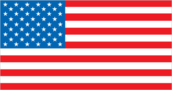
Flag
thirteen equal horizontal stripes of red (top and bottom) alternating with white; there is a blue rectangle in the upper hoist-side corner bearing 50 small white five-pointed stars arranged in nine offset horizontal rows of six stars (top and bottom) alternating with rows of five stars; the 50 stars represent the 50 states, the 13 stripes represent the 13 original colonies; known as Old Glory; the design and colors have been the basis for a number of other flags including Chile, Liberia, Malaysia, and Puerto Rico
Independence
4 July 1776 (from England)
Judicial branch
Supreme Court
Leaders
Chief of State and Head of Government--President George BUSH (since 20 January 1989); Vice President Dan QUAYLE (since 20 January 1989)
Legal system
based on English common law; judicial review of legislative acts; accepts compulsory ICJ jurisdiction, with reservations
Legislative branch
bicameral Congress consists of an upper house or Senate and a lower house or House of Representatives
Long-form name
United States of America; abbreviated US or USA
Member of
ADB, ANZUS, CCC, Colombo Plan, DAC, FAO, ESCAP, GATT, IADB, IAEA, IBRD, ICAC, ICAO, ICEM, ICES, ICO, IDA, IDB--Inter-American Development Bank, IEA, IFAD, IFC, IHO, ILO, ILZSG, IMF, IMO, INTELSAT, INTERPOL, IPU, IRC, ITC, ITU, IWC--International Whaling Commission, IWC--International Wheat Council, NATO, OAS, OECD, PAHO, SPC, UN, UPU, WHO, WIPO, WMO, WSG, WTO
National holiday
Independence Day, 4 July (1776)
Political parties and leaders
Republican Party, Lee Atwater, national committee chairman and Jeanie Austin, co-chairman; Democratic Party, Ronald H. Brown, national committee chairman; several other groups or parties of minor political significance
Suffrage
universal at age 18
Type
federal republic; strong democratic tradition
Economy
Agriculture
accounts for 2% of GNP and 2.8% of labor force; favorable climate and soils support a wide variety of crops and livestock production; world's second-largest producer and number-one exporter of grain; surplus food producer; fish catch of 5.7 million metric tons
Aid
donor--commitments, including Ex-Im (FY80-88), $90.5 billion
Budget
revenues $976 billion; expenditures $1,137 billion, including capital expenditures of NA (FY89 est.)
Currency
United States dollar (plural--dollars); 1 United States dollar (US$) = 100 cents
Electricity
776,550,000 kW capacity; 2,958,300 million kWh produced, 11,920 kWh per capita (1989)
Exchange rates
British pounds (L) per US$--0.6055 (January 1990), 0.6099 (1989), 0.5614 (1988), 0.6102 (1987), 0.6817 (1986), 0.7714 (1985); Canadian dollars (Can$) per US$--1.1885 (February 1990), 1.2307 (1988), 1.3260 (1987), 1.3895 (1986); French francs (F) per US$--5.695 (February 1990), 5.9569 (1988), 6.0107 (1987), 6.9261 (1986), 8.9852 (1985); Italian lire (Lit) per US$--1,244.8 (February 1990), 1,301.6 (1988), 1,296.1 (1987), 1,490.8 (1986), 1,909.4 (1985); Japanese yen (Y) per US$--145.55 (February 1990), 128.15 (1988), 144.64 (1987), 168.52 (1986), 238.54 (1985); FRG deutsche marks (DM) per US$--1.6775 (February 1990), 1.7562 (1988), 1.7974 (1987), 2.1715 (1986), 2.9440 (1985)
Exports
$322.3 billion (f.o.b., 1988); commodities--capital goods, automobiles, industrial supplies and raw materials, consumer goods, agricultural products; partners--Canada 22.9%, Japan 11.8% (1988)
External debt
$532 billion (December 1988)
Fiscal year
1 October-30 September
GNP
$5,233.3 billion, per capita $21,082; real growth rate 2.9%
Illicit drugs
illicit producer of cannabis for domestic consumption with 1987 production estimated at 3,500 metric tons or about 25% of the available marijuana; ongoing eradication program aimed at small plots and greenhouses has not reduced production
Imports
$440.9 billion (c.i.f., 1988); commodities--crude and partly refined petroleum, machinery, automobiles, consumer goods, industrial raw materials, food and beverages; partners--Japan 19.6% , Canada 19.1%
Industrial production
growth rate 3.3% (1989)
Industries
leading industrial power in the world, highly diversified; petroleum, steel, motor vehicles, aerospace, telecommunications, chemicals, electronics, food processing, consumer goods, fishing, lumber, mining
Inflation rate (consumer prices)
4.8% (1989)
Overview
The US has the most powerful and diversified economy in the world, with a per capita GNP of over $21,000, the largest among the major industrial nations. In 1989 the economy entered its eighth successive year of growth, the longest in peacetime history. The expansion has featured continued moderation in wage and consumer price increases, an unemployment rate of 5.2%, (the lowest in 10 years), and an inflation rate of 4.8%. On the negative side, the US enters the 1990s with massive budget and trade deficits, huge and rapidly rising medical costs, and inadequate investment in industrial capacity and economic infrastructure.
Unemployment rate
5.2% (1989)
Communications
Airports
15,422 in operation (1981)
Civil air
3,297 commercial multiengine transport aircraft, including 2,989 jet, 231 turboprop, 77 piston (1985)
Highways
6,365,590 km, including 88,641 km expressways
Inland waterways
41,009 km of navigable inland channels, exclusive of the Great Lakes (est.)
Merchant marine
373 ships (1,000 GRT or over) totaling NA GRT/NA DWT); includes 2 passenger-cargo, 37 cargo, 22 bulk, 165 tanker, 13 tanker tug-barge, 10 liquefied gas, 124 intermodal; in addition there are 248 government-owned vessels
Pipelines
275,800 km petroleum, 305,300 km natural gas (1985)
Ports
Anchorage, Baltimore, Beaumont, Boston, Charleston, Cleveland, Duluth, Freeport, Galveston, Hampton Roads, Honolulu, Houston, Jacksonville, Long Beach, Los Angeles, Milwaukee, Mobile, New Orleans, New York, Philadelphia, Portland (Oregon), Richmond (California), San Francisco, Savannah, Seattle, Tampa, Wilmington
Railroads
270,312 km
Telecommunications
182,558,000 telephones; stations--4,892 AM, 5,200 FM (including 3,915 commercial and 1,285 public broadcasting), 7,296 TV (including 796 commercial, 300 public broadcasting, and 6,200 commercial cable); 495,000,000 radio receivers (1982); 150,000,000 TV sets (1982); satellite earth stations--45 Atlantic Ocean INTELSAT and 16 Pacific Ocean INTELSAT
Military and Security
Branches
Department of the Army, Department of the Navy (including Marine Corps), Department of the Air Force
Defense expenditures
5.8% of GNP, or $302.8 billion (1989)
Military manpower
2,247,000 total; 781,000 Army; 599,000 Air Force; 793,000 Navy (includes 200,000 Marine Corps) (1988)