1999 Edition
CIA World Factbook 1999 (Internet Archive)
Geography
Area
total: 603,700 sq km land: 603,700 sq km water: 0 sq km
Area--comparative
slightly smaller than Texas
Climate
temperate continental; Mediterranean only on the southern Crimean coast; precipitation disproportionately distributed, highest in west and north, lesser in east and southeast; winters vary from cool along the Black Sea to cold farther inland; summers are warm across the greater part of the country, hot in the south
Coastline
2,782 km
Elevation extremes
lowest point: Black Sea 0 m highest point: Hora Hoverla 2,061 m
Environment--current issues
inadequate supplies of potable water; air and water pollution; deforestation; radiation contamination in the northeast from 1986 accident at Chornobyl' Nuclear Power Plant
Environment--international agreements
party to: Air Pollution, Air Pollution-Nitrogen Oxides, Air Pollution-Sulphur 85, Antarctic Treaty, Biodiversity, Climate Change, Environmental Modification, Marine Dumping, Nuclear Test Ban, Ozone Layer Protection, Ship Pollution signed, but not ratified: Air Pollution-Persistent Organic Pollutants, Air Pollution-Sulphur 94, Air Pollution-Volatile Organic Compounds, Antarctic-Environmental Protocol, Law of the Sea
Geographic coordinates
49 00 N, 32 00 E
Geography--note
strategic position at the crossroads between Europe and Asia; second-largest country in Europe
Irrigated land
26,050 sq km (1993 est.)
Land boundaries
total: 4,558 km border countries: Belarus 891 km, Hungary 103 km, Moldova 939 km, Poland 428 km, Romania (south) 169 km, Romania (west) 362 km, Russia 1,576 km, Slovakia 90 km
Land use
arable land: 58% permanent crops: 2% permanent pastures: 13% forests and woodland: 18% other: 9% (1993 est.)
Location
Eastern Europe, bordering the Black Sea, between Poland and Russia
Map references
Commonwealth of Independent States
Maritime claims
continental shelf: 200-m or to the depth of exploitation exclusive economic zone: 200 nm territorial sea: 12 nm
Natural hazards
NA
Natural resources
iron ore, coal, manganese, natural gas, oil, salt, sulfur, graphite, titanium, magnesium, kaolin, nickel, mercury, timber
Terrain
most of Ukraine consists of fertile plains (steppes) and plateaus, mountains being found only in the west (the Carpathians), and in the Crimean Peninsula in the extreme south
People and Society
Age structure
0-14 years: 18% (male 4,690,318; female 4,498,239) 15-64 years: 68% (male 16,136,296; female 17,572,011) 65 years and over: 14% (male 2,251,664; female 4,662,646) (1999 est.)
Birth rate
9.54 births/1,000 population (1999 est.)
Death rate
16.38 deaths/1,000 population (1999 est.)
Ethnic groups
Ukrainian 73%, Russian 22%, Jewish 1%, other 4%
Infant mortality rate
21.73 deaths/1,000 live births (1999 est.)
Languages
Ukrainian, Russian, Romanian, Polish, Hungarian
Life expectancy at birth
total population: 65.91 years male: 60.23 years female: 71.87 years (1999 est.)
Literacy
definition: age 15 and over can read and write total population: 98% male: 100% female: 97% (1989 est.)
Nationality
noun: Ukrainian(s) adjective: Ukrainian
Net migration rate
0.63 migrant(s)/1,000 population (1999 est.)
Population
49,811,174 (July 1999 est.)
Population growth rate
-0.62% (1999 est.)
Religions
Ukrainian Orthodox--Moscow Patriarchate, Ukrainian Orthodox--Kiev Patriarchate, Ukrainian Autocephalous Orthodox, Ukrainian Catholic (Uniate), Protestant, Jewish
Sex ratio
at birth: 1.05 male(s)/female under 15 years: 1.04 male(s)/female 15-64 years: 0.92 male(s)/female 65 years and over: 0.48 male(s)/female total population: 0.86 male(s)/female (1999 est.)
Total fertility rate
1.34 children born/woman (1999 est.)
Government
Administrative divisions
24 oblasti (singular--oblast'), 1 autonomous republic* (avtomnaya respublika), and 2 municipalities (mista, singular--misto) with oblast status**; Cherkas'ka (Cherkasy), Chernihivs'ka (Chernihiv), Chernivets'ka (Chernivtsi), Dnipropetrovs'ka (Dnipropetrovs'k), Donets'ka (Donets'k), Ivano-Frankivs'ka (Ivano-Frankivs'k), Kharkivs'ka (Kharkiv), Khersons'ka (Kherson), Khmel'nyts'ka (Khmel'nyts'kyy), Kirovohrads'ka (Kirovohrad), Kyyiv**, Kyyivs'ka (Kiev), Luhans'ka (Luhans'k), L'vivs'ka (L'viv), Mykolayivs'ka (Mykolayiv), Odes'ka (Odesa), Poltavs'ka (Poltava), Avtonomna Respublika Krym* (Simferopol'), Rivnens'ka (Rivne), Sevastopol'**, Sums'ka (Sumy), Ternopil's'ka (Ternopil'), Vinnyts'ka (Vinnytsya), Volyns'ka (Luts'k), Zakarpats'ka (Uzhhorod), Zaporiz'ka (Zaporizhzhya), Zhytomyrs'ka (Zhytomyr) note: oblasts have the administrative center name following in parentheses
Capital
Kiev (Kyyiv)
Constitution
adopted 28 June 1996
Country name
conventional long form: none conventional short form: Ukraine local long form: none local short form: Ukrayina former: Ukrainian Soviet Socialist Republic
Data code
UP
Executive branch
chief of state: President Leonid D. KUCHMA (since 19 July 1994) head of government: Prime Minister Valeriy PUSTOVOYTENKO (since 16 July 1997), First Deputy Prime Minister Volodymyr KURATCHENKO (since 14 January 1999), and three deputy prime ministers cabinet: Cabinet of Ministers appointed by the president and approved by the Supreme Council note: there is also a National Security and Defense Council or NSDC originally created in 1992 as the National Security Council, but significantly revamped and strengthened under President KUCHMA; the NSDC staff is tasked with developing national security policy on domestic and international matters and advising the president; a Presidential Administration that helps draft presidential edicts and provides policy support to the president; and a Council of Regions that serves as an advisory body created by President KUCHMA in September 1994 that includes chairmen of the Kyyiv (Kiev) and Sevastopol' municipalities and chairmen of the Oblasti elections: president elected by popular vote for a five-year term; election last held 26 June and 10 July 1994 (next to be held NA October 1999); prime minister and deputy prime ministers appointed by the president and approved by the People's Council election results: Leonid D. KUCHMA elected president; percent of vote--Leonid KUCHMA 52.15%, Leonid KRAVCHUK 45.06%
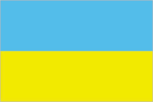
Flag description
two equal horizontal bands of azure (top) and golden yellow represent grainfields under a blue sky
Government type
republic
Independence
1 December 1991 (from Soviet Union)
International organization participation
BSEC, CCC, CE, CEI, CIS, EAPC, EBRD, ECE, IAEA, IBRD, ICAO, ICRM, IFC, IFRCS, IHO (pending member), ILO, IMF, IMO, Inmarsat, Intelsat (nonsignatory user), Interpol, IOC, IOM (observer), ISO, ITU, MONUA, NSG, OAS (observer), OPCW, OSCE, PCA, PFP, UN, UNCTAD, UNESCO, UNIDO, UNMIBH, UNMOP, UNMOT, UNPREDEP, UPU, WFTU, WHO, WIPO, WMO, WToO, WTrO (applicant) Diplomatic representation in the US: chief of mission: Ambassador Anton Denysovych BUTEYKO chancery: 3350 M Street NW, Washington, DC 20007 consulate(s) general: Chicago and New York Diplomatic representation from the US: chief of mission: Ambassador Steven Karl PIFER embassy: 10 Yuria Kotsubynskoho, 254053 Kiev 53 mailing address: use embassy street address
Judicial branch
Supreme Court; Constitutional Court Political parties and leaders: Communist Party of Ukraine [Petro VITRENKO] note: and numerous smaller parties Political pressure groups and leaders: New Ukraine (Nova Ukrayina); Congress of National Democratic Forces
Legal system
based on civil law system; judicial review of legislative acts
Legislative branch
unicameral Supreme Council or Verkhovna Rada (450 seats; under Ukraine's new election law, half of the Rada's seats are allocated on a proportional basis to those parties that gain 4% of the national electoral vote; the other 225 members are elected by popular vote in single-mandate constituencies; all serve four-year terms) elections: last held 29 March 1998 (next to be held NA 2002); note--repeat elections continuing to fill vacant seats election results: percent of vote by party (for parties clearing 4% hurdle on 29 March 1998)--Communist 24.7%, Rukh 9.4%, Socialist/Peasant 8.6%, Green 5.3%, People's Democratic Party 5.0%, Hromada 4.7%, Progressive Socialist 4.0%, United Social Democratic Party 4.0%; seats by party (as of 8 July 1998)--Communist 120, People's Democratic Party 88, Rukh 47, Hromada 45, Socialist/Peasant 33, United Social Democratic 25, Green 24, Progressive Socialist 14, independents 26, vacant 28
National holiday
Independence Day, 24 August (1991)
Suffrage
18 years of age; universal
Economy
Agriculture--products
grain, sugar beets, sunflower seeds, vegetables; beef, milk
Budget
revenues: $18 billion expenditures: $21 billion, including capital expenditures of $NA (1997 est.)
Currency
1 hryvna=100 kopiykas
Debt--external
$10.9 billion (October 1998)
Economic aid--recipient
$637.7 million (1995); IMF Extended Funds Facility $2.2 billion (1998)
Economy--overview
After Russia, the Ukrainian republic was far and away the most important economic component of the former Soviet Union, producing about four times the output of the next-ranking republic. Its fertile black soil generated more than one-fourth of Soviet agricultural output, and its farms provided substantial quantities of meat, milk, grain, and vegetables to other republics. Likewise, its diversified heavy industry supplied equipment and raw materials to industrial and mining sites in other regions of the former USSR. Ukraine depends on imports of energy, especially natural gas. Shortly after the implosion of the USSR in December 1991, the Ukrainian Government liberalized most prices and erected a legal framework for privatization, but widespread resistance to reform within the government and the legislature soon stalled reform efforts and led to some backtracking. Output in 1992-98 fell to less than half the 1991 level. Loose monetary policies pushed inflation to hyperinflationary levels in late 1993. Since his election in July 1994, President KUCHMA has pushed economic reforms, maintained financial discipline, and tried to remove almost all remaining controls over prices and foreign trade. The onset of the financial crisis in Russia dashed Ukraine's hopes for its first year of economic growth in 1998 due to a sharp fall in export revenue and reduced domestic demand. Although administrative currency controls will be lifted in early 1999, they are likely to be reimposed when the hryvnia next comes under pressure. The currency is only likely to collapse further if Ukraine abandons tight monetary policies or threatens default. Despite increasing pressure from the IMF to accelerate reform, significant economic restructuring remains unlikely in 1999.
Electricity--consumption
174 billion kWh (1998)
Electricity--exports
5 billion kWh (1998)
Electricity--imports
7 billion kWh (1998)
Electricity--production
171.8 billion kWh (1998)
Electricity--production by source
fossil fuel: 47% hydro: 9.2% nuclear: 43.8% other: 0% (1998)
Exchange rates
hryvnia per US$1--3.4270 (February 1999), 2.4495 (1998), 1.8617 (1997), 1.8295 (1996), 1.4731 (1995), 0.3275 (1994) note: in August 1998, Ukraine introduced currency controls in an attempt to fend off the impact of the Russian financial crisis; it created an exchange rate corridor for the hryvnia of 2.5-3.5 hryvnia per US$1
Exports
$11.3 billion (1998 est.)
Exports--commodities
ferrous and nonferrous metals, chemicals, machinery and transport equipment, food products
Exports--partners
Russia, China,, Turkey, Germany, Belarus (1998)
Fiscal year
calendar year
GDP
purchasing power parity--$108.5 billion (1998 est.)
GDP--composition by sector
agriculture: 14% industry: 30% services: 56% (1997 est.)
GDP--per capita
purchasing power parity?$2,200 (1998 est.)
GDP--real growth rate
-1.7% (1998 est.)
Household income or consumption by percentage share
lowest 10%: 4.1% highest 10%: 20.8% (1992)
Imports
$13.1 billion (1998 est.)
Imports--commodities
energy, machinery and parts, transportation equipment, chemicals, plastics and rubber
Imports--partners
Russia, Germany, US, Poland, Italy (1998)
Industrial production growth rate
-1.5% (1998 est.)
Industries
coal, electric power, ferrous and nonferrous metals, machinery and transport equipment, chemicals, food-processing (especially sugar)
Inflation rate (consumer prices)
20% (yearend 1998 est.)
Labor force
22.8 million (yearend 1997)
Labor force--by occupation
industry and construction 32%, agriculture and forestry 24%, health, education, and culture 17%, trade and distribution 8%, transport and communication 7%, other 12% (1996)
Population below poverty line
50% (1997 est.)
Unemployment rate
3.7% officially registered; large number of unregistered or underemployed workers (December 1998)
Communications
Radio broadcast stations
AM NA, FM NA, shortwave NA; note--at least 25 local broadcast stations of NA type (1998)
Radios
15 million (1990)
Telephone system
Ukraine's phone systems are administered through the State Committee for Communications; Ukraine has a telecommunication development plan through 2005; Internet service is available in large cities domestic: local--Kiev has a digital loop connected to the national digital backbone; Kiev has several cellular phone companies providing service in the different standards; some companies offer intercity roaming and even limited international roaming; cellular phone service is offered in at least 100 cities nationwide international: foreign investment in the form of joint business ventures greatly improved the Ukrainian telephone system; Ukraine's two main fiber-optic lines are part of the Trans-Asia-Europe Fiber-Optic Line (TAE); these lines connect Ukraine to worldwide service through Belarus, Hungary, and Poland; Odesa is a landing point for the Italy-Turkey-Ukraine-Russia Undersea Fiber-Optic Cable (ITUR) giving Ukraine an additional fiber-optic link to worldwide service; Ukraine has Intelsat, Inmarsat, and Intersputnik earth stations
Telephones
12,531,277 (1998)
Television broadcast stations
at least 33 (in addition 21 repeater stations that relay ORT broadcasts from Russia) (1997)
Televisions
17.3 million (1992)
Transportation
Airports
706 (1994 est.) Airports--with paved runways: total: 163 over 3,047 m: 14 2,438 to 3,047 m: 55 1,524 to 2,437 m: 34 914 to 1,523 m: 3 under 914 m: 57 (1994 est.) Airports--with unpaved runways: total: 543 over 3,047 m: 7 2,438 to 3,047 m: 7 1,524 to 2,437 m: 16 914 to 1,523 m: 37 under 914 m: 476 (1994 est.)
Highways
total: 172,565 km paved: 163,937 km (including 1,875 km of expressways); note--these roads are said to be hard-surfaced, meaning that some are paved and some are all-weather gravel surfaced unpaved: 8,628 km (1996 est.)
Merchant marine
total: 181 ships (1,000 GRT or over) totaling 1,022,047 GRT/1,101,278 DWT ships by type: bulk 9, cargo 117, liquefied gas tanker 1, container 4, multifunction large-load carrier 2, oil tanker 16, passenger 12, passenger-cargo 3, railcar carrier 2, refrigerated cargo 2, roll-on/roll-off cargo 10, short-sea passenger 3 (1998 est.)
Pipelines
crude oil 4,000 km (1995); petroleum products 4,500 km (1995); natural gas 34,400 km (1998) Ports and harbors: Berdyans'k, Illichivs'k, Izmayil, Kerch, Kherson, Kiev (Kyyiv), Mariupol', Mykolayiv, Odesa, Reni
Railways
total: 23,350 km broad gauge: 23,350 km 1.524-m gauge (8,600 km electrified)
Waterways
4,400 km navigable waterways, of which 1,672 km were on the Pryp''yat' and Dnistr (1990)
Military and Security
Military branches
Army, Navy, Air Force, Air Defense Force, Internal Troops, National Guard, Border Troops
Military expenditures--dollar figure
$414 million (1999)
Military expenditures--percent of GDP
1.4% (1999)
Military manpower--availability
males age 15-49: 12,434,486 (1999 est.) Military manpower--fit for military service: males age 15-49: 9,740,684 (1999 est.)
Military manpower--military age
18 years of age
Military manpower--reaching military age annually
males: 365,762 (1999 est.)
Transnational Issues
Disputes--international
dispute with Romania over continental shelf of the Black Sea under which significant gas and oil deposits may exist; agreed in 1997 to two-year negotiating period, after which either party can refer dispute to the International Court of Justice (ICJ); has made no territorial claim in Antarctica (but has reserved the right to do so) and does not recognize the claims of any other nation
Illicit drugs
limited cultivation of cannabis and opium poppy, mostly for CIS consumption; some synthetic drug production for export to West; limited government eradication program; used as transshipment point for opiates and other illicit drugs from Africa, Latin America, and Turkey, and to Europe and Russia; drug-related money laundering a minor, but growing, problem