1998 Edition
CIA World Factbook 1998 (Internet Archive)
Geography
Area
total: 603,700 sq km land: 603,700 sq km water: 0 sq km
Area-comparative
slightly smaller than Texas
Climate
temperate continental; Mediterranean only on the southern Crimean coast; precipitation disproportionately distributed, highest in west and north, lesser in east and southeast; winters vary from cool along the Black Sea to cold farther inland; summers are warm across the greater part of the country, hot in the south
Coastline
2,782 km
Elevation extremes
lowest point: Black Sea 0 m highest point: Hora Hoverla 2,061 m
Environment-current issues
inadequate supplies of potable water; air and water pollution; deforestation; radiation contamination in the northeast from 1986 accident at Chornobyl' Nuclear Power Plant
Environment-international agreements
party to: Air Pollution, Air Pollution-Nitrogen Oxides, Air Pollution-Sulphur 85, Antarctic Treaty, Biodiversity, Climate Change, Environmental Modification, Marine Dumping, Nuclear Test Ban, Ozone Layer Protection, Ship Pollution signed, but not ratified: Air Pollution-Sulphur 94, Air Pollution-Volatile Organic Compounds, Antarctic-Environmental Protocol, Law of the Sea
Geographic coordinates
49 00 N, 32 00 E
Geography-note
strategic position at the crossroads between Europe and Asia; second-largest country in Europe
Irrigated land
26,050 sq km (1993 est.)
Land boundaries
total: 4,558 km border countries: Belarus 891 km, Hungary 103 km, Moldova 939 km, Poland 428 km, Romania (south) 169 km, Romania (west) 362 km, Russia 1,576 km, Slovakia 90 km
Land use
arable land: 58% permanent crops: 2% permanent pastures: 13% forests and woodland: 18% other: 9% (1993 est.)
Location
Eastern Europe, bordering the Black Sea, between Poland and Russia
Map references
Commonwealth of Independent States
Maritime claims
continental shelf: 200-m or to the depth of exploitation exclusive economic zone: 200 nm territorial sea: 12 nm
Natural hazards
NA
Natural resources
iron ore, coal, manganese, natural gas, oil, salt, sulfur, graphite, titanium, magnesium, kaolin, nickel, mercury, timber
Terrain
most of Ukraine consists of fertile plains (steppes) and plateaus, mountains being found only in the west (the Carpathians), and in the Crimean Peninsula in the extreme south
People and Society
Age structure
0-14 years: 19% (male 4,852,461; female 4,656,688) 15-64 years: 67% (male 16,096,737; female 17,481,600) 65 years and over: 14% (male 2,284,960; female 4,752,662) (July 1998 est.)
Birth rate
9.53 births/1,000 population (1998 est.)
Death rate
16.31 deaths/1,000 population (1998 est.)
Ethnic groups
Ukrainian 73%, Russian 22%, Jewish 1%, other 4%
Infant mortality rate
21.8 deaths/1,000 live births (1998 est.)
Languages
Ukrainian, Russian, Romanian, Polish, Hungarian
Life expectancy at birth
total population: 65.84 years male: 60.08 years female: 71.89 years (1998 est.)
Literacy
definition: age 15 and over can read and write total population: 98% male: 100% female: 97% (1989 est.)
Nationality
noun: Ukrainian(s) adjective: Ukrainian
Net migration rate
0.43 migrant(s)/1,000 population (1998 est.)
Population
50,125,108 (July 1998 est.)
Population growth rate
-0.64% (1998 est.)
Religions
Ukrainian Orthodox-Moscow Patriarchate, Ukrainian Orthodox-Kiev Patriarchate, Ukrainian Autocephalous Orthodox, Ukrainian Catholic (Uniate), Protestant, Jewish
Sex ratio
at birth: 1.05 male(s)/female under 15 years: 1.04 male(s)/female 15-64 years: 0.92 male(s)/female 65 years and over: 0.48 male(s)/female (1998 est.)
Total fertility rate
1.35 children born/woman (1998 est.)
Government
Administrative divisions
24 oblasti (singular-oblast'), 1 autonomous republic* (avtomnaya respublika), and 2 municipalities (mista, singular-misto) with oblast status**; Cherkas'ka (Cherkasy), Chernihivs'ka (Chernihiv), Chernivets'ka (Chernivtsi), Dnipropetrovs'ka (Dnipropetrovs'k), Donets'ka (Donets'k), Ivano-Frankivs'ka (Ivano-Frankivs'k), Kharkivs'ka (Kharkiv), Khersons'ka (Kherson), Khmel'nyts'ka (Khmel'nyts'kyy), Kirovohrads'ka (Kirovohrad), Kyyiv**, Kyyivs'ka (Kiev), Luhans'ka (Luhans'k), L'vivs'ka (L'viv), Mykolayivs'ka (Mykolayiv), Odes'ka (Odesa), Poltavs'ka (Poltava), Avtonomna Respublika Krym* (Simferopol'), Rivnens'ka (Rivne), Sevastopol'**, Sums'ka (Sumy), Ternopil's'ka (Ternopil'), Vinnyts'ka (Vinnytsya), Volyns'ka (Luts'k), Zakarpats'ka (Uzhhorod), Zaporiz'ka (Zaporizhzhya), Zhytomyrs'ka (Zhytomyr) note: oblasts have the administrative center name following in parentheses
Constitution
adopted 28 June 1996
Country name
conventional long form: none conventional short form: Ukraine local long form: none local short form: Ukrayina former: Ukrainian Soviet Socialist Republic
Data code
UP
Executive branch
chief of state: President Leonid D. KUCHMA (since 19 July 1994) head of government: Prime Minister Valeriy PUSTOVOYTENKO (since 16 July 1997), First Deputy Prime Minister Anatoliy HOLUBCHENKO (since 8 August 1997), and three deputy prime ministers cabinet: Cabinet of Ministers appointed by the president and approved by the Supreme Council note: there is also a National Security and Defense Council or NSDC originally created in 1992 as the National Security Council, but significantly revamped and strengthened under President KUCHMA; the NSDC staff is tasked with developing national security policy on domestic and international matters and advising the president; a Presidential Administration that helps draft presidential edicts and provides policy support to the president; and a Council of Regions that serves as an advisory body created by President KUCHMA in September 1994 that includes chairmen of the Kiev and Sevastopol city councils and the chairmen of Oblast elections: president elected by popular vote for a five-year term; election last held 26 June and 10 July 1994 (next to be held NA October 1999); prime minister and deputy prime ministers appointed by the president and approved by the People's Council election results: Leonid D. KUCHMA elected president; percent of vote-Leonid KUCHMA 52.15%, Leonid KRAVCHUK 45.06%
FAX
- [1] (202) 333-0817 consulate(s) general: Chicago and New York Diplomatic representation from the US: chief of mission: Ambassador Steven Karl PIFER embassy: 10 Yuria Kotsubynskoho, 254053 Kiev 53 mailing address: use embassy street address telephone: [380] (44) 244-7345
- [380] (44) 244-7350
Flag description
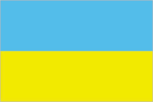
two equal horizontal bands of azure (top) and golden yellow represent grainfields under a blue sky
Government type
republic
Independence
1 December 1991 (from Soviet Union)
International organization participation
BSEC, CCC, CE, CEI, CIS, EAPC, EBRD, ECE, IAEA, IBRD, ICAO, ICRM, IFC, IFRCS, ILO, IMF, IMO, Inmarsat, Intelsat (nonsignatory user), Interpol, IOC, IOM (observer), ISO, ITU, MINUGUA, NSG, OSCE, PCA, PFP, UN, UNCTAD, UNESCO, UNIDO, UNMIBH, UNMOP, UNMOT, UNPREDEP, UPU, WFTU, WHO, WIPO, WMO, WTrO (applicant) Diplomatic representation in the US: chief of mission: Ambassador Yuriy Mykolayovych SHCHERBAK chancery: 3350 M Street NW, Washington, DC 20007 telephone: [1] (202) 333-0606
Judicial branch
Supreme Court; Constitutional Court Political parties and leaders: Communist Party of Ukraine [Petro SYMONENKO]; Hromad [Pavlo LAZARENKO]; Ukrainian Popular Movement or Rukh [Vyacheslav CHORNOVIL, chairman]; Socialist Party of Ukraine or SPU [Oleksandr MOROZ, chairman]; Peasant Party of Ukraine or SelPU [Serhiy DOVAN]; People's Democratic Party or NDPU [Valeriy PUSTOVOYTENKO, chairman]; Reforms and Order Party [Viktor PYNZENYK]; United Social-Democratic Party of Ukraine [Vasyl ONONENKO]; Christian Democratic Party of Ukraine [Vitaliy ZHURAVSKYY]; Christian People's Union [Victor MUSIYAKA]; Ukrainian National Assembly [Oleh VITOVYCH]; Democratic Party of Ukraine or DPU [Volodymyr Oleksandrovych YAVORIVSKYY, chairman]; Agrarian Party of Ukraine or APU [Kateryna VASHCHUK]; Liberal Party of Ukraine or LPU [Volodymyr SHCHERBAN]; Party of Labor [Valentyn LANDYK, chairman]; Social Democratic Party of Ukraine or SDPU [Yuriy BUZDUHAN]; Interregional Reforms Bloc [Volodymyr HRYNYOV; Republic Christian Party [Mykola POROVSKYY]; Congress of Ukrainian Nationalists or KUN [Yaroslava-Anna STETSKO]; Ukrainian Conservative Republican Party or UKRP [Yuriy VOSKOVNYUK, chairman]; Ukrainian Republican Party [Bohdan YAROSHYNSKYY]; Green Party of Ukraine or PZU [Vitaliy KONONOV, leader]; Progressive Socialist Party [Natalya VITRENKO]; State Independence of Ukraine [Roman KOVAL]; All-Ukrainian Labor Party [Leonid VERNIYHORA]; Regional Revival Party of Ukraine [Volodymyr RYBAK]; Liberal Democratic Party of Ukraine or LDPU [Andriy KOVAL, chairman]; Ukrainian Peasant Democratic Party or USDP [Viktor PRYSYAZHNYUK]; Ukraine Regional Revival Party [Volodymyr RYBAK] note: approximately 30 parties are registered to take part in the 29 March 1998 elections Political pressure groups and leaders: New Ukraine (Nova Ukrayina); Congress of National Democratic Forces
Legal system
based on civil law system; judicial review of legislative acts
Legislative branch
unicameral People's Council (before 1996 the Supreme Council) or Narodna Rada (450 seats; under Ukraine's new election law, half of the Rada's seats are allocated on a proportional basis to those parties that gain 4% of the national electoral vote; the other 225 members are elected by popular vote in single mandate constituencies; all serve four-year terms) elections: last held 27 March 1994 with repeat elections continuing through December 1996 to fill empty seats (next to be held 29 March 1998) election results: percent of vote by party-NA; seats by party-Communists 91, Rukh 22, Agrarians 18, Socialists 15, Republicans 11, Congress of Ukrainian Nationalists 5, Labor 5, Party of Democratic Revival 4, Democrats 2, Social Democrats 2, Civil Congress 2, Conservative Republicans 1, Party of Economic Revival of Crimea 1, Christian Democrats 1, independents 225; note-most recent repeat election held in April 1996 filling 422 of 450 seats as follows: independents 238, Communist 95, Rukh 22, Agrarians 18, Socialist 15, Republicans 11, Congress of Ukrainian Nationalists 5, Labor 5, Party of Democratic Revival 4, Democratic Party of Ukraine 2, Social Democrats 2, Civil Congress 2, Conservative Republicans 1, Party of Economic Revival of Crimea 1, Christian Democrats 1, vacant 28 (in February 1997 there were 35 vacant seats)
National capital
Kiev (Kyyiv)
National holiday
Independence Day, 24 August (1991)
Suffrage
18 years of age; universal
Economy
Agriculture-products
grain, sugar beets, sunflower seeds, vegetables; meat, milk
Budget
revenues: $18 billion expenditures: $21 billion, including capital expenditures of $NA (1997 est.)
Currency
on 2 September 1996, Ukraine introduced the long-awaited hryvnia as its national currency, replacing the karbovanets (in circulation since 12 November 1992) at a rate of 100,000 karbovantsi to 1 hryvnia
Debt-external
$9.6 billion (including $2.1 billion to Russia) (yearend 1997 est.)
Economic aid
recipient: ODA, $220 million (1993) note: commitments, 1992-95, $4.5 billion ($4.1 billion drawn)
Economy-overview
After Russia, the Ukrainian republic was far and away the most important economic component of the former Soviet Union, producing about four times the output of the next-ranking republic. Its fertile black soil generated more than one-fourth of Soviet agricultural output, and its farms provided substantial quantities of meat, milk, grain, and vegetables to other republics. Likewise, its diversified heavy industry supplied equipment and raw materials to industrial and mining sites in other regions of the former USSR. Ukraine depends on imports of energy, especially natural gas. Shortly after the implosion of the USSR in December 1991, the Ukrainian Government liberalized most prices and erected a legal framework for privatization, but widespread resistance to reform within the government and the legislature soon stalled reform efforts and led to some backtracking. Output in 1992-97 fell to less than half the 1991 level. Loose monetary policies pushed inflation to hyperinflationary levels in late 1993. Since his election in July 1994, President KUCHMA has pushed economic reforms, maintained financial discipline, and tried to remove almost all remaining controls over prices and foreign trade. Implementation of KUCHMA's economic agenda is encountering considerable resistance from parliament, entrenched bureaucrats, and industrial interests; and an environment of corruption continues to discourage foreign investors. One signal achievement has been the reduction of the inflation rate to 10% by yearend 1997. If KUCHMA succeeds in implementing aggressive market reforms during 1998, the economy should reverse its downward trend, with real growth occurring by late 1998 and into 1999.
Electricity-capacity
52 million kW (1997)
Electricity-consumption per capita
3,431 kWh (1997)
Electricity-production
177 billion kWh (1997)
Exchange rates
hryvnia per US$1-1.9359 (February 1998), 1.8617 (1997), 1.8295 (1996), 1.4731 (1995), 0.3275 (1994), 0.0453 (1993)
Exports
total value: $15.2 billion (1997 est.) commodities: ferrous and nonferrous metals, chemicals, machinery and transport equipment, food products partners: Russia, China, Belarus, Turkey, Germany (1997)
Fiscal year
calendar year Communications
GDP
purchasing power parity-$124.9 billion (1997 est.)
GDP-composition by sector
agriculture: 14% industry: 30% services: 56% (1997 est.)
GDP-per capita
purchasing power parity-$2,500 (1997 est.)
GDP-real growth rate
-3.2% (1997 est.)
Imports
total value: $20.2 billion (1997 est.) commodities: energy, machinery and parts, transportation equipment, chemicals, plastics and rubber partners: Russia, Turkmenistan, Belarus, Germany, China
Industrial production growth rate
-1.8% (1997 est.)
Industries
coal, electric power, ferrous and nonferrous metals, machinery and transport equipment, chemicals, food-processing (especially sugar)
Inflation rate-consumer price index
10% (yearend 1997 est.)
Labor force
total: 22.8 million (yearend 1997) by occupation: industry and construction 32%, agriculture and forestry 24%, health, education, and culture 17%, trade and distribution 8%, transport and communication 7%, other 12% (1996)
Radio broadcast stations
2 radio broadcast stations of NA type
Radios
15 million (1990)
Telephone system
system is unsatisfactory both for business and for personal use; 3.56 million applications for telephones had not been satisfied as of January 1991; electronic mail services have been established in Kiev, Odessa, and Luhans'k by Sprint domestic: an NMT-450 analog cellular telephone network operates in Kiev (Kyyiv) and allows direct dialing of international calls through Kiev's digital exchange international: calls to other CIS countries are carried by landline or microwave radio relay; calls to 167 other countries are carried by satellite or by the 150 leased lines through the Moscow international gateway switch; satellite earth stations-NA Intelsat, 1 Inmarsat (Atlantic and Indian Ocean Regions), and NA Intersputnik
Telephones
NA
Television broadcast stations
at least 2
Televisions
17.3 million (1992)
Unemployment rate
2.6% officially registered; large number of unregistered or underemployed workers (December 1997)
Transportation
Airports
706 (1994 est.) Airports-with paved runways: total: 163 over 3,047 m: 14 2,438 to 3,047 m: 55 1,524 to 2,437 m: 34 914 to 1,523 m: 3 under 914 m: 57 (1994 est.) Airports-with unpaved runways: total: 543 over 3,047 m: 7 2,438 to 3,047 m: 7 1,524 to 2,437 m: 16 914 to 1,523 m: 37 under 914 m: 476 (1994 est.)
Highways
total: 172,565 km paved: 163,937 km (including 1,875 km of expressways); note-these roads are said to be hard-surfaced, meaning that some are paved and some are all-weather gravel surfaced unpaved: 8,628 km (1996 est.)
Merchant marine
total: 202 ships (1,000 GRT or over) totaling 1,498,653 GRT/1,709,393 DWT ships by type: barge carrier 3, bulk 13, cargo 122, chemical tanker 2, combination bulk 1, container 3, multifunction large-load carrier 2, oil tanker 19, passenger 7, passenger-cargo 4, railcar carrier 2, refrigerated cargo 6, roll-on/roll-off cargo 13, short-sea passenger 5 note: Ukraine owns an additional 41 ships (1,000 GRT or over) totaling 515,743 DWT operating under the registries of The Bahamas, Cyprus, Liberia, Malta, Panama, and Saint Vincent and the Grenadines (1997 est.)
Pipelines
crude oil 2,010 km; petroleum products 1,920 km; natural gas 7,800 km (1992) Ports and harbors: Berdyans'k, Illichivs'k, Izmayil, Kerch, Kherson, Kiev (Kyyiv), Mariupol', Mykolayiv, Odesa, Reni
Railways
total: 23,350 km broad gauge: 23,350 km 1.524-m gauge (8,600 km electrified)
Waterways
4,400 km navigable waterways, of which 1,672 km were on the Pryp''yat' and Dnistr (1990)
Military and Security
Military branches
Army, Navy, Air Force, Air Defense Force, Internal Troops, National Guard, Border Troops
Military expenditures-dollar figure
1.71 billion hryvni (Ukrainian Government's forecast for 1998); note - conversion of defense expenditures into US dollars using the current exchange rate could produce misleading results
Military expenditures-percent of GDP
NA%
Military manpower-availability
males age 15-49: 12,431,318 (1998 est.) Military manpower-fit for military service: males: 9,733,193 (1998 est.)
Military manpower-military age
18 years of age
Military manpower-reaching military age annually
males: 367,160 (1998 est.)
Transnational Issues
Disputes-international
dispute with Romania over continental shelf of the Black Sea under which significant gas and oil deposits may exist; agreed in 1997 to two-year negotiating period, after which either party can refer dispute to the International Court of Justice; has made no territorial claim in Antarctica (but has reserved the right to do so) and does not recognize the claims of any other nation; certain territory of Moldova and Ukraine-including Bessarabia and Northern Bukovina-are considered by Bucharest as historically a part of Romania; this territory was incorporated into the former Soviet Union following the Molotov-Ribbentrop Pact in 1940
Illicit drugs
limited cultivation of cannabis and opium poppy, mostly for CIS consumption; limited government eradication program; used as transshipment point for opiates and other illicit drugs to Western Europe and Russia