1999 Edition
CIA World Factbook 1999 (Internet Archive)
Geography
Area
total: 56,790 sq km land: 54,390 sq km water: 2,400 sq km
Area--comparative
slightly smaller than West Virginia
Climate
tropical; hot, humid in south; semiarid in north
Coastline
56 km
Elevation extremes
lowest point: Atlantic Ocean 0 m highest point: Pic Agou 986 m
Environment--current issues
deforestation attributable to slash-and-burn agriculture and the use of wood for fuel; recent droughts affecting agriculture
Environment--international agreements
party to: Biodiversity, Climate Change, Desertification, Endangered Species, Law of the Sea, Nuclear Test Ban, Ozone Layer Protection, Ship Pollution, Tropical Timber 83, Tropical Timber 94, Wetlands signed, but not ratified: none of the selected agreements
Geographic coordinates
8 00 N, 1 10 E
Irrigated land
70 sq km (1993 est.)
Land boundaries
total: 1,647 km border countries: Benin 644 km, Burkina Faso 126 km, Ghana 877 km
Land use
arable land: 38% permanent crops: 7% permanent pastures: 4% forests and woodland: 17% other: 34% (1993 est.)
Location
Western Africa, bordering the Bight of Benin, between Benin and Ghana
Map references
Africa
Maritime claims
exclusive economic zone: 200 nm territorial sea: 30 nm
Natural hazards
hot, dry harmattan wind can reduce visibility in north during winter; periodic droughts
Natural resources
phosphates, limestone, marble
Terrain
gently rolling savanna in north; central hills; southern plateau; low coastal plain with extensive lagoons and marshes
People and Society
Age structure
0-14 years: 48% (male 1,229,026; female 1,218,956) 15-64 years: 50% (male 1,223,371; female 1,299,519) 65 years and over: 2% (male 49,890; female 60,651) (1999 est.)
Birth rate
44.78 births/1,000 population (1999 est.)
Death rate
9.69 deaths/1,000 population (1999 est.)
Ethnic groups
native African (37 tribes; largest and most important are Ewe, Mina, and Kabre) 99%, European and Syrian-Lebanese less than 1%
Infant mortality rate
77.55 deaths/1,000 live births (1999 est.)
Languages
French (official and the language of commerce), Ewe and Mina (the two major African languages in the south), Kabye (sometimes spelled Kabiye) and Dagomba (the two major African languages in the north)
Life expectancy at birth
total population: 59.25 years male: 56.93 years female: 61.64 years (1999 est.)
Literacy
definition: age 15 and over can read and write total population: 51.7% male: 67% female: 37% (1995 est.)
Nationality
noun: Togolese (singular and plural) adjective: Togolese
Net migration rate
0 migrant(s)/1,000 population (1999 est.)
Population
5,081,413 (July 1999 est.)
Population growth rate
3.51% (1999 est.)
Religions
indigenous beliefs 70%, Christian 20%, Muslim 10%
Sex ratio
at birth: 1.03 male(s)/female under 15 years: 1.01 male(s)/female 15-64 years: 0.94 male(s)/female 65 years and over: 0.82 male(s)/female total population: 0.97 male(s)/female (1999 est.)
Total fertility rate
6.53 children born/woman (1999 est.)
Government
Administrative divisions
5 regions (regions, singular--region); De La Kara, Des Plateaux, Des Savanes, Du Centre, Maritime
Capital
Lome
Constitution
multiparty draft constitution approved by High Council of the Republic 1 July 1992; adopted by public referendum 27 September 1992
Country name
conventional long form: Togolese Republic conventional short form: Togo local long form: Republique Togolaise local short form: none former: French Togo
Data code
TO
Executive branch
chief of state: President Gen. Gnassingbe EYADEMA (since 14 April 1967) head of government: Prime Minister Kwassi KLUTSE (since August 1996) cabinet: Council of Ministers appointed by the president and the prime minister elections: president elected by popular vote for a five-year term; election last held 21 June 1998 (next to be held NA 2003); prime minister appointed by the president election results: Gnassingbe EYADEMA reelected president; percent of vote--Gnassingbe EYADEMA 52.13%
Flag description
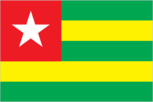
five equal horizontal bands of green (top and bottom) alternating with yellow; there is a white five-pointed star on a red square in the upper hoist-side corner; uses the popular pan-African colors of Ethiopia
Government type
republic under transition to multiparty democratic rule
Independence
27 April 1960 (from French-administered UN trusteeship)
International organization participation
ACCT, ACP, AfDB, CCC, ECA, ECOWAS, Entente, FAO, FZ, G-77, IBRD, ICAO, ICC, ICFTU, ICRM, IDA, IFAD, IFC, IFRCS, ILO, IMF, IMO, Intelsat, Interpol, IOC, ITU, MINURCA, MINURSO, MIPONUH, NAM, OAU, OIC, OPCW, UN, UNCTAD, UNESCO, UNIDO, UPU, WADB, WAEMU, WCL, WFTU, WHO, WIPO, WMO, WToO, WTrO Diplomatic representation in the US: chief of mission: Ambassador Akosita FINEANGANOFO chancery: 2208 Massachusetts Avenue NW, Washington, DC 20008 Diplomatic representation from the US: chief of mission: Ambassador Brenda Brown SCHOONOVER embassy: Rue Pelletier Caventou and Rue Vauban, Lome mailing address: B. P. 852, Lome
Judicial branch
Court of Appeal or Cour d'Appel; Supreme Court or Cour Supreme Political parties and leaders: Rally of the Togolese People or FOLLY]; Pan-African Sociodemocrats Group or GSP, an alliance of note: Rally of the Togolese People or RPT, led by President EYADEMA, was the only party until the formation of multiple parties was legalized 12 April 1991
Legal system
French-based court system
Legislative branch
unicameral National Assembly (81 seats; members are elected by popular vote to serve five-year terms) elections: last held 6 and 20 February 1994 (next to be held NA February 1999) election results: percent of vote by party--NA; seats by party--CAR 36, RPT 35, UTD 7, UJD 2, CFN 1 note: as a result of defections from the CAR to the RPT and the merging of the UJD with the RPT, representation in the National Assembly in August 1997 was RPT 42, CAR 32, UTD 5, CFN 1, independent 1
National holiday
Independence Day, 27 April (1960)
Suffrage
NA years of age; universal adult
Economy
Agriculture--products
coffee, cocoa, cotton, yams, cassava (tapioca), corn, beans, rice, millet, sorghum; livestock; fish
Budget
revenues: $232 million expenditures: $252 million, including capital expenditures of $NA (1997 est.)
Currency
1 Communaute Financiere Africaine franc (CFAF) = 100 centimes
Debt--external
$1.5 billion (1996)
Economic aid--recipient
$201.1 million (1995)
Economy--overview
This small sub-Saharan economy is heavily dependent on both commercial and subsistence agriculture, which provides employment for 65% of the labor force. Cocoa, coffee, and cotton together generate about 30% of export earnings. Togo is self-sufficient in basic foodstuffs when harvests are normal, with occasional regional supply difficulties. In the industrial sector, phosphate mining is by far the most important activity, although it has suffered from the collapse of world phosphate prices and increased foreign competition. Togo serves as a regional commercial and trade center. The government's decade-long effort, supported by the World Bank and the IMF, to implement economic reform measures, encourage foreign investment, and bring revenues in line with expenditures has stalled. Political unrest, including private and public sector strikes throughout 1992 and 1993, jeopardized the reform program, shrunk the tax base, and disrupted vital economic activity. The 12 January 1994 devaluation of the currency by 50% provided an important impetus to renewed structural adjustment; these efforts were facilitated by the end of strife in 1994 and a return to overt political calm. Progress depends on following through on privatization, increased transparency in government accounting to accommodate increased social service outlays, and possible downsizing of the military, on which the regime has depended to stay in place. However, in late 1998 the EU suspended aid and trade preferences for Togo because of grave doubts over the conduct of the presidential elections. The World Bank also suspended its disbursements at yearend 1998 because Togo was unable to pay its arrears.
Electricity--consumption
408 million kWh (1996)
Electricity--exports
0 kWh (1996)
Electricity--imports
320 million kWh (1996) note: imports electricity from Ghana
Electricity--production
88 million kWh (1996)
Electricity--production by source
fossil fuel: 93.18% hydro: 6.82% nuclear: 0% other: 0% (1996)
Exchange rates
Communaute Financiere Africaine francs (CFAF) per US$1--560.01 (December 1998), 589.95 (1998), 583.67 (1997), 511.55 (1996), 499.15 (1995), 555.20 (1994)
Exports
$345 million (f.o.b., 1997)
Exports--commodities
cotton, phosphates, coffee, cocoa
Exports--partners
Canada 7.6%, Taiwan 7.1%, Nigeria 6.8%, South Africa 5.2% (1996 est.)
Fiscal year
calendar year
GDP
purchasing power parity--$8.2 billion (1998 est.)
GDP--composition by sector
agriculture: 32% industry: 23% services: 45% (1995)
GDP--per capita
purchasing power parity?$1,670 (1998 est.)
GDP--real growth rate
3.8% (1998 est.)
Household income or consumption by percentage share
lowest 10%: NA% highest 10%: NA%
Imports
$400 million (f.o.b., 1997)
Imports--commodities
machinery and equipment, consumer goods, petroleum products
Imports--partners
Ghana 19.1%, France 10.8%, China 8.2%, Cameroon 6.8% (1996 est.)
Industrial production growth rate
13.6% (1995)
Industries
phosphate mining, agricultural processing, cement; handicrafts, textiles, beverages
Inflation rate (consumer prices)
7.2% (1997)
Labor force
1.538 million (1993 est.)
Labor force--by occupation
agriculture 65%, industry 5%, services 30% (1998 est.)
Population below poverty line
32.3% (1987-89 est.)
Unemployment rate
NA%
Communications
Radio broadcast stations
AM 2, FM 0, shortwave 0
Radios
795,000 (1992 est.)
Telephone system
fair system based on network of microwave radio relay routes supplemented by open-wire lines and cellular system domestic: microwave radio relay and open-wire lines for conventional system; cellular system has capacity of 10,000 telephones international: satellite earth stations--1 Intelsat (Atlantic Ocean) and 1 Symphonie
Telephones
47,000 (10,000 cellular telephone subscribers) (1998 est.)
Television broadcast stations
3 (in addition, there are two repeaters) (1997)
Televisions
24,000 (1992 est.)
Transportation
Airports
9 (1998 est.) Airports--with paved runways: total: 2 2,438 to 3,047 m: 2 (1998 est.) Airports--with unpaved runways: total: 7 914 to 1,523 m: 5 under 914 m: 2 (1998 est.)
Highways
total: 7,520 km paved: 2,376 km unpaved: 5,144 km (1996 est.)
Merchant marine
none
Railways
total: 525 km (1995) narrow gauge: 525 km 1.000-m gauge
Waterways
50 km Mono river Ports and harbors: Kpeme, Lome
Military and Security
Military branches
Army, Navy, Air Force, Gendarmerie
Military expenditures--dollar figure
$27 million (1996)
Military expenditures--percent of GDP
2% (1996)
Military manpower--availability
males age 15-49: 1,102,453 (1999 est.) Military manpower--fit for military service: males age 15-49: 578,109 (1999 est.)
Transnational Issues
Disputes--international
none
Illicit drugs
transit hub for Nigerian heroin and cocaine traffickers