1993 Edition
CIA World Factbook 1993 (Project Gutenberg)
Geography
Area
total area: 514,000 km2 land area: 511,770 km2 comparative area: slightly more than twice the size of Wyoming
Climate
tropical; rainy, warm, cloudy southwest monsoon (mid-May to September); dry, cool northeast monsoon (November to mid-March); southern isthmus always hot and humid
Coastline
3,219 km
Environment
air and water pollution; land subsidence in Bangkok area
International disputes
boundary dispute with Laos; unresolved maritime boundary with Vietnam
Irrigated land
42,300 km2 (1989 est.)
Land boundaries
total 4,863 km, Burma 1,800 km, Cambodia 803 km, Laos 1,754 km, Malaysia 506 km
Land use
arable land: 34% permanent crops: 4% meadows and pastures: 1% forest and woodland: 30% other: 31%
Location
Southeast Asia, bordering the Gulf of Thailand, between Burma and Cambodia
Map references
Asia, Southeast Asia, Standard Time Zones of the World
Maritime claims
exclusive economic zone: 200 nm territorial sea: 12 nm
Natural resources
tin, rubber, natural gas, tungsten, tantalum, timber, lead, fish, gypsum, lignite, fluorite
Note
controls only land route from Asia to Malaysia and Singapore
Terrain
central plain; eastern plateau (Khorat); mountains elsewhere
People and Society
Birth rate
19.97 births/1,000 population (1993 est.)
Death rate
6.33 deaths/1,000 population (1993 est.)
Ethnic divisions
Thai 75%, Chinese 14%, other 11%
Infant mortality rate
38.5 deaths/1,000 live births (1993 est.)
Labor force
30.87 million by occupation: agriculture 62%, industry 13%, commerce 11%, services (including government) 14% (1989 est.)
Languages
Thai, English the secondary language of the elite, ethnic and regional dialects
Life expectancy at birth
total population: 68.28 years male: 65.05 years female: 71.66 years (1993 est.)
Literacy
age 15 and over can read and write (1990) total population: 93% male: 96% female: 90%
Nationality
noun: Thai (singular and plural) adjective: Thai
Net migration rate
0 migrant(s)/1,000 population (1993 est.)
Population
58,722,437 (July 1993 est.)
Population growth rate
1.36% (1993 est.)
Religions
Buddhism 95%, Muslim 3.8%, Christianity 0.5%, Hinduism 0.1%, other 0.6% (1991)
Total fertility rate
2.16 children born/woman (1993 est.)
Government
Administrative divisions
73 provinces (changwat, singular and plural); Ang Thong, Buriram, Chachoengsao, Chai Nat, Chaiyaphum, Changwat Mukdahan, Chanthaburi, Chiang Mai, Chiang Rai, Chon Buri, Chumphon, Kalasin, Kamphaeng Phet, Kanchanaburi, Khon Kaen, Krabi, Krung Thep Mahanakhon, Lampang, Lamphun, Loei, Lop Buri, Mae Hong Son, Maha Sarakham, Nakhon Nayok, Nakhon Pathom, Nakhon Phanom, Nakhon Ratchasima, Nakhon Sawan, Nakhon Si Thammarat, Nan, Narathiwat, Nong Khai, Nonthaburi, Pathum Thani, Pattani, Phangnga, Phatthalung, Phayao, Phetchabun, Phetchaburi, Phichit, Phitsanulok, Phra Nakhon Si Ayutthaya, Phrae, Phuket, Prachin Buri, Prachuap Khiri Khan, Ranong, Ratchaburi, Rayong, Roi Et, Sakon Nakhon, Samut Prakan, Samut Sakhon, Samut Songkhram, Sara Buri, Satun, Sing Buri, Sisaket, Songkhla, Sukhothai, Suphan Buri, Surat Thani, Surin, Tak, Trang, Trat, Ubon Ratchathani, Udon Thani, Uthai Thani, Uttaradit, Yala, Yasothon
Capital
Bangkok
Chiang Mai consulates
Songkhla, Udorn
Chief of State
King PHUMIPHON Adunyadet (since 9 June 1946); Heir Apparent Crown Prince WACHIRALONGKON (born 28 July 1952)
Constitution
22 December 1978; new constitution approved 7 December 1991; amended 10 June 1992
Digraph
TH
Diplomatic representation in US
chief of mission: Ambassador-designate PHIRAPHONG Kasemsi chancery: 2300 Kalorama Road NW, Washington, DC 20008 telephone: (202) 483-7200 consulates general: Chicago, Los Angeles, and New York
Executive branch
monarch, prime minister, four deputy prime ministers, Council of Ministers (cabinet), Privy Council
FAX
[66] (2) 254-2990 consulate general:
Flag
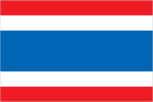
five horizontal bands of red (top), white, blue (double width), white, and red
Head of Government
Prime Minister CHUAN Likphai (since 23 September 1992)
House of Representatives
last held 13 September 1992 (next to be held by NA); results - percent of vote by party NA; seats - (360 total) DP 79, TNP 77, NDP 60, NAP 51, Phalang Tham 47, SAP 22, LDP 8, SP 8, Mass Party 4, Thai Citizen's Party 3, People's Party 1, People's Force Party 0
Independence
1238 (traditional founding date; never colonized)
Judicial branch
Supreme Court (Sarndika)
Legal system
based on civil law system, with influences of common law; has not accepted compulsory ICJ jurisdiction; martial law in effect since 23 February 1991 military coup
Legislative branch
bicameral National Assembly (Rathasatha) consists of an upper house or Senate (Vuthisatha) and a lower house or House of Representatives (Saphaphoothan-Rajsadhorn)
Member of
APEC, AsDB, ASEAN, CCC, CP, ESCAP, FAO, G-77, GATT, IAEA, IBRD, ICAO, ICFTU, IDA, IFAD, IFC, ILO, IMF, IMO, INTELSAT, INTERPOL, IOC, IOM, ISO, ITU, LORCS, PCA, UN, UNCTAD, UNESCO, UNHCR, UNIDO, UNIKOM, UNTAC, UPU, WCL, WHO, WIPO, WMO
Names
conventional long form: Kingdom of Thailand conventional short form: Thailand
National holiday
Birthday of His Majesty the King, 5 December (1927)
Political parties and leaders
Democrat Party (DP), Chuan LIKPHAI; Thai Nation Pary (TNP or Chat Thai Party), Praman ADIREKSAN; National Development Party (NDP or Chat Phattana), Chatchai CHUNHAWAN; New Aspiration Party, Gen. Chawalit YONGCHAIYUT; Phalang Tham (Palang Dharma), Bunchu ROTCHANASATIEN; Social Action Party (SAP), Montri PHONGPHANIT; Liberal Democratic Party (LDP or Seri Tham), Athit URAIRAT; Solidarity Party (SP), Uthai PHIMCHAICHON; Mass Party (Muanchon), Pol. Cpt. Choem YUBAMRUNG; Thai Citizen's Party (Prachakon Thai), Samak SUNTHONWET; People's Party (Ratsadon), Chaiphak SIRIWAT; People's Force Party (Phalang Prachachon), Col. Sophon HANCHAREON
Suffrage
21 years of age; universal
Type
constitutional monarchy
US diplomatic representation
chief of mission: Ambassador David F. LAMBERTSON embassy: 95 Wireless Road, Bangkok mailing address: APO AP 96546 telephone: [66] (2) 252-5040
Economy
Agriculture
accounts for 12% of GDP and 60% of labor force; leading producer and exporter of rice and cassava (tapioca); other crops - rubber, corn, sugarcane, coconuts, soybeans; except for wheat, self-sufficient in food
Budget
revenues $21.36 billion; expenditures $22.40 billion, including capital expenditures of $6.24 billion (FY93 est.)
Currency
1 baht (B) = 100 satang
Economic aid
US commitments, including Ex-Im (FY70-89), $870 million; Western (non-US) countries, ODA and OOF bilateral commitments (1970-89), $8.6 billion; OPEC bilateral aid (1979-89), $19 million
Electricity
10,000,000 kW capacity; 43,750 million kWh produced, 760 kWh per capita (1992)
Exchange rates
baht (B) per US$1 - 25.280 (April 1993), 25.400 (1992), 25.517 (1991), 25.585 (1990), 25.702 (1989), 25.294 (1988)
Exports
$32.9 billion (f.o.b., 1992) commodities: machinery and manufactures 76.9%, agricultural products 14.9%, fisheries products 5.9% (1992) partners: US 21.6%, Japan 18.0%, Singapore 8.7%, Hong Kong 4.8%, Germany 4.4%, Netherlands 4.2%, UK 3.4%, Malaysia, France, China (1992 est.)
External debt
$33.4 billion (1991)
Fiscal year
1 October-30 September
Illicit drugs
a minor producer, major illicit trafficker of heroin, particularly from Burma and Laos, and cannabis for the international drug market; eradication efforts have reduced the area of cannabis cultivation and shifted some production to neighboring countries; opium poppy cultivation has been affected by eradication efforts; also a major drug money laundering center
Imports
$41.5 billion (c.i.f., 1992) commodities: capital goods 41.4%, intermediate goods and raw materials 32.8%, consumer goods 10.4%, oil 8.2% partners: Japan 29.3%, US 11.4%, Singapore 7.6%, Taiwan 5.5%, Germany 5.4%, South Korea 4.6%, Malaysia 4.2%, China 3.3%, Hong Kong 3.3%, UK (1992 est.)
Industrial production
growth rate 18% (1990); accounts for about 26% of GDP
Industries
tourism is the largest source of foreign exchange; textiles and garments, agricultural processing, beverages, tobacco, cement, light manufacturing, such as jewelry; electric appliances and components, integrated circuits, furniture, plastics; world's second-largest tungsten producer and third-largest tin producer
Inflation rate (consumer prices)
4.5% (1992 est.)
National product
GDP - exchange rate conversion - $103 billion (1992 est.)
National product per capita
$1,800 (1992 est.)
National product real growth rate
7% (1992 est.)
Overview
Thailand's economy recovered rapidly from the political unrest in May 1992 to post an impressive 7% growth rate for the year. Thailand, one of the more advanced developing countries in Asia, depends on exports of manufactures and the development of the service sector to fuel the country's rapid growth. The trade and current account deficits fell in 1992; much of Thailand's recent imports have been for capital equipment suggesting that the export sector is poised for further growth. With foreign investment slowing, Bangkok is working to increase the generation of capital domestically. Prime Minister CHUAN's government - Thailand's fifth government in less than two years - is pledged to continue Bangkok's probusiness policies, and the return of a democratically elected government has improved business confidence. Nevertheless, CHUAN must overcome divisions within his ruling coalition to complete much needed infrastructure development programs if Thailand is to remain an attractive place for business investment. Over the longer-term, Bangkok must produce more college graduates with technical training and upgrade workers' skills to continue its rapid economic development.
Unemployment rate
4.7% (1992 est.)
Communications
Airports
total: 106 usable: 95 with permanent-surface runways: 51 with runways over 3,659 m: 1 with runways 2,440-3,659 m: 14 with runways 1,220-2,439 m: 28
Highways
77,697 km total; 35,855 km paved (including 88 km expressways), 14,092 km gravel or other stabilization, 27,750 km mostly dirt and other (1988)
Inland waterways
3,999 km principal waterways; 3,701 km with navigable depths of 0.9 m or more throughout the year; numerous minor waterways navigable by shallow-draft native craft
Merchant marine
169 ships (1,000 GRT or over) totaling 752,055 GRT/1,166,136 DWT; includes 1 short-sea passenger, 91 cargo, 12 container, 40 oil tanker, 9 liquefied gas, 2 chemical tanker, 5 bulk, 6 refrigerated cargo, 2 combination bulk, 1 passenger
Pipelines
natural gas 350 km, petroleum products 67 km
Ports
Bangkok, Pattani, Phuket, Sattahip, Si Racha
Railroads
3,940 km 1.000-meter gauge, 99 km double track
Telecommunications
service to general public inadequate; bulk of service to government activities provided by multichannel cable and microwave radio relay network; 739,500 telephones (1987); broadcast stations - over 200 AM, 100 FM, and 11 TV in government-controlled networks; satellite earth stations - 1 Indian Ocean INTELSAT and 1 Pacific Ocean INTELSAT; domestic satellite system being developed
Military and Security
Branches
Royal Thai Army, Royal Thai Navy (including Royal Thai Marine Corps), Royal Thai Air Force, Paramilitary Forces
Defense expenditures
exchange rate conversion - $2.6 billion, about 2% of GNP (FY92/93 est.)
Manpower availability
males age 15-49 16,685,044; fit for military service 10,148,786; reach military age (18) annually 616,042 (1993 est.)