2005 Edition
CIA World Factbook 2005 (Project Gutenberg)
Introduction
Administrative divisions
14 provinces (muhafazat, singular - muhafazah); Al Hasakah, Al Ladhiqiyah, Al Qunaytirah, Ar Raqqah, As Suwayda', Dar'a, Dayr az Zawr, Dimashq, Halab, Hamah, Hims, Idlib, Rif Dimashq, Tartus
Age structure
0-14 years: 37.4% (male 3,556,795/female 3,350,267) 15-64 years: 59.3% (male 5,601,971/female 5,333,799) 65 years and over: 3.3% (male 288,868/female 317,052) (2005 est.)
Agriculture - products
wheat, barley, cotton, lentils, chickpeas, olives, sugar beets; beef, mutton, eggs, poultry, milk
Airports
92 (2004 est.)
Airports - with paved runways
- total
- 26 over 3,047 m: 5 2,438 to 3,047 m: 16 914 to 1,523 m: 3 under 914 m: 2 (2004 est.)
Airports - with unpaved runways
- total
- 66 1,524 to 2,437 m: 2 914 to 1,523 m: 10 under 914 m: 54 (2004 est.)
Area
- land
- 184,050 sq km
- total
- 185,180 sq km
- water
- 1,130 sq km note: includes 1,295 sq km of Israeli-occupied territory
Area - comparative
slightly larger than North Dakota
Background
Following the breakup of the Ottoman Empire during World War I, Syria was administered by the French until independence in 1946. In the 1967 Arab-Israeli War, Syria lost the Golan Heights to Israel. Syrian troops - stationed in Lebanon since 1976 in an ostensible peacekeeping role - were withdrawn in April of 2005. Over the past decade, Syria and Israel have held occasional peace talks over the return of the Golan Heights. Geography Syria
Birth rate
28.29 births/1,000 population (2005 est.)
Budget
- expenditures
- $9.45 billion, including capital expenditures of $4.67 billion (2004 est.)
- revenues
- $6.58 billion
Capital
Damascus
Climate
mostly desert; hot, dry, sunny summers (June to August) and mild, rainy winters (December to February) along coast; cold weather with snow or sleet periodically in Damascus
Coastline
193 km
Constitution
13 March 1973
Country name
- conventional long form
- Syrian Arab Republic
- conventional short form
- Syria
- former
- United Arab Republic (with Egypt)
- local long form
- Al Jumhuriyah al Arabiyah as Suriyah
- local short form
- Suriyah
Currency (code)
Syrian pound (SYP)
Currency code
SYP
Current account balance
$1.1 billion (2003)
Death rate
4.88 deaths/1,000 population (2005 est.)
Debt - external
$4 billion (excludes military debt and debt to Russia) (2004 est.)
Diplomatic representation from the US
- chief of mission
- Ambassador Margaret SCOBEY
- embassy
- Abou Roumaneh, Al-Mansur Street, No. 2, Damascus
- FAX
- [963] (11) 331-9678
- mailing address
- P. O. Box 29, Damascus
- telephone
- [963] (11) 333-1342
Diplomatic representation in the US
- chancery
- 2215 Wyoming Avenue NW, Washington, DC 20008
- chief of mission
- Ambassador Imad MUSTAFA
- FAX
- [1] (202) 234-9548
- telephone
- [1] (202) 232-6313
Disputes - international
Golan Heights is Israeli-occupied with the almost 1,000-strong UN Disengagement Observer Force (UNDOF) patrolling a buffer zone since 1964; Lebanon claims Shaba'a farms in Golan Heights; international pressure prompts the removal of Syrian troops and intelligence personel stationed in Lebanon since October 1976; Syria protests Turkish hydrological projects regulating upper Euphrates waters; 2004 Agreement and pending demarcation settles border dispute with Jordan
Economic aid - recipient
$180 million (2002 est.)
Economy - overview
Real GDP growth rose to 2.3 percent in 2004, a slight increase from 2003 when the predominantly statist economy suffered from disruptions caused by the war in Iraq and other developments in the region. Annual real GDP growth has averaged 2.3 percent for the last seven years. The Government of Syria has implemented modest economic reforms in the last few years, including cutting interest rates, opening private banks, consolidating some of the multiple exchange rates, and raising prices on some subsidized foodstuffs. Nevertheless, the economy remains highly controlled by the government. Long run economic constraints include declining oil production and exports and pressure on water supplies caused by rapid population growth, industrial expansion, and increased water pollution.
Electricity - consumption
24.32 billion kWh (2002)
Electricity - exports
0 kWh (2002)
Electricity - imports
0 kWh (2002)
Electricity - production
26.15 billion kWh (2002)
Electricity - production by source
- fossil fuel
- 57.6%
- hydro
- 42.4%
- nuclear
- 0%
- other
- 0% (2001)
Elevation extremes
- highest point
- Mount Hermon 2,814 m
- lowest point
- unnamed location near Lake Tiberias -200 m
Environment - current issues
deforestation; overgrazing; soil erosion; desertification; water pollution from raw sewage and petroleum refining wastes; inadequate potable water
Environment - international agreements
- party to
- Biodiversity, Climate Change, Desertification, Endangered Species, Hazardous Wastes, Ozone Layer Protection, Ship Pollution, Wetlands signed, but not ratified: Environmental Modification
Ethnic groups
Arab 90.3%, Kurds, Armenians, and other 9.7%
Exchange rates
- Syrian pounds per US dollar - (official rate)
- 11.225 (2004), 11.225 (2003), 11.225 (2002), 11.225 (2001), 11.225 (2000), (parallel market rate in Amman and Beirut) NA (2004), 52.8 (2003), 52.4 (2002), 50.4 (2002), 49.4 (2000)
Executive branch
- cabinet
- Council of Ministers appointed by the president
- chief of state
- President Bashar al-ASAD (since 17 July 2000); Vice Presidents Abd al-Halim ibn Said KHADDAM (since 11 March 1984) and Muhammad Zuhayr MASHARIQA (since 11 March 1984)
- election results
- Bashar al-ASAD elected president; percent of vote - Bashar al-ASAD 97.29% note: Hafiz al-ASAD died on 10 June 2000; on 20 June 2000, the Ba'th Party nominated Bashar al-ASAD for president and presented his name to the People's Council on 25 June 2000
- elections
- president elected by popular vote for a seven-year term; referendum/election last held 10 July 2000 - after the death of President Hafiz al-ASAD, father of Bashar al-ASAD - (next to be held 2007); vice presidents appointed by the president; prime minister and deputy prime ministers appointed by the president
- head of government
- Prime Minister Muhammad Naji al-UTRI (since 10 September 2003)
Exports
$6.086 billion f.o.b. (2004 est.)
Exports - commodities
crude oil, petroleum products, fruits and vegetables, cotton fiber, clothing, meat and live animals, wheat
Exports - partners
Italy 22.7%, France 18%, Turkey 12.9%, Iraq 9%, Saudi Arabia 6.2% (2004)
Fiscal year
calendar year Communications Syria
Flag description
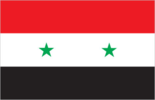
three equal horizontal bands of red (top), white, and black, colors associated with the Arab Liberation flag; two small green five-pointed stars in a horizontal line centered in the white band; former flag of the United Arab Republic where the two stars represented the constituent states of Syria and Egypt; similar to the flag of Yemen, which has a plain white band, Iraq, which has three green stars (plus an Arabic inscription) in a horizontal line centered in the white band, and that of Egypt, which has a gold Eagle of Saladin centered in the white band; the current design dates to 1980 Economy Syria
GDP - composition by sector
- agriculture
- 25%
- industry
- 31%
- services
- 44% (2003 est.)
GDP - per capita
purchasing power parity - $3,400 (2004 est.)
GDP - real growth rate
2.3% (2004 est.)
GDP (purchasing power parity)
$60.44 billion (2004 est.)
Geographic coordinates
35 00 N, 38 00 E
Geography - note
there are 42 Israeli settlements and civilian land use sites in the Israeli-occupied Golan Heights (February 2002 est.) People Syria
Government type
republic under military regime since March 1963
Heliports
7 (2004 est.) Military Syria
Highways
- paved
- 6,489 km (including 1,001 km of expressways)
- total
- 45,697 km
- unpaved
- 39,208 km (2002)
HIV/AIDS - adult prevalence rate
less than 0.1% (2001 est.)
HIV/AIDS - deaths
less than 200 (2003 est.)
HIV/AIDS - people living with HIV/AIDS
less than 500 (2003 est.)
Household income or consumption by percentage share
lowest 10%: NA highest 10%: NA
Illicit drugs
a transit point for opiates and hashish bound for regional and Western markets; weak anti-money-laundering controls, bank privatization may leave it vulnerable to money-laundering This page was last updated on 20 October, 2005 ======================================================================
Imports
$5.042 billion f.o.b. (2004 est.)
Imports - commodities
machinery and transport equipment, electric power machinery, food and livestock, metal and metal products, chemicals and chemical products, plastics, yarn, paper
Imports - partners
Turkey 9.4%, Ukraine 8.7%, China 7.8%, Russia 5.4%, Saudi Arabia 5.2%, US 4.7%, South Korea 4.6%, Italy 4.3% (2004)
Independence
17 April 1946 (from League of Nations mandate under French administration)
Industrial production growth rate
7% (2002 est.)
Industries
petroleum, textiles, food processing, beverages, tobacco, phosphate rock mining
Infant mortality rate
- female
- 29.28 deaths/1,000 live births (2005 est.)
- male
- 29.76 deaths/1,000 live births
- total
- 29.53 deaths/1,000 live births
Inflation rate (consumer prices)
2.1% (2004 est.)
International organization participation
ABEDA, AFESD, AMF, CAEU, FAO, G-24, G-77, IAEA, IBRD, ICAO, ICC, ICCt (signatory), ICRM, IDA, IDB, IFAD, IFC, IFRCS, IHO, ILO, IMF, IMO, Interpol, IOC, ISO, ITU, LAS, MIGA, NAM, OAPEC, OIC, UN, UNCTAD, UNESCO, UNIDO, UNRWA, UPU, WCO, WFTU, WHO, WIPO, WMO, WToO
Internet country code
.sy
Internet hosts
11 (2004)
Internet Service Providers (ISPs)
1 (2000)
Internet users
220,000 (2002) Transportation Syria
Investment (gross fixed)
16.3% of GDP (2004 est.)
Irrigated land
12,130 sq km (1998 est.)
Judicial branch
Supreme Constitutional Court (justices are appointed for four-year terms by the president); High Judicial Council; Court of Cassation; State Security Courts
Labor force
5.12 million (2004 est.)
Labor force - by occupation
agriculture 30%, industry 27%, services 43% (2002 est.)
Land boundaries
- border countries
- Iraq 605 km, Israel 76 km, Jordan 375 km, Lebanon 375 km, Turkey 822 km
- total
- 2,253 km
Land use
- arable land
- 25.22%
- other
- 70.35% (2001)
- permanent crops
- 4.43%
Languages
Arabic (official); Kurdish, Armenian, Aramaic, Circassian widely understood; French, English somewhat understood
Legal system
based on Islamic law and civil law system; special religious courts; has not accepted compulsory ICJ jurisdiction
Legislative branch
- unicameral People's Council or Majlis al-Shaab (250 seats; members elected by popular vote to serve four-year terms)
- election results
- percent of vote by party - NPF 67%, independents 33%; seats by party - NPF 167, independents 83; note - the constitution guarantees that the Ba'th Party (part of the NPF alliance) receives one-half of the seats
- elections
- last held 2-3 March 2003 (next to be held NA 2007)
Life expectancy at birth
- female
- 71.38 years (2005 est.)
- male
- 68.75 years
- total population
- 70.03 years
Literacy
- definition: age 15 and over can read and write
- female
- 64% (2003 est.) Government Syria
- male
- 89.7%
- total population
- 76.9%
Location
Middle East, bordering the Mediterranean Sea, between Lebanon and Turkey
Manpower available for military service
males age 18-49: 4,356,413 (2005 est.)
Manpower fit for military service
males age 18-49: 3,453,888 (2005 est.)
Manpower reaching military service age annually
- males
- 225,113 (2005 est.)
Map references
Middle East
Maritime claims
- contiguous zone
- 41 nm
- territorial sea
- 12 nm
Median age
- female
- 20.51 years (2005 est.)
- male
- 20.24 years
- total
- 20.37 years
Merchant marine
- by type
- bulk carrier 8, cargo 105, container 1, livestock carrier 4, petroleum tanker 1, roll on/roll off 1
- foreign-owned
- 12 (Egypt 1, Greece 1, Jordan 2, Lebanon 7, Romania 1)
- registered in other countries
- 73 (2005)
- total
- 120 ships (1,000 GRT or over) 446,981 GRT/636,620 DWT
Military branches
Syrian Arab Army, Syrian Arab Navy, Syrian Arab Air Force (includes Air Defense Command), Police and Security Force
Military expenditures - dollar figure
$858 million (FY00 est.); note - based on official budget data that may understate actual spending
Military expenditures - percent of GDP
5.9% (FY00) Transnational Issues Syria
Military service age and obligation
18 years of age for compulsory military service; conscript service obligation - 30 months (2004)
National holiday
Independence Day, 17 April (1946)
Nationality
- adjective
- Syrian
- noun
- Syrian(s)
Natural gas - consumption
5.84 billion cu m (2001 est.)
Natural gas - exports
0 cu m (2001 est.)
Natural gas - imports
0 cu m (2001 est.)
Natural gas - production
5.84 billion cu m (2001 est.)
Natural gas - proved reserves
240.7 billion cu m (2004)
Natural hazards
dust storms, sandstorms
Natural resources
petroleum, phosphates, chrome and manganese ores, asphalt, iron ore, rock salt, marble, gypsum, hydropower
Net migration rate
0 migrant(s)/1,000 population (2005 est.)
Oil - consumption
240,000 bbl/day (2004 est.)
Oil - exports
285,000 bbl/day (2004)
Oil - imports
NA
Oil - production
525,000 bbl/day (2004 est.)
Oil - proved reserves
2.5 billion bbl (2004 est.)
Pipelines
gas 2,300 km; oil 2,183 km (2004)
Political parties and leaders
Arab Socialist Unionist Movement [Ahmed al-AHMED]; National Progressive Front or NPF (includes Arab Socialist Renaissance (Ba'th) Party; the governing party) [President Bashar al-ASAD, secretary general]; Socialist Unionist Democratic Party [Fadlallal Nasr Al-DIN]; Syrian Arab Socialist Party or ASP [Safwan QUDSI]; Syrian Communist Party (two branches) [Wissal Farha BAKDASH, Yuusuf Rashid FAYSAL]; Syrian Social National Party [Jubran URAYJI]; Unionist Socialist Party [Fayez ISMAIL]
Political pressure groups and leaders
conservative religious leaders; Kurdish Democratic Alliance [leader NA]; Kurdish Democratic Front [leader NA]; Muslim Brotherhood (operates in exile in London) [Ali Badr Eddine al-BAYANOUNI]; National Democratic Front [Hassan Abd al-AZIM]
Population
18,448,752 note: in addition, about 40,000 people live in the Israeli-occupied Golan Heights - 20,000 Arabs (18,000 Druze and 2,000 Alawites) and about 20,000 Israeli settlers (July 2005 est.)
Population below poverty line
20% (2004 est.)
Population growth rate
2.34% (2005 est.)
Ports and harbors
Baniyas, Latakia
Public debt
32% of GDP (2004 est.)
Radio broadcast stations
AM 14, FM 2, shortwave 1 (1998)
Radios
4.15 million (1997)
Railways
- narrow gauge
- 251 km 1.050-m gauge (2004)
- standard gauge
- 2,460 km 1.435-m gauge
- total
- 2,711 km
Refugees and internally displaced persons
- IDPs
- 170,000 (most displaced from Golan Heights during 1967 Arab-Israeli War) (2004)
- refugees (country of origin)
- 413,827 (Palestinian Refugees (UNRWA))
Religions
Sunni Muslim 74%, Alawite, Druze, and other Muslim sects 16%, Christian (various sects) 10%, Jewish (tiny communities in Damascus, Al Qamishli, and Aleppo)
Reserves of foreign exchange and gold
$5 billion (2004 est.)
Sex ratio
- at birth
- 1.06 male(s)/female under 15 years: 1.06 male(s)/female 15-64 years: 1.05 male(s)/female 65 years and over: 0.91 male(s)/female
- total population
- 1.05 male(s)/female (2005 est.)
Suffrage
18 years of age; universal
Telephone system
- domestic
- coaxial cable and microwave radio relay network
- general assessment
- fair system currently undergoing significant improvement and digital upgrades, including fiber-optic technology
- international
- country code - 963; satellite earth stations - 1 Intelsat (Indian Ocean) and 1 Intersputnik (Atlantic Ocean region); 1 submarine cable; coaxial cable and microwave radio relay to Iraq, Jordan, Lebanon, and Turkey; participant in Medarabtel
Telephones - main lines in use
2,099,300 (2002)
Telephones - mobile cellular
400,000 (2002)
Television broadcast stations
44 (plus 17 repeaters) (1995)
Televisions
1.05 million (1997)
Terrain
primarily semiarid and desert plateau; narrow coastal plain; mountains in west
Total fertility rate
3.5 children born/woman (2005 est.)
Unemployment rate
20% (2002 est.)
Waterways
900 km (not economically significant) (2002)