1994 Edition
CIA World Factbook 1994 (Project Gutenberg)
Introduction
Administrative divisions
24 provinces (lan, singular and plural); Alvsborgs Lan, Blekinge Lan, Gavleborgs Lan, Goteborgs och Bohus Lan, Gotlands Lan, Hallands Lan, Jamtlands Lan, Jonkopings Lan, Kalmar Lan, Kopparbergs Lan, Kristianstads Lan, Kronobergs Lan, Malmohus Lan, Norrbottens Lan, Orebro Lan, Ostergotlands Lan, Skaraborgs Lan, Sodermanlands Lan, Stockholms Lan, Uppsala Lan, Varmlands Lan, Vasterbottens Lan, Vasternorrlands Lan, Vastmanlands Lan
Agriculture
animal husbandry predominates, with milk and dairy products accounting for 37% of farm income; main crops - grains, sugar beets, potatoes; 100% self-sufficient in grains and potatoes; Sweden is about 50% self-sufficient in most products; farming accounted for 1.2% of GDP and 1.9% of jobs in 1990
Airports
total: 252 usable: 248 with permanent-surface runways: 138 with runways over 3,659 m: with runways 2,440-3,659 m: 11 with runways 1,220-2,439 m: 94
Area
total area: 449,964 sq km land area: 410,928 sq km comparative area: slightly smaller than California
Birth rate
13.5 births/1,000 population (1994 est.)
Branches
Swedish Army, Royal Swedish Navy, Swedish Air Force
Budget
revenues: $45.1 billion expenditures: $73.1 billion, including capital expenditures of $NA (FY94)
Capital
Stockholm
Climate
temperate in south with cold, cloudy winters and cool, partly cloudy summers; subarctic in north
Coastline
3,218 km
Constitution
1 January 1975
Currency
1 Swedish krona (SKr) = 100 oere
Death rate
10.9 deaths/1,000 population (1994 est.)
Defense expenditures
exchange rate conversion - $5.2 billion, 2.6% of GDP (FY93/94)
Digraph
SW
Diplomatic representation in US
chief of mission: Ambassador Carl Henrik LILJEGREN chancery: Suites 1200 and 715, 600 New Hampshire Avenue NW, Washington, DC 20037 telephone: (202) 944-5600
Economic aid
donor: ODA and OOF commitments (1970-89), $10.3 billion
Electricity
capacity: 39,716,000 kW production: 142.5 billion kWh consumption per capita: 16,560 kWh (1992)
Environment
current issues: acid rain damaging soils and lakes; pollution of the North Sea and the Baltic Sea natural hazards: ice floes in the surrounding waters, especially in the Gulf of Bothnia, can interfere with navigation international agreements: party to - Air Pollution, Air Pollution-Nitrogen Oxides, Air Pollution-Sulphur, Air Pollution-Volatile Organic Compounds, Antarctic-Environmental Protocol, Antarctic Treaty, Biodiversity, Climate Change, Endangered Species, Environmental Modification, Hazardous Wastes, Marine Dumping, Nuclear Test Ban, Ozone Layer Protection, Ship Pollution, Tropical Timber, Wetlands, Whaling; signed, but not ratified - Law of the Sea
Ethnic divisions
white, Lapp (Sami), foreign born or first-generation immigrants 12% (Finns, Yugoslavs, Danes, Norwegians, Greeks, Turks)
Exchange rates
Swedish kronor (SKr) per US$1 - 8.1255 (January 1994), 7.834 (1993), 5.8238 (1992), 6.0475 (1991) 5.9188 (1990), 6.4469 (1989)
Executive branch
chief of state: King CARL XVI GUSTAF (since 19 September 1973); Heir Apparent Princess VICTORIA Ingrid Alice Desiree, daughter of the King (born 14 July 1977) head of government: Prime Minister Carl BILDT (since 3 October 1991); Deputy Prime Minister Bengt WESTERBERG (since NA) cabinet: Cabinet; appointed by the prime minister
Exports
$49.7 billion (f.o.b., 1993 est.) commodities: machinery, motor vehicles, paper products, pulp and wood, iron and steel products, chemicals, petroleum and petroleum products partners: EC 55.8% (Germany 15%, UK 9.7%, Denmark 7.2%, France 5.8%), EFTA 17.4% (Norway 8.4%, Finland 5.1%), US 8.2%, Central and Eastern Europe 2.5% (1992)
External debt
$19.5 billion (1992 est.)
FAX
- (202) 342-1319 consulate(s) general: Los Angeles and New York
- [46] (8) 661-1964
Fiscal year
1 July - 30 June
Flag
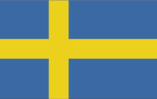
blue with a yellow cross that extends to the edges of the flag; the vertical part of the cross is shifted to the hoist side in the style of the Dannebrog (Danish flag)
Highways
total: 205,000 km paved: 69,754 km (including 936 km of expressways) unpaved: gravel 45,900 km; unimproved earth 38,060 km; NA 51,286 km (1990)
Illicit drugs
transshipment point for narcotics shipped via the CIS and Baltic states for the European market
Imports
$42.3 billion (c.i.f., 1993 est.) commodities: machinery, petroleum and petroleum products, chemicals, motor vehicles, foodstuffs, iron and steel, clothing partners: EC 53.6% (Germany 17.9%, UK 6.3%, Denmark 7.5%, France 4.9%), EFTA (Norway 6.6%, Finland 6%), US 8.4%, Central and Eastern Europe 3% (1992)
Independence
6 June 1809 (constitutional monarchy established)
Industrial production
growth rate 0.8% (1993 est.)
Industries
iron and steel, precision equipment (bearings, radio and telephone parts, armaments), wood pulp and paper products, processed foods, motor vehicles
Infant mortality rate
5.7 deaths/1,000 live births (1994 est.)
Inflation rate (consumer prices)
4.4% (1993 est.)
Inland waterways
2,052 km navigable for small steamers and barges
International disputes
none
Irrigated land
1,120 sq km (1989 est.)
Judicial branch
Supreme Court (Hogsta Domstolen)
Labor force
4.552 million (84% unionized,1992) by occupation: community, social and personal services 38.3%, mining and manufacturing 21.2%, commerce, hotels, and restaurants 14.1%, banking, insurance 9.0%, communications 7.2%, construction 7.0%, agriculture, fishing, and forestry 3.2% (1991)
Land boundaries
total 2,205 km, Finland 586 km, Norway 1,619 km
Land use
arable land: 7% permanent crops: 0% meadows and pastures: 2% forest and woodland: 64% other: 27%
Languages
Swedish note: small Lapp- and Finnish-speaking minorities; immigrants speak native languages
Legal system
civil law system influenced by customary law; accepts compulsory ICJ jurisdiction, with reservations
Legislative branch
unicameral parliament (Riksdag): elections last held 15 September 1991 (next to be held NA September 1994); results - Social Democratic Party 37.6%, Moderate Party (conservative) 21.9%, Liberal People's Party 9.1%, Center Party 8.5%, Christian Democrats 7.1%, New Democracy 6.7%, Left Party (Communist) 4.5%, Green Party 3.4%, other 1.2%; seats - (349 total) Social Democratic 138, Moderate Party (conservative) 80, Liberal People's Party 33, Center Party 31, Christian Democrats 26, New Democracy 25, Left Party (Communist) 16; note - the Green Party has no seats in the Riksdag because it received less than the required 4% of the vote
Life expectancy at birth
total population: 78.25 years male: 75.47 years female: 81.2 years (1994 est.)
Literacy
age 15 and over can read and write (1979 est.) total population: 99% male: NA% female: NA%
Location
Nordic State, Northern Europe, bordering the Baltic Sea, between Norway and Finland
Manpower availability
males age 15-49 2,146,145; fit for military service 1,874,787; reach military age (19) annually 55,262 (1994 est.)
Map references
Arctic Region, Asia, Europe, Standard Time Zones of the World
Maritime claims
continental shelf: 200-m depth or to depth of exploitation exclusive fishing zone: 200 nm territorial sea: 12 nm
Member of
AfDB, AG (observer), AsDB, Australian Group, BIS, CBSS, CCC, CE, CERN, COCOM (cooperating), CSCE, EBRD, ECE, EFTA, ESA, FAO, G-6, G-8, G-9, G-10, GATT, IADB, IAEA, IBRD, ICAO, ICC, ICFTU, IDA, IEA, IFAD, IFC, ILO, IMF, IMO, INMARSAT, INTERPOL, INTELSAT, IOC, IOM, ISO, ITU, LORCS, MTRC, NAM (guest), NC, NEA, NIB, NSG, OECD, ONUSAL, PCA, UN, UNAVEM II, UNCTAD, UNESCO, UNFICYP, UNHCR, UNIDO, UNIFIL, UNIKOM, UNMOGIP, UNOMIG, UNOMOZ, UNOSOM, UNPROFOR, UNTAC, UNTSO, UPU, WFTU, WHO, WIPO, WMO, ZC
Merchant marine
161 ships (1,000 GRT or over) totaling 2,049,554 GRT/2,516,350 DWT, bulk 10, cargo 24, chemical tanker 25, combination ore/oil 1, container 2, oil tanker 30, railcar carrier 2, refrigerated cargo 1, roll-on/roll-off cargo 39, short-sea passenger 10, specialized tanker 4, vehicle carrier 13
Names
conventional long form: Kingdom of Sweden conventional short form: Sweden local long form: Konungariket Sverige local short form: Sverige
National holiday
Day of the Swedish Flag, 6 June
National product
GDP - purchasing power equivalent - $153.7 billion (1993)
National product per capita
$17,600 (1993)
National product real growth rate
-2.7% (1993)
Nationality
noun: Swede(s) adjective: Swedish
Natural resources
zinc, iron ore, lead, copper, silver, timber, uranium, hydropower potential
Net migration rate
2.62 migrant(s)/1,000 population (1994 est.)
Note
strategic location along Danish Straits linking Baltic and North Seas
Overview
Aided by a long period of peace and neutrality during World War I through World War II, Sweden has achieved an enviable standard of living under a mixed system of high-tech capitalism and extensive welfare benefits. It has a modern distribution system, excellent internal and external communications, and a skilled labor force. Timber, hydropower, and iron ore constitute the resource base of an economy that is heavily oriented toward foreign trade. Privately owned firms account for about 90% of industrial output, of which the engineering sector accounts for 50% of output and exports. In the last few years, however, this extraordinarily favorable picture has been clouded by inflation, growing unemployment, and a gradual loss of competitiveness in international markets. Although Prime Minister BILDT's center-right minority coalition had hoped to charge ahead with free-market-oriented reforms, a skyrocketing budget deficit - almost 14% of GDP in FY94 projections - and record unemployment have forestalled many of the plans. Unemployment in 1993 is estimated at around 8% with another 5% in job training. Continued heavy foreign exchange speculation forced the government to cooperate in late 1992 with the opposition Social Democrats on two crisis packages - one a severe austerity pact and the other a program to spur industrial competitiveness - which basically set economic policy through 1997. In November 1992, Sweden broke its tie to the EC's ECU, and the krona has since depreciated about 25% against the dollar. The government hopes the boost in export competitiveness from the depreciation will help lift Sweden out of its 3-year recession. To curb the budget deficit and bolster confidence in the economy, BILDT continues to propose cuts in welfare benefits, subsidies, defense, and foreign aid. Sweden continues to harmonize its economic policies with those of the EU in preparation for scheduled membership by early 1995, which will help to broaden European economic unity.
Pipelines
natural gas 84 km
Political parties and leaders
ruling four-party coalition consists of Moderate Party (conservative), Carl BILDT; Liberal People's Party, Bengt WESTERBERG; Center Party, Olof JOHANSSON; and the Christian Democratic Party, Alf SVENSSON; Social Democratic Party, Ingvar CARLSSON; New Democracy Party, Harriet COLLIANDER; Left Party (VP; Communist), Gudrun SCHYMAN; Communist Workers' Party, Rolf HAGEL; Green Party, no formal leader
Population
8,778,461 (July 1994 est.)
Population growth rate
0.52% (1994 est.)
Ports
Gavle, Goteborg, Halmstad, Helsingborg, Kalmar, Malmo, Stockholm; numerous secondary and minor ports
Railroads
12,084 km total; Swedish State Railways (SJ) 11,202 km - 10,819 km 1.435-meter standard gauge, 6,955 km electrified and 1,152 km double track; 182 km 0.891-meter gauge; 117 km rail ferry service; privately-owned railways 882 km - 511 km 1.435-meter standard gauge (332 km electrified) and 371 km 0.891-meter gauge (all electrified)
Religions
Evangelical Lutheran 94%, Roman Catholic 1.5%, Pentecostal 1%, other 3.5% (1987)
Suffrage
18 years of age; universal
Telecommunications
excellent domestic and international facilities; 8,200,000 telephones; mainly coaxial and multiconductor cables carry long-distance network; parallel microwave network carries primarily radio, TV and some telephone channels; automatic system; broadcast stations - 5 AM, 360 (mostly repeaters) FM, 880 (mostly repeaters) TV; 5 submarine coaxial cables; satellite earth stations - 1 Atlantic Ocean INTELSAT and 1 EUTELSAT
Terrain
mostly flat or gently rolling lowlands; mountains in west
Total fertility rate
2 children born/woman (1994 est.)
Type
constitutional monarchy
Unemployment rate
8.2% (1993 est.)
US diplomatic representation
chief of mission: Ambassador Thomas SIEBERT embassy: Strandvagen 101, S-115 89 Stockholm mailing address: use embassy street address telephone: [46] (8) 783-5300