2023 Edition
CIA World Factbook 2023 (factbook.json @ 0d4fa4984ecb)
Introduction
Background
First explored by the Spaniards in the 16th century and then settled by the English in the mid-17th century, Suriname became a Dutch colony in 1667. With the abolition of African slavery in 1863, workers were brought in from India and Java. The Netherlands granted the colony independence in 1975. Five years later, the civilian government was replaced by a military regime that soon declared Suriname a socialist republic. It continued to exert control through a succession of nominally civilian administrations until 1987, when international pressure finally forced a democratic election. In 1990, the military overthrew the civilian leadership, but a democratically elected government - a four-party coalition - returned to power in 1991. The coalition expanded to eight parties in 2005 and ruled until August 2010, when voters returned former military leader Desire BOUTERSE and his opposition coalition to power. President BOUTERSE was reelected unopposed in 2015. Opposition parties campaigned hard against BOUTERSE in the lead up to the May 2020 elections and, in July 2020, a multi-party coalition led by Chandrikapersad SANTOKHI’s VHP and Ronnie Brunswijk’s ABOP was installed. The SANTOKHI government promised to tackle COVID-19, the economic crisis it inherited, and corruption.
Geography
Area
- land
- 156,000 sq km
- total
- 163,820 sq km
- water
- 7,820 sq km
Area - comparative
slightly larger than Georgia
Climate
tropical; moderated by trade winds
Coastline
386 km
Elevation
- highest point
- Juliana Top 1,230 m
- lowest point
- unnamed location in the coastal plain -2 m
- mean elevation
- 246 m
Geographic coordinates
4 00 N, 56 00 W
Geography - note
smallest independent country on South American continent; mostly tropical rain forest; great diversity of flora and fauna that, for the most part, is increasingly threatened by new development; relatively small population, mostly along the coast
Irrigated land
600 sq km (2020)
Land boundaries
- border countries
- Brazil 515 km; French Guiana 556 km; Guyana 836 km
- total
- 1,907 km
Land use
- agricultural land
- 0.5% (2018 est.)
- agricultural land: arable land
- arable land: 0.4% (2018 est.)
- agricultural land: permanent crops
- permanent crops: 0% (2018 est.)
- agricultural land: permanent pasture
- permanent pasture: 0.1% (2018 est.)
- forest
- 94.6% (2018 est.)
- other
- 4.9% (2018 est.)
Location
Northern South America, bordering the North Atlantic Ocean, between French Guiana and Guyana
Major watersheds (area sq km)
Atlantic Ocean drainage: Amazon (6,145,186 sq km)
Map references
South America
Maritime claims
- exclusive economic zone
- 200 nm
- territorial sea
- 12 nm
Natural hazards
flooding
Natural resources
timber, hydropower, fish, kaolin, shrimp, bauxite, gold, and small amounts of nickel, copper, platinum, iron ore
Population distribution
population concentrated along the nothern coastal strip; the remainder of the country is sparsely populated
Terrain
mostly rolling hills; narrow coastal plain with swamps
People and Society
Age structure
- 0-14 years
- 22.77% (male 73,914/female 71,762)
- 15-64 years
- 69.96% (male 223,807/female 223,762)
- 65 years and over
- 7.27% (2023 est.) (male 19,152/female 27,362)
Alcohol consumption per capita
- beer
- 3.4 liters of pure alcohol (2019 est.)
- other alcohols
- 0.18 liters of pure alcohol (2019 est.)
- spirits
- 2.87 liters of pure alcohol (2019 est.)
- total
- 6.6 liters of pure alcohol (2019 est.)
- wine
- 0.14 liters of pure alcohol (2019 est.)
Birth rate
15.2 births/1,000 population (2023 est.)
Child marriage
- men married by age 18
- 19.6% (2018 est.)
- women married by age 15
- 8.8%
- women married by age 18
- 36%
Children under the age of 5 years underweight
6.7% (2018)
Contraceptive prevalence rate
39.1% (2018)
Current health expenditure
6.8% of GDP (2020)
Currently married women (ages 15-49)
52.1% (2023 est.)
Death rate
6.6 deaths/1,000 population (2023 est.)
Demographic profile
Suriname is a pluralistic society consisting primarily of Creoles (persons of mixed African and European heritage), the descendants of escaped African slaves known as Maroons, and the descendants of Indian and Javanese (Indonesian) contract workers. The country overall is in full, post-industrial demographic transition, with a low fertility rate, a moderate mortality rate, and a rising life expectancy. However, the Maroon population of the rural interior lags behind because of lower educational attainment and contraceptive use, higher malnutrition, and significantly less access to electricity, potable water, sanitation, infrastructure, and health care.Some 350,000 people of Surinamese descent live in the Netherlands, Suriname's former colonial ruler. In the 19th century, better-educated, largely Dutch-speaking Surinamese began emigrating to the Netherlands. World War II interrupted the outflow, but it resumed after the war when Dutch labor demands grew - emigrants included all segments of the Creole population. Suriname still is strongly influenced by the Netherlands because most Surinamese have relatives living there and it is the largest supplier of development aid. Other emigration destinations include French Guiana and the United States. Suriname's immigration rules are flexible, and the country is easy to enter illegally because rainforests obscure its borders. Since the mid-1980s, Brazilians have settled in Suriname's capital, Paramaribo, or eastern Suriname, where they mine gold. This immigration is likely to slowly re-orient Suriname toward its Latin American roots.
Dependency ratios
- elderly dependency ratio
- 11
- potential support ratio
- 9.1 (2021 est.)
- total dependency ratio
- 50.9
- youth dependency ratio
- 40
Drinking water source
- improved: rural
- rural: 98.2% of population
- improved: total
- total: 99.1% of population
- improved: urban
- urban: 99.5% of population
- unimproved: rural
- rural: 1.8% of population
- unimproved: total
- total: 0.9% of population (2020 est.)
- unimproved: urban
- urban: 0.5% of population
Education expenditures
5% of GDP (2020 est.)
Ethnic groups
Hindustani (also known locally as "East Indians"; their ancestors emigrated from northern India in the latter part of the 19th century) 27.4%, Maroon (their African ancestors were brought to the country in the 17th and 18th centuries as slaves and escaped to the interior) 21.7%, Creole (mixed White and Black) 15.7%, Javanese 13.7%, mixed 13.4%, other 7.6%, unspecified 0.6% (2012 est.)
Gross reproduction rate
0.92 (2023 est.)
Hospital bed density
3 beds/1,000 population (2017)
Infant mortality rate
- female
- 21.3 deaths/1,000 live births
- male
- 38 deaths/1,000 live births
- total
- 29.9 deaths/1,000 live births (2023 est.)
Languages
- Languages
- Dutch (official), English (widely spoken), Sranang Tongo (Surinamese, sometimes called Taki-Taki, is the native language of Creoles and much of the younger population and is lingua franca among others), Caribbean Hindustani (a dialect of Hindi), Javanese
- major-language sample(s)
- Het Wereld Feitenboek, een omnisbare bron van informatie. (Dutch)The World Factbook, the indispensable source for basic information. (English)
Life expectancy at birth
- female
- 76.5 years
- male
- 68.9 years
- total population
- 72.6 years (2023 est.)
Literacy
- definition
- age 15 and over can read and write
- female
- 93.4% (2021)
- male
- 96.5%
- total population
- 95%
Major infectious diseases
- degree of risk
- very high (2023)
- food or waterborne diseases
- bacterial and protozoal diarrhea, hepatitis A, and typhoid fever
- vectorborne diseases
- malaria
Major urban areas - population
239,000 PARAMARIBO (capital) (2018)
Maternal mortality ratio
96 deaths/100,000 live births (2020 est.)
Median age
- female
- 32.6 years
- male
- 30.7 years
- total
- 31.6 years (2023 est.)
Nationality
- adjective
- Surinamese
- noun
- Surinamer(s)
Net migration rate
2.5 migrant(s)/1,000 population (2023 est.)
Obesity - adult prevalence rate
26.4% (2016)
Physicians density
0.82 physicians/1,000 population (2018)
Population
639,759 (2023 est.)
Population distribution
population concentrated along the nothern coastal strip; the remainder of the country is sparsely populated
Population growth rate
1.11% (2023 est.)
Religions
Protestant 23.6% (includes Evangelical 11.2%, Moravian 11.2%, Reformed .7%, Lutheran .5%), Hindu 22.3%, Roman Catholic 21.6%, Muslim 13.8%, other Christian 3.2%, Winti 1.8%, Jehovah's Witness 1.2%, other 1.7%, none 7.5%, unspecified 3.2% (2012 est.)
Sanitation facility access
- improved: rural
- rural: 91.2% of population
- improved: total
- total: 96% of population
- improved: urban
- urban: 98.5% of population
- unimproved: rural
- rural: 8.8% of population
- unimproved: total
- total: 4% of population (2020 est.)
- unimproved: urban
- urban: 1.5% of population
Sex ratio
- 0-14 years
- 1.03 male(s)/female
- 15-64 years
- 1 male(s)/female
- 65 years and over
- 0.7 male(s)/female
- at birth
- 1.07 male(s)/female
- total population
- 0.98 male(s)/female (2023 est.)
Total fertility rate
1.91 children born/woman (2023 est.)
Urbanization
- rate of urbanization
- 0.88% annual rate of change (2020-25 est.)
- urban population
- 66.4% of total population (2023)
Youth unemployment rate (ages 15-24)
- female
- 46.1%
- male
- 22.1%
- total
- 30.5% (2021 est.)
Government
Administrative divisions
10 districts (distrikten, singular - distrikt); Brokopondo, Commewijne, Coronie, Marowijne, Nickerie, Para, Paramaribo, Saramacca, Sipaliwini, Wanica
Capital
- etymology
- the name may be the corruption of a Carib (Kalina) village or tribe named Parmirbo
- geographic coordinates
- 5 50 N, 55 10 W
- name
- Paramaribo
- time difference
- UTC-3 (2 hours ahead of Washington, DC, during Standard Time)
Citizenship
- citizenship by birth
- no
- citizenship by descent only
- at least one parent must be a citizen of Suriname
- dual citizenship recognized
- no
- residency requirement for naturalization
- 5 years
Constitution
- amendments
- proposed by the National Assembly; passage requires at least two-thirds majority vote of the total membership; amended 1992
- history
- previous 1975; latest ratified 30 September 1987, effective 30 October 1987
Country name
- conventional long form
- Republic of Suriname
- conventional short form
- Suriname
- etymology
- name may derive from the indigenous "Surinen" people who inhabited the area at the time of European contact
- former
- Netherlands Guiana, Dutch Guiana
- local long form
- Republiek Suriname
- local short form
- Suriname
Diplomatic representation from the US
- chief of mission
- Ambassador Robert J. FAUCHER (since 31 January 2023)
- email address and website
- caparamar@state.govhttps://sr.usembassy.gov/
- embassy
- 165 Kristalstraat, Paramaribo
- FAX
- [597] 551-524
- mailing address
- 3390 Paramaribo Place, Washington DC 20521-3390
- telephone
- [597] 556-700
Diplomatic representation in the US
- chancery
- 4301 Connecticut Avenue NW, Suite 400, Washington, DC 20008
- chief of mission
- Ambassador Jan Marten Willem SCHALKWIJK (since 19 April 2022)
- consulate(s) general
- Miami
- email address and website
- amb.vs@gov.srhttps://surinameembassy.org/index.html
- FAX
- [1] (202) 629-4769
- telephone
- [1] (202) 629-4302
Executive branch
- cabinet
- Cabinet of Ministers appointed by the president
- chief of state
- President Chandrikapersad SANTOKHI (since 16 July 2020); Vice President Ronnie BRUNSWIJK (since 16 July 2020); note - the president is both chief of state and head of government
- election results
- Chandrikapersad SANTOKHI elected president unopposed; National Assembly vote - NA
- elections/appointments
- president and vice president indirectly elected by the National Assembly; president and vice president serve a 5-year term (no term limits); election last held on 13 July 2020 (next to be held in May 2025)
- head of government
- President Chandrikapersad SANTOKHI (since 16 July 2020); Vice President Ronnie BRUNSWIJK (since 16 July 2020)
Flag description
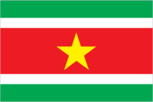
five horizontal bands of green (top, double width), white, red (quadruple width), white, and green (double width); a large, yellow, five-pointed star is centered in the red band; red stands for progress and love, green symbolizes hope and fertility, white signifies peace, justice, and freedom; the star represents the unity of all ethnic groups; from its yellow light the nation draws strength to bear sacrifices patiently while working toward a golden future
Government type
presidential republic
Independence
25 November 1975 (from the Netherlands)
International law organization participation
accepts compulsory ICJ jurisdiction with reservations; accepts ICCt jurisdiction
International organization participation
ACP, AOSIS, Caricom, CD, CDB, CELAC, FAO, G-77, IADB, IBRD, ICAO, ICCt, ICRM, IDA, IDB, IFAD, IFC, IFRCS, IHO, ILO, IMF, IMO, Interpol, IOC, IOM, IPU, ISO (correspondent), ITU, ITUC (NGOs), LAES, MIGA, NAM, OAS, OIC, OPANAL, OPCW, PCA, Petrocaribe, UN, UNASUR, UNCTAD, UNESCO, UNIDO, UPU, WHO, WIPO, WMO, WTO
Judicial branch
- highest court(s)
- High Court of Justice of Suriname (consists of the court president, vice president, and 4 judges); note - appeals beyond the High Court are referred to the Caribbean Court of Justice; human rights violations can be appealed to the Inter-American Commission on Human Rights with judgments issued by the Inter-American Court on Human Rights
- judge selection and term of office
- court judges appointed by the national president in consultation with the National Assembly, the State Advisory Council, and the Order of Private Attorneys; judges serve for life
- subordinate courts
- cantonal courts
Legal system
civil law system influenced by Dutch civil law; note - a new criminal code was enacted in 2017
Legislative branch
- description
- unicameral National Assembly or Nationale Assemblee (51 seats; members directly elected in 10 multi-seat constituencies by party-list proportional representation vote, using the D'Hondt method, to serve 5-year terms)
- election results
- percent of vote by party - VHP 41.1%, NDP 29.4%, ABOP 17.6%, NPS 7.8%, other 3.9%; seats by party - VHP 20, NDP 16, ABOP 9, NPS 3, BEP 2, PL 2; composition - men 36, women 15, percent of women 29.4%
- elections
- last held on 25 May 2020 (next to be held in May 2025)
National anthem
- lyrics/music
- Cornelis Atses HOEKSTRA and Henry DE ZIEL/Johannes Corstianus DE PUY
- name
- "God zij met ons Suriname!" (God Be With Our Suriname)
- note
- note: adopted 1959; originally adapted from a Sunday school song written in 1893 and contains lyrics in both Dutch and Sranang Tongo
National heritage
- selected World Heritage Site locales
- Central Suriname Nature Reserve (n); Historic Inner City of Paramaribo (c)
- total World Heritage Sites
- 2 (1 cultural, 1 natural)
National holiday
Independence Day, 25 November (1975)
National symbol(s)
royal palm, faya lobi (flower); national colors: green, white, red, yellow
Political parties and leaders
Brotherhood and Unity in Politics or BEP [Ronnie ASABINA]Democratic Alternative '91 or DA91 [Angelique DEL CASTILHO]General Liberation and Development Party or ABOP [Ronnie BRUNSWIJK}National Democratic Party or NDP [Desire Delano BOUTERSE]National Party of Suriname or NPS [Gregory RUSLAND]Party for Democracy and Development in Unity or DOE [Carl BREEVELD]Party for National Unity and Solidarity or KTPI [Iwan GANGA]People's Alliance (Pertjajah Luhur) or PL [Paul SOMOHARDJO]Progressive Workers' and Farmers' Union or PALU [Jim HOK]Progressive Reform Party or VHP [Chandrikapersad SANTOKHI]Reform and Renewal Movement or HVB [Mike NOERSALIM]Surinamese Labor Party or SPA [Guno CASTELEN]
Suffrage
18 years of age; universal
Economy
Agricultural products
rice, sugar cane, bananas, oranges, vegetables, plantains, coconuts, poultry, cassava, eggs
Budget
- expenditures
- $1.648 billion (2019 est.)
- revenues
- $863 million (2019 est.)
Budget surplus (+) or deficit (-)
-7.8% (of GDP) (2017 est.)
Credit ratings
- Fitch rating
- C (2020)
- Moody's rating
- Caa3 (2020)
- note
- note: The year refers to the year in which the current credit rating was first obtained.
- Standard & Poors rating
- SD (2020)
Current account balance
- Current account balance 2019
- -$448.255 million (2019 est.)
- Current account balance 2020
- $259.846 million (2020 est.)
- Current account balance 2021
- $176.13 million (2021 est.)
Debt - external
- Debt - external 31 December 2016
- $1.436 billion (31 December 2016 est.)
- Debt - external 31 December 2017
- $1.7 billion (31 December 2017 est.)
Economic overview
upper middle-income South American economy; new floating currency regime; key aluminum goods, gold, and hydrocarbon exporter; new IMF plan for economic recovery and fiscal sustainability; controversial hardwood industry
Exchange rates
- Currency
- Surinamese dollars (SRD) per US dollar -
- Exchange rates 2017
- 7.488 (2017 est.)
- Exchange rates 2018
- 7.463 (2018 est.)
- Exchange rates 2019
- 7.458 (2019 est.)
- Exchange rates 2020
- 9.31 (2020 est.)
- Exchange rates 2021
- 18.239 (2021 est.)
Exports
- Exports 2019
- $2.287 billion (2019 est.)
- Exports 2020
- $2.446 billion (2020 est.) note: data are in current year dollars
- Exports 2021
- $2.299 billion (2021 est.) note: data are in current year dollars
Exports - commodities
gold, lumber, refined petroleum, excavation machinery, rice (2021)
Exports - partners
Switzerland 51%, United Arab Emirates 22%, Belgium 6%, Trinidad and Tobago 2%, Guyana 2% (2021)
Fiscal year
calendar year
GDP - composition, by end use
- exports of goods and services
- 68.9% (2017 est.)
- government consumption
- 11.7% (2017 est.)
- household consumption
- 27.6% (2017 est.)
- imports of goods and services
- -60.6% (2017 est.)
- investment in fixed capital
- 52.5% (2017 est.)
- investment in inventories
- 26.5% (2017 est.)
GDP - composition, by sector of origin
- agriculture
- 11.6% (2017 est.)
- industry
- 31.1% (2017 est.)
- services
- 57.4% (2017 est.)
GDP (official exchange rate)
$3.419 billion (2017 est.)
Household income or consumption by percentage share
- highest 10%
- NA
- lowest 10%
- NA
Imports
- Imports 2019
- $2.413 billion (2019 est.)
- Imports 2020
- $1.845 billion (2020 est.) note: data are in current year dollars
- Imports 2021
- $1.876 billion (2021 est.) note: data are in current year dollars
Imports - commodities
refined petroleum, excavation machinery, delivery trucks, cars, cigarettes (2021)
Imports - partners
United States 19%, China 16%, Netherlands 15%, Trinidad and Tobago 8%, Japan 3% (2021)
Industrial production growth rate
-10.92% (2021 est.)
Industries
gold mining, oil, lumber, food processing, fishing
Inflation rate (consumer prices)
- Inflation rate (consumer prices) 2017
- 22% (2017 est.)
- Inflation rate (consumer prices) 2020
- 34.89% (2020 est.)
- Inflation rate (consumer prices) 2021
- 59.11% (2021 est.)
Labor force
244,200 (2021 est.)
Labor force - by occupation
- agriculture
- 11.2%
- industry
- 19.5%
- services
- 69.3% (2010)
Population below poverty line
70% (2002 est.)
Public debt
- Public debt 2016
- 75.8% of GDP (2016 est.)
- Public debt 2017
- 69.3% of GDP (2017 est.)
Real GDP (purchasing power parity)
- note
- note: data are in 2017 dollars
- Real GDP (purchasing power parity) 2019
- $11.075 billion (2019 est.)
- Real GDP (purchasing power parity) 2020
- $9.306 billion (2020 est.)
- Real GDP (purchasing power parity) 2021
- $9.052 billion (2021 est.)
Real GDP growth rate
- Real GDP growth rate 2019
- 1.17% (2019 est.)
- Real GDP growth rate 2020
- -15.98% (2020 est.)
- Real GDP growth rate 2021
- -2.73% (2021 est.)
Real GDP per capita
- note
- note: data are in 2017 dollars
- Real GDP per capita 2019
- $18,400 (2019 est.)
- Real GDP per capita 2020
- $15,300 (2020 est.)
- Real GDP per capita 2021
- $14,800 (2021 est.)
Reserves of foreign exchange and gold
- Reserves of foreign exchange and gold 31 December 2019
- $647.935 million (31 December 2019 est.)
- Reserves of foreign exchange and gold 31 December 2020
- $584.929 million (31 December 2020 est.)
- Reserves of foreign exchange and gold 31 December 2021
- $992.257 million (31 December 2021 est.)
Taxes and other revenues
16.4% (of GDP) (2017 est.)
Unemployment rate
- Unemployment rate 2019
- 8.04% (2019 est.)
- Unemployment rate 2020
- 9.78% (2020 est.)
- Unemployment rate 2021
- 10.06% (2021 est.)
Youth unemployment rate (ages 15-24)
- female
- 46.1%
- male
- 22.1%
- total
- 30.5% (2021 est.)
Energy
Carbon dioxide emissions
- from coal and metallurgical coke
- 0 metric tonnes of CO2 (2019 est.)
- from consumed natural gas
- 11,000 metric tonnes of CO2 (2019 est.)
- from petroleum and other liquids
- 2.361 million metric tonnes of CO2 (2019 est.)
- total emissions
- 2.372 million metric tonnes of CO2 (2019 est.)
Coal
- consumption
- 0 metric tons (2020 est.)
- exports
- 0 metric tons (2020 est.)
- imports
- 0 metric tons (2020 est.)
- production
- 0 metric tons (2020 est.)
- proven reserves
- 0 metric tons (2019 est.)
Electricity
- consumption
- 2,938,391,000 kWh (2019 est.)
- exports
- 0 kWh (2019 est.)
- imports
- 808 million kWh (2019 est.)
- installed generating capacity
- 542,000 kW (2020 est.)
- transmission/distribution losses
- 234 million kWh (2019 est.)
Electricity access
- electrification - rural areas
- 97.4% (2021)
- electrification - total population
- 98.8% (2021)
- electrification - urban areas
- 99.5% (2021)
Electricity generation sources
- biomass and waste
- 0.3% of total installed capacity (2020 est.)
- fossil fuels
- 40.5% of total installed capacity (2020 est.)
- geothermal
- 0% of total installed capacity (2020 est.)
- hydroelectricity
- 58.8% of total installed capacity (2020 est.)
- nuclear
- 0% of total installed capacity (2020 est.)
- solar
- 0.4% of total installed capacity (2020 est.)
- tide and wave
- 0% of total installed capacity (2020 est.)
- wind
- 0% of total installed capacity (2020 est.)
Energy consumption per capita
- Total energy consumption per capita 2019
- 82.356 million Btu/person (2019 est.)
Natural gas
- consumption
- 0 cubic meters (2020 est.)
- exports
- 0 cubic meters (2021 est.)
- imports
- 0 cubic meters (2021 est.)
- production
- 0 cubic meters (2020 est.)
- proven reserves
- 0 cubic meters (2021 est.)
Petroleum
- crude oil and lease condensate exports
- 0 bbl/day (2018 est.)
- crude oil and lease condensate imports
- 200 bbl/day (2018 est.)
- crude oil estimated reserves
- 89 million barrels (2021 est.)
- refined petroleum consumption
- 15,800 bbl/day (2019 est.)
- total petroleum production
- 14,800 bbl/day (2021 est.)
Refined petroleum products - exports
14,000 bbl/day (2015 est.)
Refined petroleum products - imports
10,700 bbl/day (2015 est.)
Refined petroleum products - production
7,571 bbl/day (2015 est.)
Communications
Broadband - fixed subscriptions
- subscriptions per 100 inhabitants
- 16 (2020 est.)
- total
- 92,270 (2020 est.)
Broadcast media
2 state-owned TV stations; 1 state-owned radio station; multiple private radio and TV stations (2019)
Internet country code
.sr
Internet users
- percent of population
- 66% (2021 est.)
- total
- 402,600 (2021 est.)
Telecommunication systems
- domestic
- fixed-line is 20 per 100 and mobile-cellular teledensity is 148 telephones per 100 persons (2021)
- general assessment
- Suriname is the smallest nation on the South American continent, with about 580,000 inhabitants; the only Dutch-speaking nation in South America, it has close affinities with the Caribbean, and is a member of the Caribbean Community and Common Market (CARICOM); the country’s fixed-line infrastructure is reasonably reliable in the more populated coastal region, though poor in the interior; fixed teledensity and broadband penetration are slightly lower than average for Latin America and the Caribbean, while mobile penetration is significantly above the regional average and much higher than would be expected given the country’s relatively low GDP per capita; many Surinamese have up to three mobile lines with different providers, which has pushed up penetration figures although the number of subscribers has fallen in recent years as consumers have responded to economic pressures (2021)
- international
- country code - 597; landing point for the SG-SCS submarine cable linking South America with the Caribbean; satellite earth stations - 2 Intelsat (Atlantic Ocean) (2019)
Telephones - fixed lines
- subscriptions per 100 inhabitants
- 20 (2021 est.)
- total subscriptions
- 119,977 (2021 est.)
Telephones - mobile cellular
- subscriptions per 100 inhabitants
- 148 (2021 est.)
- total subscriptions
- 906,170 (2021 est.)
Transportation
Airports
55 (2021)
Airports - with paved runways
- 6
- note
- note: paved runways have a concrete or asphalt surface but not all have facilities for refueling, maintenance, or air traffic control; the length of a runway required for aircraft to safely operate depends on a number of factors including the type of aircraft, the takeoff weight (including passengers, cargo, and fuel), engine types, flap settings, landing speed, elevation of the airport, and average maximum daily air temperature; paved runways can reach a length of 5,000 m (16,000 ft.), but the “typical” length of a commercial airline runway is between 2,500-4,000 m (8,000-13,000 ft.)
Airports - with unpaved runways
- 49
- note
- note: unpaved runways have a surface composition such as grass or packed earth and are most suited to the operation of light aircraft; unpaved runways are usually short, often less than 1,000 m (3,280 ft.) in length; airports with unpaved runways often lack facilities for refueling, maintenance, or air traffic control
Civil aircraft registration country code prefix
PZ
Merchant marine
- by type
- general cargo 5, oil tanker 3, other 2
- total
- 10 (2022)
National air transport system
- annual freight traffic on registered air carriers
- 33.2 million (2018) mt-km
- annual passenger traffic on registered air carriers
- 272,347 (2018)
- inventory of registered aircraft operated by air carriers
- 20
- number of registered air carriers
- 4 (2020)
Pipelines
50 km oil (2013)
Ports and terminals
- major seaport(s)
- Paramaribo, Wageningen
Roadways
- paved
- 1,119 km (2003)
- total
- 4,304 km (2003)
- unpaved
- 3,185 km (2003)
Waterways
1,200 km (2011) (most navigable by ships with drafts up to 7 m)
Military and Security
Military - note
key missions for the National Leger include border control and supporting domestic security; the military police has direct responsibility for immigration control at the country’s ports of entry; in addition, the military assists the police in combating crime, particularly narco-trafficking, including joint military and police patrols, as well as joint special security teams (2023)
Military and security forces
Suriname National Army (Nationaal Leger or NL); Army (Landmacht), Navy (Marine); Air Force (Luchtmacht), Military Police (Korps Militaire Politie)Ministry of Justice and Police: Suriname Police Force (Korps Politie Suriname or KPS) (2023)
Military and security service personnel strengths
approximately 2,000 total personnel (2023)
Military equipment inventories and acquisitions
the Suriname Army has a limited inventory comprised of a mix of older, foreign-supplied equipment; in recent years, Suriname has received small quantities of military hardware from India (2023)
Military expenditures
- Military Expenditures 2015
- 1.4% of GDP (2015 est.)
- Military Expenditures 2016
- 1.2% of GDP (2016 est.)
- Military Expenditures 2017
- 1.1% of GDP (2017 est.)
- Military Expenditures 2018
- 1.1% of GDP (2018 est.)
- Military Expenditures 2019
- 1.2% of GDP (2019 est.)
Military service age and obligation
18 is the legal minimum age for voluntary military service for men and women; no conscription (2022)
Transnational Issues
Disputes - international
Suriname-Brazil: none identified Suriname-France (French Guiana): in March 2021, Suriname and France signed an agreement to establish their border along the Maroni River and its tributary the Lawa River and to cooperate in combatting illegal gold mining; however, the area further south between the Litani and Marouini Rivers is still disputed, with Suriname claiming the border is along the Marouini to the east and France arguing it is along the Litani River to the west Suriname-Guyana: the two countries dispute the territory between two rivers, known as the New River Triangle, with Suriname contending that the New River (also called the Upper Corentyne) to the west marks their common border, while Guyana asserts that the Kutari River to the east forms the border; each side claims that their river is the source of the Corentyne River that forms a border further north between the two countries; the Permanent Court of Arbitration settled the maritime boundary between Suriname and Guyana in 2007 in an area with potentially substantial oil reserves
Illicit drugs
a transit country for South American cocaine en route to Europe; illicit drugs are smuggled in cargo containers, commercial and private air transport and human couriers
Environment
Air pollutants
- carbon dioxide emissions
- 1.74 megatons (2016 est.)
- methane emissions
- 2.28 megatons (2020 est.)
- particulate matter emissions
- 12.17 micrograms per cubic meter (2019 est.)
Climate
tropical; moderated by trade winds
Environment - current issues
deforestation as timber is cut for export; pollution of inland waterways by small-scale mining activities
Environment - international agreements
- party to
- Biodiversity, Climate Change, Climate Change-Kyoto Protocol, Climate Change-Paris Agreement, Comprehensive Nuclear Test Ban, Desertification, Endangered Species, Hazardous Wastes, Law of the Sea, Marine Dumping-London Convention, Marine Dumping-London Protocol, Nuclear Test Ban, Ozone Layer Protection, Ship Pollution, Tropical Timber 2006, Wetlands, Whaling
- signed, but not ratified
- none of the selected agreements
Land use
- agricultural land
- 0.5% (2018 est.)
- agricultural land: arable land
- arable land: 0.4% (2018 est.)
- agricultural land: permanent crops
- permanent crops: 0% (2018 est.)
- agricultural land: permanent pasture
- permanent pasture: 0.1% (2018 est.)
- forest
- 94.6% (2018 est.)
- other
- 4.9% (2018 est.)
Major watersheds (area sq km)
Atlantic Ocean drainage: Amazon (6,145,186 sq km)
Revenue from coal
0% of GDP (2018 est.)
Revenue from forest resources
2.36% of GDP (2018 est.)
Total renewable water resources
99 billion cubic meters (2020 est.)
Total water withdrawal
- agricultural
- 430 million cubic meters (2020 est.)
- industrial
- 140 million cubic meters (2020 est.)
- municipal
- 50 million cubic meters (2020 est.)
Urbanization
- rate of urbanization
- 0.88% annual rate of change (2020-25 est.)
- urban population
- 66.4% of total population (2023)
Waste and recycling
- municipal solid waste generated annually
- 78,620 tons (2010 est.)