2016 Edition
CIA World Factbook 2016 Archive (HTML)
Introduction
Background
The first Sinhalese arrived in Sri Lanka late in the 6th century B.C., probably from northern India. Buddhism was introduced circa 250 B.C., and a great civilization developed at the cities of Anuradhapura (kingdom from circa 200 B.C. to circa A.D. 1000) and Polonnaruwa (from about 1070 to 1200). In the 14th century, a south Indian dynasty established a Tamil kingdom in northern Sri Lanka. The Portuguese controlled the coastal areas of the island in the 16th century and the Dutch in the 17th century. The island was ceded to the British in 1796, became a crown colony in 1802, and was formally united under British rule by 1815. As Ceylon, it became independent in 1948; its name was changed to Sri Lanka in 1972. Tensions between the Sinhalese majority and Tamil separatists erupted into war in 1983. After two decades of fighting, the government and Liberation Tigers of Tamil Eelam (LTTE) formalized a cease-fire in February 2002 with Norway brokering peace negotiations. Violence between the LTTE and government forces intensified in 2006, but the government regained control of the Eastern Province in 2007 and by May 2009, the remnants of the LTTE had been defeated. Since the end of the conflict, the government has enacted an ambitious program of economic development projects, many of which are financed by loans from the Government of China. In addition to efforts at reconstructing its economy, the government has resettled more than 95% of those civilians displaced during the final phase of the conflict and released the vast majority of former LTTE combatants captured by Government Security Forces. At the same time, there has been little progress on more contentious and politically difficult issues such as reaching a political settlement with Tamil elected representatives and holding accountable those alleged to have been involved in human rights violations and other abuses during the conflict.
Geography
Area
- 65,610 sq km 64,630 sq km 980 sq km
- land
- 64,630 sq km
- total
- 65,610 sq km
- water
- 980 sq km
Area - comparative
slightly larger than West Virginia
Climate
tropical monsoon; northeast monsoon (December to March); southwest monsoon (June to October)
Coastline
1,340 km
Elevation
- 228 m lowest point: Indian Ocean 0 m highest point: Pidurutalagala 2,524 m
- elevation extremes
- lowest point: Indian Ocean 0 m
- highest point
- Pidurutalagala 2,524 m
- mean elevation
- 228 m
Environment - current issues
deforestation; soil erosion; wildlife populations threatened by poaching and urbanization; coastal degradation from mining activities and increased pollution; freshwater resources being polluted by industrial wastes and sewage runoff; waste disposal; air pollution in Colombo
Environment - international agreements
- Biodiversity, Climate Change, Climate Change-Kyoto Protocol, Desertification, Endangered Species, Environmental Modification, Hazardous Wastes, Law of the Sea, Ozone Layer Protection, Ship Pollution, Wetlands Marine Life Conservation
- party to
- Biodiversity, Climate Change, Climate Change-Kyoto Protocol, Desertification, Endangered Species, Environmental Modification, Hazardous Wastes, Law of the Sea, Ozone Layer Protection, Ship Pollution, Wetlands
- signed, but not ratified
- Marine Life Conservation
Geographic coordinates
7 00 N, 81 00 E
Geography - note
strategic location near major Indian Ocean sea lanes
Irrigated land
5,700 sq km (2012)
Land boundaries
0 km
Land use
- 43.5% arable land 20.7%; permanent crops 15.8%; permanent pasture 7% 29.4% 27.1% (2011 est.)
- agricultural land
- 43.5%
- forest
- 29.4%
- other
- 27.1% (2011 est.)
Location
Southern Asia, island in the Indian Ocean, south of India
Map references
Asia
Maritime claims
- 12 nm 24 nm 200 nm 200 nm or to the edge of the continental margin
- contiguous zone
- 24 nm
- continental shelf
- 200 nm or to the edge of the continental margin
- exclusive economic zone
- 200 nm
- territorial sea
- 12 nm
Natural hazards
occasional cyclones and tornadoes
Natural resources
limestone, graphite, mineral sands, gems, phosphates, clay, hydropower, arable land
Terrain
mostly low, flat to rolling plain; mountains in south-central interior
People and Society
Age structure
- 24.35% (male 2,760,821/female 2,652,747) 14.7% (male 1,660,402/female 1,608,022) 41.71% (male 4,544,253/female 4,729,544) 9.89% (male 1,018,357/female 1,181,060) 9.35% (male 882,740/female 1,197,054) (2016 est.)
- 0-14 years
- 24.35% (male 2,760,821/female 2,652,747)
- 15-24 years
- 14.7% (male 1,660,402/female 1,608,022)
- 25-54 years
- 41.71% (male 4,544,253/female 4,729,544)
- 55-64 years
- 9.89% (male 1,018,357/female 1,181,060)
- 65 years and over
- 9.35% (male 882,740/female 1,197,054) (2016 est.)
Birth rate
15.5 births/1,000 population (2016 est.)
Children under the age of 5 years underweight
26.3% (2012)
Contraceptive prevalence rate
68.4% (2006/07)
Death rate
6.2 deaths/1,000 population (2016 est.)
Dependency ratios
- 51.2% 37.2% 14.1% 7.1% (2015 est.)
- elderly dependency ratio
- 14.1%
- potential support ratio
- 7.1% (2015 est.)
- total dependency ratio
- 51.2%
- youth dependency ratio
- 37.2%
Drinking water source
- urban: 98.5% of population rural: 95% of population total: 95.6% of population urban: 1.5% of population rural: 5% of population total: 4.4% of population (2015 est.)
- rural
- 5% of population
- total
- 4.4% of population (2015 est.)
- urban
- 1.5% of population
Education expenditures
1.6% of GDP (2013)
Ethnic groups
Sinhalese 74.9%, Sri Lankan Tamil 11.2%, Sri Lankan Moors 9.2%, Indian Tamil 4.2%, other 0.5% (2012 est.)
Health expenditures
3.5% of GDP (2014)
HIV/AIDS - adult prevalence rate
0.03% (2015 est.)
HIV/AIDS - deaths
100 (2015 est.)
HIV/AIDS - people living with HIV/AIDS
4,200 (2015 est.)
Hospital bed density
3.6 beds/1,000 population (2012)
Infant mortality rate
- 8.6 deaths/1,000 live births 9.5 deaths/1,000 live births 7.6 deaths/1,000 live births (2016 est.)
- female
- 7.6 deaths/1,000 live births (2016 est.)
- male
- 9.5 deaths/1,000 live births
- total
- 8.6 deaths/1,000 live births
Languages
- Sinhala (official and national language) 74%, Tamil (official and national language) 18%, other 8% English, spoken competently by about 10% of the population, is commonly used in government and is referred to as the link language in the constitution
- note
- English, spoken competently by about 10% of the population, is commonly used in government and is referred to as the link language in the constitution
Life expectancy at birth
- 76.8 years 73.3 years 80.4 years (2016 est.)
- female
- 80.4 years (2016 est.)
- male
- 73.3 years
- total population
- 76.8 years
Literacy
- age 15 and over can read and write 92.6% 93.6% 91.7% (2015 est.)
- definition
- age 15 and over can read and write
- female
- 91.7% (2015 est.)
- male
- 93.6%
- total population
- 92.6%
Major infectious diseases
- high bacterial diarrhea and hepatitis A dengue fever leptospirosis rabies (2016)
- animal contact disease
- rabies (2016)
- degree of risk
- high
- food or waterborne diseases
- bacterial diarrhea and hepatitis A
- vectorborne disease
- dengue fever
- water contact disease
- leptospirosis
Major urban areas - population
Sri Jayewardenepura Kotte (legislative capital) 128,000 (2014); COLOMBO (capital) 707,000 (2015)
Maternal mortality rate
30 deaths/100,000 live births (2015 est.)
Median age
- 32.5 years 31.2 years 33.7 years (2016 est.)
- female
- 33.7 years (2016 est.)
- male
- 31.2 years
- total
- 32.5 years
Mother's mean age at first birth
- 25.4 median age at first birth among women 30-34 (2006/07 est.)
- note
- median age at first birth among women 30-34 (2006/07 est.)
Nationality
- Sri Lankan(s) Sri Lankan
- adjective
- Sri Lankan
- noun
- Sri Lankan(s)
Net migration rate
-1.3 migrant(s)/1,000 population (2016 est.)
Obesity - adult prevalence rate
6.8% (2014)
Physicians density
0.68 physicians/1,000 population (2010)
Population
22.235 million (July 2016 est.)
Population growth rate
0.8% (2016 est.)
Religions
Buddhist (official) 70.2%, Hindu 12.6%, Muslim 9.7%, Roman Catholic 6.1%, other Christian 1.3%, other 0.05% (2012 est.)
Sanitation facility access
- urban: 88.1% of population rural: 96.7% of population total: 95.1% of population urban: 11.9% of population rural: 3.3% of population total: 4.9% of population (2015 est.)
- rural
- 3.3% of population
- total
- 4.9% of population (2015 est.)
- urban
- 11.9% of population
School life expectancy (primary to tertiary education)
- 14 years 14 years 14 years (2013)
- female
- 14 years (2013)
- male
- 14 years
- total
- 14 years
Sex ratio
- 1.04 male(s)/female 1.04 male(s)/female 1.03 male(s)/female 0.96 male(s)/female 0.86 male(s)/female 0.74 male(s)/female 0.96 male(s)/female (2016 est.)
- 0-14 years
- 1.04 male(s)/female
- 15-24 years
- 1.03 male(s)/female
- 25-54 years
- 0.96 male(s)/female
- 55-64 years
- 0.86 male(s)/female
- 65 years and over
- 0.74 male(s)/female
- at birth
- 1.04 male(s)/female
- total population
- 0.96 male(s)/female (2016 est.)
Total fertility rate
2.09 children born/woman (2016 est.)
Unemployment, youth ages 15-24
- 20.1% 15% 27.8% (2013 est.)
- female
- 27.8% (2013 est.)
- male
- 15%
- total
- 20.1%
Urbanization
- 18.4% of total population (2015) 0.72% annual rate of change (2010-15 est.)
- rate of urbanization
- 0.72% annual rate of change (2010-15 est.)
- urban population
- 18.4% of total population (2015)
Government
Administrative divisions
9 provinces; Central, Eastern, North Central, Northern, North Western, Sabaragamuwa, Southern, Uva, Western
Capital
- Colombo; note - Sri Jayewardenepura Kotte is the legislative capital 6 55 N, 79 50 E UTC+5.5 (10.5 hours ahead of Washington, DC, during Standard Time)
- geographic coordinates
- 6 55 N, 79 50 E
- name
- Colombo; note - Sri Jayewardenepura Kotte is the legislative capital
- time difference
- UTC+5.5 (10.5 hours ahead of Washington, DC, during Standard Time)
Citizenship
- no at least one parent must be a citizen of Sri Lanka no, except in cases where the government rules it is to the benefit of Sri Lanka 7 years
- citizenship by birth
- no
- citizenship by descent only
- at least one parent must be a citizen of Sri Lanka
- dual citizenship recognized
- no, except in cases where the government rules it is to the benefit of Sri Lanka
- residency requirement for naturalization
- 7 years
Constitution
several previous; latest adopted 16 August 1978, certified 31 August 1978; amended many times, last in 2015 (2016)
Country name
- Democratic Socialist Republic of Sri Lanka Sri Lanka Shri Lanka Prajatantrika Samajavadi Janarajaya/Ilankai Jananayaka Choshalichak Kutiyarachu Shri Lanka/Ilankai Serendib, Ceylon the name means "resplendent island" in Sanskrit
- conventional long form
- Democratic Socialist Republic of Sri Lanka
- conventional short form
- Sri Lanka
- former
- Serendib, Ceylon
- local long form
- Shri Lanka Prajatantrika Samajavadi Janarajaya/Ilankai Jananayaka Choshalichak Kutiyarachu
- local short form
- Shri Lanka/Ilankai
- note
- the name means "resplendent island" in Sanskrit
Diplomatic representation from the US
- Ambassador Atul KESHAP (since 21 August 2015); note - also accredited to Maldives 210 Galle Road, Colombo 3 P. O. Box 106, Colombo [94] (11) 249-8500 [94] (11) 243-7345
- chief of mission
- Ambassador Atul KESHAP (since 21 August 2015); note - also accredited to Maldives
- embassy
- 210 Galle Road, Colombo 3
- FAX
- [94] (11) 243-7345
- mailing address
- P. O. Box 106, Colombo
- telephone
- [94] (11) 249-8500
Diplomatic representation in the US
- Ambassador Prasad KARIYAWASAM (since 14 July 2014) 2148 Wyoming Avenue NW, Washington, DC 20008 [1] (202) 483-4025 through 4028 [1] (202) 232-7181 Los Angeles, New York
- chancery
- 2148 Wyoming Avenue NW, Washington, DC 20008
- chief of mission
- Ambassador Prasad KARIYAWASAM (since 14 July 2014)
- consulate(s) general
- Los Angeles, New York
- FAX
- [1] (202) 232-7181
- telephone
- [1] (202) 483-4025 through 4028
Executive branch
- President Maithripala SIRISENA (since 9 January 2015); note - the president is both chief of state and head of government; Ranil WICKREMESINGHE (since 9 January 2015) holds the title of prime minister President Maithripala SIRISENA (since 9 January 2015) Cabinet appointed by the president in consultation with the prime minister president directly elected by preferential majority popular vote for a 6-year term (eligible for a second term); election last held on 8 January 2015 (next to be held by January 2021); note - the January 2015 election was held nearly 2 years ahead of schedule Maithripala SIRISENA elected president; percent of vote - Maithripala SIRISENA (Sri Lanka Freedom Party) 51.3%, Mahinda Percy RAJAPAKSA (Sri Lanka Freedom Party) 47.6%, other 1.1%
- cabinet
- Cabinet appointed by the president in consultation with the prime minister
- chief of state
- President Maithripala SIRISENA (since 9 January 2015); note - the president is both chief of state and head of government; Ranil WICKREMESINGHE (since 9 January 2015) holds the title of prime minister
- election results
- Maithripala SIRISENA elected president; percent of vote - Maithripala SIRISENA (Sri Lanka Freedom Party) 51.3%, Mahinda Percy RAJAPAKSA (Sri Lanka Freedom Party) 47.6%, other 1.1%
- elections/appointments
- president directly elected by preferential majority popular vote for a 6-year term (eligible for a second term); election last held on 8 January 2015 (next to be held by January 2021); note - the January 2015 election was held nearly 2 years ahead of schedule
- head of government
- President Maithripala SIRISENA (since 9 January 2015)
Flag description
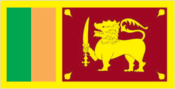
yellow with two panels; the smaller hoist-side panel has two equal vertical bands of green (hoist side) and orange; the other larger panel depicts a yellow lion holding a sword on a maroon rectangular field that also displays a yellow bo leaf in each corner; the yellow field appears as a border around the entire flag and extends between the two panels; the lion represents Sinhalese ethnicity, the strength of the nation, and bravery; the sword demonstrates the sovereignty of the nation; the four bo leaves - symbolizing Buddhism and its influence on the country - stand for the four virtues of kindness, friendliness, happiness, and equanimity; orange signifies Sri Lankan Tamils, green Sri Lankan Moors, and maroon the Sinhalese majority; yellow denotes other ethnic groups; also referred to as the Lion Flag
Government type
presidential republic
Independence
4 February 1948 (from the UK)
International law organization participation
has not submitted an ICJ jurisdiction declaration; non-party state to the ICCt
International organization participation
ABEDA, ADB, ARF, BIMSTEC, C, CD, CICA (observer), CP, FAO, G-11, G-15, G-24, G-77, IAEA, IBRD, ICAO, ICC (national committees), ICRM, IDA, IFAD, IFC, IFRCS, IHO, ILO, IMF, IMO, IMSO, Interpol, IOC, IOM, IPU, ISO, ITSO, ITU, ITUC (NGOs), MIGA, MINURSO, MINUSTAH, MONUSCO, NAM, OAS (observer), OPCW, PCA, SAARC, SACEP, SCO (dialogue member), UN, UNCTAD, UNESCO, UNIDO, UNIFIL, UNISFA, UNMISS, UNWTO, UPU, WCO, WFTU (NGOs), WHO, WIPO, WMO, WTO
Judicial branch
- Supreme Court of the Republic (consists of the chief justice and 10 justices); note - the court has exclusive jurisdiction to review legislation chief justice appointed by the president; other justices appointed by the president with the advice of the chief justice; all justices hold office until age 65 Court of Appeals; High Courts; Magistrate's Courts; municipal and primary courts
- highest court(s)
- Supreme Court of the Republic (consists of the chief justice and 10 justices); note - the court has exclusive jurisdiction to review legislation
- judge selection and term of office
- chief justice appointed by the president; other justices appointed by the president with the advice of the chief justice; all justices hold office until age 65
- subordinate courts
- Court of Appeals; High Courts; Magistrate's Courts; municipal and primary courts
Legal system
mixed legal system of Roman-Dutch civil law, English common law, and Jaffna Tamil customary law
Legislative branch
- unicameral Parliament (225 seats; 196 members directly elected in multi-seat constituencies by proportional representation vote using a preferential method in which voters select 3 candidates in order of preference; remaining 29 seats allocated to other political parties and groups in proportion to share of national vote; members serve 6-year terms) last held on 17 August 2015 following President SIRISENA's dissolution of Parliament in late June in an effort to consolidate power and pass reforms (next to be held in 2021) percent of vote by alliance/party - EYJP 45.7%, UPFA 42.4%, JVP 4.9%, TNA 4.6%, SLMC 0.4%, EPDP 0.3% other 1.7%; seats by alliance/party EYJP 106, UPFA 95, TNA 16, JVP 6, SLMC 1, EPDP 1
- description
- unicameral Parliament (225 seats; 196 members directly elected in multi-seat constituencies by proportional representation vote using a preferential method in which voters select 3 candidates in order of preference; remaining 29 seats allocated to other political parties and groups in proportion to share of national vote; members serve 6-year terms)
- election results
- percent of vote by alliance/party - EYJP 45.7%, UPFA 42.4%, JVP 4.9%, TNA 4.6%, SLMC 0.4%, EPDP 0.3% other 1.7%; seats by alliance/party EYJP 106, UPFA 95, TNA 16, JVP 6, SLMC 1, EPDP 1
- elections
- last held on 17 August 2015 following President SIRISENA's dissolution of Parliament in late June in an effort to consolidate power and pass reforms (next to be held in 2021)
National anthem
- "Sri Lanka Matha" (Mother Sri Lanka) Ananda SAMARKONE adopted 1951
- lyrics/music
- Ananda SAMARKONE
- name
- "Sri Lanka Matha" (Mother Sri Lanka)
- note
- adopted 1951
National holiday
Independence Day, 4 February (1948)
National symbol(s)
- lion, water lily; national colors: maroon, yellow
- lion, water lily; national colors
- maroon, yellow
Political parties and leaders
Eelam People's Democratic Party or EPDP [Douglas DEVANANDA] Janatha Vimukthi Peramuna or JVP [Anura Kumara DISSANAYAKE] Jathika Hela Urumaya or JHU [Patali Champika RANAWAKA] Sri Lanka Freedom Party or SLFP [Maithripala SIRISENA] Sri Lanka Muslim Congress or SLMC [Rauff HAKEEM] Tamil National Alliance or TNA [R. SAMPANTHAN] United National Front for Good Governance or EYJP (coalition includes UNP) United National Party or UNP [Ranil WICKREMESINGHE] United People's Freedom Alliance or UPFA (coalition includes SLFP)
Political pressure groups and leaders
- Buddhist clergy Sinhalese Buddhist lay groups labor unions; hard-line nationalist Sinhalese groups such as the National Movement Against Terrorism
- other
- labor unions; hard-line nationalist Sinhalese groups such as the National Movement Against Terrorism
Suffrage
18 years of age; universal
Economy
Agriculture - products
rice, sugarcane, grains, pulses, oilseed, spices, vegetables, fruit, tea, rubber, coconuts; milk, eggs, hides, beef; fish
Budget
- $10.75 billion $16.95 billion (2015 est.)
- expenditures
- $16.95 billion (2015 est.)
- revenues
- $10.75 billion
Budget surplus (+) or deficit (-)
-7.5% of GDP (2015 est.)
Central bank discount rate
6% (31 December 2015) 6.5% (31 December 2013)
Commercial bank prime lending rate
6.96% (31 December 2015 est.) 7.84% (31 December 2014 est.)
Current account balance
-$1.681 billion (2015 est.) -$2.018 billion (2014 est.)
Debt - external
$45.47 billion (31 December 2015 est.) $43.61 billion (31 December 2014 est.)
Distribution of family income - Gini index
49 (2010) 46 (1995)
Economy - overview
Sri Lanka continues to experience strong economic growth following the end of the government's 26-year conflict with the Liberation Tigers of Tamil Eelam. The government has been pursuing large-scale reconstruction and development projects in its efforts to spur growth in war-torn and disadvantaged areas, develop small and medium enterprises, and increase agricultural productivity. The government's high debt payments and bloated civil service have contributed to historically high budget deficits and low tax revenues remain a concern. Government debt of about 72% of GDP remains among the highest in emerging markets. The new government in 2015 drastically increased wages for public sector employees, which boosted demand for consumer goods but hurt the overall balance of payments and reduced foreign exchange reserves.
Exchange rates
Sri Lankan rupees (LKR) per US dollar - 135.86 (2015 est.) 130.57 (2014 est.) 130.57 (2013 est.) 127.6 (2012 est.) 110.57 (2011 est.)
Exports
$10.5 billion (2015 est.) $11.13 billion (2014 est.)
Exports - commodities
textiles and apparel, tea and spices; rubber manufactures; precious stones; coconut products, fish
Exports - partners
US 26%, UK 9%, India 7.2%, Germany 4.3% (2015)
Fiscal year
calendar year
GDP - composition, by end use
- 68.6% 8.8% 26.2% 3.9% 20.5% -28% (2015 est.)
- exports of goods and services
- 20.5%
- government consumption
- 8.8%
- household consumption
- 68.6%
- imports of goods and services
- -28% (2015 est.)
- investment in fixed capital
- 26.2%
- investment in inventories
- 3.9%
GDP - composition, by sector of origin
- 8.7% 30.7% 60.6% (2015 est.)
- agriculture
- 8.7%
- industry
- 30.7%
- services
- 60.6% (2015 est.)
GDP - per capita (PPP)
- $10,600 (2015 est.) $10,100 (2014 est.) $9,700 (2013 est.) data are in 2015 US dollars
- note
- data are in 2015 US dollars
GDP - real growth rate
5.2% (2015 est.) 4.5% (2014 est.) 3.4% (2013 est.)
GDP (official exchange rate)
$82.1 billion (2015 est.)
GDP (purchasing power parity)
- $223 billion (2015 est.) $212 billion (2014 est.) $203 billion (2013 est.) data are in 2015 US dollars
- note
- data are in 2015 US dollars
Gross national saving
27.6% of GDP (2015 est.) 29.5% of GDP (2014 est.) 29.8% of GDP (2013 est.)
Household income or consumption by percentage share
- 1.6% 39.5% (2009)
- highest 10%
- 39.5% (2009)
- lowest 10%
- 1.6%
Imports
$18.93 billion (2015 est.) $19.42 billion (2014 est.)
Imports - commodities
petroleum, textiles, machinery and transportation equipment, building materials, mineral products, foodstuffs
Imports - partners
India 24.6%, China 20.6%, UAE 7.2%, Singapore 5.9%, Japan 5.7% (2015)
Industrial production growth rate
3% (2015 est.)
Industries
processing of rubber, tea, coconuts, tobacco and other agricultural commodities; telecommunications, insurance, banking; tourism, shipping; clothing, textiles; cement, petroleum refining, information technology services, construction
Inflation rate (consumer prices)
0.9% (2015 est.) 3.3% (2014 est.)
Labor force
8.928 million (2015 est.)
Labor force - by occupation
- 28.4% 25.7% 45.9% (30 Jun 2015)
- agriculture
- 28.4%
- industry
- 25.7%
- services
- 45.9% (30 Jun 2015)
Market value of publicly traded shares
$18.48 billion (31 December 2015 est.) $17.05 billion (31 December 2014 est.) $19.44 billion (31 December 2013 est.)
Population below poverty line
8.9% (2010 est.)
Public debt
- 76% of GDP (2015 est.) 70.7% of GDP (2014 est.) covers central government debt, and excludes debt instruments directly owned by government entities other than the treasury (e.g. commercial bank borrowings of a government corporation); the data includes treasury debt held by foreign entities as well as intra-governmental debt; intra-governmental debt consists of treasury borrowings from surpluses in the social funds, such as for retirement; sub-national entities are usually not permitted to sell debt instruments
- note
- covers central government debt, and excludes debt instruments directly owned by government entities other than the treasury (e.g. commercial bank borrowings of a government corporation); the data includes treasury debt held by foreign entities as well as intra-governmental debt; intra-governmental debt consists of treasury borrowings from surpluses in the social funds, such as for retirement; sub-national entities are usually not permitted to sell debt instruments
Reserves of foreign exchange and gold
$7.303 billion (31 December 2015 est.) $8.209 billion (31 December 2014 est.)
Stock of broad money
$26.79 billion (31 December 2015 est.) $25.95 billion (31 December 2014 est.)
Stock of direct foreign investment - abroad
$NA
Stock of direct foreign investment - at home
$NA
Stock of domestic credit
$39.22 billion (31 December 2015 est.) $33.79 billion (31 December 2014 est.)
Stock of narrow money
$4.963 billion (31 December 2015 est.) $4.671 billion (31 December 2014 est.)
Taxes and other revenues
13.1% of GDP (2015 est.)
Unemployment rate
4.7% (2015 est.) 4.3% (2014 est.)
Energy
Carbon dioxide emissions from consumption of energy
16 million Mt (2013 est.)
Crude oil - exports
0 bbl/day (2013 est.)
Crude oil - imports
34,860 bbl/day (2013 est.)
Crude oil - production
0 bbl/day (2015 est.)
Crude oil - proved reserves
0 bbl (1 January 2016 es)
Electricity - consumption
11 billion kWh (2014 est.)
Electricity - exports
0 kWh (2013 est.)
Electricity - from fossil fuels
51.1% of total installed capacity (2012 est.)
Electricity - from hydroelectric plants
47% of total installed capacity (2012 est.)
Electricity - from nuclear fuels
0% of total installed capacity (2012 est.)
Electricity - from other renewable sources
1.9% of total installed capacity (2012 est.)
Electricity - imports
0 kWh (2013 est.)
Electricity - installed generating capacity
3.4 million kW (2014 est.)
Electricity - production
12 billion kWh (2014 est.)
Electricity access
- 1,334,100 94% 99% 93% (2013)
- electrification - rural areas
- 93% (2013)
- electrification - total population
- 94%
- electrification - urban areas
- 99%
- population without electricity
- 1,334,100
Natural gas - consumption
0 cu m (2013 est.)
Natural gas - exports
0 cu m (2013 est.)
Natural gas - imports
0 cu m (2013 est.)
Natural gas - production
0 cu m (2013 est.)
Natural gas - proved reserves
0 cu m (1 January 2014 es)
Refined petroleum products - consumption
98,000 bbl/day (2014 est.)
Refined petroleum products - exports
2,682 bbl/day (2013 est.)
Refined petroleum products - imports
56,570 bbl/day (2013 est.)
Refined petroleum products - production
32,780 bbl/day (2013 est.)
Communications
Broadcast media
government operates 8 TV channels and a radio network; multi-channel satellite and cable TV subscription services available; 35 private TV stations and about 50 radio stations (2012)
Internet country code
.lk
Internet users
- 6.614 million 30% (July 2015 est.)
- percent of population
- 30% (July 2015 est.)
- total
- 6.614 million
Telephone system
- telephone services have improved significantly and are available in most parts of the country national trunk network consists mostly of digital microwave radio relay; fiber-optic links now in use in Colombo area and fixed wireless local loops have been installed; competition is strong in mobile cellular systems and mobile cellular subscribership is increasing country code - 94; the SEA-ME-WE-3 and SEA-ME-WE-4 submarine cables provide connectivity to Asia, Australia, Middle East, Europe, US; satellite earth stations - 2 Intelsat (Indian Ocean) (2015)
- domestic
- national trunk network consists mostly of digital microwave radio relay; fiber-optic links now in use in Colombo area and fixed wireless local loops have been installed; competition is strong in mobile cellular systems and mobile cellular subscribership is increasing
- general assessment
- telephone services have improved significantly and are available in most parts of the country
- international
- country code - 94; the SEA-ME-WE-3 and SEA-ME-WE-4 submarine cables provide connectivity to Asia, Australia, Middle East, Europe, US; satellite earth stations - 2 Intelsat (Indian Ocean) (2015)
Telephones - fixed lines
- 2,601,196 12 (July 2015 est.)
- subscriptions per 100 inhabitants
- 12 (July 2015 est.)
- total subscriptions
- 2,601,196
Telephones - mobile cellular
- 24.385 million 111 (July 2015 est.)
- subscriptions per 100 inhabitants
- 111 (July 2015 est.)
- total
- 24.385 million
Transportation
Airports
19 (2013)
Airports - with paved runways
- 7 (2013)
- 1,524 to 2,437 m
- 6
- 914 to 1,523 m
- 7 (2013)
- over 3,047 m
- 2
- total
- 15
Airports - with unpaved runways
- 3 (2013)
- 914 to 1,523 m
- 1
- total
- 4
- under 914 m
- 3 (2013)
Civil aircraft registration country code prefix
4R (2016)
Heliports
1 (2013)
Merchant marine
- bulk carrier 4, cargo 13, chemical tanker 1, container 1, petroleum tanker 2 8 (Germany 8) (2010)
- by type
- bulk carrier 4, cargo 13, chemical tanker 1, container 1, petroleum tanker 2
- foreign-owned
- 8 (Germany 8) (2010)
- total
- 21
National air transport system
- 4,911,730 381,381,300 mt-km (2015)
- annual freight traffic on registered air carriers
- 381,381,300 mt-km (2015)
- annual passenger traffic on registered air carriers
- 4,911,730
- inventory of registered aircraft operated by air carriers
- 25
- number of registered air carriers
- 3
Ports and terminals
- Colombo Colombo (3,651,963)
- container port(s) (TEUs)
- Colombo (3,651,963)
- major seaport(s)
- Colombo
Railways
- 1,447 km 1,447 km 1.676-m gauge (2014)
- broad gauge
- 1,447 km 1.676-m gauge (2014)
- total
- 1,447 km
Roadways
- 114,093 km 16,977 km 97,116 km (2010)
- paved
- 16,977 km
- total
- 114,093 km
- unpaved
- 97,116 km (2010)
Waterways
160 km (primarily on rivers in southwest) (2012)
Military and Security
Military branches
Sri Lanka Army, Sri Lanka Navy, Sri Lanka Air Force, Sri Lanka Coast Guard (2015)
Military expenditures
2.43% of GDP (2012) 2.89% of GDP (2011) 2.43% of GDP (2010)
Military service age and obligation
18-22 years of age for voluntary military service; no conscription; 5-year service obligation (Air Force) (2012)
Transnational Issues
Disputes - international
none
Refugees and internally displaced persons
- 44,934 (civil war; more than half displaced prior to 2008; many of the more than 480,000 IDPs registered as returnees have not reached durable solutions) (2015)
- IDPs
- 44,934 (civil war; more than half displaced prior to 2008; many of the more than 480,000 IDPs registered as returnees have not reached durable solutions) (2015)
Trafficking in persons
- Sri Lanka is primarily a source and, to a lesser extent, a destination country for men, women, and children subjected to forced labor and sex trafficking; some Sri Lankan adults and children who migrate willingly to the Middle East, Southeast Asia, and Afghanistan to work in the construction, garment, and domestic service sectors are subsequently subjected to forced labor or debt bondage (incurred through high recruitment fees or money advances); some Sri Lankan women are forced into prostitution in Jordan, Maldives, Malaysia, Singapore, and other countries; within Sri Lanka, women and children are subjected to sex trafficking, and children are also forced to beg and work in the agriculture, fireworks, and fish-drying industries; a small number of women from Asia, Central Asia, Europe, and the Middle East have been forced into prostitution in Sri Lanka in recent years Tier 2 Watch List – Sri Lanka does not fully comply with the minimum standards for the elimination of trafficking; however, it is making significant efforts to do so; in 2014, Sri Lanka was granted a waiver from an otherwise required downgrade to Tier 3 because its government has a written plan that, if implemented, would constitute making significant efforts to bring itself into compliance with the minimum standards for the elimination of trafficking; law enforcement continues to demonstrate a lack of understanding of trafficking crimes and inadequate investigations, relying on trafficking cases to be prosecuted under the procurement statute rather than the trafficking statute, which carries more stringent penalties; authorities convicted only one offender under the procurement statue, a decrease from 2013; the government approved guidelines for the identification of victims and their referral to protective services but failed to ensure that victims were not jailed and charged for crimes committed as a direct result of being trafficked; no government employees were investigated or prosecuted, despite allegations of complicity (2015)
- current situation
- Sri Lanka is primarily a source and, to a lesser extent, a destination country for men, women, and children subjected to forced labor and sex trafficking; some Sri Lankan adults and children who migrate willingly to the Middle East, Southeast Asia, and Afghanistan to work in the construction, garment, and domestic service sectors are subsequently subjected to forced labor or debt bondage (incurred through high recruitment fees or money advances); some Sri Lankan women are forced into prostitution in Jordan, Maldives, Malaysia, Singapore, and other countries; within Sri Lanka, women and children are subjected to sex trafficking, and children are also forced to beg and work in the agriculture, fireworks, and fish-drying industries; a small number of women from Asia, Central Asia, Europe, and the Middle East have been forced into prostitution in Sri Lanka in recent years
- tier rating
- Tier 2 Watch List – Sri Lanka does not fully comply with the minimum standards for the elimination of trafficking; however, it is making significant efforts to do so; in 2014, Sri Lanka was granted a waiver from an otherwise required downgrade to Tier 3 because its government has a written plan that, if implemented, would constitute making significant efforts to bring itself into compliance with the minimum standards for the elimination of trafficking; law enforcement continues to demonstrate a lack of understanding of trafficking crimes and inadequate investigations, relying on trafficking cases to be prosecuted under the procurement statute rather than the trafficking statute, which carries more stringent penalties; authorities convicted only one offender under the procurement statue, a decrease from 2013; the government approved guidelines for the identification of victims and their referral to protective services but failed to ensure that victims were not jailed and charged for crimes committed as a direct result of being trafficked; no government employees were investigated or prosecuted, despite allegations of complicity (2015)