2022 Edition
CIA World Factbook 2022 (factbook.json @ 61dadec0c9c9)
Introduction
Background
Ancient Egypt trade expeditions along the northeastern coast of Africa - including today's Eritrea, Djibouti, and Somalia - occurred at various times between the 25th and 12th centuries B.C. Between A.D. 800 and 1100, immigrant Muslim Arabs and Persians set up coastal trading posts along the Gulf of Aden and the Indian Ocean, solidifying Somalia’s close trading relationship with the Arab Peninsula. In the late 19th century, Britain and Italy established colonies in the Somali Peninsula, where they remained until 1960, when British Somaliland gained independence and joined with Italian Somaliland to form the Republic of Somalia. The country functioned as a parliamentary democracy until 1969, when General Mohamed SIAD Barre took control in a coup, beginning a 22-year authoritarian socialist dictatorship. In an effort to centralize power, SIAD called for the eradication of the clan, the key cultural and social organizing principle in Somali society. Resistance to SIAD’s socialist leadership, which was causing a rapid deterioration of the country, prompted allied clan militias to overthrow SIAD in early 1991, resulting in state collapse. Subsequent fighting between rival clans for resources and territory overwhelmed the country, resulting in a manmade famine and prompting international intervention. Beginning in 1993, the UN spearheaded a humanitarian mission supported by international forces, but the international community largely withdrew by 1995 following an incident that became known as Black Hawk Down in which two American Sikorsky UH-60 Black Hawk helicopters were shot down in Mogadishu. The fighting and subsequent siege and rescue resulted in 21 deaths and 82 wounded among the international forces.International peace conferences in the 2000s resulted in a number of transitional governments that operated outside of Somalia. Left largely to themselves, Somalis in the country established alternative governance structures; some areas formed their own administrations, such as Somaliland and Puntland, while others developed localized institutions. Many local populations turned to using sharia courts, an Islamic judicial system that implements religious law. Several of these courts came together in 2006 to form the Islamic Courts Union (ICU). The ICU established order in many areas of central and southern Somalia, including Mogadishu, but was forced out when Ethiopia intervened militarily in December 2006 on behalf of the Somali Transitional Federal Government (TFG). While the TFG settled in the capital, the ICU fled to rural areas or from Somalia altogether, reemerging less than a year later as the Islamic insurgent and terrorist movement al-Shabaab, which is still active today. In January 2007, the African Union (AU) established the AU Mission in Somalia peacekeeping force, which allowed Ethiopia to withdraw its forces, took over security responsibility for the country, and gave the TFG space to develop Somalia’s new government. By 2012, Somali powerbrokers agreed on a provisional constitution with a loose federal structure and established a central government in Mogadishu termed the Somali Federal Government (SFG). Since then, several interim regional administrations have been established and there have been two presidential elections. However, significant and fundamental governance and security problems remain for the SFG since al-Shabaab controls large portions of the country.
Geography
Area
- land
- 627,337 sq km
- total
- 637,657 sq km
- water
- 10,320 sq km
Area - comparative
almost five times the size of Alabama; slightly smaller than Texas
Climate
principally desert; northeast monsoon (December to February), moderate temperatures in north and hot in south; southwest monsoon (May to October), torrid in the north and hot in the south, irregular rainfall, hot and humid periods (tangambili) between monsoons
Coastline
3,025 km
Elevation
- highest point
- Mount Shimbiris 2,460 m
- lowest point
- Indian Ocean 0 m
- mean elevation
- 410 m
Geographic coordinates
10 00 N, 49 00 E
Geography - note
strategic location on Horn of Africa along southern approaches to Bab el Mandeb and route through Red Sea and Suez Canal
Irrigated land
2,000 sq km (2012)
Land boundaries
- border countries
- Djibouti 61 km; Ethiopia 1,640 km; Kenya 684 km
- total
- 2,385 km
Land use
- agricultural land
- 70.3% (2018 est.)
- agricultural land: arable land
- arable land: 1.8% (2018 est.)
- agricultural land: permanent crops
- permanent crops: 0% (2018 est.)
- agricultural land: permanent pasture
- permanent pasture: 68.5% (2018 est.)
- forest
- 10.6% (2018 est.)
- other
- 19.1% (2018 est.)
Location
Eastern Africa, bordering the Gulf of Aden and the Indian Ocean, east of Ethiopia
Major aquifers
Ogaden-Juba Basin
Map references
Africa
Maritime claims
- exclusive economic zone
- 200 nm
- territorial sea
- 200 nm; note: the US does not recognize this claim
Natural hazards
recurring droughts; frequent dust storms over eastern plains in summer; floods during rainy season
Natural resources
uranium and largely unexploited reserves of iron ore, tin, gypsum, bauxite, copper, salt, natural gas, likely oil reserves
Population distribution
distribution varies greatly throughout the country; least densely populated areas are in the northeast and central regions, as well as areas along the Kenyan border; most populated areas are in and around the cities of Mogadishu, Marka, Boorama, Hargeysa, and Baidoa as shown on this population distribution map
Terrain
mostly flat to undulating plateau rising to hills in north
People and Society
Age structure
- 0-14 years
- 42.38% (male 2,488,604/female 2,493,527)
- 15-24 years
- 19.81% (male 1,167,807/female 1,161,040)
- 25-54 years
- 30.93% (male 1,881,094/female 1,755,166)
- 55-64 years
- 4.61% (male 278,132/female 264,325)
- 65 years and over
- 2.27% (male 106,187/female 161,242) (2020 est.)
Alcohol consumption per capita
- beer
- 0 liters of pure alcohol (2019 est.)
- other alcohols
- 0 liters of pure alcohol (2019 est.)
- spirits
- 0 liters of pure alcohol (2019 est.)
- total
- 0 liters of pure alcohol (2019 est.)
- wine
- 0 liters of pure alcohol (2019 est.)
Birth rate
37.98 births/1,000 population (2022 est.)
Child marriage
- men married by age 18
- 5.6% (2020 est.)
- women married by age 15
- 16.8%
- women married by age 18
- 35.5%
Children under the age of 5 years underweight
23% (2009)
Contraceptive prevalence rate
6.9% (2018/19)
Current health expenditure
NA
Death rate
11.62 deaths/1,000 population (2022 est.)
Demographic profile
Somalia scores very low for most humanitarian indicators, suffering from poor governance, protracted internal conflict, underdevelopment, economic decline, poverty, social and gender inequality, and environmental degradation. Despite civil war and famine raising its mortality rate, Somalia’s high fertility rate and large proportion of people of reproductive age maintain rapid population growth, with each generation being larger than the prior one. More than 60% of Somalia’s population is younger than 25, and the fertility rate is among the world’s highest at almost 6 children per woman – a rate that has decreased little since the 1970s. A lack of educational and job opportunities is a major source of tension for Somalia’s large youth cohort, making them vulnerable to recruitment by extremist and pirate groups. Somalia has one of the world’s lowest primary school enrollment rates – just over 40% of children are in school – and one of world’s highest youth unemployment rates. Life expectancy is low as a result of high infant and maternal mortality rates, the spread of preventable diseases, poor sanitation, chronic malnutrition, and inadequate health services. During the two decades of conflict that followed the fall of the SIAD regime in 1991, hundreds of thousands of Somalis fled their homes. Today Somalia is the world’s fourth highest source country for refugees, after Ukraine, Syria and Afghanistan. Insecurity, drought, floods, food shortages, and a lack of economic opportunities are the driving factors. As of 2022, more than 660,000 Somali refugees were hosted in the region, mainly in Kenya, Yemen, Egypt, Ethiopia, Djibouti, and Uganda, while nearly 3 million Somalis were internally displaced. Since the implementation of a tripartite voluntary repatriation agreement among Kenya, Somalia, and the UNHCR in 2013, many Somali refugees have returned home, some 80,000 between 2014 and 2022. The Kenyan Government in March 2021 ordered the closure of its two largest refugee camps, Dadaab and Kakuma, which then hosted more than 410,000 mainly Somali refugees. However, the UN refugee agency presented a road map, including voluntary repatriation, relocation to third countries, and alternative stay options that persuaded the Kenyan Government to delay the closures. The plan was supposed to lead to both camps being closed by 30 June 2022. Yet, as of May 2022, few Somali refugees had decided to return home because of security concerns and the lack of job prospects, instead waiting in the camps unsure of what the future held for them. Other Somali asylum seekers brave the dangers of crossing the Gulf of Aden to reach Yemen – despite its internal conflict – with aspirations to move onward to Saudi Arabia and other locations.
Dependency ratios
- elderly dependency ratio
- 5.2
- potential support ratio
- 19.3 (2021 est.)
- total dependency ratio
- 99.4
- youth dependency ratio
- 94.2
Drinking water source
- improved: rural
- rural: 73.7% of population
- improved: total
- total: 84.2% of population
- improved: urban
- urban: 96.4% of population
- unimproved: rural
- rural: 26.3% of population
- unimproved: total
- total: 15.8% of population (2020 est.)
- unimproved: urban
- urban: 3.6% of population
Education expenditures
0.3% of GDP (2019) NA
Ethnic groups
Somali 85%, Bantu and other non-Somali 15% (including 30,000 Arabs)
HIV/AIDS - adult prevalence rate
(2021 est.)
Hospital bed density
0.9 beds/1,000 population (2017)
Infant mortality rate
- female
- 76.59 deaths/1,000 live births (2022 est.)
- male
- 96.18 deaths/1,000 live births
- total
- 86.53 deaths/1,000 live births
Languages
- Languages
- Somali (official, according to the 2012 Transitional Federal Charter), Arabic (official, according to the 2012 Transitional Federal Charter), Italian, English
- major-language sample(s)
- Buugga Xaqiiqda Aduunka, waa laga maarmaanka macluumaadka assasiga. (Somali)The World Factbook, the indispensable source for basic information.
Life expectancy at birth
- female
- 58.12 years (2022 est.)
- male
- 53.39 years
- total population
- 55.72 years
Literacy
- female
- NA
- male
- NA
- total population
- NA
Major infectious diseases
- animal contact diseases
- rabies
- degree of risk
- very high (2020)
- food or waterborne diseases
- bacterial and protozoal diarrhea, hepatitis A and E, and typhoid fever
- note
- note: on 21 March 2022, the US Centers for Disease Control and Prevention (CDC) issued a Travel Alert for polio in Africa; Somalia is currently considered a high risk to travelers for circulating vaccine-derived polioviruses (cVDPV); vaccine-derived poliovirus (VDPV) is a strain of the weakened poliovirus that was initially included in oral polio vaccine (OPV) and that has changed over time and behaves more like the wild or naturally occurring virus; this means it can be spread more easily to people who are unvaccinated against polio and who come in contact with the stool or respiratory secretions, such as from a sneeze, of an “infected” person who received oral polio vaccine; the CDC recommends that before any international travel, anyone unvaccinated, incompletely vaccinated, or with an unknown polio vaccination status should complete the routine polio vaccine series; before travel to any high-risk destination, the CDC recommends that adults who previously completed the full, routine polio vaccine series receive a single, lifetime booster dose of polio vaccine
- vectorborne diseases
- dengue fever, malaria, and Rift Valley fever
- water contact diseases
- schistosomiasis
Major urban areas - population
2.610 million MOGADISHU (capital), 1.127 million Hargeysa (2023)
Maternal mortality ratio
829 deaths/100,000 live births (2017 est.)
Median age
- female
- 18.3 years (2020 est.)
- male
- 18.7 years
- total
- 18.5 years
Nationality
- adjective
- Somali
- noun
- Somali(s)
Net migration rate
-2.18 migrant(s)/1,000 population (2022 est.)
Obesity - adult prevalence rate
8.3% (2016)
Physicians density
0.02 physicians/1,000 population (2014)
Population
- 12,386,248 (2022 est.)
- note
- note: this estimate was derived from an official census taken in 1975 by the Somali Government; population counting in Somalia is complicated by the large number of nomads and by refugee movements in response to famine and clan warfare
Population distribution
distribution varies greatly throughout the country; least densely populated areas are in the northeast and central regions, as well as areas along the Kenyan border; most populated areas are in and around the cities of Mogadishu, Marka, Boorama, Hargeysa, and Baidoa as shown on this population distribution map
Population growth rate
2.42% (2022 est.)
Religions
Sunni Muslim (Islam) (official, according to the 2012 Transitional Federal Charter)
Sanitation facility access
- improved: rural
- rural: 33.8% of population
- improved: total
- total: 56.2% of population
- improved: urban
- urban: 82.4% of population
- unimproved: rural
- rural: 66.2% of population
- unimproved: total
- total: 43.8% of population (2020 est.)
- unimproved: urban
- urban: 17.6% of population
Sex ratio
- 0-14 years
- 1 male(s)/female
- 15-24 years
- 1 male(s)/female
- 25-54 years
- 1.08 male(s)/female
- 55-64 years
- 1.08 male(s)/female
- 65 years and over
- 0.56 male(s)/female
- at birth
- 1.03 male(s)/female
- total population
- 1.01 male(s)/female (2022 est.)
Total fertility rate
5.31 children born/woman (2022 est.)
Urbanization
- rate of urbanization
- 4.2% annual rate of change (2020-25 est.)
- urban population
- 47.9% of total population (2023)
Youth unemployment rate (ages 15-24)
- female
- 36.7% (2019)
- male
- 31.9%
- total
- 33.8%
Government
Administrative divisions
18 regions (plural - gobollo, singular - gobol); Awdal, Bakool, Banaadir, Bari, Bay, Galguduud, Gedo, Hiiraan, Jubbada Dhexe (Middle Jubba), Jubbada Hoose (Lower Jubba), Mudug, Nugaal, Sanaag, Shabeellaha Dhexe (Middle Shabeelle), Shabeellaha Hoose (Lower Shabeelle), Sool, Togdheer, Woqooyi Galbeed
Capital
- etymology
- several theories attempt to explain the city's name; one of the more plausible is that it derives from "maq'ad-i-shah" meaning "the seat of the shah," reflecting the city's links with Persia
- geographic coordinates
- 2 04 N, 45 20 E
- name
- Mogadishu
- time difference
- UTC+3 (8 hours ahead of Washington, DC, during Standard Time)
Citizenship
- citizenship by birth
- no
- citizenship by descent only
- the father must be a citizen of Somalia
- dual citizenship recognized
- no
- residency requirement for naturalization
- 7 years
Constitution
- amendments
- proposed by the federal government, by members of the state governments, the Federal Parliament, or by public petition; proposals require review by a joint committee of Parliament with inclusion of public comments and state legislatures’ comments; passage requires at least two-thirds majority vote in both houses of Parliament and approval by a majority of votes cast in a referendum; constitutional clauses on Islamic principles, the federal system, human rights and freedoms, powers and authorities of the government branches, and inclusion of women in national institutions cannot be amended; note - in late December 2020, the president signed a decree blocking the approval of amendments
- history
- previous 1961, 1979; latest drafted 12 June 2012, adopted 1 August 2012 (provisional)
Country name
- conventional long form
- Federal Republic of Somalia
- conventional short form
- Somalia
- etymology
- "Land of the Somali" (ethnic group)
- former
- British Somaliland, Italian Somaliland, Somali Republic, Somali Democratic Republic
- local long form
- Jamhuuriyadda Federaalka Soomaaliya (Somali)/ Jumhuriyat as Sumal al Fidiraliyah (Arabic)
- local short form
- Soomaaliya (Somali)/ As Sumal (Arabic)
Diplomatic representation from the US
- chief of mission
- Ambassador Larry E. ANDRE, Jr. (since 9 February 2022)
- email address and website
- Kenya_ACS@state.govhttps://so.usembassy.gov/
- embassy
- Mogadishu, (reopened October 2019 on the grounds of the Mogadishu Airport)
- mailing address
- P.O. Box 606 Village Market00621 Nairobi, Kenya
- telephone
- [254] 20 363-6451
Diplomatic representation in the US
- chancery
- 1609 22nd Street NW, Washington, DC 20008
- chief of mission
- Ambassador Ali Sharif AHMED (since 16 September 2019)
- email address and website
- info@somaliembassydc.nethttps://somaliembassydc.net/
- telephone
- [1] (202) 853-9164
Executive branch
- cabinet
- Cabinet appointed by the prime minister, approved by the House of the People
- chief of state
- President HASSAN SHEIKH Mohamud (since 23 May 2022)
- election results
- 2022: HASSAN SHEIKH Mohamud elected president in third round - Federal Parliament vote in the first round - Said ABDULLAHI DENI (Kaah) 20.2%, Mohamed ABDULLAHI Mohamed "Farmaajo" (TPP) 18.3%, HASSAN SHEIKH Mohamud (PDP) 16.2%, Hassan Ali KHAYRE (Independent) 14.6%, other 30.7%; Federal Parliament vote in the second round - HASSAN SHEIKH Mohamud (PDP) 34.1%, Mohamed ABDULLAHI Mohamed "Farmaajo" (TPP) 25.7%, Said ABDULLAHI DENI (Kaah) 21%, Hassan Ali KHAYRE (Independent) 19.2%; Federal Parliament vote in the third round - HASSAN SHEIKH Mohamud (PDP) 66%, Mohamed ABDULLAHI Mohamed "Farmaajo" (TPP) 34%2017: Mohamed ABDULLAHI Mohamed "Farmaajo" elected president in second round; Federal Parliament vote in the first round - HASSAN SHEIKH Mohamud (PDP) 88, Mohamed ABDULLAHI Mohamed "Farmaajo" (TPP) 72, Sheikh SHARIF Sheikh Ahmed (ARS) 49, other 37; Federal Parliament vote in the second round - Mohamed ABDULLAHI Mohamed "Farmaajo" (TPP) 184, HASSAN SHEIKH Mohamud (PDP) 97, Sheikh SHARIF Sheikh Ahmed (ARS) 45
- elections/appointments
- president indirectly elected by the Federal Parliament by two-thirds majority vote in 2 rounds if needed for a single 4-year term; election last held on 15 May 2022 (next to be held in 2026); prime minister appointed by the president, approved by the House of the People; note - elections were originally scheduled for 10 October 2021 but did not take place; on 13 April 2022, the election of the House of the People representatives was completed and the presidential election date was set for 15 May 2022
- head of government
- Prime Minister Hamza Abdi BARRE (since 25 June 2022)
Flag description
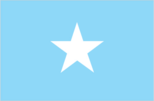
light blue with a large white five-pointed star in the center; the blue field was originally influenced by the flag of the UN but today is said to denote the sky and the neighboring Indian Ocean; the five points of the star represent the five regions in the horn of Africa that are inhabited by Somali people: the former British Somaliland and Italian Somaliland (which together make up Somalia), Djibouti, Ogaden (Ethiopia), and the North East Province (Kenya)
Government - note
regional and local governing bodies continue to exist and control various areas of the country, including the self-declared Republic of Somaliland in northwestern Somalia
Government type
federal parliamentary republic
Independence
1 July 1960 (from a merger of British Somaliland, which became independent from the UK on 26 June 1960, and Italian Somaliland, which became independent from the Italian-administered UN trusteeship on 1 July 1960 to form the Somali Republic)
International law organization participation
accepts compulsory ICJ jurisdiction with reservations; non-party state to the ICCt
International organization participation
ACP, AfDB, AFESD, AMF, AU, CAEU (candidate), FAO, G-77, IBRD, ICAO, ICRM, IDA, IDB, IFAD, IFC, IFRCS, IGAD, ILO, IMF, IMO, Interpol, IOC, IOM, IPU, ITSO, ITU, LAS, NAM, OIC, OPCW, OPCW (signatory), UN, UNCTAD, UNESCO, UNHCR, UNHRC, UNIDO, UPU, WFTU (NGOs), WHO, WIPO, WMO
Judicial branch
- highest court(s)
- the provisional constitution stipulates the establishment of the Constitutional Court (consists of 5 judges, including the chief judge and deputy chief judge); note - under the terms of the 2004 Transitional National Charter, a Supreme Court based in Mogadishu and the Appeal Court were established; yet most regions have reverted to local forms of conflict resolution, either secular, traditional Somali customary law, or Islamic law
- judge selection and term of office
- judges appointed by the president upon proposal of the Judicial Service Commission, a 9-member judicial and administrative body; judge tenure NA
- subordinate courts
- federal courts; federal member state-level courts; military courts; sharia courts
Legal system
mixed legal system of civil law, Islamic (sharia) law, and customary law (referred to as Xeer)
Legislative branch
- description
- bicameral Federal Parliament to consist of:Senate (54 seats; senators indirectly elected by state assemblies to serve 4-year terms)House of the People (275 seats; members indirectly elected by electoral colleges, each consisting of 51 delegates selected by the 136 Traditional Elders in consultation with sub-clan elders; members serve 4-year terms)
- election results
- Senate - percent of vote by party - NA; seats by party - NA; composition - men 40, women 14, percent of women 25.9%House of the People - percent of vote by party - NA; seats by party - NA; composition - men 225, women 50, percent of women 22.2%; note - total Parliament percent of women 19.5%
- elections
- Senate - first held on 10 October 2016; last held 27 July - 13 November 2021 (next to be held in 2024)House of the People - first held 23 October - 10 November 2016 (next scheduled for September - October 2021 but postponed to November 2021 and then extended numerous times until April 2022; next to be held in 2024)
- note
- note 1: the inaugural House of the People was appointed in September 2012 by clan elders; in 2016 and 2017, the Federal Parliament became bicameral with indirect elections scheduled for 10 October 2016 for the Upper House - renamed 'Senate' and 23 October to 10 November 2016 for the House of the People; while the elections were delayed, they were eventually held in most regions despite voting irregularities; on 27 December 2016, 41 Upper House senators and 242 House of the People Members of Parliament (MP) were sworn innote 2: despite the formation of political parties in 2020, the 2021 parliamentary elections maintained a primarily clan-based system of appointments; seats in the legislature were apportioned to Somali member states and not by party representation
National anthem
- lyrics/music
- lyrics/music: Abdullahi QARSHE
- name
- "Qolobaa Calankeed" (Every Nation Has its own Flag)
- note
- note: adopted 2012; written in 1959
National holiday
Foundation of the Somali Republic, 1 July (1960); note - 26 June (1960) in Somaliland
National symbol(s)
leopard; national colors: blue, white
Political parties and leaders
- select National Independent Electoral Commission (NIEC) approved parties (as of 2020): Cosmopolitan Democratic Party [Yarow Sharef ADEN]Green Party [Ahmed HAJI]Himilo Qaran Party [Sharif SHEIKH AHMED]Ilays Party [Abdulkadir OSOBLE]Justice and Reconciliation PartyNational Progressive PartyPeace and Unity Party [Asha ABDALLA]Qaransoor Party [Abdijabaar SHEIKH AHMED]Qiimo Qaran PartySecurity and Justice PartySocial Justice Party [Mohamed NUR, chairman]Somali Labour Party[Ali Mohamed APOLLO, chairman]Somali Republic Party [Abdinur Ahmed DARMAN, chairman]Somali Social Unity Party or SSUP [Yaasiin Maaxi MACALIN]Union for Peace and Development Party or PDP [HASSAN SHEIKH Mohamud]Wadajir Party [Abdirahman Abdishakur WARSAME]
- note
- note: in 2017 an independent electoral commission (the NIEC) was inaugurated with a mandate to oversee the process of registration of political parties in the country; as of 2021, the NIEC had registered a total of 110 parties
Suffrage
18 years of age; universal
Economy
Agricultural products
camel milk, milk, sheep milk, goat milk, sugar cane, fruit, sorghum, cassava, vegetables, maize
Budget
- expenditures
- 151.1 million (2014 est.)
- revenues
- 145.3 million (2014 est.)
Budget surplus (+) or deficit (-)
-0.1% (of GDP) (2014 est.)
Current account balance
- Current account balance 2016
- -$427 million (2016 est.)
- Current account balance 2017
- -$464 million (2017 est.)
Debt - external
- Debt - external 31 December 2014
- $5.3 billion (31 December 2014 est.)
Economic overview
Despite the lack of effective national governance, Somalia maintains an informal economy largely based on livestock, remittance/money transfer companies, and telecommunications. Somalia's government lacks the ability to collect domestic revenue and external debt – mostly in arrears – was estimated at about 77% of GDP in 2017. Agriculture is the most important sector, with livestock normally accounting for about 40% of GDP and more than 50% of export earnings. Nomads and semi-pastoralists, who are dependent upon livestock for their livelihood, make up a large portion of the population. Economic activity is estimated to have increased by 2.4% in 2017 because of growth in the agriculture, construction and telecommunications sector. Somalia's small industrial sector, based on the processing of agricultural products, has largely been looted and the machinery sold as scrap metal. In recent years, Somalia's capital city, Mogadishu, has witnessed the development of the city's first gas stations, supermarkets, and airline flights to Turkey since the collapse of central authority in 1991. Mogadishu's main market offers a variety of goods from food to electronic gadgets. Hotels continue to operate and are supported with private-security militias. Formalized economic growth has yet to expand outside of Mogadishu and a few regional capitals, and within the city, security concerns dominate business. Telecommunication firms provide wireless services in most major cities and offer the lowest international call rates on the continent. In the absence of a formal banking sector, money transfer/remittance services have sprouted throughout the country, handling up to $1.6 billion in remittances annually, although international concerns over the money transfers into Somalia continues to threaten these services’ ability to operate in Western nations. In 2017, Somalia elected a new president and collected a record amount of foreign aid and investment, a positive sign for economic recovery.
Exchange rates
- Currency
- Somali shillings (SOS) per US dollar -
- Exchange rates 2016
- 23,960 (2016 est.)
Exports
- Exports 2013
- $779 million (2013 est.)
- Exports 2014
- $819 million (2014 est.)
Exports - commodities
gold, sheep, goats, sesame seeds, insect resins, cattle (2019)
Exports - partners
United Arab Emirates 47%, Saudi Arabia 19%, India 5%, Japan 5% (2019)
Fiscal year
NA
GDP - composition, by end use
- exports of goods and services
- 0.3% (2015 est.)
- government consumption
- 8.7% (2015 est.)
- household consumption
- 72.6% (2015 est.)
- imports of goods and services
- -1.6% (2015 est.)
- investment in fixed capital
- 20% (2015 est.)
- investment in inventories
- 0.8% (2016 est.)
GDP - composition, by sector of origin
- agriculture
- 60.2% (2013 est.)
- industry
- 7.4% (2013 est.)
- services
- 32.5% (2013 est.)
GDP (official exchange rate)
$7.052 billion (2017 est.)
Household income or consumption by percentage share
- highest 10%
- NA
- lowest 10%
- NA
Imports
- Imports 2017
- $80.07 billion (2017 est.)
- Imports 2018
- $94.43 billion (2018 est.)
Imports - commodities
cigarettes, raw sugar, rice, broadcasting equipment, textiles (2019)
Imports - partners
United Arab Emirates 32%, China 20%, India 17%, Turkey 7% (2019)
Industrial production growth rate
3.5% (2014 est.)
Industries
light industries, including sugar refining, textiles, wireless communication
Inflation rate (consumer prices)
- Inflation rate (consumer prices) 2016
- -71.1% (2016 est.)
- Inflation rate (consumer prices) 2017
- 1.5% (2017 est.)
Labor force
4.154 million (2016 est.)
Labor force - by occupation
- agriculture
- 71%
- industry
- 29%
- industry and services
- 29% (1975)
Population below poverty line
NA
Public debt
- Public debt 2014
- 93% of GDP (2014 est.)
- Public debt 2017
- 76.7% of GDP (2017 est.)
Real GDP (purchasing power parity)
- note
- note: data are in 2017 US dollars
- Real GDP (purchasing power parity) 2018
- $13.01 billion (2018 est.)
- Real GDP (purchasing power parity) 2019
- $13.39 billion (2019 est.)
- Real GDP (purchasing power parity) 2020
- $13.19 billion (2020 est.)
Real GDP growth rate
- Real GDP growth rate 2015
- 3.9% (2015 est.)
- Real GDP growth rate 2016
- 4.4% (2016 est.)
- Real GDP growth rate 2017
- 2.3% (2017 est.)
Real GDP per capita
- note
- note: data are in 2017 dollars
- Real GDP per capita 2018
- $900 (2018 est.)
- Real GDP per capita 2019
- $900 (2019 est.)
- Real GDP per capita 2020
- $800 (2020 est.)
Reserves of foreign exchange and gold
- Reserves of foreign exchange and gold 2014
- $30.45 million (2014 est.)
Taxes and other revenues
2.1% (of GDP) (2014 est.)
Unemployment rate
NA
Youth unemployment rate (ages 15-24)
- female
- 36.7% (2019)
- male
- 31.9%
- total
- 33.8%
Energy
Carbon dioxide emissions
- from coal and metallurgical coke
- 0 metric tonnes of CO2 (2019 est.)
- from consumed natural gas
- 0 metric tonnes of CO2 (2019 est.)
- from petroleum and other liquids
- 882,000 metric tonnes of CO2 (2019 est.)
- total emissions
- 882,000 metric tonnes of CO2 (2019 est.)
Coal
- consumption
- 0 metric tons (2020 est.)
- exports
- 0 metric tons (2020 est.)
- imports
- 0 metric tons (2020 est.)
- production
- 0 metric tons (2020 est.)
- proven reserves
- 0 metric tons (2019 est.)
Electricity
- consumption
- 311.2 million kWh (2019 est.)
- exports
- 0 kWh (2019 est.)
- imports
- 0 kWh (2019 est.)
- installed generating capacity
- 91,000 kW (2020 est.)
- transmission/distribution losses
- 35 million kWh (2019 est.)
Electricity access
- electrification - rural areas
- 4% (2019)
- electrification - total population
- 18% (2019)
- electrification - urban areas
- 34% (2019)
Electricity generation sources
- biomass and waste
- 0% of total installed capacity (2020 est.)
- fossil fuels
- 95.3% of total installed capacity (2020 est.)
- geothermal
- 0% of total installed capacity (2020 est.)
- hydroelectricity
- 0% of total installed capacity (2020 est.)
- nuclear
- 0% of total installed capacity (2020 est.)
- solar
- 3% of total installed capacity (2020 est.)
- tide and wave
- 0% of total installed capacity (2020 est.)
- wind
- 1.7% of total installed capacity (2020 est.)
Energy consumption per capita
- Total energy consumption per capita 2019
- 802,000 Btu/person (2019 est.)
Natural gas
- consumption
- 0 cubic meters (2021 est.)
- exports
- 0 cubic meters (2021 est.)
- imports
- 0 cubic meters (2021 est.)
- production
- 0 cubic meters (2021 est.)
- proven reserves
- 5.663 billion cubic meters (2021 est.)
Petroleum
- crude oil and lease condensate exports
- 0 bbl/day (2018 est.)
- crude oil and lease condensate imports
- 0 bbl/day (2018 est.)
- crude oil estimated reserves
- 0 barrels (2021 est.)
- refined petroleum consumption
- 5,900 bbl/day (2019 est.)
- total petroleum production
- 0 bbl/day (2021 est.)
Refined petroleum products - exports
0 bbl/day (2015 est.)
Refined petroleum products - imports
5,590 bbl/day (2015 est.)
Refined petroleum products - production
0 bbl/day (2015 est.)
Communications
Broadband - fixed subscriptions
- subscriptions per 100 inhabitants
- 1 (2020 est.)
- total
- 119,000 (2020 est.)
Broadcast media
2 private TV stations rebroadcast Al-Jazeera and CNN; Somaliland has 1 government-operated TV station and Puntland has 1 private TV station; the transitional government operates Radio Mogadishu; 1 SW and roughly 10 private FM radio stations broadcast in Mogadishu; several radio stations operate in central and southern regions; Somaliland has 1 government-operated radio station; Puntland has roughly a half-dozen private radio stations; transmissions of at least 2 international broadcasters are available (2019)
Internet country code
.so
Internet users
- percent of population
- 2% (2019 est.)
- total
- 308,858 (2019 est.)
Telecommunication systems
- domestic
- seven networks compete for customers in the mobile sector; some of these mobile-service providers offer fixed-lines and Internet services; fixed-line is less than 1 per 100 and mobile-cellular roughly 56 per 100 (2020)
- general assessment
- Somalia’s economic difficulties in recent years have made it difficult for telcos and the government to sustain investment in infrastructure; the government has also had to contend with militant groups which continue on occasion to force the closure of internet services in many areas of the country; in recent years, though, the government has addressed the lack of guidance which had prevailed since 1991, when a dictatorial regime was overthrown; the National Communications Law was passed in October 2017, aimed at setting a legal and regulatory framework for the telecoms sector, while provision was made in the following year to set up a regulatory authority to oversee the telecom sector; more recently, three types of licenses were mandated to provide clarity to operators, and to bring the market closer into line with international standards; all operators were given until August 2020 to secure one of the three license types; given the poor condition of fixed-line infrastructure, operators have concentrated on mobile connectivity; their investment plans have involved the development of LTE services to provide mobile data and broadband services; the telecom market has flourished; tariffs are among the lowest in Africa, and new cable systems coming on stream in the next few years, as well as planned investments from local operators to bolster the country’s national fiber backbone, will lead to downward pressure on retail pricing; on the consumer side, spending on telecoms services and devices are under pressure from the financial effect of large-scale job losses and the consequent restriction on disposable incomes as the remnants of the impact of the Covid-19 pandemic remain and as global events, such as the Russian invasion of Ukraine, continue to play out; the market is continuing a positive growth trajectory, supported by a slow economic rebound in the country (2022)
- international
- country code - 252; landing points for the G2A, DARE1, PEACE, and EASSy fiber-optic submarine cable system linking East Africa, Indian Ocean Islands, the Middle East, North Africa and Europe (2019)
- note
- note: the COVID-19 pandemic continues to have a significant impact on production and supply chains globally; since 2020, some aspects of the telecom sector have experienced a downturn, particularly in mobile device production; progress toward 5G implementation has resumed, as well as upgrades to infrastructure; consumer spending on telecom services has increased due to the surge in demand for capacity and bandwidth; the crucial nature of telecom services as a tool for work and school from home is still evident, and the spike in this area has seen growth opportunities for development of new tools and increased services
Telephones - fixed lines
- subscriptions per 100 inhabitants
- 1 (2020 est.)
- total subscriptions
- 91,000 (2020 est.)
Telephones - mobile cellular
- subscriptions per 100 inhabitants
- 48.8 (2019)
- total subscriptions
- 7.119 million (2018)
Transportation
Airports
- total
- 52 (2021)
Airports - with paved runways
- 1,524 to 2,437 m
- 2 (2021)
- 2,438 to 3,047 m
- 1
- over 3,047 m
- 5
- total
- 8
Airports - with unpaved runways
- 1,524 to 2,437 m
- 16
- 2,438 to 3,047 m
- 5
- 914 to 1,523 m
- 22
- total
- 44
- under 914 m
- 1 (2021)
Civil aircraft registration country code prefix
6O
Merchant marine
- by type
- general cargo 1, other 3 (2021)
- total
- 4
National air transport system
- annual passenger traffic on registered air carriers
- 4,486 (2018)
- inventory of registered aircraft operated by air carriers
- 7
- number of registered air carriers
- 6 (2020)
Ports and terminals
- major seaport(s)
- Berbera, Kismaayo
Roadways
- total
- 15,000 km (2018)
Military and Security
Maritime threats
the International Maritime Bureau’s (IMB) Piracy Reporting Center (PRC) received one incident of piracy and armed robbery in 2021 for the Horn of Africa; while there were no recorded incidents, the IMB PRC warns that Somalia pirates continue to possess the capacity to carry out attacks in the Somali basin and wider Indian Ocean; in particular, the report warns that, "Masters and crew must remain vigilant and cautious when transiting these waters."; the presence of several naval task forces in the Gulf of Aden and additional anti-piracy measures on the part of ship operators, including the use of on-board armed security teams, contributed to the drop in incidents; the EU naval mission, Operation ATALANTA, continues its operations in the Gulf of Aden and Indian Ocean through 2022; naval units from China, India, Japan, Pakistan, South Korea, the US, and other countries also operate in conjunction with EU forces
Military - note
as of 2022, the Somali National Army (SNA) and supporting security and militia forces were actively conducting operations against the al-Shabaab terrorist group (see Appendix T); al-Shabaab controlled large parts of southern and central Somalia of the SNA’s approximately 13 brigades, the most effective were assessed to be the US-trained Danab ("Lightning") Advanced Infantry Brigade and those of the Turkish-trained Gorgor ("Eagle") Special Division; as of 2022, the Danab Brigade numbered about 1,500 troops with an eventual projected strength of 3,000, while the Gorgor Division was estimated to up to 5,000 trained troops; the Somali Government also sent some 5,000 recruits to Eritrea for military training; the troops returned in 2022the African Union Mission in Somalia (AMISOM) operated in the country with the approval of the UN from 2007-2022; its peacekeeping mission included assisting Somali forces in providing security for a stable political process, enabling the gradual handing over of security responsibilities from AMISOM to the Somali security forces, and reducing the threat posed by al-Shabaab and other armed opposition groups; in April 2022, AMISOM was reconfigured and replaced with the AU Transition Mission in Somalia (ATMIS); the ATMIS mission is to support the Somalia Federal Government (FGS) in implementing the security objectives of the FGS's security transition plan, a comprehensive strategy developed by the FGS and its international partners in 2018 and updated in 2021 to gradually transfer security responsibilities from ATMIS to Somali security forces; ATMIS is projected to gradually reduce staffing from its 2022 level of about 20,000 personnel (civilians, military, and police) to zero by the end of 2024 UN Assistance Mission in Somalia (UNSOM; established 2013) is mandated by the Security Council to work with the FGS to support national reconciliation, provide advice on peace-building and state-building, monitor the human rights situation, and help coordinate the efforts of the international community; the UN Support Office in Somalia (UNSOS; established 2015) is responsible for providing logistical field support to ATMIS, UNSOM, and the Somali security forces on joint operations with ATMISthe European Union Training Mission in Somalia (EUTM-S) has operated in the country since 2010; the EUTM provides advice and training to the Somali military; the US, UK, and Turkey maintain separate military training missions in Somalia (the US has also supported the SNA with air strikes); the UAE maintains a military presence in Somaliland (2022)
Military and security forces
- Ministry of Defense: Somali National Army (SNA); Ministry of Internal Security: Somali National Police (SNP, includes a maritime unit and a Turkish-trained commando unit known as Harmacad, or Cheetah); National Security and Intelligence Agency (includes a commando/counterterrorism unit) (2022)
- note
- note 1: Somalia has numerous militia and regional forces operating throughout the country; these forces include ones that are clan- and warlord-based, semi-official paramilitary and special police forces (aka darwish), and externally-sponsored militias; the SNA is attempting to incorporate some of these militia unitsnote 2: Somaliland has army and naval forces under the Somaliland Ministry of Defense and Armed Forces
Military and security service personnel strengths
- estimates vary widely due to inconsistent data and ongoing efforts to integrate various militias; up to 20,000 active-duty SNA personnel (2022)
- note
- note 1: in 2017, the Somali Government announced a plan for the SNA to eventually number about 18,000 troops; the same plan called for 32,000 federal and regional policenote 2: as of 2021, there were estimates of up to 50,000 militia forces operating in the country
Military equipment inventories and acquisitions
- the SNA is lightly armed with an inventory that includes a variety of older, second-hand equipment largely from Italy, Russia, South Africa, and the UK; since 2015, it has received small quantities of second-hand equipment as aid/donations from a variety of countries (2022)
- note
- note: in 2022, the UN voted to maintain an arms embargo on Somali in place since 1992; however, the embargo was modified to reflect the the Somali Government’s progress in improving its management of weapons and ammunition; it includes allowing Somalia to import portable surface-to-air missiles, higher-caliber mortars, anti-tank guided weapons, some aircraft and vessels designed or modified for military use, and combat drones for use by its security forces and police — unless the Security Council committee monitoring sanctions objects within five working days of receiving notification from the Somali Government
Military expenditures
- Military Expenditures 2015
- 5.9% of GDP (2015 est.) (approximately $110 million)
- Military Expenditures 2016
- 6% of GDP (2016 est.) (approximately $110 million)
- Military Expenditures 2017
- 5.9% of GDP (2017 est.) (approximately $110 million)
- Military Expenditures 2018
- 6% of GDP (2018 est.) (approximately $120 million)
- Military Expenditures 2019
- 5.6% of GDP (2019 est.) (approximately $120 million)
Military service age and obligation
- 18 is the legal minimum age for compulsory and voluntary military service; conscription is authorized but not currently utilized; women may volunteer (2021)
- note
- note: in 2019, the Federal Government of Somalia renewed its commitment to end the recruitment and use of child soldiers by signing a roadmap detailing measures and practical actions to prevent violations against children, release children associated with armed forces, and reintegrate them into communities; the signing followed a similar accord committed to ending the use of child soldiers signed by both the Somali Transitional Government and the UN in 2012
Transnational Issues
Disputes - international
Somalia-Djibouti: none identified Somalia-Ethiopia: Ethiopian forces invaded southern Somalia and routed Islamist Courts from Mogadishu in January 2007; the border between the Ogaden region of eastern Ethiopia, which is inhabited by ethnic Somalis, and Somalia is only partially demarcated under colonial rule and has been the source of tension for decades Somalia-Kenya: Kenya works hard to prevent the clan and militia fighting in Somalia from spreading south across the border, which has long been open to nomadic pastoralists; in 2015, the Kenyan Government began building a wall along the border to prevent the crossborder movement of militant groups; the boundary separates ethnic Somalis; in October 2021, the Somalia-Kenya Indian Ocean boundary dispute was decided by the International Court of Justice; the ruling adjusted the boundary slightly north of Somalia’s claim giving Somalia the majority of the contested maritime territory, which is believed to contain rich oil and natural gas deposits; while the decision is legally binding, it has no enforcement mechanism, and Kenya has said it will not abide by it
Refugees and internally displaced persons
- IDPs
- 2.968 million (civil war since 1988, clan-based competition for resources; famine; insecurity because of fighting between al-Shabaab and the Transitional Federal Government's allied forces) (2022)
- refugees (country of origin)
- 9,208 (Yemen) (2022)
Terrorism
Terrorist group(s)
- al-Shabaab; Islamic State of Iraq and ash-Sham – Somalia
- note
- note: details about the history, aims, leadership, organization, areas of operation, tactics, targets, weapons, size, and sources of support of the group(s) appear(s) in Appendix-T
Environment
Air pollutants
- carbon dioxide emissions
- 0.65 megatons (2016 est.)
- methane emissions
- 20.13 megatons (2020 est.)
- particulate matter emissions
- 29.51 micrograms per cubic meter (2016 est.)
Climate
principally desert; northeast monsoon (December to February), moderate temperatures in north and hot in south; southwest monsoon (May to October), torrid in the north and hot in the south, irregular rainfall, hot and humid periods (tangambili) between monsoons
Environment - current issues
water scarcity; contaminated water contributes to human health problems; improper waste disposal; deforestation; land degradation; overgrazing; soil erosion; desertification
Environment - international agreements
- party to
- Biodiversity, Climate Change, Climate Change-Kyoto Protocol, Climate Change-Paris Agreement, Desertification, Endangered Species, Hazardous Wastes, Law of the Sea, Ozone Layer Protection
- signed, but not ratified
- Nuclear Test Ban
Food insecurity
- exceptional shortfall in aggregate food production/supplies
- due to drought conditions and internal conflict - an estimated 6.7 million people are expected to face severe acute food insecurity between October and December 2022, including about 300,000 people facing “Catastrophe” levels of food insecurity, resulting from consecutive poor rainy seasons since late 2020, which severely affected crop and livestock production, and due to heightened conflict since early 2021; famine is expected to occur in Bay region between October and December 2022 if humanitarian assistance is not urgently scaled up (2022)
Land use
- agricultural land
- 70.3% (2018 est.)
- agricultural land: arable land
- arable land: 1.8% (2018 est.)
- agricultural land: permanent crops
- permanent crops: 0% (2018 est.)
- agricultural land: permanent pasture
- permanent pasture: 68.5% (2018 est.)
- forest
- 10.6% (2018 est.)
- other
- 19.1% (2018 est.)
Major aquifers
Ogaden-Juba Basin
Major infectious diseases
- animal contact diseases
- rabies
- degree of risk
- very high (2020)
- food or waterborne diseases
- bacterial and protozoal diarrhea, hepatitis A and E, and typhoid fever
- note
- note: on 21 March 2022, the US Centers for Disease Control and Prevention (CDC) issued a Travel Alert for polio in Africa; Somalia is currently considered a high risk to travelers for circulating vaccine-derived polioviruses (cVDPV); vaccine-derived poliovirus (VDPV) is a strain of the weakened poliovirus that was initially included in oral polio vaccine (OPV) and that has changed over time and behaves more like the wild or naturally occurring virus; this means it can be spread more easily to people who are unvaccinated against polio and who come in contact with the stool or respiratory secretions, such as from a sneeze, of an “infected” person who received oral polio vaccine; the CDC recommends that before any international travel, anyone unvaccinated, incompletely vaccinated, or with an unknown polio vaccination status should complete the routine polio vaccine series; before travel to any high-risk destination, the CDC recommends that adults who previously completed the full, routine polio vaccine series receive a single, lifetime booster dose of polio vaccine
- vectorborne diseases
- dengue fever, malaria, and Rift Valley fever
- water contact diseases
- schistosomiasis
Total renewable water resources
14.7 billion cubic meters (2017 est.)
Total water withdrawal
- agricultural
- 3.281 billion cubic meters (2017 est.)
- industrial
- 2 million cubic meters (2017 est.)
- municipal
- 15 million cubic meters (2017 est.)
Urbanization
- rate of urbanization
- 4.2% annual rate of change (2020-25 est.)
- urban population
- 47.9% of total population (2023)
Waste and recycling
- municipal solid waste generated annually
- 2,326,099 tons (2016 est.)