2010 Edition
CIA World Factbook 2010 (Project Gutenberg)
Introduction
Background
The UK established a protectorate over the Solomon Islands in the 1890s. Some of the most bitter fighting of World War II occurred on this archipelago. Self-government was achieved in 1976 and independence two years later. Ethnic violence, government malfeasance, and endemic crime have undermined stability and civil society. In June 2003, then Prime Minister Sir Allan KEMAKEZA sought the assistance of Australia in reestablishing law and order; the following month, an Australian-led multinational force arrived to restore peace and disarm ethnic militias. The Regional Assistance Mission to the Solomon Islands (RAMSI) has generally been effective in restoring law and order and rebuilding government institutions.
Geography
Area
- land
- 27,986 sq km
- total
- 28,896 sq km
- water
- 910 sq km
Area - comparative
slightly smaller than Maryland
Climate
tropical monsoon; few extremes of temperature and weather
Coastline
5,313 km
Elevation extremes
- highest point
- Mount Popomanaseu 2,310 m
- lowest point
- Pacific Ocean 0 m
Environment - current issues
deforestation; soil erosion; many of the surrounding coral reefs are dead or dying
Environment - international agreements
- party to
- Biodiversity, Climate Change, Climate Change-Kyoto Protocol, Desertification, Environmental Modification, Law of the Sea, Marine Dumping, Marine Life Conservation, Ozone Layer Protection, Whaling signed, but not ratified: none of the selected agreements
Geographic coordinates
8 00 S, 159 00 E
Geography - note
strategic location on sea routes between the South Pacific Ocean, the Solomon Sea, and the Coral Sea; on 2 April 2007 an undersea earthquake measuring 8.1 on the Richter scale occurred 345 km WNW of the capital Honiara; the resulting tsunami devastated coastal areas of Western and Choiseul provinces with dozens of deaths and thousands dislocated; the provincial capital of Gizo was especially hard hit
Irrigated land
NA
Land boundaries
0 km
Land use
- arable land
- 0.62%
- other
- 97.34% (2005)
- permanent crops
- 2.04%
Location
Oceania, group of islands in the South Pacific Ocean, east of Papua New Guinea
Map references
Oceania
Maritime claims
- measured from claimed archipelagic baselines
- continental shelf
- 200 nm
- exclusive economic zone
- 200 nm
- territorial sea
- 12 nm
Natural hazards
- typhoons, but rarely destructive; geologically active region with frequent earthquakes, tremors, and volcanic activity; tsunamis
- volcanism
- Tinakula (elev. 851 m, 2,792 ft) has frequent eruption activity, while an eruption of Savo (elev. 485 m, 1,591 ft) could affect the capital Honiara on nearby Guadalcanal
Natural resources
fish, forests, gold, bauxite, phosphates, lead, zinc, nickel
Terrain
mostly rugged mountains with some low coral atolls
Total renewable water resources
44.7 cu km (1987)
People and Society
Age structure
0-14 years: 39.5% (male 119,875/female 115,127) 15-64 years: 57.1% (male 171,792/female 168,023) 65 years and over: 3.5% (male 9,849/female 10,947) (2010 est.)
Birth rate
28.6 births/1,000 population (2010 est.)
Death rate
3.96 deaths/1,000 population (July 2010 est.)
Education expenditures
2.2% of GDP (1999)
Ethnic groups
Melanesian 94.5%, Polynesian 3%, Micronesian 1.2%, other 1.1%, unspecified 0.2% (1999 census)
HIV/AIDS - adult prevalence rate
NA
HIV/AIDS - deaths
NA
HIV/AIDS - people living with HIV/AIDS
NA
Infant mortality rate
- female
- 15.74 deaths/1,000 live births (2010 est.)
- male
- 20.95 deaths/1,000 live births
- total
- 18.41 deaths/1,000 live births
Languages
Melanesian pidgin in much of the country is lingua franca; English (official but spoken by only 1%-2% of the population); 120 indigenous languages
Life expectancy at birth
- female
- 76.63 years (2010 est.)
- male
- 71.37 years
- total population
- 73.94 years
Literacy
NA
Median age
- female
- 20.8 years (2010 est.)
- male
- 20.4 years
- total
- 20.6 years
Nationality
- adjective
- Solomon Islander
- noun
- Solomon Islander(s)
Net migration rate
-1.94 migrant(s)/1,000 population (2009 est.)
Population
559,198 (July 2010 est.)
Population growth rate
2.27% (2010 est.)
Religions
Church of Melanesia 32.8%, Roman Catholic 19%, South Seas Evangelical 17%, Seventh-Day Adventist 11.2%, United Church 10.3%, Christian Fellowship Church 2.4%, other Christian 4.4%, other 2.4%, unspecified 0.3%, none 0.2% (1999 census)
School life expectancy (primary to tertiary education)
- female
- 9 years (2006)
- male
- 9 years
- total
- 9 years
Sex ratio
- at birth
- 1.05 male(s)/female under 15 years: 1.04 male(s)/female 15-64 years: 1.02 male(s)/female 65 years and over: 0.89 male(s)/female
- total population
- 1.02 male(s)/female (2010 est.)
Total fertility rate
3.67 children born/woman (2010 est.)
Urbanization
- rate of urbanization
- 4.1% annual rate of change (2005-10 est.)
- urban population
- 18% of total population (2008)
Government
Administrative divisions
9 provinces and 1 capital territory*; Central, Choiseul, Guadalcanal, Honiara*, Isabel, Makira, Malaita, Rennell and Bellona, Temotu, Western
Capital
- geographic coordinates
- 9 26 S, 159 57 E
- name
- Honiara
- time difference
- UTC+11 (16 hours ahead of Washington, DC during Standard Time)
Constitution
7 July 1978
Country name
- conventional long form
- none
- conventional short form
- Solomon Islands
- former
- British Solomon Islands
- local long form
- none
- local short form
- Solomon Islands
Diplomatic representation from the US
the US does not have an embassy in the Solomon Islands; the US ambassador to Papua New Guinea is accredited to the Solomon Islands
Diplomatic representation in the US
- chancery
- 800 Second Avenue, Suite 400L, New York, NY 10017
- chief of mission
- Ambassador Collin David BECK
- FAX
- [1] (212) 661-8925
- telephone
- [1] (212) 599-6192, 6193
Executive branch
- cabinet
- Cabinet consists of 20 members appointed by the governor general on the advice of the prime minister from among the members of parliament (For more information visit the World Leaders website )
- chief of state
- Queen ELIZABETH II (since 6 February 1952); represented by Governor General Frank KABUI (since 7 July 2009)
- elections
- the monarchy is hereditary; governor general appointed by the monarch on the advice of parliament for up to five years (eligible for a second term); following legislative elections, the leader of the majority party or the leader of a majority coalition usually elected prime minister by parliament; deputy prime minister appointed by the governor general on the advice of the prime minister from among the members of parliament
- head of government
- Prime Minister Danny PHILIP (since 25 August 2010)
Flag description
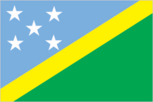
divided diagonally by a thin yellow stripe from the lower hoist-side corner; the upper triangle (hoist side) is blue with five white five-pointed stars arranged in an X pattern; the lower triangle is green; blue represents the ocean; green the land; and yellow sunshine; the five stars stand for the five main island groups of the Solomon Islands
Government - note
by the end of 2007, the Regional Assistance Mission to the Solomon Islands (RAMSI) - originally made up of police and troops from Australia, NZ, Fiji, Papua New Guinea, and Tonga - had been scaled back to 303 police officers, 197 civilian technical advisers, and 72 military advisers from 15 countries across the region
Government type
parliamentary democracy and a Commonwealth realm
Independence
7 July 1978 (from the UK)
International organization participation
ACP, ADB, AOSIS, C, ESCAP, FAO, G-77, IBRD, ICAO, ICRM, IDA, IFAD, IFC, IFRCS, ILO, IMF, IMO, IOC, ITU, MIGA, OPCW, PIF, Sparteca, SPC, UN, UNCTAD, UNESCO, UPU, WFTU, WHO, WMO, WTO
Judicial branch
Court of Appeal
Legal system
English common law, which is widely disregarded; has not accepted compulsory ICJ jurisdiction
Legislative branch
- unicameral National Parliament (50 seats; members elected from single-member constituencies by popular vote to serve four-year terms)
- election results
- percent of vote by party - NA; seats by party - Solomon Islands Democratic Party 13, Our Party 3, Reformed Democratic Party 3, Independent Democratic Party 2, PAP 2, SIPRA 2, Peoples Congress Party 1, Peoples Federation Party 1, Rural Development Party 1, Rural and Urban Political Party 1, Solomon Islands Liberal Party 1, Solomon Islands National Party 1, independents 19
- elections
- last held on 4 August 2010 (next to be held in 2014)
National anthem
- lyrics/music
- Panapasa BALEKANA and Matila BALEKANA/Panapasa BALEKANA note: adopted 1978
- name
- "God Save Our Solomon Islands"
National holiday
Independence Day, 7 July (1978)
Political parties and leaders
Association of Independent Members or AIM [Thomas CHAN]; Christian Alliance Solomon Islands or CASI [Edward RONIA]; LAFARI Party [John GARO]; National Party [Francis HILLY]; People's Alliance Party or PAP [Sir Allan KEMAKEZA]; Social Credit Party or SOCRED [Manasseh Damukana SOGAVARE]; Solomon First Party [David QUAN]; Solomon Islands Democratic Party [Gabriel SURI]; Solomon Islands Labor Party or SILP [Joses TUHANUKU]; Solomon Islands Liberal Party [Bartholomew ULUFA'ALU]; Solomon Islands Party for Rural Advancement or SIPRA [Job D. TAUSINGA]; United Party [Sir Peter KENILOREA] note: in general, Solomon Islands politics is characterized by fluid coalitions
Political pressure groups and leaders
Isatabu Freedom Movement (IFM); Malaita Eagle Force (MEF); note - these rival armed ethnic factions crippled the Solomon Islands in a wave of violence from 1999 to 2003
Suffrage
21 years of age; universal
Economy
Agriculture - products
cocoa beans, coconuts, palm kernels, rice, potatoes, vegetables, fruit; timber; cattle, pigs; fish
Commercial bank prime lending rate
15.26% (31 December 2009 est.) 14.44% (31 December 2008 est.)
Current account balance
-$143 million (2007 est.)
Debt - external
$166 million (2004)
Economy - overview
The bulk of the population depends on agriculture, fishing, and forestry for at least part of its livelihood. Most manufactured goods and petroleum products must be imported. The islands are rich in undeveloped mineral resources such as lead, zinc, nickel, and gold. Prior to the arrival of RAMSI, severe ethnic violence, the closing of key businesses, and an empty government treasury culminated in economic collapse. RAMSI's efforts to restore law and order and economic stability have led to modest growth as the economy rebuilds.
Electricity - consumption
66.03 million kWh (2007 est.)
Electricity - exports
0 kWh (2008 est.)
Electricity - imports
0 kWh (2008 est.)
Electricity - production
71 million kWh (2007 est.)
Exchange rates
Solomon Islands dollars (SBD) per US dollar - NA (2007), 7.3447 (2006), 7.5299 (2005), 7.4847 (2004), 7.5059 (2003)
Exports
$237 million (2006)
Exports - commodities
timber, fish, copra, palm oil, cocoa
Exports - partners
China 54.07%, South Korea 6.19%, Philippines 6.04%, Spain 4.87% (2009)
GDP - composition by sector
- agriculture
- 42%
- industry
- 11%
- services
- 47% (2005 est.)
GDP - per capita (PPP)
$2,800 (2010 est.) $2,800 (2009 est.) $2,900 (2008 est.) note: data are in 2010 US dollars
GDP - real growth rate
2.8% (2010 est.) -2.3% (2009 est.) 7.4% (2008 est.)
GDP (official exchange rate)
$674 million (2010 est.)
GDP (purchasing power parity)
$1.559 billion (2010 est.) $1.517 billion (2009 est.) $1.553 billion (2008 est.) note: data are in 2010 US dollars
Household income or consumption by percentage share
lowest 10%: NA% highest 10%: NA%
Imports
$256 million (2006)
Imports - commodities
food, plant and equipment, manufactured goods, fuels, chemicals
Imports - partners
Singapore 24.69%, Australia 23.06%, NZ 5.2%, Fiji 4.47%, Papua New Guinea 4.34%, Malaysia 3.98% (2009)
Industrial production growth rate
NA%
Industries
fish (tuna), mining, timber
Inflation rate (consumer prices)
6.3% (2007 est.)
Labor force
202,500 (2007)
Labor force - by occupation
- agriculture
- 75%
- industry
- 5%
- services
- 20% (2000 est.)
Natural gas - consumption
0 cu m (2008 est.)
Natural gas - exports
0 cu m (2008 est.)
Natural gas - imports
0 cu m (2008 est.)
Natural gas - production
0 cu m (2008 est.)
Natural gas - proved reserves
0 cu m (1 January 2010 est.)
Oil - consumption
2,000 bbl/day (2009 est.)
Oil - exports
0 bbl/day (2007 est.)
Oil - imports
1,323 bbl/day (2007 est.)
Oil - production
0 bbl/day (2009 est.)
Oil - proved reserves
0 bbl (1 January 2010 est.)
Population below poverty line
NA%
Stock of broad money
$227.1 million (31 December 2009) $195.9 million (31 December 2008)
Stock of domestic credit
$221.9 million (31 December 2008 est.) $183.8 million (31 December 2007 est.)
Stock of narrow money
$139.9 million (31 December 2009) $124.4 million (31 December 2008)
Unemployment rate
NA%
Communications
Broadcast media
Solomon Islands Broadcasting Corporation (SIBC) is the sole TV broadcaster with 1 station; multi-channel pay-TV is available; SIBC, the public service broadcaster, operates 2 national radio stations and 2 provincial stations; 2 local commercial radio stations operating; Radio Australia is obtainable via satellite feed (2009)
Internet country code
.sb
Internet hosts
4,065 (2010)
Internet users
10,000 (2009)
Telephone system
- domestic
- mobile-cellular telephone density is about 5 telephones per 100 persons
- general assessment
- NA
- international
- country code - 677; satellite earth station - 1 Intelsat (Pacific Ocean)
Telephones - main lines in use
8,200 (2009)
Telephones - mobile cellular
30,000 (2009)
Transportation
Airports
36 (2010)
Airports - with paved runways
- total
- 2 1,524 to 2,437 m: 1 914 to 1,523 m: 1 (2010)
Airports - with unpaved runways
- total
- 34 1,524 to 2,437 m: 1 914 to 1,523 m: 8 under 914 m: 25 (2010)
Heliports
3 (2010)
Ports and terminals
Honiara, Malloco Bay, Viru Harbor, Tulaghi
Roadways
- paved
- 33 km
- total
- 1,360 km
- unpaved
- 1,327 km note: includes 800 km of private plantation roads (2002)
Military and Security
Manpower available for military service
males age 16-49: 150,987 (2010 est.)
Manpower fit for military service
males age 16-49: 125,928 females age 16-49: 126,999 (2010 est.)
Manpower reaching militarily significant age annually
- female
- 6,995 (2010 est.)
- male
- 7,256
Military branches
no regular military forces; Solomon Islands Police Force (2009)
Military expenditures
3% of GDP (2006)
Transnational Issues
Disputes - international
since 2003, RAMSI, consisting of police, military, and civilian advisors drawn from 15 countries, has assisted in reestablishing and maintaining civil and political order while reinforcing regional stability and security
Refugees and internally displaced persons
- IDPs
- 5,400 (displaced by tsunami on 2 April 2007) (2007) page last updated on January 11, 2011 ======================================================================