Introduction
<p>Settlers from Papua arrived on the Solomon Islands around 30,000 years ago. About 6,000 years ago, Austronesian settlers came to the islands, and the two groups mixed extensively. Despite significant inter-island trade, no attempts were made to unite the islands into a single political entity. In 1568, a Spanish explorer became the first European to spot the islands. After a failed Spanish attempt at creating a permanent European settlement in the late 1500s, the Solomon Islands remained free of European contact until a British explorer arrived in 1767. European explorers and US and British whaling ships regularly visited the islands into the 1800s.<br><br>Germany declared a protectorate over the northern Solomon Islands in 1885, and the UK established a protectorate over the southern islands in 1893. In 1899, Germany transferred its islands to the UK in exchange for the UK relinquishing all claims in Samoa. In 1942, Japan invaded the islands, and the Guadalcanal Campaign (August 1942-February 1943) proved a turning point in the Pacific theater of WWII. The fighting destroyed large parts of the Solomon Islands, and a nationalist movement emerged near the end of the war. By 1960, the British allowed some local autonomy. The islands were granted self-government in 1976 and independence two years later under Prime Minister Sir Peter KENILOREA.<br><br>In 1999, longstanding tensions between ethnic Guale in Honiara and ethnic Malaitans in Honiara’s suburbs erupted in civil war, leading thousands of Malaitans to take refuge in Honiara and prompting Guale to flee the city. In 2000, newly elected Prime Minister Manasseh SOGAVARE focused on peace agreements and distributing resources equally among groups, but his actions bankrupted the government in 2001 and led to his ouster. In 2003, the Solomon Islands requested international assistance to reestablish law and order; the Australian-led Regional Assistance Mission to the Solomon Islands, which ended in 2017, improved the security situation. In 2006, however, riots broke out in Honiara, and the city’s Chinatown was burned amid allegations that the prime minister took money from China. SOGAVARE was reelected prime minister for a fourth time in 2019. When a small group of protestors, mostly from the island of Malaita, approached parliament to lodge a petition calling for SOGAVARE’s removal and more development in Malaita in 2021, police fired tear gas into the crowd which sparked rioting and looting in Honiara. </p>
Geography
- Land
- 27,986 sq km
- Total
- 28,896 sq km
- Water
- 910 sq km
slightly smaller than Maryland
tropical monsoon; few temperature and weather extremes
5,313 km
Oceania
- Highest point
- Mount Popomanaseu 2,335 m
- Lowest point
- Pacific Ocean 0 m
8 00 S, 159 00 E
strategic location on sea routes between the South Pacific Ocean, the Solomon Sea, and the Coral Sea; Rennell Island, the southernmost in the Solomon Islands chain, is one of the world’s largest raised coral atolls; the island’s Lake Tegano, formerly a lagoon on the atoll, is the largest lake in the insular Pacific (15,500 hectares; 38,300 acres)
0 sq km (2022)
- Total
- 0 km
- Agricultural land
- 3.9% (2023 est.)
- Agricultural land: arable land
- arable land: 0.8% (2023 est.)
- Agricultural land: permanent crops
- permanent crops: 2.8% (2023 est.)
- Agricultural land: permanent pasture
- permanent pasture: 0.3% (2023 est.)
- arable land
- 0.82%
- Forest
- 89.9% (2023 est.)
- Other
- 6.2% (2023 est.)
- permanent crops
- 2.79%
No
Oceania, group of islands in the South Pacific Ocean, east of Papua New Guinea
- Google Maps
- https://goo.gl/maps/JbPkx86Ywjv8C1n8A
- OpenStreetMap
- https://www.openstreetmap.org/relation/1857436
Oceania
- Continental shelf
- 200 nm
- Exclusive economic zone
- 200 nm
- Note
- <strong>note: </strong>measured from claimed archipelagic baselines
- Territorial sea
- 12 nm
tropical cyclones, but rarely destructive; geologically active region with frequent earthquakes, tremors, and volcanic activity; tsunamis <br><br><strong>volcanism:</strong> Tinakula (851 m) has frequent eruption activity, and an eruption of Savo (485 m) could affect the capital Honiara on nearby Guadalcanal
fish, forests, gold, bauxite, phosphates, lead, zinc, nickel
most of the population lives along the coastal regions; about one in five live in urban areas, and of these about two thirds reside in Honiara, the largest town and chief port
Melanesia
mostly rugged mountains with some low coral atolls
- UTC+11:00
- number of time zones
- 1
People and Society
- 0-14 years
- 30.6% (male 114,246/female 108,020)
- 15-64 years
- 64.2% (male 238,708/female 227,636)
- 65 years and over
- 5.3% (2024 est.) (male 18,016/female 20,173)
- Beer
- 1.1 liters of pure alcohol (2019 est.)
- Other alcohols
- 0 liters of pure alcohol (2019 est.)
- Spirits
- 0.02 liters of pure alcohol (2019 est.)
- Total
- 1.19 liters of pure alcohol (2019 est.)
- Wine
- 0.06 liters of pure alcohol (2019 est.)
21.57 births/1,000 population (2025 est.)
- Men married by age 18
- 4.4% (2015)
- Women married by age 15
- 5.6% (2015)
- Women married by age 18
- 21.3% (2015)
64.5% (2019 est.)
- 3.94 deaths/1,000 population (2025 est.)
- adult female
- 147 per 1,000
- adult male
- 185 per 1,000
- Elderly dependency ratio
- 8.4 (2025 est.)
- Potential support ratio
- 12 (2025 est.)
- Total dependency ratio
- 55.1 (2025 est.)
- Youth dependency ratio
- 46.7 (2025 est.)
- Improved: rural
- rural: 59.4% of population (2022 est.)
- Improved: total
- total: 73.1% of population
- Unimproved: rural
- rural: 40.6% of population (2022 est.)
- Education expenditure (% GDP)
- 8.3% of GDP (2023 est.)
- Education expenditure (% national budget)
- 25.2% national budget (2024 est.)
8 % of GDP
Melanesian 95.3%, Polynesian 3.1%, Micronesian 1.2%, other 0.3% (2009 est.)
1.33 (2025 est.)
- 5 % of GDP
- Health expenditure (as % of GDP)
- 4.8% of GDP (2021)
- Health expenditure (as % of national budget)
- 9.7% of national budget (2022 est.)
0.1%
- Female
- 15.2 deaths/1,000 live births
- Male
- 22.7 deaths/1,000 live births
- neonatal
- 8 deaths/1,000 live births
- Total
- 18.6 deaths/1,000 live births (2025 est.)
- Melanesian pidgin (lingua franca in much of the country), English (official but spoken by only 1%-2% of the population), 120 indigenous languages
- languages
- English
- number of languages
- 1
- Female
- 80 years
- Male
- 74.6 years
- Total population
- 77.2 years (2024 est.)
82,000 HONIARA (capital) (2018)
123 deaths/100,000 live births (2023 est.)
- Female
- 25.4 years
- Male
- 25 years
- Total
- 25.5 years (2025 est.)
- 22.6 years (2015 est.)
- note
- <strong>note:</strong> data represents median age at first birth among women 25-29
- Adjective
- Solomon Islander
- Noun
- Solomon Islander(s)
-1.47 migrant(s)/1,000 population (2025 est.)
22.5% (2016)
0.24 physicians/1,000 population (2023)
- Female
- 361,707
- Male
- 377,067
- Total
- 738,774 (2025 est.)
1.62% (2025 est.)
Protestant 73.4% (Church of Melanesia 31.9%, South Sea Evangelical 17.1%, Seventh Day Adventist 11.7%, United Church 10.1%, Christian Fellowship Church 2.5%), Roman Catholic 19.6%, other Christian 2.9%, other 4%, unspecified 0.1% (2009 est.)
- Improved: rural
- rural: 22.6% of population (2022 est.)
- Unimproved: rural
- rural: 77.4% of population (2022 est.)
- Unimproved: total
- total: 59.4% of population
- 0-14 years
- 1.06 male(s)/female
- 15-64 years
- 1.05 male(s)/female
- 65 years and over
- 0.89 male(s)/female
- At birth
- 1.05 male(s)/female
- Total population
- 1.04 male(s)/female (2024 est.)
- Female
- 18.8% (2025 est.)
- Male
- 54.5% (2025 est.)
- Total
- 36.8% (2025 est.)
2.72 children born/woman (2025 est.)
- Rate of urbanization
- 3.57% annual rate of change (2020-25 est.)
- Urban population
- 26% of total population (2023)
- measles
- 78%
Government
9 provinces and 1 city*; Central, Choiseul, Guadalcanal, Honiara*, Isabel, Makira and Ulawa, Malaita, Rennell and Bellona, Temotu, Western
- Etymology
- the name derives from the local term <em>nagho ni ara</em>, meaning "place of the east wind" or "facing the trade winds"
- Geographic coordinates
- 9 26 S, 159 57 E
- Name
- Honiara
- Time difference
- UTC+11 (16 hours ahead of Washington, DC, during Standard Time)
- Citizenship by birth
- no
- Citizenship by descent only
- at least one parent must be a citizen of the Solomon Islands
- Dual citizenship recognized
- no
- Residency requirement for naturalization
- 7 years
- svg
- https://mainfacts.com/media/images/coats_of_arms/sb.svg
- Amendment process
- proposed by the National Parliament; passage of constitutional sections, including those on fundamental rights and freedoms, the legal system, Parliament, alteration of the constitution and the ombudsman, requires three-fourths majority vote by Parliament and assent of the governor general; passage of other amendments requires two-thirds majority vote and assent of the governor general
- History
- adopted 31 May 1978, effective 7 July 1978
- alternative spellings
- SB
- Conventional long form
- none
- Conventional short form
- Solomon Islands
- Etymology
- Spanish explorer Alvaro de MENDANA named the isles in 1568 after the wealthy biblical King SOLOMON in the mistaken belief that the islands contained great riches
- FIFA code
- SOL
- Former
- British Solomon Islands
- Local long form
- none
- local long form (eng)
- Solomon Islands
- Local short form
- Solomon Islands
- Chief of mission
- Ambassador Ann Marie YASTISHOCK (since 14 March 2024); note - also accredited to the Papua New Guinea and Vanuatu, based in Port Moresby, Papua New Guinea
- Email address and website
- <br>EmbassyHoniara@state.gov<br><br>https://pg.usembassy.gov/
- Embassy
- BJS Building<br>Commonwealth Avenue<br>Honiara, Solomon Islands
- FAX
- [677] 27429
- Telephone
- [677] 23426
- Chancery
- 685 Third Avenue, 11th Floor, Suite 1102, New York, NY 10017
- Chief of mission
- Ambassador Jane Mugafalu Kabui WAETARA (since 16 September 2022); note - also Permanent Representative to the UN
- Email address and website
- <br>simun@solomons.com
- FAX
- [1] (212) 661-8925
- Telephone
- [1] (212) 599-6192
- Cabinet
- Cabinet appointed by the governor general on the advice of the prime minister
- Chief of state
- King CHARLES III (since 8 September 2022); represented by Governor General David Tiva KAPU (since 7 July 2024)
- Election/appointment process
- the monarchy is hereditary; governor general appointed by the monarch on the advice of the National Parliament for up to 5 years (eligible for a second term); following legislative elections, the National Parliament usually elects the leader of the majority party or majority coalition as prime minister; deputy prime minister appointed by the governor general on the advice of the prime minister
- Head of government
- Prime Minister Jeremiah MANELE (since 2 May 2024)
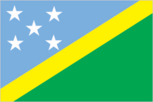
<strong>description: </strong>divided diagonally by a yellow stripe from the lower-left corner; the upper triangle (left side) is blue with five five-pointed white stars in an "X" pattern; the lower triangle is green<br><br><strong>meaning:</strong> blue stands for the ocean, green for the land, and yellow for sunshine; the five stars stand for the main island groups
The flag of Solomon Islands features a thin yellow diagonal band that extends from the lower hoist-side corner to the upper fly-side corner of the field. Above and beneath this band are a blue and green triangle respectively. Five white five-pointed stars arranged in an X shape are situated on the hoist side of the upper blue triangle.
- svg
- https://flagcdn.com/sb.svg
parliamentary democracy under a constitutional monarchy; a Commonwealth realm
7 July 1978 (from the UK)
has not submitted an ICJ jurisdiction declaration; non-party state to the ICCt
ACP, ADB, AOSIS, C, EITI (candidate country), ESCAP, FAO, G-77, IBRD, ICAO, ICRM, IDA, IFAD, IFC, IFRCS, ILO, IMF, IMO, IOC, ITU, MIGA, OPCW, PIF, Sparteca, SPC, UN, UNCTAD, UNESCO, UPU, WFTU, WHO, WMO, WTO
- Highest court(s)
- Court of Appeal (consists of the court president and ex officio members including the High Court chief justice and puisne judges); High Court (consists of the chief justice and puisne judges)
- Judge selection and term of office
- Court of Appeal and High Court president, chief justices, and puisne judges appointed by the governor general on recommendation of the Judicial and Legal Service Commission, chaired by the chief justice and includes 5 members, mostly judicial officials and legal professionals; all judges serve until retirement at age 60
- Subordinate courts
- Magistrates' Courts; Customary Land Appeal Court; local courts
mixed system of English common law and customary law
- Electoral system
- plurality/majority
- Expected date of next election
- April 2028
- Legislative structure
- unicameral
- Legislature name
- National Parliament
- Most recent election date
- 4/17/2024
- Number of seats
- 50 (all directly elected)
- Parties elected and seats per party
- Ownership Unity and Responsibility (OUR Party) (15); Solomon Islands Democratic Party (SIDP) (11); Solomon Islands United Party (UP) (6); Solomon Islands People First Party (SIPFP) (3); Independents (11); Other (4)
- Percentage of women in chamber
- 6%
- Scope of elections
- full renewal
- Term in office
- 4 years
blue, yellow, green, white
- Selected World Heritage Site locales
- East Rennell
- Total World Heritage Sites
- 1 (natural)
Independence Day, 7 July (1978)
- Democratic Alliance Party or DAP<br>Kadere Party of Solomon Islands or KAD<br>Ownership, Unity, and Responsibility Party (OUR Party)<br>Solomon Islands People First Party or SIPFP<br>Solomon Islands Democratic Party or SIDP<br>Solomon Islands Party for Rural Advancement or SIPRA<br>Solomon Islands United Party or UP<br>United for Change Party or U4C<br>Coalition for Accountability Reform and Empowerment (CARE) (includes DAP, SIDP, and U4C)
- note
- <strong>note:</strong> the Solomon Islands political party system is characterized by fluid coalitions
Monday
21 years of age; universal
Yes
Economy
- oil palm fruit, coconuts, sweet potatoes, yams, taro, fruits, pulses, vegetables, cocoa beans, cassava (2023)
- note
- <b>note:</b> top ten agricultural products based on tonnage
- Expenditures
- $482.24 million (2022 est.)
- Note
- <b>note:</b> central government revenues and expenses (excluding grants/extrabudgetary units/social security funds) converted to US dollars at average official exchange rate for year indicated
- Revenues
- $436.174 million (2022 est.)
- code
- SBD
- name
- Solomon Islands dollar (SBD) [$]
- $-66,230,866
- Current account balance 2022
- -$218.534 million (2022 est.)
- Current account balance 2023
- -$178.197 million (2023 est.)
- Current account balance 2024
- -$66.231 million (2024 est.)
- Note
- <b>note:</b> balance of payments - net trade and primary/secondary income in current dollars
- $596.15 million
- Debt - external 2023
- $184.191 million (2023 est.)
- Note
- <b>note:</b> present value of external debt in current US dollars
lower middle-income Pacific island economy; natural resource rich but environmentally fragile; key agrarian sector; growing Chinese economic relationship; infrastructure damage due to social unrest; metal mining operations
- Currency
- Solomon Islands dollars (SBD) per US dollar -
- Exchange rates 2020
- 8.213 (2020 est.)
- Exchange rates 2021
- 8.03 (2021 est.)
- Exchange rates 2022
- 8.156 (2022 est.)
- Exchange rates 2023
- 8.376 (2023 est.)
- Exchange rates 2024
- 8.455 (2024 est.)
- $642.59 million
- Exports 2022
- $411.359 million (2022 est.)
- Exports 2023
- $546.025 million (2023 est.)
- Exports 2024
- $642.877 million (2024 est.)
- Note
- <b>note:</b> balance of payments - exports of goods and services in current dollars
- wood, fish, gold, precious metal ore, palm oil (2023)
- note
- <b>note:</b> top five export commodities based on value in dollars
- China 56%, Australia 11%, Italy 10%, Spain 5%, Netherlands 4% (2023)
- note
- <b>note:</b> top five export partners based on percentage share of exports
- net inflows
- $32.97 million
- Exports of goods and services
- 26.3% (2022 est.)
- Government consumption
- 29.2% (2022 est.)
- Household consumption
- 61.7% (2022 est.)
- Imports of goods and services
- -51.7% (2022 est.)
- Investment in fixed capital
- 24.4% (2022 est.)
- Investment in inventories
- -1% (2022 est.)
- Note
- <strong>note:</strong> figures may not total 100% due to rounding or gaps in data collection
- Agriculture
- 33.8% (2022 est.)
- Industry
- 18.7% (2022 est.)
- Note
- <b>note:</b> figures may not total 100% due to non-allocated consumption not captured in sector-reported data
- Services
- 47.3% (2022 est.)
- $1.761 billion (2024 est.)
- note
- <b>note:</b> data in current dollars at official exchange rate
$1,934
37.1 (2012)
$1.59 billion
$1,910
19 % of GDP
- $1.12 billion
- Imports 2022
- $764.641 million (2022 est.)
- Imports 2023
- $883.611 million (2023 est.)
- Imports 2024
- $857.128 million (2024 est.)
- Note
- <b>note:</b> balance of payments - imports of goods and services in current dollars
- refined petroleum, plastic products, fish, broadcasting equipment, iron structures (2023)
- note
- <b>note:</b> top five import commodities based on value in dollars
- China 42%, Singapore 13%, Australia 13%, Taiwan 5%, Malaysia 5% (2023)
- note
- <b>note:</b> top five import partners based on percentage share of imports
- 4.7% (2022 est.)
- note
- <b>note:</b> annual % change in industrial value added based on constant local currency
fish (tuna), mining, timber
- 4.32%
- Inflation rate (consumer prices) 2021
- -0.1% (2021 est.)
- Inflation rate (consumer prices) 2022
- 5.5% (2022 est.)
- Inflation rate (consumer prices) 2023
- 5.9% (2023 est.)
- Note
- <b>note:</b> annual % change based on consumer prices
- 435,600 (2024 est.)
- note
- <b>note:</b> number of people ages 15 or older who are employed or seeking work
- total
- 448,502 persons
- agriculture
- 42.47%
- industry
- 7.58%
- services
- 49.95%
- 16 % of GDP
- Note
- <b>note:</b> central government debt as a % of GDP
- Public debt 2022
- 15.4% of GDP (2022 est.)
- $2.19 billion
- Note
- <b>note:</b> data in 2021 dollars
- Real GDP (purchasing power parity) 2022
- $1.967 billion (2022 est.)
- Real GDP (purchasing power parity) 2023
- $2.019 billion (2023 est.)
- Real GDP (purchasing power parity) 2024
- $2.07 billion (2024 est.)
- 3%
- Note
- <b>note:</b> annual GDP % growth based on constant local currency
- Real GDP growth rate 2022
- 2.4% (2022 est.)
- Real GDP growth rate 2023
- 2.7% (2023 est.)
- Real GDP growth rate 2024
- 2.5% (2024 est.)
- $2,675
- Note
- <b>note:</b> data in 2021 dollars
- Real GDP per capita 2022
- $2,500 (2022 est.)
- Real GDP per capita 2023
- $2,500 (2023 est.)
- Real GDP per capita 2024
- $2,500 (2024 est.)
- $95.18 million
- Note
- <b>note:</b> personal transfers and compensation between resident and non-resident individuals/households/entities
- Remittances 2022
- 5.2% of GDP (2022 est.)
- Remittances 2023
- 5.1% of GDP (2023 est.)
- Remittances 2024
- 5.4% of GDP (2024 est.)
- $688.22 million
- Note
- <b>note:</b> holdings of gold (year-end prices)/foreign exchange/special drawing rights in current dollars
- Reserves of foreign exchange and gold 2021
- $694.515 million (2021 est.)
- Reserves of foreign exchange and gold 2022
- $661.604 million (2022 est.)
- Reserves of foreign exchange and gold 2023
- $688.22 million (2023 est.)
25 % of GDP
22 % of GDP
- 20.7% (of GDP) (2022 est.)
- note
- <b>note:</b> central government tax revenue as a % of GDP
- 1.43%
- Note
- <b>note:</b> % of labor force seeking employment
- Unemployment rate 2022
- 1.5% (2022 est.)
- Unemployment rate 2023
- 1.5% (2023 est.)
- Unemployment rate 2024
- 1.5% (2024 est.)
- Female
- 3.4% (2024 est.)
- Male
- 2.6% (2024 est.)
- Note
- <b>note:</b> % of labor force ages 15-24 seeking employment
- Total
- 3% (2024 est.)
Energy
- Consumption
- 91.031 million kWh (2023 est.)
- Installed generating capacity
- 37,000 kW (2023 est.)
- Transmission/distribution losses
- 19.969 million kWh (2023 est.)
- Electrification - rural areas
- 75.4%
- Electrification - total population
- 76% (2022 est.)
- Electrification - urban areas
- 79%
- Biomass and waste
- 3.6% of total installed capacity (2023 est.)
- Fossil fuels
- 90.1% of total installed capacity (2023 est.)
- hydroelectric
- 0.86%
- Hydroelectricity
- 0.9% of total installed capacity (2023 est.)
- nuclear
- 0%
- renewable
- 6.56%
- Solar
- 5.4% of total installed capacity (2023 est.)
- Total energy consumption per capita 2023
- 5.655 million Btu/person (2023 est.)
- Refined petroleum consumption
- 2,000 bbl/day (2023 est.)
50.1%
Communications
- per 100 inhabitants
- 0 per 100
- Subscriptions per 100 inhabitants
- (2022 est.) less than 1
- Total
- 1,000 (2022 est.)
multi-channel pay-TV is available; Solomon Islands Broadcasting Corporation (SIBC) operates 2 national radio stations and 2 provincial stations; 2 local commercial radio stations; Radio Australia is available via satellite (2019)
.sb
- Percent of population
- 43% (2023 est.)
+677
- Subscriptions per 100 inhabitants
- 1 (2022 est.) less than 1
- Total subscriptions
- 7,000 (2021 est.)
- subscriptions per 100
- 62 per 100
- Subscriptions per 100 inhabitants
- 62 (2022 est.)
- Total subscriptions
- 485,000 (2022 est.)
Transportation
- passengers carried
- 157,418 passengers
- registered carrier departures
- 6,974 departures
36 (2025)
H4
Left
2 (2025)
- By type
- general cargo 8, oil tanker 1, other 16
- Total
- 25 (2023)
- Key ports
- Gizo Harbor, Honiara, Port Noro, Ringgi Cove, Tulaghi, Yandina
- Large
- 0
- Medium
- 0
- Ports with oil terminals
- 1
- Small
- 2
- Total ports
- 6 (2024)
- Very small
- 4
SOL
Military and Security
in 2017, the Solomon Islands and Australia signed a security treaty allowing Australian police, defense, and associated civilian personnel to deploy rapidly to Solomon Islands should the need arise and where both countries consent; the treaty was activated for the first time in November 2021 following civil unrest in Honiara; Australia was the first country Solomon Islands called upon for support, and from November 2021, Australia deployed police and defense personnel to work alongside partners from Fiji, Papua New Guinea, and New Zealand to restore law and order in Honiara<br><br>in 2022, the Solomon Islands Government has also signed a police and security agreement with China (2025)
Ministry of Police, National Security and Correctional Services (MPNSCS): the Royal Solomon Islands Police Force (RSIPF) (2025)
Transnational Issues
- IDPs
- 1,638 (2023 est.)
- Tier rating
- Tier 2 Watch List — Solomon Islands does not fully meet the minimum standards for the elimination of trafficking, but the government has devoted sufficient resources to a written plan that, if implemented, would constitute significant efforts to meet the minimum standards; therefore, Solomon Islands was granted a waiver per the Trafficking Victims Protection Act from an otherwise required downgrade to Tier 3 and remained on Tier 2 Watch List for the third consecutive year; for more details, go to: https://www.state.gov/reports/2025-trafficking-in-persons-report/solomon-islands/
Environment
- From petroleum and other liquids
- 318,000 metric tonnes of CO2 (2023 est.)
- Total emissions
- 318,000 metric tonnes of CO2 (2023 est.)
deforestation; soil erosion; damage to coral reefs
- Party to
- Biodiversity, Climate Change, Climate Change-Kyoto Protocol, Climate Change-Paris Agreement, Desertification, Endangered Species, Environmental Modification, Law of the Sea, Marine Dumping-London Convention, Marine Life Conservation, Ozone Layer Protection, Ship Pollution, Whaling
- Signed, but not ratified
- Comprehensive Nuclear Test Ban
8.8 micrograms per cubic meter (2019 est.)
0 % of total land area
6 % of total
44.7 billion cubic meters (2022 est.)
- Municipal solid waste generated annually
- 180,000 tons (2024 est.)
- Percent of municipal solid waste recycled
- 6.1% (2022 est.)