1994 Edition
CIA World Factbook 1994 (Project Gutenberg)
Introduction
Administrative divisions
7 provinces and 1 town*; Central, Guadalcanal, Honiara*, Isabel, Makira, Malaita, Temotu, Western
Agriculture
including fishing and forestry, accounts for 31% of GDP; mostly subsistence farming; cash crops - cocoa, beans, coconuts, palm kernels, timber; other products - rice, potatoes, vegetables, fruit, cattle, pigs; not self-sufficient in food grains; 90% of the total fish catch of 44,500 metric tons was exported (1988)
Airports
total: 31 usable: 30 with permanent-surface runways: 2 with runways over 3,659 m: with runways 2,440-3,659 m: with runways 1,220-2,439 m: 4
Area
total area: 28,450 sq km land area: 27,540 sq km comparative area: slightly larger than Maryland
Birth rate
38.93 births/1,000 population (1994 est.)
Branches
Police Force
Budget
revenues: $48 million expenditures: $107 million, including capital expenditures of $45 million (1991 est.)
Capital
Honiara
Climate
tropical monsoon; few extremes of temperature and weather
Coastline
5,313 km
Constitution
7 July 1978
Currency
1 Solomon Islands dollar (SI$) = 100 cents
Death rate
4.63 deaths/1,000 population (1994 est.)
Defense expenditures
$NA, NA% of GDP
Digraph
BP
Diplomatic representation in US
chief of mission: (vacant); ambassador traditionally resides in Honiara (Solomon Islands)
Economic aid
recipient: Western (non-US) countries, ODA and OOF bilateral commitments (1980-89), $250 million
Electricity
capacity: 21,000 kW production: 39 million kWh consumption per capita: 115 kWh (1990)
Environment
current issues: deforestation; soil erosion; limited arable land natural hazards: subject to typhoons, but they are rarely destructive; geologically active region with frequent earth tremors international agreements: party to - Environmental Modification, Marine Dumping, Marine Life Conservation, Ozone Layer Protection, Whaling; signed, but not ratified - Biodiversity, Climate Change, Law of the Sea
Ethnic divisions
Melanesian 93%, Polynesian 4%, Micronesian 1.5%, European 0.8%, Chinese 0.3%, other 0.4%
Exchange rates
Solomon Islands dollars (SI$) per US$1 - 3.2383 (November 1993), 2.9281 (1992), 2.7148 (1991), 2.5288 (1990), 2.2932 (1989)
Executive branch
chief of state: Queen ELIZABETH II (since 6 February 1952), represented by Governor General Sir George LEPPING (since 27 June 1989, previously acted as governor general since 7 July 1988) head of government: Prime Minister Francis Billy HILLY (since June 1993); Deputy Prime Minister Francis SAEMALA (since June 1993) cabinet: Cabinet; appointed by the governor general on advice of the prime minister from members of parliament
Exports
$84 million (f.o.b., 1991) commodities: fish 46%, timber 31%, palm oil 5%, cocoa, copra partners: Japan 39%, UK 23%, Thailand 9%, Australia 5%, US 2% (1991)
External debt
$128 million (1988 est.)
Fiscal year
calendar year
Flag
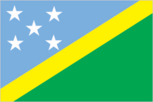
divided diagonally by a thin yellow stripe from the lower hoist-side corner; the upper triangle (hoist side) is blue with five white five-pointed stars arranged in an X pattern; the lower triangle is green
Highways
total: 1,300 km paved: 30 km unpaved: gravel 290 km; earth 980 km note: in addition, there are 800 km of private logging and plantation roads of varied construction (1982)
Imports
$110 million (c.i.f., 1991) commodities: plant and machinery manufactured goods, food and live animals, fuel partners: Australia 34%, Japan 16%, Singapore 14%, NZ 9%
Independence
7 July 1978 (from UK)
Industrial production
growth rate -3.8% (1991 est.); accounts for 5% of GDP
Industries
copra, fish (tuna)
Infant mortality rate
27.8 deaths/1,000 live births (1994 est.)
Inflation rate (consumer prices)
13% (1992 est.)
International disputes
none
Irrigated land
NA sq km
Judicial branch
High Court
Labor force
23,448 economically active by occupation: agriculture, forestry, and fishing 32.4%, services 25%, construction, manufacturing, and mining 7.0%, commerce, transport, and finance 4.7% (1984)
Land boundaries
0 km
Land use
arable land: 1% permanent crops: 1% meadows and pastures: 1% forest and woodland: 93% other: 4%
Languages
Melanesian pidgin in much of the country is lingua franca, English spoken by 1%-2% of population note: 120 indigenous languages
Legal system
common law
Legislative branch
unicameral
Life expectancy at birth
total population: 70.48 years male: 68.05 years female: 73.03 years (1994 est.)
Literacy
total population: NA% male: NA% female: NA%
Location
Oceania, Melanesia, just east of Papua New Guinea in the South Pacific Ocean
Map references
Oceania, Standard Time Zones of the World
Maritime claims
measured from claimed archipelagic baselines exclusive economic zone: 200 nm territorial sea: 12 nm
Member of
ACP, AsDB, C, ESCAP, FAO, G-77, IBRD, ICAO, IDA, IFAD, IFC, ILO, IMF, IMO, INTELSAT (nonsignatory user), IOC, ITU, LORCS, SPARTECA, SPC, SPF, UN, UNCTAD, UNESCO, UPU, WFTU, WHO, WMO
Names
conventional long form: none conventional short form: Solomon Islands former: British Solomon Islands
National holiday
Independence Day, 7 July (1978)
National Parliament
elections last held NA May 1993 (next to be held NA 1997); results - percent of vote by party NA; seats - (47 total) National Unity Group 21, PAP 8, National Action Party 6, LP 4, UP 3, Christian Fellowship 2, NFP 1, independents 2
National product
GDP - purchasing power equivalent - $900 million (1991 est.)
National product per capita
$2,500 (1991 est.)
National product real growth rate
1.8% (1991 est.)
Nationality
noun: Solomon Islander(s) adjective: Solomon Islander
Natural resources
fish, forests, gold, bauxite, phosphates, lead, zinc, nickel
Net migration rate
0 migrant(s)/1,000 population (1994 est.)
Note
located just east of Papua New Guinea in the South Pacific Ocean
Overview
The bulk of the population depend on subsistence agriculture, fishing, and forestry for at least part of their livelihood. Most manufactured goods and petroleum products must be imported. The islands are rich in undeveloped mineral resources such as lead, zinc, nickel, and gold. The economy suffered from a severe cyclone in mid-1986 that caused widespread damage to the infrastructure. In 1993, the government was working with the IMF to develop a structural adjustment program to address the country's fiscal deficit.
Political parties and leaders
People's Alliance Party (PAP); United Party (UP), leader NA; Solomon Islands Liberal Party (SILP), Bartholemew ULUFA'ALU; Nationalist Front for Progress (NFP), Andrew NORI; Labor Party (LP), Joses TUHANUKU; National Action Party, leader NA; Christian Fellowship, leader NA; National Unity Group, Solomon MAMALONI
Population
385,811 (July 1994 est.)
Population growth rate
3.43% (1994 est.)
Ports
Honiara, Ringi Cove
Religions
Anglican 34%, Roman Catholic 19%, Baptist 17%, United (Methodist/Presbyterian) 11%, Seventh-Day Adventist 10%, other Protestant 5%
Suffrage
21 years of age; universal
Telecommunications
3,000 telephones; broadcast stations - 4 AM, no FM, no TV; 1 Pacific Ocean INTELSAT earth station
Terrain
mostly rugged mountains with some low coral atolls
Total fertility rate
5.73 children born/woman (1994 est.)
Type
parliamentary democracy
Unemployment rate
NA%
US diplomatic representation
embassy closed July 1993; the ambassador to Papua New Guinea is accredited to the Solomon Islands