2023 Edition
CIA World Factbook 2023 (factbook.json @ 0d4fa4984ecb)
Introduction
Background
Seychelles was uninhabited prior to being discovered by Europeans early in the 16th century. A lengthy struggle between France and Great Britain for the islands ended in 1814, when they were ceded to the latter. During colonial rule, a plantation-based economy developed that relied on imported labor, primarily from European colonies in Africa. Seychelles gained independence in 1976 through negotiations with Great Britain. In 1977, prime minister France-Albert RENE launched a coup against the country’s first president and Seychelles became a socialist one-party state until adopting a new constitution and holding elections in 1993. RENE continued to lead Seychelles through two election cycles until he stepped down in 2004. Vice President James Alix MICHEL took over the presidency and in 2006 was elected to a new five-year term; he was reelected in 2011 and again in 2015. In 2016, James MICHEL resigned and handed over the presidency to his vice-president, Danny FAURE. In 2020, Wavel RAMKALAWAN was elected president, the first time an opposition candidate has won the presidency.
Geography
Area
- land
- 455 sq km
- total
- 455 sq km
- water
- 0 sq km
Area - comparative
2.5 times the size of Washington, DC
Climate
tropical marine; humid; cooler season during southeast monsoon (late May to September); warmer season during northwest monsoon (March to May)
Coastline
491 km
Elevation
- highest point
- Morne Seychellois 905 m
- lowest point
- Indian Ocean 0 m
Geographic coordinates
4 35 S, 55 40 E
Geography - note
the smallest African country in terms of both area and population; the constitution of the Republic of Seychelles lists 155 islands: 42 granitic and 113 coralline; by far the largest island is Mahe, which is home to about 90% of the population and the site of the capital city of Victoria
Irrigated land
3 sq km (2012)
Land boundaries
- total
- 0 km
Land use
- agricultural land
- 6.5% (2018 est.)
- agricultural land: arable land
- arable land: 2.2% (2018 est.)
- agricultural land: permanent crops
- permanent crops: 4.3% (2018 est.)
- agricultural land: permanent pasture
- permanent pasture: 0% (2018 est.)
- forest
- 88.5% (2018 est.)
- other
- 5% (2018 est.)
Location
archipelago in the Indian Ocean, northeast of Madagascar
Map references
Africa
Maritime claims
- contiguous zone
- 24 nm
- continental shelf
- 200 nm or to the edge of the continental margin
- exclusive economic zone
- 200 nm
- territorial sea
- 12 nm
Natural hazards
lies outside the cyclone belt, so severe storms are rare; occasional short droughts
Natural resources
fish, coconuts (copra), cinnamon trees
Population distribution
more than three-quarters of the population lives on the main island of Mahe; Praslin contains less than 10%; a smaller percent on La Digue and the outer islands as shown in this population distribution map
Terrain
Mahe Group is volcanic with a narrow coastal strip and rocky, hilly interior; others are relatively flat coral atolls, or elevated reefs; sits atop the submarine Mascarene Plateau
People and Society
Age structure
- 0-14 years
- 17.95% (male 8,999/female 8,524)
- 15-64 years
- 72.58% (male 37,677/female 33,177)
- 65 years and over
- 9.47% (2023 est.) (male 3,956/female 5,284)
Alcohol consumption per capita
- beer
- 4.11 liters of pure alcohol (2019 est.)
- other alcohols
- 0.25 liters of pure alcohol (2019 est.)
- spirits
- 4.62 liters of pure alcohol (2019 est.)
- total
- 9.48 liters of pure alcohol (2019 est.)
- wine
- 0.49 liters of pure alcohol (2019 est.)
Birth rate
12.1 births/1,000 population (2023 est.)
Contraceptive prevalence rate
NA
Current health expenditure
6.4% of GDP (2020)
Currently married women (ages 15-49)
45% (2023 est.)
Death rate
6.9 deaths/1,000 population (2023 est.)
Demographic profile
Seychelles has no indigenous population and was first permanently settled by a small group of French planters, African slaves, and South Indians in 1770. Seychelles’ modern population is composed of the descendants of French and later British settlers, Africans, and Indian, Chinese, and Middle Eastern traders and is concentrated on three of its 155 islands – the vast majority on Mahe and lesser numbers on Praslin and La Digue. Seychelles’ population grew rapidly during the second half of the 20th century, largely due to natural increase, but the pace has slowed because of fertility decline. The total fertility rate dropped sharply from 4.0 children per woman in 1980 to 1.9 in 2015, mainly as a result of a family planning program, free education and health care, and increased female labor force participation. Life expectancy has increased steadily, but women on average live 9 years longer than men, a difference that is higher than that typical of developed countries.The combination of reduced fertility and increased longevity has resulted in an aging population, which will put pressure on the government’s provision of pensions and health care. Seychelles’ sustained investment in social welfare services, such as free primary health care and education up to the post-secondary level, have enabled the country to achieve a high human development index score – among the highest in Africa. Despite some of its health and education indicators being nearly on par with Western countries, Seychelles has a high level of income inequality.An increasing number of migrant workers – mainly young men – have been coming to Seychelles in recent years to work in the construction and tourism industries. As of 2011, foreign workers made up nearly a quarter of the workforce. Indians are the largest non-Seychellois population – representing half of the country’s foreigners – followed by Malagasy.
Dependency ratios
- elderly dependency ratio
- 11.4
- potential support ratio
- 8.7 (2021 est.)
- total dependency ratio
- 45
- youth dependency ratio
- 33.6
Drinking water source
- improved: rural
- rural: NA
- improved: total
- total: 96.2% of population
- improved: urban
- urban: NA
- unimproved: rural
- rural: NA
- unimproved: total
- total: 3.8% of population (2017 est.)
- unimproved: urban
- urban: NA
Education expenditures
5.2% of GDP (2020 est.)
Ethnic groups
predominantly Creole (mainly of East African and Malagasy heritage); also French, Indian, Chinese, and Arab populations
Gross reproduction rate
0.89 (2023 est.)
Hospital bed density
3.6 beds/1,000 population (2011)
Infant mortality rate
- female
- 7.6 deaths/1,000 live births
- male
- 13.1 deaths/1,000 live births
- total
- 10.4 deaths/1,000 live births (2023 est.)
Languages
Seychellois Creole (official) 89.1%, English (official) 5.1%, French (official) 0.7%, other 3.8%, unspecified 1.4% (2010 est.)
Life expectancy at birth
- female
- 80.9 years
- male
- 72 years
- total population
- 76.4 years (2023 est.)
Literacy
- definition
- age 15 and over can read and write
- female
- 96.4% (2018)
- male
- 95.4%
- total population
- 95.9%
Major urban areas - population
28,000 VICTORIA (capital) (2018)
Maternal mortality ratio
3 deaths/100,000 live births (2020)
Median age
- female
- 38.8 years
- male
- 37.7 years
- total
- 38.2 years (2023 est.)
Nationality
- adjective
- Seychellois
- noun
- Seychellois (singular and plural)
Net migration rate
0.8 migrant(s)/1,000 population (2023 est.)
Obesity - adult prevalence rate
14% (2016)
Physicians density
2.25 physicians/1,000 population (2019)
Population
97,617 (2023 est.)
Population distribution
more than three-quarters of the population lives on the main island of Mahe; Praslin contains less than 10%; a smaller percent on La Digue and the outer islands as shown in this population distribution map
Population growth rate
0.6% (2023 est.)
Religions
Roman Catholic 76.2%, Protestant 10.5% (Anglican 6.1%, Pentecostal Assembly 1.5%, Seventh Day Adventist 1.2%, other Protestant 1.7%), other Christian 2.4%, Hindu 2.4%, Muslim 1.6%, other non-Christian 1.1%, unspecified 4.8%, none 0.9% (2010 est.)
Sanitation facility access
- improved: rural
- rural: NA
- improved: total
- total: 100% of population
- improved: urban
- urban: NA
- unimproved: rural
- rural: NA
- unimproved: total
- total: 0% of population (2020 est.)
- unimproved: urban
- urban: NA
School life expectancy (primary to tertiary education)
- female
- 16 years (2021)
- male
- 13 years
- total
- 15 years
Sex ratio
- 0-14 years
- 1.06 male(s)/female
- 15-64 years
- 1.14 male(s)/female
- 65 years and over
- 0.75 male(s)/female
- at birth
- 1.03 male(s)/female
- total population
- 1.08 male(s)/female (2023 est.)
Tobacco use
- female
- 6.4% (2020 est.)
- male
- 34% (2020 est.)
- total
- 20.2% (2020 est.)
Total fertility rate
1.81 children born/woman (2023 est.)
Urbanization
- rate of urbanization
- 0.99% annual rate of change (2020-25 est.)
- urban population
- 58.8% of total population (2023)
Youth unemployment rate (ages 15-24)
- female
- 15.6%
- male
- 17.5%
- total
- 16.5% (2020 est.)
Government
Administrative divisions
27 administrative districts; Anse aux Pins, Anse Boileau, Anse Etoile, Anse Royale, Au Cap, Baie Lazare, Baie Sainte Anne, Beau Vallon, Bel Air, Bel Ombre, Cascade, Glacis, Grand Anse Mahe, Grand Anse Praslin, Ile Perseverance I, Ile Perseverance II, La Digue, La Riviere Anglaise, Les Mamelles, Mont Buxton, Mont Fleuri, Plaisance, Pointe Larue, Port Glaud, Roche Caiman, Saint Louis, Takamaka
Capital
- etymology
- founded as L'etablissement in 1778 by French colonists, the town was renamed in 1841 by the British after Queen VICTORIA (1819-1901); "victoria" is the Latin word for "victory"
- geographic coordinates
- 4 37 S, 55 27 E
- name
- Victoria
- time difference
- UTC+4 (9 hours ahead of Washington, DC, during Standard Time)
Citizenship
- citizenship by birth
- no
- citizenship by descent only
- at least one parent must be a citizen of the Seychelles
- dual citizenship recognized
- no
- residency requirement for naturalization
- 5 years
Constitution
- amendments
- proposed by the National Assembly; passage requires at least two-thirds majority vote by the National Assembly; passage of amendments affecting the country’s sovereignty, symbols and languages, the supremacy of the constitution, fundamental rights and freedoms, amendment procedures, and dissolution of the Assembly also requires approval by at least 60% of voters in a referendum; amended several times, last in 2018
- history
- previous 1970, 1979; latest drafted May 1993, approved by referendum 18 June 1993, effective 23 June 1993
Country name
- conventional long form
- Republic of Seychelles
- conventional short form
- Seychelles
- etymology
- named by French Captain Corneille Nicholas MORPHEY after Jean Moreau de SECHELLES, the finance minister of France, in 1756
- local long form
- Republic of Seychelles
- local short form
- Seychelles
Diplomatic representation from the US
- chief of mission
- Ambassador Henry V. JARDINE (since 22 February 2023); note - Ambassador JARDINE is posted in Mauritius but is accredited to Seychelles
- embassy
- 2nd Floor, Oliaji Trade Center, Victoria Mahe, Seychelles; note - US Embassy in Seychelles reopened on 1 June 2023 after having been closed in 1996
- telephone
- [248] 422 5256
Diplomatic representation in the US
- chancery
- 685 Third Avenue, Suite 1107, 11th Floor, New York, NY 10017
- chief of mission
- Ambassador Ian Dereck Joseph MADELEINE (since 1 December 2021)note - also Permanent Representative to the UN
- consulate(s) general
- New York
- email address and website
- seychelles@un.int; seychellesmission@sycun.orgForeign Affairs Department Republic of Seychelles » United States of America (mfa.gov.sc)
- FAX
- [1] (212) 972-1786
- telephone
- [1] (212) 972-1785
Executive branch
- cabinet
- Council of Ministers appointed by the president
- chief of state
- President Wavel RAMKALAWAN (since 26 October 2020); Vice President Ahmed AFIF (since 27 October 2020); the president is both chief of state and head of government
- election results
- 2020: Wavel RAMKALAWAN elected president; Wavel RAMKALAWAN (LDS) 54.9%, Danny FAURE (US) 43.5%, other 1.6%2015: President James Alix MICHEL reelected president in second round; percent of vote first round - James Alix MICHEL (PL) 47.8%, Wavel RAMKALAWAN (SNP) 35.3%, other 16.9%; percent of vote second round - James Alix MICHEL 50.2%, Wavel RAMKALAWAN 49.8%
- elections/appointments
- president directly elected by absolute majority popular vote in 2 rounds if needed for a 5-year term (eligible for a second term); election last held on 22-24 October 2020; next presidential election due in 2025
- head of government
- President Wavel RAMKALAWAN (since 26 October 2020); Vice President Ahmed AFIF (since 27 October 2020)
Flag description
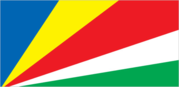
five oblique bands of blue (hoist side), yellow, red, white, and green (bottom) radiating from the bottom of the hoist side; the oblique bands are meant to symbolize a dynamic new country moving into the future; blue represents sky and sea, yellow the sun giving light and life, red the peoples' determination to work for the future in unity and love, white social justice and harmony, and green the land and natural environment
Government type
presidential republic
Independence
29 June 1976 (from the UK)
International law organization participation
has not submitted an ICJ jurisdiction declaration; accepts ICCt jurisdiction
International organization participation
ACP, AfDB, AOSIS, AU, C, CD, COMESA, EITI (candidate country), FAO, G-77, IAEA, IBRD, ICAO, ICC (NGOs), ICCt, ICRM, IDA, IFAD, IFC, IFRCS, ILO, IMF, IMO, InOC, Interpol, IOC, IOM, IPU, ISO (correspondent), ITU, MIGA, NAM, OIF, OPCW, SADC, UN, UNCTAD, UNESCO, UNIDO, UNWTO, UPU, WCO, WHO, WIPO, WMO, WTO
Judicial branch
- highest court(s)
- Seychelles Court of Appeal (consists of the court president and 4 justices); Supreme Court of Seychelles (consists of the chief justice and 9 puisne judges); Constitutional Court (consists of 3 Supreme Court judges)
- judge selection and term of office
- all judges appointed by the president of the republic upon the recommendation of the Constitutional Appointments Authority, a 3-member body, with 1 member appointed by the president of the republic, 1 by the opposition leader in the National Assembly, and 1 by the other 2 appointees; judges serve until retirement at age 70
- subordinate courts
- Magistrates' Courts of Seychelles; Family Tribunal for issues such as domestic violence, child custody, and maintenance; Employment Tribunal for labor-related disputes
Legal system
mixed legal system of English common law, French civil law, and customary law
Legislative branch
- description
- unicameral National Assembly or Assemblee Nationale (35 seats in the 2020-25 term; 26 members directly elected in single-seat constituencies by simple majority vote and up to 9 members elected by proportional representation vote; members serve 5-year terms)
- election results
- percent of vote by party - LDS 54.8%, US 42.3%, other 2.9%; seats by party - LDS 25, US 10; composition - men 27, women 8, percent of women 22.9%
- elections
- last held on 22-24 October 2020 (next to be held in October 2025); note - the election was originally scheduled for 2021 but was moved up a year and held alongside the presidential election in order to cut election costs
National anthem
- lyrics/music
- David Francois Marc ANDRE and George Charles Robert PAYET
- name
- "Koste Seselwa" (Seychellois Unite)
- note
- note: adopted 1996
National heritage
- selected World Heritage Site locales
- Aldabra Atoll; Vallée de Mai Nature Reserve
- total World Heritage Sites
- 2 (both natural)
National holiday
Constitution Day, 18 June (1993); Independence Day (National Day), 29 June (1976)
National symbol(s)
coco de mer (sea coconut); national colors: blue, yellow, red, white, green
Political parties and leaders
Seychelles Party for Social Justice and Democracy or SPSJD [Vesna RAKIC]Seychellois Democratic Alliance or LDS (Linyon Demokratik Seselwa/Union Démocratique Seychelloise) (coalition includes SNP and SPSJD) [Roger MANCIENNE]Seychelles National Party or SNP [Wavel RAMKALAWAN]United Seychelles or US [Patrick HERMINIE]note: only parties with seats in the National Assembly listed
Suffrage
18 years of age; universal
Economy
Agricultural products
coconuts, vegetables, bananas, fruit, eggs, poultry, tomatoes, pork, tropical fruit, cassava
Budget
- expenditures
- $586 million (2019 est.)
- revenues
- $601 million (2019 est.)
Budget surplus (+) or deficit (-)
-0.5% (of GDP) (2017 est.)
Credit ratings
- Fitch rating
- B+ (2020)
- note
- note: The year refers to the year in which the current credit rating was first obtained.
Current account balance
- Current account balance 2019
- -$53.115 million (2019 est.)
- Current account balance 2020
- -$173.236 million (2020 est.)
- Current account balance 2021
- -$154.259 million (2021 est.)
Debt - external
- Debt - external 2018
- $4.613 billion (2018 est.)
- Debt - external 2019
- $4.802 billion (2019 est.)
Economic overview
high-income Indian Ocean island economy; rapidly growing tourism sector; major tuna exporter; offshore financial hub; environmentally fragile and investing in ocean rise mitigation; recently discovered offshore oil potential; successful anticorruption efforts
Exchange rates
- Currency
- Seychelles rupees (SCR) per US dollar -
- Exchange rates 2017
- 13.648 (2017 est.)
- Exchange rates 2018
- 13.911 (2018 est.)
- Exchange rates 2019
- 14.033 (2019 est.)
- Exchange rates 2020
- 17.617 (2020 est.)
- Exchange rates 2021
- 16.921 (2021 est.)
Exports
- Exports 2019
- $2.085 billion (2019 est.) note: data are in current year dollars
- Exports 2020
- $1.24 billion (2020 est.) note: data are in current year dollars
- Exports 2021
- $1.751 billion (2021 est.) note: data are in current year dollars
Exports - commodities
refined petroleum, fish, recreational boats, cigarettes, animal meal (2019)
Exports - partners
United Arab Emirates 17%, United Kingdom 13%, France 12%, British Virgin Islands 11%, Zambia 9%, Mauritius 5%, Japan 5% (2019)
Fiscal year
calendar year
GDP - composition, by end use
- exports of goods and services
- 79.4% (2017 est.)
- government consumption
- 34.4% (2017 est.)
- household consumption
- 52.7% (2017 est.)
- imports of goods and services
- -93.2% (2017 est.)
- investment in fixed capital
- 26.7% (2017 est.)
- investment in inventories
- 0% (2017 est.)
GDP - composition, by sector of origin
- agriculture
- 2.5% (2017 est.)
- industry
- 13.8% (2017 est.)
- services
- 83.7% (2017 est.)
GDP (official exchange rate)
$1.748 billion (2019 est.)
Gini Index coefficient - distribution of family income
- Gini Index coefficient - distribution of family income 2018
- 32.1 (2018 est.)
Household income or consumption by percentage share
- highest 10%
- 15.4% (2007)
- lowest 10%
- 4.7%
Imports
- Imports 2019
- $2.025 billion (2019 est.) note: data are in current year dollars
- Imports 2020
- $1.332 billion (2020 est.) note: data are in current year dollars
- Imports 2021
- $1.821 billion (2021 est.) note: data are in current year dollars
Imports - commodities
recreational boats, refined petroleum, fish, aircraft, cars (2019)
Imports - partners
United Arab Emirates 21%, Qatar 13%, British Virgin Islands 7%, Germany 6%, France 6%, China 5%, Spain 5%, South Africa 5% (2019)
Industrial production growth rate
3.63% (2021 est.)
Industries
fishing, tourism, beverages
Inflation rate (consumer prices)
- Inflation rate (consumer prices) 2018
- 3.7% (2018 est.)
- Inflation rate (consumer prices) 2019
- 2.07% (2019 est.)
- Inflation rate (consumer prices) 2020
- 8.28% (2020 est.)
Labor force
51,000 (2018 est.)
Labor force - by occupation
- agriculture
- 3%
- industry
- 23%
- services
- 74% (2006)
Population below poverty line
25.3% (2018 est.)
Public debt
- Public debt 2016
- 69.1% of GDP (2016 est.)
- Public debt 2017
- 63.6% of GDP (2017 est.)
Real GDP (purchasing power parity)
- note
- note: data are in 2017 dollars
- Real GDP (purchasing power parity) 2019
- $2.867 billion (2019 est.)
- Real GDP (purchasing power parity) 2020
- $2.647 billion (2020 est.)
- Real GDP (purchasing power parity) 2021
- $2.855 billion (2021 est.)
Real GDP growth rate
- Real GDP growth rate 2019
- 3.1% (2019 est.)
- Real GDP growth rate 2020
- -7.69% (2020 est.)
- Real GDP growth rate 2021
- 7.86% (2021 est.)
Real GDP per capita
- note
- note: data are in 2017 dollars
- Real GDP per capita 2019
- $29,400 (2019 est.)
- Real GDP per capita 2020
- $26,900 (2020 est.)
- Real GDP per capita 2021
- $28,800 (2021 est.)
Reserves of foreign exchange and gold
- Reserves of foreign exchange and gold 31 December 2019
- $580.546 million (31 December 2019 est.)
- Reserves of foreign exchange and gold 31 December 2020
- $559.682 million (31 December 2020 est.)
- Reserves of foreign exchange and gold 31 December 2021
- $702.585 million (31 December 2021 est.)
Taxes and other revenues
31.52% (of GDP) (2018 est.)
Unemployment rate
- Unemployment rate 2016
- 2.7% (2016 est.)
- Unemployment rate 2017
- 3% (2017 est.)
Youth unemployment rate (ages 15-24)
- female
- 15.6%
- male
- 17.5%
- total
- 16.5% (2020 est.)
Energy
Carbon dioxide emissions
- from coal and metallurgical coke
- 0 metric tonnes of CO2 (2019 est.)
- from consumed natural gas
- 0 metric tonnes of CO2 (2019 est.)
- from petroleum and other liquids
- 1.156 million metric tonnes of CO2 (2019 est.)
- total emissions
- 1.156 million metric tonnes of CO2 (2019 est.)
Coal
- consumption
- 0 metric tons (2020 est.)
- exports
- 0 metric tons (2020 est.)
- imports
- 0 metric tons (2020 est.)
- production
- 0 metric tons (2020 est.)
- proven reserves
- 0 metric tons (2019 est.)
Electricity
- consumption
- 463.894 million kWh (2019 est.)
- exports
- 0 kWh (2020 est.)
- imports
- 0 kWh (2020 est.)
- installed generating capacity
- 157,000 kW (2020 est.)
- transmission/distribution losses
- 30 million kWh (2019 est.)
Electricity access
- electrification - total population
- 100% (2021)
Electricity generation sources
- biomass and waste
- 0% of total installed capacity (2020 est.)
- fossil fuels
- 99.1% of total installed capacity (2020 est.)
- geothermal
- 0% of total installed capacity (2020 est.)
- hydroelectricity
- 0% of total installed capacity (2020 est.)
- nuclear
- 0% of total installed capacity (2020 est.)
- solar
- 0.9% of total installed capacity (2020 est.)
- tide and wave
- 0% of total installed capacity (2020 est.)
- wind
- 0% of total installed capacity (2020 est.)
Energy consumption per capita
- Total energy consumption per capita 2019
- 163.06 million Btu/person (2019 est.)
Natural gas
- consumption
- 0 cubic meters (2021 est.)
- exports
- 0 cubic meters (2021 est.)
- imports
- 0 cubic meters (2021 est.)
- production
- 0 cubic meters (2021 est.)
- proven reserves
- 0 cubic meters (2021 est.)
Petroleum
- crude oil and lease condensate exports
- 0 bbl/day (2018 est.)
- crude oil and lease condensate imports
- 0 bbl/day (2018 est.)
- crude oil estimated reserves
- 0 barrels (2021 est.)
- refined petroleum consumption
- 7,500 bbl/day (2019 est.)
- total petroleum production
- 0 bbl/day (2021 est.)
Refined petroleum products - exports
0 bbl/day (2015 est.)
Refined petroleum products - imports
7,225 bbl/day (2015 est.)
Refined petroleum products - production
0 bbl/day (2015 est.)
Communications
Broadband - fixed subscriptions
- subscriptions per 100 inhabitants
- 36 (2020 est.)
- total
- 34,966 (2020 est.)
Broadcast media
the national broadcaster, Seychelles Broadcasting Corporation (SBC), which is funded by taxpayer money, operates the only terrestrial TV station, which provides local programming and airs broadcasts from international services; a privately owned Internet Protocol Television (IPTV) channel also provides local programming multi-channel cable and satellite TV are available through 2 providers; the national broadcaster operates 1 AM and 1 FM radio station; there are 2 privately operated radio stations; transmissions of 2 international broadcasters are accessible in Victoria (2019)
Internet country code
.sc
Internet users
- percent of population
- 82% (2021 est.)
- total
- 90,200 (2021 est.)
Telecommunication systems
- domestic
- fixed-line is 18 per 100 and mobile-cellular teledensity is 173 telephones per 100 persons (2021)
- general assessment
- effective system; direct international calls to over 100 countries; radiotelephone communications between islands in the archipelago; 3 ISPs; use of Internet cafes' for access to Internet; 4G services and 5G pending (2020)
- international
- country code - 248; landing points for the PEACE and the SEAS submarine cables providing connectivity to Europe, the Middle East, Africa and Asia; direct radiotelephone communications with adjacent island countries and African coastal countries; satellite earth station - 1 Intelsat (Indian Ocean) (2019)
Telephones - fixed lines
- subscriptions per 100 inhabitants
- 18 (2022 est.)
- total subscriptions
- 19,027 (2022 est.)
Telephones - mobile cellular
- subscriptions per 100 inhabitants
- 192 (2022 est.)
- total subscriptions
- 205,140 (2022 est.)
Transportation
Airports
14 (2021)
Airports - with paved runways
- 7
- note
- note: paved runways have a concrete or asphalt surface but not all have facilities for refueling, maintenance, or air traffic control; the length of a runway required for aircraft to safely operate depends on a number of factors including the type of aircraft, the takeoff weight (including passengers, cargo, and fuel), engine types, flap settings, landing speed, elevation of the airport, and average maximum daily air temperature; paved runways can reach a length of 5,000 m (16,000 ft.), but the “typical” length of a commercial airline runway is between 2,500-4,000 m (8,000-13,000 ft.)
Airports - with unpaved runways
- 7
- note
- note: unpaved runways have a surface composition such as grass or packed earth and are most suited to the operation of light aircraft; unpaved runways are usually short, often less than 1,000 m (3,280 ft.) in length; airports with unpaved runways often lack facilities for refueling, maintenance, or air traffic control
Civil aircraft registration country code prefix
S7
Heliports
1 (2021)
Merchant marine
- by type
- general cargo 6, oil tanker 7, other 18
- total
- 31 (2022)
National air transport system
- annual freight traffic on registered air carriers
- 7.79 million (2018) mt-km
- annual passenger traffic on registered air carriers
- 455,201 (2018)
- inventory of registered aircraft operated by air carriers
- 7
- number of registered air carriers
- 1 (2020)
Ports and terminals
- major seaport(s)
- Victoria
Roadways
- paved
- 514 km (2015)
- total
- 526 km (2015)
- unpaved
- 12 km (2015)
Military and Security
Military - note
formed in 1977, the SDF is one of the world's smallest militaries; its primary responsibility is maritime security, particularly countering illegal fishing, piracy, and drug smuggling; it was given police powers in 2022; the Seychelles has strong security ties with India (2023)
Military and security forces
- Seychelles Defense Forces (SDF): Army (includes infantry, special forces, and a presidential security unit), Coast Guard, and Air ForceMinistry of Internal Affairs: Seychelles Police Force (includes unarmed police and an armed paramilitary Police Special Support Wing, and the Marine Police Unit) (2023)
- note
- note: the SDF reports to the president, who acts as minister of defense
Military and security service personnel strengths
approximately 500-1,000 personnel (2023)
Military equipment inventories and acquisitions
the SDF's inventory primarily consists of Soviet-era equipment delivered in the 1970s and 1980s; in recent years, the SDF has received limited amounts of more modern equipment, mostly donations of patrol boats and aircraft, from several suppliers led by China and India (2023)
Military expenditures
- Military Expenditures 2018
- 1.4% of GDP (2018 est.)
- Military Expenditures 2019
- 1.3% of GDP (2019 est.)
- Military Expenditures 2020
- 1.6% of GDP (2020 est.)
- Military Expenditures 2021
- 1.5% of GDP (2021 est.)
- Military Expenditures 2022
- 1.4% of GDP (2022 est.)
Military service age and obligation
18-28 (18-25 for officers) years of age for voluntary military service for men and women; 6-year initial commitment; no conscription (2023)
Transnational Issues
Disputes - international
Seychelles-UK: Mauritius and Seychelles claim the Chagos Islands (UK-administered British Indian Ocean Territory)
Environment
Air pollutants
- carbon dioxide emissions
- 0.61 megatons (2016 est.)
- methane emissions
- 0.1 megatons (2020 est.)
- particulate matter emissions
- 16.96 micrograms per cubic meter (2019 est.)
Climate
tropical marine; humid; cooler season during southeast monsoon (late May to September); warmer season during northwest monsoon (March to May)
Environment - current issues
water supply depends on catchments to collect rainwater; water pollution; biodiversity maintainance
Environment - international agreements
- party to
- Biodiversity, Climate Change, Climate Change-Kyoto Protocol, Climate Change-Paris Agreement, Comprehensive Nuclear Test Ban, Desertification, Endangered Species, Hazardous Wastes, Law of the Sea, Marine Dumping-London Convention, Nuclear Test Ban, Ozone Layer Protection, Ship Pollution, Wetlands
- signed, but not ratified
- none of the selected agreements
Land use
- agricultural land
- 6.5% (2018 est.)
- agricultural land: arable land
- arable land: 2.2% (2018 est.)
- agricultural land: permanent crops
- permanent crops: 4.3% (2018 est.)
- agricultural land: permanent pasture
- permanent pasture: 0% (2018 est.)
- forest
- 88.5% (2018 est.)
- other
- 5% (2018 est.)
Revenue from coal
0% of GDP (2018 est.)
Revenue from forest resources
0.09% of GDP (2018 est.)
Total renewable water resources
0 cubic meters (2017 est.)
Total water withdrawal
- agricultural
- 900,000 cubic meters (2017 est.)
- industrial
- 3.8 million cubic meters (2017 est.)
- municipal
- 10 million cubic meters (2020 est.)
Urbanization
- rate of urbanization
- 0.99% annual rate of change (2020-25 est.)
- urban population
- 58.8% of total population (2023)
Waste and recycling
- municipal solid waste generated annually
- 48,000 tons (2012 est.)