2013 Edition
CIA World Factbook 2013 Archive (HTML)
Introduction
Background
A lengthy struggle between France and Great Britain for the islands ended in 1814, when they were ceded to the latter. Independence came in 1976. Socialist rule was brought to a close with a new constitution and free elections in 1993. President France-Albert RENE, who had served since 1977, was re-elected in 2001, but stepped down in 2004. Vice President James MICHEL took over the presidency and in July 2006 was elected to a new five-year term; he was reelected in May 2011.
Geography
Area
- 455 sq km 455 sq km 0 sq km
- total
- 455 sq km
- water
- 0 sq km
Area - comparative
2.5 times the size of Washington, DC
Climate
tropical marine; humid; cooler season during southeast monsoon (late May to September); warmer season during northwest monsoon (March to May)
Coastline
491 km
Elevation extremes
- Indian Ocean 0 m Morne Seychellois 905 m
- highest point
- Morne Seychellois 905 m
- lowest point
- Indian Ocean 0 m
Environment - current issues
water supply depends on catchments to collect rainwater
Environment - international agreements
- Biodiversity, Climate Change, Climate Change-Kyoto Protocol, Desertification, Endangered Species, Hazardous Wastes, Law of the Sea, Marine Dumping, Ozone Layer Protection, Ship Pollution, Wetlands none of the selected agreements
- party to
- Biodiversity, Climate Change, Climate Change-Kyoto Protocol, Desertification, Endangered Species, Hazardous Wastes, Law of the Sea, Marine Dumping, Ozone Layer Protection, Ship Pollution, Wetlands
- signed, but not ratified
- none of the selected agreements
Geographic coordinates
4 35 S, 55 40 E
Geography - note
- the constitution of the Republic of Seychelles lists 155 islands: 42 granitic and 113 coralline; by far the largest island is Mahe, which is home to about 90% of the population and the site of the capital city of Victoria
- the constitution of the Republic of Seychelles lists 155 islands
- 42 granitic and 113 coralline; by far the largest island is Mahe, which is home to about 90% of the population and the site of the capital city of Victoria
Irrigated land
2.6 sq km (2003)
Land boundaries
0 km
Land use
- 2.17% 4.35% 93.48% (2011)
- arable land
- 2.17%
- other
- 93.48% (2011)
- permanent crops
- 4.35%
Location
archipelago in the Indian Ocean, northeast of Madagascar
Map references
Africa
Maritime claims
- 12 nm 24 nm 200 nm 200 nm or to the edge of the continental margin
- contiguous zone
- 24 nm
- continental shelf
- 200 nm or to the edge of the continental margin
- exclusive economic zone
- 200 nm
- territorial sea
- 12 nm
Natural hazards
lies outside the cyclone belt, so severe storms are rare; occasional short droughts
Natural resources
fish, copra, cinnamon trees
Terrain
Mahe Group is granitic, narrow coastal strip, rocky, hilly; others are coral, flat, elevated reefs
People and Society
Age structure
- 21.2% (male 9,852/female 9,364) 14.6% (male 6,932/female 6,293) 49.3% (male 23,471/female 21,306) 7.8% (male 3,663/female 3,378) 7.3% (male 2,520/female 4,067) (2013 est.)
- 0-14 years
- 21.2% (male 9,852/female 9,364)
- 15-24 years
- 14.6% (male 6,932/female 6,293)
- 25-54 years
- 49.3% (male 23,471/female 21,306)
- 55-64 years
- 7.8% (male 3,663/female 3,378)
- 65 years and over
- 7.3% (male 2,520/female 4,067) (2013 est.)
Birth rate
14.85 births/1,000 population (2013 est.)
Death rate
6.89 deaths/1,000 population (2013 est.)
Dependency ratios
- 42.6 % 31.6 % 11 % 9.1 (2013)
- elderly dependency ratio
- 11 %
- potential support ratio
- 9.1 (2013)
- total dependency ratio
- 42.6 %
- youth dependency ratio
- 31.6 %
Drinking water source
- urban: 100% of population (2010 est.)
- urban
- 100% of population (2010 est.)
Education expenditures
4.8% of GDP (2006)
Ethnic groups
mixed French, African, Indian, Chinese, and Arab
Health expenditures
3.8% of GDP (2011)
HIV/AIDS - adult prevalence rate
NA
HIV/AIDS - deaths
NA
HIV/AIDS - people living with HIV/AIDS
NA
Hospital bed density
3.6 beds/1,000 population (2011)
Infant mortality rate
- 11.06 deaths/1,000 live births 13.85 deaths/1,000 live births 8.18 deaths/1,000 live births (2013 est.)
- female
- 8.18 deaths/1,000 live births (2013 est.)
- total
- 11.06 deaths/1,000 live births
Languages
Creole 91.8%, English (official) 4.9%, other 3.1%, unspecified 0.2% (2002 census)
Life expectancy at birth
- 74.01 years 69.4 years 78.76 years (2013 est.)
- female
- 78.76 years (2013 est.)
- total population
- 74.01 years
Literacy
- age 15 and over can read and write 91.8% 91.4% 92.3% (2011 est.)
- definition
- age 15 and over can read and write
- female
- 92.3% (2011 est.)
- male
- 91.4%
- total population
- 91.8%
Major urban areas - population
VICTORIA (capital) 26,000 (2009)
Median age
- 33.4 years 33 years 34 years (2013 est.)
- female
- 34 years (2013 est.)
- male
- 33 years
- total
- 33.4 years
Nationality
- Seychellois (singular and plural) Seychellois
- adjective
- Seychellois
- noun
- Seychellois (singular and plural)
Net migration rate
1.01 migrant(s)/1,000 population (2013 est.)
Obesity - adult prevalence rate
23.9% (2008)
Physicians density
1.51 physicians/1,000 population (2004)
Population
90,846 (July 2013 est.)
Population growth rate
0.9% (2013 est.)
Religions
Roman Catholic 82.3%, Protestant 7.5% (Anglican 6.4%, Seventh-Day Adventist 1.1%), other Christian 3.4%, Hindu 2.1%, Muslim 1.1%, other non-Christian 1.5%, unspecified 1.5%, none 0.6% (2002 census)
Sanitation facility access
- urban: 98% of population urban: 2% of population (2010 est.)
- urban
- 2% of population (2010 est.)
School life expectancy (primary to tertiary education)
- 13 years 13 years 14 years (2011)
- female
- 14 years (2011)
- male
- 13 years
- total
- 13 years
Sex ratio
- 1.03 male(s)/female 1.05 male(s)/female 1.09 male(s)/female 1.1 male(s)/female 1.09 male(s)/female 0.61 male(s)/female 1.04 male(s)/female (2013 est.)
- 0-14 years
- 1.05 male(s)/female
- 15-24 years
- 1.09 male(s)/female
- 25-54 years
- 1.1 male(s)/female
- 55-64 years
- 1.09 male(s)/female
- 65 years and over
- 0.61 male(s)/female
- at birth
- 1.03 male(s)/female
- total population
- 1.04 male(s)/female (2013 est.)
Total fertility rate
1.89 children born/woman (2013 est.)
Unemployment, youth ages 15-24
- 20.3% (2002)
- total
- 20.3% (2002)
Urbanization
- 53.6% of total population (2011) 1.05% annual rate of change (2010-15 est.)
- rate of urbanization
- 1.05% annual rate of change (2010-15 est.)
- urban population
- 53.6% of total population (2011)
Government
Administrative divisions
25 administrative districts; Anse aux Pins, Anse Boileau, Anse Etoile, Anse Royale, Au Cap, Baie Lazare, Baie Sainte Anne, Beau Vallon, Bel Air, Bel Ombre, Cascade, Glacis, Grand Anse Mahe, Grand Anse Praslin, Inner Islands, La Riviere Anglaise, Les Mamalles, Mont Buxton, Mont Fleuri, Plaisance, Pointe Larue, Port Glaud, Roche Caiman, Saint Louis, Takamaka
Capital
- Victoria 4 37 S, 55 27 E UTC+4 (9 hours ahead of Washington, DC during Standard Time)
- geographic coordinates
- 4 37 S, 55 27 E
- name
- Victoria
- time difference
- UTC+4 (9 hours ahead of Washington, DC during Standard Time)
Constitution
previous 1970, 1979; latest drafted May 1993, approved by referendum 18 June 1993, effective 23 June 1993; amended many times, last in 2011 (2011)
Country name
- Republic of Seychelles Seychelles Republic of Seychelles Seychelles
- conventional long form
- Republic of Seychelles
- conventional short form
- Seychelles
- local long form
- Republic of Seychelles
- local short form
- Seychelles
Diplomatic representation from the US
the US does not have an embassy in Seychelles; the US Ambassador to Mauritius, currently Ambassador Shari VILLAROSA, is accredited to Seychelles
Diplomatic representation in the US
- Ambassador Marie-Louise Cecile POTTER (since 6 September 2012) 800 Second Avenue, Suite 400C, New York, NY 10017 [1] (212) 972-1785 [1] (212) 972-1786 Los Angeles
- chancery
- 800 Second Avenue, Suite 400C, New York, NY 10017
- chief of mission
- Ambassador Marie-Louise Cecile POTTER (since 6 September 2012)
- consulate(s) general
- Los Angeles
- FAX
- [1] (212) 972-1786
- telephone
- [1] (212) 972-1785
Executive branch
- President James Alix MICHEL (since 14 April 2004); Vice President Danny FAURE (since 1 July 2010); note - the president is both the chief of state and head of government President James Alix MICHEL (since 14 April 2004); Vice President Danny FAURE (since 1 July 2010) Council of Ministers appointed by the president president elected by popular vote for a five-year term (eligible for two more terms); election last held on 19-21 May 2011 (next to be held in 2016) President James MICHEL elected president; percent of vote - James MICHEL 55.5%, Wavel RAMKALAWAN 41.4%, Philippe BOULLE 1.7%, Ralph VOLCERE 1.5%; note - this was the second election in which President James MICHEL participated; he was originally sworn in as president after former president France Albert RENE stepped down in April 2004
- cabinet
- Council of Ministers appointed by the president
- chief of state
- President James Alix MICHEL (since 14 April 2004); Vice President Danny FAURE (since 1 July 2010); note - the president is both the chief of state and head of government
- election results
- President James MICHEL elected president; percent of vote - James MICHEL 55.5%, Wavel RAMKALAWAN 41.4%, Philippe BOULLE 1.7%, Ralph VOLCERE 1.5%; note - this was the second election in which President James MICHEL participated; he was originally sworn in as president after former president France Albert RENE stepped down in April 2004
- elections
- president elected by popular vote for a five-year term (eligible for two more terms); election last held on 19-21 May 2011 (next to be held in 2016)
- head of government
- President James Alix MICHEL (since 14 April 2004); Vice President Danny FAURE (since 1 July 2010)
Flag description
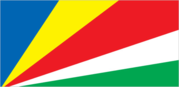
five oblique bands of blue (hoist side), yellow, red, white, and green (bottom) radiating from the bottom of the hoist side; the oblique bands are meant to symbolize a dynamic new country moving into the future; blue represents sky and sea, yellow the sun giving light and life, red the peoples' determination to work for the future in unity and love, white social justice and harmony, green the land and natural environment
Government type
republic
Independence
29 June 1976 (from the UK)
International law organization participation
has not submitted an ICJ jurisdiction declaration; accepts ICCt jurisdiction
International organization participation
ACP, AfDB, AOSIS, AU, C, CD, COMESA, FAO, G-77, IAEA, IBRD, ICAO, ICRM, IDA, IFAD, IFC, IFRCS, ILO, IMF, IMO, InOC, Interpol, IOC, IOM, IPU, ISO (correspondent), ITU, MIGA, NAM, OIF, OPCW, SADC, UN, UNCTAD, UNESCO, UNIDO, UNWTO, UPU, WCO, WHO, WIPO, WMO, WTO (observer)
Judicial branch
- Seychelles Court of Appeal (consists of the court president and 4 justices; Supreme Court of Seychelles (consists of the chief justice and 5 pusine judges); Constitutional Court (consists of 3 Supreme Court judges) all judges appointed by the president of the republic upon the recommendation of the Constitutional Appointments Committee, a 3-member body, with 1 member appointed by the president of the republic, 1 by the opposition leader in the National Assembly, and 1 by the other 2 appointees; judges appointed until retirement at age 70 Magistrates' Courts of Seychelles; Family Tribunal for issues such as domestic violence, and child custody and maintenance
- highest court(s)
- Seychelles Court of Appeal (consists of the court president and 4 justices; Supreme Court of Seychelles (consists of the chief justice and 5 pusine judges); Constitutional Court (consists of 3 Supreme Court judges)
- judge selection and term of office
- all judges appointed by the president of the republic upon the recommendation of the Constitutional Appointments Committee, a 3-member body, with 1 member appointed by the president of the republic, 1 by the opposition leader in the National Assembly, and 1 by the other 2 appointees; judges appointed until retirement at age 70
- subordinate courts
- Magistrates' Courts of Seychelles; Family Tribunal for issues such as domestic violence, and child custody and maintenance
Legal system
mixed legal system of English common law, French civil law, and customary law
Legislative branch
- unicameral National Assembly or Assemblee Nationale (34 seats; 25 members elected by popular vote, 9 allocated on a proportional basis to parties winning at least 10% of the vote; members to serve five-year terms) last held on 29 September - 1 October 2011 (next to be held in 2016); note - the National Assembly was dissolved in July 2011 resulting in early elections percent of vote by party - PL 88.6%, PDM 10.9%, independents 0.6%; seats by party - PL 31, vacant - 3; note - the ruling SPPF changed its name to People's Party (Party Lepep) in June 2009; the SNP and NDP boycotted the 2011 elections
- election results
- percent of vote by party - PL 88.6%, PDM 10.9%, independents 0.6%; seats by party - PL 31, vacant - 3; note - the ruling SPPF changed its name to People's Party (Party Lepep) in June 2009; the SNP and NDP boycotted the 2011 elections
- elections
- last held on 29 September - 1 October 2011 (next to be held in 2016); note - the National Assembly was dissolved in July 2011 resulting in early elections
National anthem
- "Koste Seselwa" (Seychellois Unite) David Francois Marc ANDRE and George Charles Robert PAYET adopted 1996
- lyrics/music
- David Francois Marc ANDRE and George Charles Robert PAYET
- name
- "Koste Seselwa" (Seychellois Unite)
National holiday
Constitution Day (National Day), 18 June (1993)
Political parties and leaders
Democratic Party or DP [James MANCHAM, Paul CHOW] New Democratic Party or NDP People's Party (Parti Lepep) or PL [France Albert RENE] Popular Democratic Movement or PDM Seychelles National Party or SNP [Wavel RAMKALAWAN] (formerly the United Opposition or UO)
Political pressure groups and leaders
- Roman Catholic Church trade unions
- other
- trade unions
Suffrage
18 years of age; universal
Economy
Agriculture - products
coconuts, cinnamon, vanilla, sweet potatoes, cassava (tapioca), copra, bananas; poultry; tuna
Budget
- $438.3 million $415.4 million (2012 est.)
- expenditures
- $415.4 million (2012 est.)
- revenues
- $438.3 million
Budget surplus (+) or deficit (-)
2.2% of GDP (2012 est.)
Central bank discount rate
11.17% (31 December 2010 est.)
Commercial bank prime lending rate
12.19% (31 December 2012 est.) 11.19% (31 December 2011 est.)
Current account balance
$-208.9 million (2012 est.) $-226.3 million (2011 est.)
Debt - external
$1.733 billion (31 December 2012 est.) $1.779 billion (31 December 2011 est.)
Economy - overview
since independence in 1976, per capita output in this Indian Ocean archipelago has expanded to roughly seven times the pre-independence, near-subsistence level, moving the island into the upper-middle-income group of countries. Growth has been led by the tourist sector, which employs about 30% of the labor force and provides more than 70% of hard currency earnings, and by tuna fishing. In recent years, the government has encouraged foreign investment to upgrade hotels and other services. At the same time, the government has moved to reduce the dependence on tourism by promoting the development of farming, fishing, and small-scale manufacturing. In July 2008 the government defaulted on a Euro amortizing note worth roughly US$80 million, leading to a downgrading of Seychelles credit rating. In an effort to obtain loans to service its debt, Seychelles in November 2008 signed a standby arrangement with the IMF that mandated floating the exchange rate, removing foreign exchange controls, cutting government spending, and tightening monetary policy. In response to Seychelles' successful implementation of these policies, the IMF upgraded Seychelles to a three-year extended fund facility (EFF) of $31 million in December 2009. In 2008, GDP fell more than 1% due to declining tourism and the initial effects of liberalization, but the economy recovered in 2010-11 after the reforms took hold and tourism increased. Growth slowed again in 2012 with flagging tourism from Russia and the United Arab Emirates. Seychelles is attempting to implement further structural reforms, including overhauling the tax system, reorganizing of state enterprises, and deregulating the finance and communications sectors.
Exchange rates
Seychelles rupees (SCR) per US dollar - 13.7 (2012 est.) 12.38 (2011 est.) 12.07 (2010 est.) 13.61 (2009) 8 (2008)
Exports
$493.3 million (2012 est.) $478 million (2011 est.)
Exports - commodities
canned tuna, frozen fish, cinnamon bark, copra, petroleum products (reexports)
Exports - partners
France 27.7%, UK 17.6%, Japan 15.2%, Italy 10.6% (2012)
Fiscal year
calendar year
GDP - composition, by end use
- 101.5% 14.7% 31.3% 0.6% 45.7% -92.6% (2012 est.)
- exports of goods and services
- 45.7%
- government consumption
- 14.7%
- household consumption
- 101.5%
- imports of goods and services
- -92.6%
- investment in fixed capital
- 31.3%
- investment in inventories
- 0.6%
GDP - composition, by sector of origin
- 2% 18.6% 79.4% (2012 est.)
- agriculture
- 2%
- industry
- 18.6%
- services
- 79.4% (2012 est.)
GDP - per capita (PPP)
$25,000 (2012 est.) $24,600 (2011 est.) $23,700 (2010 est.) data are in 2012 US dollars
GDP - real growth rate
2.9% (2012 est.) 5% (2011 est.) 5.6% (2010 est.)
GDP (official exchange rate)
$1.018 billion (2012 est.)
GDP (purchasing power parity)
$2.295 billion (2012 est.) $2.23 billion (2011 est.) $2.124 billion (2010 est.) data are in 2012 US dollars
Gross national saving
10.6% of GDP (2012 est.) 6.3% of GDP (2011 est.) 5.8% of GDP (2010 est.)
Household income or consumption by percentage share
- 4.7% 15.4% (2007)
- highest 10%
- 15.4% (2007)
- lowest 10%
- 4.7%
Imports
$889.6 million (2012 est.) $879.6 million (2011 est.)
Imports - commodities
machinery and equipment, foodstuffs, petroleum products, chemicals, other manufactured goods
Imports - partners
Saudi Arabia 24%, Spain 12.1%, France 5.9% (2012)
Industrial production growth rate
4% (2012 est.)
Industries
fishing, tourism, processing of coconuts and vanilla, coir (coconut fiber) rope, boat building, printing, furniture; beverages
Inflation rate (consumer prices)
7.1% (2012 est.) 2.6% (2011 est.)
Labor force
39,560 (2006)
Labor force - by occupation
- 3% 23% 74% (2006)
- agriculture
- 3%
- industry
- 23%
- services
- 74% (2006)
Market value of publicly traded shares
$NA
Population below poverty line
NA%
Public debt
68.4% of GDP (2012 est.) 74.3% of GDP (2011 est.)
Reserves of foreign exchange and gold
$318.7 million (31 December 2012 est.) $290.3 million (31 December 2011 est.)
Stock of broad money
$553.4 million (31 December 2011 est.) $598.9 million (31 December 2010 est.)
Stock of domestic credit
$408.1 million (31 December 2012 est.) $422.3 million (31 December 2011 est.)
Stock of narrow money
$301.5 million (31 December 2012 est.) $302.3 million (31 December 2011 est.)
Taxes and other revenues
43.1% of GDP (2012 est.)
Unemployment rate
2% (2006 est.)
Energy
Carbon dioxide emissions from consumption of energy
1.088 million Mt (2011 est.)
Crude oil - exports
0 bbl/day (2010 est.)
Crude oil - imports
0 bbl/day (2010 est.)
Crude oil - production
0 bbl/day (2012 est.)
Crude oil - proved reserves
0 bbl (1 January 2010 es)
Electricity - consumption
263.2 million kWh (2010 est.)
Electricity - exports
0 kWh (2012 est.)
Electricity - from fossil fuels
100% of total installed capacity (2010 est.)
Electricity - from hydroelectric plants
0% of total installed capacity (2010 est.)
Electricity - from nuclear fuels
0% of total installed capacity (2010 est.)
Electricity - from other renewable sources
0% of total installed capacity (2010 est.)
Electricity - imports
0 kWh (2012 est.)
Electricity - installed generating capacity
89,000 kW (2010 est.)
Electricity - production
283 million kWh (2010 est.)
Natural gas - consumption
0 cu m (2010 est.)
Natural gas - exports
0 cu m (2011 est.)
Natural gas - imports
0 cu m (2011 est.)
Natural gas - production
0 cu m (2011 est.)
Natural gas - proved reserves
0 cu m (1 January 2013 es)
Refined petroleum products - consumption
7,793 bbl/day (2011 est.)
Refined petroleum products - exports
0 bbl/day (2010 est.)
Refined petroleum products - imports
6,316 bbl/day (2010 est.)
Refined petroleum products - production
0 bbl/day (2010 est.)
Communications
Broadcast media
the government operates the only terrestrial TV station, which provides local programming and airs broadcasts from international services; multi-channel cable and satellite TV are available; the government operates 1 AM and 1 FM radio station; transmissions of 2 international broadcasters are accessible in Victoria (2007)
Internet country code
.sc
Internet hosts
247 (2012)
Internet users
32,000 (2008)
Telephone system
- effective system combined fixed-line and mobile-cellular teledensity exceeds 170 telephones per 100 persons; radiotelephone communications between islands in the archipelago country code - 248; direct radiotelephone communications with adjacent island countries and African coastal countries; satellite earth station - 1 Intelsat (Indian Ocean) (2011)
- domestic
- combined fixed-line and mobile-cellular teledensity exceeds 170 telephones per 100 persons; radiotelephone communications between islands in the archipelago
- general assessment
- effective system
- international
- country code - 248; direct radiotelephone communications with adjacent island countries and African coastal countries; satellite earth station - 1 Intelsat (Indian Ocean) (2011)
Telephones - main lines in use
28,900 (2012)
Telephones - mobile cellular
138,300 (2012)
Transportation
Airports
14 (2013)
Airports - with paved runways
- 1 (2013)
- 2,438 to 3,047 m
- 1
- 914 to 1,523 m
- 5
- total
- 7
- under 914 m
- 1 (2013)
Airports - with unpaved runways
- 5 (2013)
- 914 to 1,523 m
- 2
- total
- 7
Heliports
1 (2013)
Merchant marine
- cargo 1, carrier 1, chemical tanker 6, petroleum tanker 1 3 (Hong Kong 1, Nigeria 1, South Africa 1) (2010)
- foreign-owned
- 3 (Hong Kong 1, Nigeria 1, South Africa 1) (2010)
- total
- 9
Ports and terminals
Victoria
Roadways
- 508 km 490 km 18 km (2010)
- total
- 508 km
- unpaved
- 18 km (2010)
Military and Security
Manpower available for military service
- 26,257 23,996 (2010 est.)
- females age 16-49
- 23,996 (2010 est.)
- males age 16-49
- 26,257
Manpower fit for military service
- 20,231 19,891 (2010 est.)
- females age 16-49
- 19,891 (2010 est.)
- males age 16-49
- 20,231
Manpower reaching militarily significant age annually
- 650 (2010 est.)
- female
- 650 (2010 est.)
- male
- 686
Military branches
- Seychelles Defense Force: Army, Coast Guard (includes Naval Wing, Air Wing), National Guard (2005)
- Seychelles Defense Force
- Army, Coast Guard (includes Naval Wing, Air Wing), National Guard (2005)
Military expenditures
0.8% of GDP (2011)
Military service age and obligation
18 years of age for voluntary military service (younger with parental consent); no conscription (2012)
Transnational Issues
Disputes - international
Mauritius and Seychelles claim the Chagos Islands (UK-administered British Indian Ocean Territory)
Trafficking in persons
- Seychelles is a source and destination country for Seychellois children and foreign women subjected to sex trafficking; Seychellois girls and, to a lesser extent, boys are forced into prostitution in nightclubs, bars, guest houses, hotels, brothels, private homes, and on the streets by peers, family members, and pimps; foreign tourists, sailors, and migrant workers contribute to the demand for commercial sex acts in Seychelles; some of the large population of foreign migrant workers reportedly experience the underpayment of wages and substandard housing Tier 2 Watch List - Seychelles does not fully comply with the minimum standards for the elimination of trafficking; however, it is making significant efforts to do so; the government has failed to report any investigations, prosecutions, or convictions of trafficking offenses; the government also has not identified or provided protective services to any trafficking victims and punished victims for crimes committed as a result of being trafficked, although it has acknowledged the need for specialized training of officials in recognizing, investigating, and prosecuting trafficking offenses, it did not provide any such training during the reporting period (2013)
- current situation
- Seychelles is a source and destination country for Seychellois children and foreign women subjected to sex trafficking; Seychellois girls and, to a lesser extent, boys are forced into prostitution in nightclubs, bars, guest houses, hotels, brothels, private homes, and on the streets by peers, family members, and pimps; foreign tourists, sailors, and migrant workers contribute to the demand for commercial sex acts in Seychelles; some of the large population of foreign migrant workers reportedly experience the underpayment of wages and substandard housing
- tier rating
- Tier 2 Watch List - Seychelles does not fully comply with the minimum standards for the elimination of trafficking; however, it is making significant efforts to do so; the government has failed to report any investigations, prosecutions, or convictions of trafficking offenses; the government also has not identified or provided protective services to any trafficking victims and punished victims for crimes committed as a result of being trafficked, although it has acknowledged the need for specialized training of officials in recognizing, investigating, and prosecuting trafficking offenses, it did not provide any such training during the reporting period (2013)