2007 Edition
CIA World Factbook 2007 (Project Gutenberg)
Introduction
Administrative divisions
190 municipalites (opcinas, singular - opcina)
Agriculture - products
wheat, maize, sugar beets, sunflower, beef, pork, milk
Airports
39 (2006)
Airports - with paved runways
- over 3,047 m
- 2 2,438 to 3,047 m: 4 1,524 to 2,437 m: 4 914 to 1,523 m: 2
- total
- 16
- under 914 m
- 4 (2006)
Airports - with unpaved runways
- total
- 23 1,524 to 2,437 m: 2 914 to 1,523 m: 9
- under 914 m
- 12 (2006)
Area
- land
- 88,361 sq km
- total
- 88,361 sq km
- water
- 0 sq km
Area - comparative
slightly larger than South Carolina
Background
The Kingdom of Serbs, Croats, and Slovenes was formed in 1918; its name was changed to Yugoslavia in 1929. Various paramilitary bands resisted Nazi Germany's occupation and division of Yugoslavia from 1941 to 1945, but fought each other and ethnic opponents as much as the invaders. The military and political movement headed by Josip TITO (Partisans) took full control of Yugoslavia when German and Croatian separatist forces were defeated in 1945. Although Communist, Tito's new government and his successors (he died in 1980) managed to steer their own path between the Warsaw Pact nations and the West for the next four and a half decades. In 1989, Slobodan MILOSEVIC became president of the Serbian Republic and his ultranationalist calls for Serbian domination led to the violent breakup of Yugoslavia along ethnic lines. In 1991, Croatia, Slovenia, and Macedonia declared independence, followed by Bosnia in 1992. The remaining republics of Serbia and Montenegro declared a new Federal Republic of Yugoslavia (FRY) in April 1992 and under MILOSEVIC's leadership, Serbia led various military campaigns to unite ethnic Serbs in neighboring republics into a "Greater Serbia." These actions led to Yugoslavia being ousted from the UN in 1992, but Serbia continued its - ultimately unsuccesful - campaign until signing the Dayton Peace Accords in 1995. MILOSEVIC kept tight control over Serbia and eventually became president of the FRY in 1997. In 1998, a small-scale ethnic Albanian insurgency in the formerly autonomous Serbian province of Kosovo provoked a Serbian counterinsurgency campaign that resulted in massacres and massive expulsions of ethnic Albanians living in Kosovo by FRY forces and Serb paramilitaries. The MILOSEVIC government's rejection of a proposed international settlement led to NATO's bombing of Serbia in the spring of 1999 and to the eventual withdrawal of Serbian military and police forces from Kosovo in June 1999. UNSC Resolution 1244 in June 1999 authorized the stationing of a NATO-led force (KFOR) in Kosovo to provide a safe and secure environment for the region's ethnic communities, created a UN Administration Mission in Kosovo (UNMIK) to foster self-governing institutions, and reserved the issue of Kosovo's final status for an unspecified date in the future. In 2001, UNMIK promulgated a constitutional framework that allowed Kosovo to establish institutions of self-government and led to Kosovo's first parliamentary election. FRY elections in September 2000 led to the ouster of MILOSEVIC and installed Vojislav KOSTUNICA as president. A broad coalition of democratic reformist parties known as DOS (the Democratic Opposition of Serbia) was subsequently elected to parliament in December 2000 and took control of the government. The arrest of MILOSEVIC by DOS in 2001 allowed for his subsequent transfer to the International Criminal Tribunal for the Former Yugoslavia in The Hague to be tried for crimes against humanity. (MILOSEVIC died at The Hague in March 2006 before the completion of his trial.) In 2001, the country's suspension from the UN was lifted, and it was once more accepted into UN organizations. In 2003, the FRY became Serbia and Montenegro, a loose federation of the two republics with a federal level parliament. Violent rioting in Kosovo in 2004 caused the international community to open negotiations on the future status of Kosovo in January 2006. In May 2006, Montenegro invoked its right under the Constitutional Charter of Serbia and Montenegro to hold a referendum on independence from the state union. The referendum was successful and Montenegro declared itself an independent nation on 3 June 2006. Two days later, Serbia declared that it was the successor state to the union of Serbia and Montenegro. In October 2006, the Serbian parliament unanimously approved - and a referendum confirmed - a new constitution for the country. Geography Serbia
Banatski Okrug
Alibunar, Bela Crkva, Kovacica, Kovin, Opovo, Pancevo, Plandiste, Vrsac; Severno-Backi Okrug: Bacha Topola, Mali Idjos, Subotica; Severno-Banatski Okrug: Ada, Coka, Kanjiza,
Borski Okrug
Bor, Kladovo, Majdanpek, Negotin; Branicevski Okrug: Golubac, Kucevo, Malo Crnice, Petrovac, Pozarevac, Veliko Gradiste,
Budget
- expenditures
- $11.12 billion; including capital expenditures $NA; note - figures are for Serbia and Montenegro; Serbian Statistical Office indicates that for 2006 budget, Serbia will have revenues of $7.08 billion (2005 est.)
- revenues
- $11.45 billion
Capital
- daylight saving time
- +1hr, begins last Sunday in March; ends last Sunday in October
- geographic coordinates
- 44 50 N, 20 30 E
- name
- Belgrade
- time difference
- UTC+1 (6 hours ahead of Washington, DC during Standard Time)
Climate
in the north, continental climate (cold winters and hot, humid summers with well distributed rainfall); in other parts, continental and Mediterranean climate (hot, dry summers and autumns and relatively cold winters with heavy snowfall)
Coastline
0 km (landlocked)
Constitution
10 November 2006
Country name
- conventional long form
- Republic of Serbia
- conventional short form
- Serbia
- former
- People's Republic of Serbia, Socialist Republic of Serbia
- local long form
- Republika Srbija
- local short form
- Srbija
Currency (code)
Serbian Dinar (RSD)
Current account balance
$-2.451 billion (2005 est.)
Debt - external
$15.43 billion (including Montenegro) (2005 est.)
Diplomatic representation from the US
- chief of mission
- Ambassador Michael C. POLT
- embassy
- Kneza Milosa 50, 11000 Belgrade
- mailing address
- 5070 Belgrade Place, Washington, DC 20521-5070
- telephone
- [381] (11) 361-9344
Diplomatic representation in the US
- chancery
- 2134 Kalorama Road NW, Washington, DC 20008
- chief of mission
- Ambassador Ivan VUJACIC
- telephone
- [1] (202) 332-0333
Disputes - international
as the final status of the Serbian province of Kosovo approaches resolution through the six-nation contact group, the several thousand peacekeepers from the UN Interim Administration Mission in Kosovo (UNMIK) since 1999, continue to keep the peace between Kosovar Albanians overwhelmingly supporting Kosovo independence and the Serb minority in Kosovo and Serbian officials in Belgrade, who oppose independence for the province; ethnic Albanians in Kosovo oppose demarcation of the boundary with Macedonia based on the 2000 Macedonia-Serbia and Montenegro delimitation agreement; Serbia and Montenegro delimited about half of the boundary with Bosnia and Herzegovina, but sections with Serbia along the Drina River remain in dispute
Economic aid - recipient
$2 billion pledged in 2001 to Serbia and Montenegro (disbursements to follow over several years; aid pledged by EU and US has been placed on hold because of lack of cooperation by Serbia in handing over General Ratko MLADIC to the criminal court in The Hague)
Economy - overview
- MILOSEVIC-era mismanagement of the economy, an extended period of economic sanctions, and the damage to Yugoslavia's infrastructure and industry during the NATO airstrikes in 1999 left the economy only half the size it was in 1990. After the ousting of former Federal Yugoslav President MILOSEVIC in October 2000, the Democratic Opposition of Serbia (DOS) coalition government implemented stabilization measures and embarked on a market reform program. After renewing its membership in the IMF in December 2000, a down-sized Yugoslavia continued to reintegrate into the international community by rejoining the World Bank (IBRD) and the European Bank for Reconstruction and Development (EBRD). A World Bank-European Commission sponsored Donors' Conference held in June 2001 raised $1.3 billion for economic restructuring. In November 2001, the Paris Club agreed to reschedule the country's $4.5 billion public debt and wrote off 66% of the debt. In July 2004, the London Club of private creditors forgave $1.7 billion of debt, just over half the total owed. Belgrade has made only minimal progress in restructuring and privatizing its holdings in major sectors of the economy, including energy and telecommunications. It has made halting progress towards EU membership and is currently pursuing a Stabilization and Association Agreement with Brussels. Serbia is also pursuing membership in the World Trade Organization. Unemployment remains an ongoing political and economic problem. The Republic of Montenegro severed its economy from Serbia during the MILOSEVIC era; therefore, the formal separation of Serbia and Montenegro in June 2006 had little real impact on either economy. Kosovo's economy continues to transition to a market-based system and is largely dependent on the international community and the diaspora for financial and technical assistance. The euro and the Serbian dinar are both accepted currencies in Kosovo. While maintaining ultimate oversight, UNMIK continues to work with the EU and Kosovo's local provisional government to accelerate economic growth, lower unemployment, and attract foreign investment to help Kosovo integrate into regional economic structures. The complexity of Serbia and Kosovo's political and legal relationships has created uncertainty over property rights and hindered the privatization of state-owned assets in Kosovo. Most of Kosovo's population lives in rural towns outside of the largest city, Pristina. Inefficient, near-subsistence farming is common.
- note
- economic data for Serbia currently reflects information for the former Serbia and Montenegro, unless otherwise noted; data for Serbia alone will be added when available
Electricity - consumption
NA
Electricity - exports
12.05 billion kWh (excluding Kosovo; exported to Montenegro) (2004)
Electricity - imports
11.23 billion kWh (excluding Kosovo; imports from Montenegro) (2004)
Electricity - production
33.87 billion kWh (excluding Kosovo and Montenegro) (2004)
Elevation extremes
- highest point
- Daravica 2,656 m
- lowest point
- NA
Environment - current issues
air pollution around Belgrade and other industrial cities; water pollution from industrial wastes dumped into the Sava which flows into the Danube
Environment - international agreements
- party to
- Air Pollution, Biodiversity, Climate Change, Endangered Species, Hazardous Wastes, Law of the Sea, Marine Dumping, Marine Life Conservation, Ozone Layer Protection, Ship Pollution, Wetlands
- signed, but not ratified
- none of the selected agreements
Ethnic groups
Serb 66%, Albanian 17%, Hungarian 3.5%, other 13.5% (1991)
Exchange rates
Serbian dinars per US dollar - 58.6925 Communications Serbia
Executive branch
- cabinet
- Federal Ministries act as cabinet; Kosovo - ministry heads act as cabinet; some ministry functions are controlled by the UNMIK
- chief of state
- President Boris TADIC (since 11 July 2004); Kosovo - President Fatmir SEJDIU (since 10 February 2006)
- election results
- Boris TADIC elected president in the second round of voting; Boris TADIC received 53% of the vote
- elections
- president elected by direct vote for a five-year term (eligible for a second term); election last held 27 June 2004 (next to be held in 2007 due to constitutional changes); prime minister elected by the Assembly; Kosovo - president is elected by the Assembly for a three-year term; prime minister and proposed cabinet are elected by the Assembly
- head of government
- Prime Minister Vojislav KOSTUNICA (since 3 March 2004) - in an acting capacity pending formation of new government following January 2007 elections; Kosovo - Prime Minister Agim CEKU (since 10 March 2006)
Exports
$4.553 billion (excluding Kosovo and Montenegro) (2005 est.)
Exports - commodities
manufactured goods, food and live animals, machinery and transport equipment
FAX
- [1] (202) 332-3933
- [381] (11) 361-8230
- consulate(s) general
- Chicago, New York
- note
- there is a branch office in Pristina at 30 Nazim Hikmet 38000 Prstina, Kososvo; telephone: [381] (38) 549-516; FAX:[381] (38) 549-890
Flag description
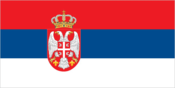
three equal horizontal stripes of red (top), blue, and white; charged with the coat of arms of Serbia shifted slightly to the hoist side Economy Serbia
GDP - composition by sector
- agriculture
- 16.6%
- industry
- 25.5%
- services
- 57.9% (2005 est.)
GDP - per capita (PPP)
$4,400 for Serbia (including Kosovo) (2005 est.)
GDP - real growth rate
5.9% for Serbia alone (excluding Kosovo) (2005 est.)
GDP (official exchange rate)
$19.19 billion for Serbia alone (excluding Kosovo) (2006 est.)
GDP (purchasing power parity)
$44.83 billion for Serbia (including Kosovo) (2006 est.)
Geographic coordinates
44 00 N, 21 00 E
Geography - note
controls one of the major land routes from Western Europe to Turkey and the Near East People Serbia
Government type
republic
Heliports
4 (2006)
IDPs
228,000 (mostly ethnic Serbs and Roma who fled Kosovo in 1999) (2006)
Illicit drugs
transshipment point for Southwest Asian heroin moving to Western Europe on the Balkan route; economy vulnerable to money laundering This page was last updated on 8 February, 2007
Imports
$10.58 billion (excluding Kosovo and Montenegro) (2005 est.)
Independence
5 June 2006 (from Serbia and Montenegro)
Industrial production growth rate
1.4% (2006 est.)
Industries
sugar, agricultural machinery, electrical and communication equipment, paper and pulp, lead, transportation equipment
Inflation rate (consumer prices)
15.5% (2005 est.)
International organization participation
ABEDA, BIS, BSEC, CE, CEI, EBRD, FAO, G-9, IAEA, IBRD, ICAO, ICC, ICCt, ICRM, IDA, IFAD (suspended), IFC, IFRCS, IHO, ILO, IMF, IMO, Interpol, IOC, IOM, IPU, ISO, ITU, ITUC, MIGA, MONUC, NAM (observer), OAS (observer), OIF (observer), OPCW, OSCE, PCA, PFP, SECI, UN, UNCTAD, UNESCO, UNHCR, UNIDO, UNMIL, UNOCI, UNWTO, UPU, WCL, WCO, WHO, WIPO, WMO, WTO (observer)
Internet country code
.rs; note - former ccTLD .yu will remain in service until the end of 2006
Internet hosts
NA
Internet users
1.4 million (2006) Transportation Serbia
Investment (gross fixed)
14.2% of GDP (2005 est.)
Irrigated land
NA
Judicial branch
- Constitutional Court, Supreme Court (to become court of cassation under new constitution), appellate courts, district courts,
- municipal courts; Kosovo
- Supreme Court, district courts, municipal courts, minor offense courts; note - Ministry of Justice was created on 20 December 2004; UNMIK appoints all judges and prosecutors; UNMIK is working on transferring competencies
Kikinda, Novi Knezevac, Senta Srednjo-Banatski Okrug
Nova Crnja, Novi Becej, Secanj, Zitiste, Zrenjanin; Sremski Okrug: Indjija, Irig, Pecinci, Ruma, Sid, Sremska Mitrovica, Stara Pazova;
Kosovo and Metojia Autonomous Province
Kosovaki Okrug: Glogovac, Kacanik, Kosovo Polje, Lipljan, Obilic, Podujevo, Pristina, Stimlje, Strpce, Urosevac; Kosovsko-Mitrovacki Okrug: Kosovska Mitrovica, Leposavic, Srbica, Vucitrn, Zubin Potok, Zvecan; Kosovsko-Pomoravski
Labor force
2.961 million for Serbia (including Kosovo) (2002 est.)
Labor force - by occupation
- agriculture
- 30%
- industry
- 46%
- note
- excluding Kosovo and Montenegro (2002)
- services
- 24%
Land boundaries
- border countries
- Albania 115 km, Bosnia and Herzegovina 302 km, Bulgaria 318 km, Croatia 241 km, Hungary 151 km, Macedonia 221 km, Montenegro 203 km, Romania 476 km
- total
- 2,027 km
Land use
- arable land
- NA
- other
- NA
- permanent crops
- NA
Languages
Serbian (official nationwide); Romanian, Hungarian, Slovak, Ukrainian, and Croatian (all official in Vojvodina); Albanian (official in Kosovo)
Legal system
based on civil law system
Legislative branch
- unicameral National Assembly (250 deputies elected by direct vote for a four-year term); Kosovo - unicameral Assembly (120 deputies - 100 deputies elected by direct vote and 20 deputies from minority community members; elected for a three-year term)
- election results
- SRS 81, DSS 64, DSS-NS 47, G17 Plus 19, SPS 16, LDP Coaliton 15, SVM 3, KZS 2, URS 1, KAPD 1, RP 1; Kosovo - LDK 46, PDK 30, AAK 9, SLKM 8, Ora 7, Bosniak Vakat coalition 4, KDTP 3, other 13
- elections
- last held 21 January 2007 (next to be held 2017); Kosovo - last held 23 October 2004 (next to be held in 2007)
Life expectancy at birth
- female
- 76 years
- male
- 71 years
- total population
- 74 years
Literacy
- definition
- age 15 and over can read and write
- female
- 94.1% (2002 est.) Government Serbia
- male
- 98.9%
- total population
- 96.4%
Location
Southeastern Europe, between Macedonia and Hungary
Map references
Europe
Maritime claims
none (landlocked)
Median age
- female
- 41.7 years
- male
- 39.1 years
- total
- 40.4 years
Merchant marine
- note
- see entry for Montenegro Military Serbia
Military expenditures - dollar figure
$14.85 million Transnational Issues Serbia
Military service age and obligation
peacetime service obligation begins at age 17 and lasts until age 60 for men and 50 for women; under a state of war or impending war, the obligation can begin at age 16 and be extended beyond 60 (2006)
Moravicki Okrug
Cacak, Gornkji Milanovac, Ivanjica, Lucani;
National holiday
National Day, 15 February
Nationality
- adjective
- Serbian
- noun
- Serb(s)
Natural gas - consumption
2.55 billion cu m (2003 est.)
Natural gas - exports
0 cu m (2004 est.)
Natural gas - imports
- 2.1 billion cu m
- note
- includes Montenegro (2004)
Natural gas - production
650 million cu m (2003 est.)
Natural gas - proved reserves
48.14 billion cu m (1 January 2005)
Natural hazards
destructive earthquakes
Natural resources
oil, gas, coal, iron ore, copper, lead, zinc, antimony, chromite, nickel, gold, silver, magnesium, pyrite, limestone, marble, salt, arable land
Nisavski Okrug
Aleksinac, Doljevac, Gadzin Han, Merosina, Nis, Razanj, Svrljig; Pcinjski Okrug: Bosilegrad, Bujanovac, Presevo, Surdulica, Trgoviste, Vladcin Han, Vranje; Pirotski Okrug: Babusnica, Bela Palanka, Dimitrovgrad, Pirot; Podunavski Okrug: Smederevo, Smederevskia Palanka, Velika Plana; Pomoravaki Okrug: Cuprija, Despotovac, Jagodina, Paracin, Rckovac, Svilajnac; Rasinski
Oil - consumption
85,000 bbl/day (2003 est.)
Oil - production
14,660 bbl/day (2003)
Oil - proved reserves
38.75 million bbl (1 January 2002)
Okrug
- Aleksandrovac, Brus, Cicevac, Krusevac, Trstenik, Varvarin;
- Gnjilane, Kosovska Kamenica, Novo Brdo, Vitina; Pecki Okrug: Decani, Djakovica, Istok, Klina, Pec; Prizrenski Okrug: Gora i Opolje, Orahovac, Prizren, Suva Reka
Pipelines
gas 3,177 km; oil 393 km (2006)
Political parties and leaders
Coalition of Albanians of the Presevo Valley or KAPD [Riza HALIMI]; Coalition for Sandzak or KZS [Sulejman UGLJANIN]; Democratic Party of Serbia or DSS [Vojislav KOSTUNICA]; Democratic Party or DS [Boris TADIC]; G17 Plus [Mladjan DINKIC]; League of Vojvodina Hungarians or SVM [Jozsef KASZA]; Liberal Democratic Party or LDP [Cedomir JOVANOVIC]; New Serbia or NS [Velimir ILIC]; Roma Party or RP [Srdjan SAJN]; Serbian Radical Party or SRS [Vojislav SESELJ (currently on trial at The Hague), but Tomislav NIKOLIC is acting leader]; Socialist Party of Serbia or SPS [Ivica DACIC]; Union of Roma of Serbia or URS [Rajko DJURIC]; Kosovo Albanian Christian Democatic Party or PShDK [Mark KRASNIQI]; Alliance for the Future of Kosovo or AAK [Rmuch HARADINAJ]; Citizens' Initiative of Gora or GIG [Rustem IBISI]; Democratic Ashkali Party of Kosovo or PDAK [Sabit RRAHMANI]; Democratic League of Kosovo or LDK [Fatmir SEJDIU]; Democratic Party of Kosovo or PDK [Hashim THACI]; Justice Party or PD [Sylejman CERKEZI]; Kosovo Democratic Turkish Party of KDTP [Mahir YAGCILAR]; Liberal Party of Kosovo or PLK [Gjergi DEDAJ]; New Democratic Initiative of Kosovo or IRDK [Xhevdet NEZIRAJ]; Ora Citizens' List or Ora [Veton SURROI]; Party of Democratic Action or SDA [Numan BALIC]; Popular Movement of Kosovo or LPK [Emrush XHEMAJLI]; Serb List for Kosovo and Metohija or SLKM [Oliver IVANOVIC]; Serb Democratic Party or SDS KiM [Slavisa PETKOVIC]; United Roma Partty of Kosovo or PREBK [Zylfi MERXHA]
Population
9,396,411 (2002 census)
Population below poverty line
- 30%
- note
- data covers the former Serbia and Montenegro (1999 est.)
Public debt
53.1% of GDP (2005 est.)
Radio broadcast stations
153 (2001)
Railways
- standard guage
- 4,135 km 1.435-m guage (electrified 1,195 km) (2005)
- total
- 4,135 km
Raski Okrug
Kraljevo, Novi Pazar, Raska, Tutin, Vrnjacka Banja;
Refugees and internally displaced persons
- refugees (country of origin)
- 100,651 (Croatia), 46,951 (Bosnia and Herzegovina)
Religions
Serbian Orthodox, Muslim, Roman Catholic, Protestant
Reserves of foreign exchange and gold
$5.35 billion (2005 est.)
Roadways
- paved
- 23,937 km
- total
- 37,887 km
- unpaved
- 13,950 km (2002)
Serbia Proper
Beograd: Barajevo, Cukavica, Grocka, Lazarevac, Mladnovac, Novi Beograd, Obrenovac, Palilula, Rakovica, Savski Venac, Sopot, Stari Grad, Surcin, Vozdovac, Vracar, Zemun, Zrezdara
Serbian Armed Forces (Vojska Srbije, VS)
Serbian Land Forces (Kopnene Vojska, KoV), Air Force and Air Defense Force (Vozduhoplostvo i Protivozduhoplovna Odbrana, ViPO), naval force to be determined (2006)
Suffrage
18 universal
Sumadijski Okrug
Arandjelovac, Batocina, Knic, Kragujevac, Lapovo, Raca, Topola; Toplicki Okrug: Blace, Kursumlija, Prokuplje, Zitoradja; Zajocarski Okrug: Boljevac, Knjazevac, Sokobanja, Zalecar; Zlatiborski Okrug: Arilje, Bajina Basta, Cejetina, Kosjevic, Nova Varos, Pozega, Priboj, Prijepolje, Sjenica, Uzice;
Telephone system
- domestic
- teledensity remains below the average for neighboring states; GSM wireless service, available through two providers with national coverage, is growing very rapidly; best telecommunications service limited to urban centers
- general assessment
- modernization of the telecommunications network has been slow as a result of damage stemming from the 1999 war and transition to a competitive market-based system; network was only 65% digitalized in 2005
- international
- country code - 381
Telephones - main lines in use
2,685,400 (2004)
Telephones - mobile cellular
5.229 million (2005)
Terrain
extremely varied; to the north, rich fertile plains; to the east, limestone ranges and basins; to the southeast, ancient mountains and hills
Total fertility rate
1.78 children born/woman (2006 est.)
Unemployment rate
- 31.6%
- note
- unemployment is approximately 50% in Kosovo (2005 est.)
Vojvodina Autonomous Province
Juzno-Backi Okrug: Backi Petrovac, Beocin, Novi Sad, Sremski Karlovci, Temerin, Titel, Zabalj; Juzno
Waterways
587 km - primarily on Danube and Sava rivers (2005)
Zabari, Zagubica Jablanicki Okrug
Bojnik, Crna Trava, Lebane, Leskovac, Medvedja, Vlasotince; Kolubarski Okrug: Lajkovac, Ljig, Mionica, Osecina, Ub, Valjevo; Macvanski Okrug: Bogotic, Koceljeva, Krupanj, Ljubovija, Loznica, Malizvornik, Sabac, Vladimirci;
Zapadno-Backi Okrug
Apatin, Kula, Odzaci, Sombor