1993 Edition
CIA World Factbook 1993 (Project Gutenberg)
Geography
Area
total area: 102,350 km2 land area: 102,136 km2 comparative area: slightly larger than Kentucky note: Serbia has a total area and a land area of 88,412 km2 making it slightly larger than Maine; Montenegro has a total area of 13,938 km2 and a land area of 13,724 km2 making it slightly larger than Connecticut
Climate
in the north, continental climate (cold winter and hot, humid summers with well distributed rainfall); central portion, continental and Mediterranean climate; to the south, Adriatic climate along the coast, hot, dry summers and autumns and relatively cold winters with heavy snowfall inland
Coastline
199 km (Montenegro 199 km, Serbia 0 km)
Environment
coastal water pollution from sewage outlets, especially in tourist-related areas such as Kotor; air pollution around Belgrade and other industrial cities; water pollution along Danube from industrial waste dumped into the Sava which drains into the Danube; subject to destructive earthquakes
International disputes
Sandzak region bordering northern Montenegro and southeastern Serbia - Muslims seeking autonomy; Vojvodina taken from Hungary and awarded to the former Yugoslavia by Treaty of Trianon in 1920; disputes with Bosnia and Herzegovina and Croatia over Serbian populated areas; Albanian minority in Kosovo seeks independence from Serbian Republic
Irrigated land
NA km2
Land boundaries
total 2,234 km, Albania 287 km (114 km with Serbia; 173 km with Motenegro), Bosnia and Herzegovina 527 km (312 km with Serbia; 215 km with Montenegro), Bulgaria 318 km, Croatia (north) 239 km, Croatia (south) 15 km, Hungary 151 km, Macedonia 221 km, Romania 476 km note: the internal boundary between Montenegro and Serbia is 211 km
Land use
arable land: 30% permanent crops: 5% meadows and pastures: 20% forest and woodland: 25% other: 20%
Location
Southern Europe, bordering the Adriatic Sea, between Bosnia and Herzegovina and Bulgaria
Map references
Ethnic Groups in Eastern Europe, Europe, Standard Time Zones of the World
Maritime claims
territorial sea: 12 nm
Natural resources
oil, gas, coal, antimony, copper, lead, zinc, nickel, gold, pyrite, chrome
Note
controls one of the major land routes from Western Europe to Turkey and the Near East; strategic location along the Adriatic coast
Terrain
extremely varied; to the north, rich fertile plains; to the east, limestone ranges and basins; to the southeast, ancient mountain and hills; to the southwest, extremely high shoreline with no islands off the coast; home of largest lake in former Yugoslavia, Lake Scutari
People and Society
Birth rate
NA births/1,000 population
Death rate
NA deaths/1,000 population
Ethnic divisions
Serbs 63%, Albanians 14%, Montenegrins 6%, Hungarians 4%, other 13%
Infant mortality rate
NA deaths/1,000 live births
Labor force
2,640,909 by occupation: industry, mining 40%, agriculture 5% (1990)
Languages
Serbo-Croatian 95%, Albanian 5%
Life expectancy at birth
total population: NA years male: NA years female: NA years
Literacy
total population: NA% male: NA% female: NA%
Nationality
noun: Serb(s) and Montenegrin(s) adjective: Serbian and Montenegrin
Net migration rate
NA migrant(s)/1,000 population
Population
10,699,539 (July 1993 est.)
Population growth rate
NA%
Religions
Orthodox 65%, Muslim 19%, Roman Catholic 4%, Protestant 1%, other 11%
Total fertility rate
NA children born/woman
Government
Administrative divisions
2 republics (pokajine, singular - pokajina); and 2 autonomous provinces*;, Kosovo*, Montenegro,,
Capital
Belgrade
Chamber of Citizens
last held 31 May 1992 (next to be held NA 1996); results - percent of votes by party NA; seats (138 total; 108 Serbian, 30 Montenegrin) - SPS 73, SRS 33, DSSCG 23, SK-PJ 2, DZVM 2, independents 2, vacant 3
Chamber of Republics
last held 31 May 1992 (next to be held NA 1996); results - percent of vote by party NA; seats - (40 total; 20 Serbian, 20 Montenegrin)
Chief of State
Zoran LILIC (since 25 June 1993); note - Slobodan MILOSEVIC is president of Serbia (since 9 December 1990); Momir BULATOVIC is president of Montenegro (since 23 December 1990)
Constitution
27 April 1992
Digraph
SR
Diplomatic representation in US
US and Serbia and Montenegro do not maintain full diplomatic relations; the Embassy of the former Socialist Federal Republic of Yugoslavia continues to function in the US
Executive branch
president, vice president, prime minister, deputy prime minister, cabinet
FAX
[38] (11) 645-221
Flag
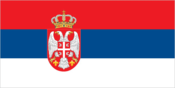
three equal horizontal bands of blue (top), white, and red
Head of Government
Prime Minister Radoje KONTIC (since NA December 1992); Deputy Prime Ministers Jovan ZEBIC (since NA March 1993), Asim TELACEVIC (since NA March 1993), Lovre KOVILJKO (since NA March 1993)
Judicial branch
Savezni Sud (Federal Court), Constitutional Court
Legal system
based on civil law system
Legislative branch
bicameral Federal Assembly consists of an upper house or Chamber of Republics and a lower house or Chamber of Deputies
Names
conventional long form: none conventional short form: Serbia and Montenegro local long form: none local short form: Srbija-Crna Gora
National holiday
NA
Other political or pressure groups
Serbian Democratic Movement (DEPOS; coalition of opposition parties)
Political parties and leaders
Serbian Socialist Party (SPS; former Communist Party), Slobodan MILOSEVIC; Serbian Radical Party (SRS), Vojislav SESELJ; Serbian Renewal Party (SPO), Vuk DRASKOVIC; Democratic Party (DS), Dragoljub MICUNOVIC; Democratic Party of Serbia, Vojislav KOSTUNICA; Democratic Party of Socialists (DSSCG), Momir BULATOVIC; People's Party of Montenegro (NS), Novak KILIBARDA; Liberal Alliance of Montenegro, Slavko PEROVIC; Democratic Community of Vojvodina Hungarians (DZVM), Agoston ANDRAS; League of Communists-Movement for Yugoslavia (SK-PJ), Dragan ATANASOVSKI
President
Federal Assembly elected Zoran LILIC on 25 June 1993
Serbia, Vojvodina*, Independence
11 April 1992 (from Yugoslavia)
Suffrage
16 years of age, if employed; 18 years of age, universal
Type
republic
US diplomatic representation
chief of mission: (vacant) embassy: address NA, Belgrade mailing address: American Embassy Box 5070, Unit 25402, APO AE 09213-5070 telephone: [38] (11) 645-655
Economy
Agriculture
the fertile plains of Vojvodina produce 80% of the cereal production of the former Yugoslavia and most of the cotton, oilseeds, and chicory; Vojvodina also produces fodder crops to support intensive beef and dairy production; Serbia proper, although hilly, has a well-distributed rainfall and a long growing season; produces fruit, grapes, and cereals; in this area, livestock production (sheep and cattle) and dairy farming prosper; Kosovo produces fruits, vegetables, tobacco, and a small amount of cereals; the mountainous pastures of Kosovo and Montenegro support sheep and goat husbandry; Montenegro has only a small agriculture sector, mostly near the coast where a Mediterranean climate permits the culture of olives, citrus, grapes, and rice
Budget
revenues $NA; expenditures $NA, including capital expenditures of $NA
Currency
1 Yugoslav New Dinar (YD) = 100 paras
Economic aid
NA
Electricity
8,850,000 kW capacity; 42,000 million kWh produced, 3,950 kWh per capita (1992)
Exchange rates
Yugoslav New Dinars (YD) per US $1 - 28.230 (December 1991), 15.162 (1990), 15.528 (1989), 0.701 (1988), 0.176 (1987)
Exports
$4.4 billion (f.o.b., 1990) commodities: machinery and transport equipment 29%, manufactured goods 28.5%, miscellaneous manufactured articles 13.5%, chemicals 11%, food and live animals 9%, raw materials 6%, fuels and lubricants 2%, beverages and tobacco 1% partners: prior to the imposition of sanctions by the UN Security Council trade partners were principally the other former Yugoslav republics; Italy, Germany, other EC, the successor states of the former USSR, East European countries, US
External debt
$4.2 billion (may assume some part of foreign debt of former Yugoslavia)
Fiscal year
calendar year
Illicit drugs
NA
Imports
$6.4 billion (c.i.f., 1990) commodities: machinery and transport equipment 26%, fuels and lubricants 18%, manufactured goods 16%, chemicals 12.5%, food and live animals 11%, miscellaneous manufactured items 8%, raw materials, including coking coal for the steel industry, 7%, beverages, tobacco, and edible oils 1.5% partners: prior to the imposition of sanctions by the UN Security Council the trade partners were principally the other former Yugoslav republics; the successor states of the former USSR, EC countries (mainly Italy and Germany), East European countries, US
Industrial production
growth rate -20% or greater (1991 est.)
Industries
machine building (aircraft, trucks, and automobiles; armored vehicles and weapons; electrical equipment; agricultural machinery), metallurgy (steel, aluminum, copper, lead, zinc, chromium, antimony, bismuth, cadmium), mining (coal, bauxite, nonferrous ore, iron ore, limestone), consumer goods (textiles, footwear, foodstuffs, appliances), electronics, petroleum products, chemicals, and pharmaceuticals
Inflation rate (consumer prices)
81% (1991)
National product
GDP - exchange rate conversion - $27-37 billion (1992 est.)
National product per capita
$2,500-$3,500 (1992 est.)
National product real growth rate
NA%
Overview
The swift collapse of the Yugoslav federation has been followed by bloody ethnic warfare, the destabilization of republic boundaries, and the breakup of important interrepublic trade flows. The situation in Serbia and Montenegro remains fluid in view of the extensive political and military strife. Serbia and Montenegro faces major economic problems. First, like the other former Yugoslav republics, it depended on its sister republics for large amounts of foodstuffs, energy supplies, and manufactures. Wide varieties in climate, mineral resources, and levels of technology among the republics accentuate this interdependence, as did the Communist practice of concentrating much industrial output in a small number of giant plants. The breakup of many of the trade links, the sharp drop in output as industrial plants lost suppliers and markets, and the destruction of physical assets in the fighting all have contributed to the economic difficulties of the republics. One singular factor in the economic situation of Serbia and Montenegro is the continuation in office of a Communist government that is primarily interested in political and military mastery, not economic reform. A further complication is the imposition of economic sanctions by the UN.
Unemployment rate
25%-40% (1991 est.)
Communications
Airports
total: 48 useable: 48 with permanent-surface runways: 16 with runways over 3,659 m: with runways 2,440-3,659 m: 6 with runways 1,220-2,439 m: 9
Highways
46,019 km total (1990); 26,949 km paved, 10,373 km gravel, 8,697 km earth
Inland waterways
NA km
Montenegro
40 ships (1,000 GRT or over) totaling 620,455 GRT/1,024,227 DWT; includes 17 cargo, 5 container, 17 bulk, 1 passenger ship; note - most under Maltese flag except 2 bulk under Panamian flag
Pipelines
crude oil 415 km, petroleum products 130 km, natural gas 2,110 km
Ports
coastal - Bar; inland - Belgrade
Railroads
NA
Serbia
4 ships (1,000 GRT or over) totaling 246,631 GRT/451,843 DWT; includes 2 bulk, 2 conbination tanker/ore carrier; note - all under the flag of Saint Vincent and the Grenadines
Telecommunications
700,000 telephones; broadcast stations - 26 AM, 9 FM, 18 TV; 2,015,000 radios; 1,000,000 TVs; satellite ground stations - 1 Atlantic Ocean INTELSAT
Military and Security
Branches
People's Army - Ground Forces (internal and border troops), Naval Forces, Air and Air Defense Forces, Frontier Guard, Territorial Defense Force, Civil Defense
Defense expenditures
245 billion dinars, 4-6% of GDP (1992 est.); note - conversion of defense expenditures into US dollars using the current exchange rate could produce misleading results
Manpower availability
males age 15-49 2,700,485; fit for military service 2,178,128; reach military age (19) annually 83,783 (1993 est.)