1998 Edition
CIA World Factbook 1998 (Internet Archive)
Geography
Area
total: 960 sq km land: 960 sq km water: 0 sq km
Area-comparative
more than five times the size of Washington, DC
Climate
tropical; hot, humid; one rainy season (October to May)
Coastline
209 km
Elevation extremes
lowest point: Atlantic Ocean 0 m highest point: Pico de Sao Tome 2,024 m
Environment-current issues
deforestation; soil erosion and exhaustion
Environment-international agreements
party to: Environmental Modification, Law of the Sea signed, but not ratified: Biodiversity, Climate Change, Desertification
Geographic coordinates
1 00 N, 7 00 E
Irrigated land
100 sq km (1993 est.)
Land boundaries
0 km
Land use
arable land: 2% permanent crops: 36% permanent pastures: 1% forests and woodland: NA% other: 61% (1993 est.)
Location
Western Africa, island in the Gulf of Guinea, straddling the Equator, west of Gabon
Map references
Africa
Maritime claims
measured from claimed archipelagic baselines exclusive economic zone: 200 nm territorial sea: 12 nm
Natural hazards
NA
Natural resources
fish
Terrain
volcanic, mountainous
People and Society
Age structure
0-14 years: 48% (male 36,127; female 35,253) 15-64 years: 48% (male 34,980; female 37,555) 65 years and over: 4% (male 2,813; female 3,395) (July 1998 est.)
Birth rate
43.48 births/1,000 population (1998 est.)
Death rate
8.31 deaths/1,000 population (1998 est.)
Ethnic groups
mestico, angolares (descendants of Angolan slaves), forros (descendants of freed slaves), servicais (contract laborers from Angola, Mozambique, and Cape Verde), tongas (children of servicais born on the islands), Europeans (primarily Portuguese)
Infant mortality rate
54.55 deaths/1,000 live births (1998 est.)
Languages
Portuguese (official)
Life expectancy at birth
total population: 64.34 years male: 62.87 years female: 65.86 years (1998 est.)
Literacy
definition: age 15 and over can read and write total population: 73% male: 85% female: 62% (1991 est.)
Nationality
noun: Sao Tomean(s) adjective: Sao Tomean
Net migration rate
-4.15 migrant(s)/1,000 population (1998 est.)
Population
150,123 (July 1998 est.)
Population growth rate
3.1% (1998 est.)
Religions
Roman Catholic, Evangelical Protestant, Seventh-Day Adventist
Sex ratio
at birth: 1.03 male(s)/female under 15 years: 1.02 male(s)/female 15-64 years: 0.93 male(s)/female 65 years and over: 0.82 male(s)/female (1998 est.)
Total fertility rate
6.19 children born/woman (1998 est.)
Government
Administrative divisions
2 districts (concelhos, singular-concelho); Principe, Sao Tome
Constitution
approved March 1990; effective 10 September 1990
Country name
conventional long form: Democratic Republic of Sao Tome and Principe conventional short form: Sao Tome and Principe local long form: Republica Democratica de Sao Tome e Principe local short form: Sao Tome e Principe
Data code
TP
Executive branch
chief of state: President Miguel TROVOADA (since 4 April 1991) head of government: Prime Minister Raul Wagner BRAGANCA NETO (since 20 November 1996) cabinet: Council of Ministers appointed by the president on the proposal of the prime minister elections: president elected by popular vote for a five-year term; election last held 30 June and 15 July 1996 (next to be held in 2001); prime minister chosen by the National Assembly and approved by the president election results: Miguel TROVOADA reelected president in Sao Tome's second multiparty presidential election; percent of vote-NA
Flag description
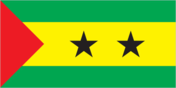
three horizontal bands of green (top), yellow (double width), and green with two black five-pointed stars placed side by side in the center of the yellow band and a red isosceles triangle based on the hoist side; uses the popular pan-African colors of Ethiopia
Government type
republic
Independence
12 July 1975 (from Portugal)
International organization participation
ACP, AfDB, CEEAC, ECA, FAO, G-77, IBRD, ICAO, ICRM, IDA, IFAD, IFRCS, ILO, IMF, IMO, Intelsat (nonsignatory user), Interpol, IOC, IOM (observer), ITU, NAM, OAU, UN, UNCTAD, UNESCO, UNIDO, UPU, WHO, WMO, WToO, WTrO (applicant) Diplomatic representation in the US: Sao Tome and Principe does not have an embassy in the US, but does have a Permanent Mission to the UN, headed by First Secretary Domingos AUGUSTO Ferreira, located at 122 East 42nd Street, Suite 1604, New York, NY 10168, telephone [1] (212) 697-4211 Diplomatic representation from the US: the US does not have an embassy in Sao Tome and Principe; the Ambassador to Gabon is accredited to Sao Tome and Principe on a nonresident basis and makes periodic visits to the islands
Judicial branch
Supreme Court, judges are appointed by the National Assembly Political parties and leaders: Party for Democratic Convergence-Reflection Group or PCD-GR [Armindo AGUIAR, secretary general]; Movement for the Liberation of Sao Tome and Principe or MLSTP [Francisco Fortunas PIRES]; Christian Democratic Front or FDC [Alphonse Dos SANTOS]; Democratic Opposition Coalition or CODO; Independent Democratic Action or ADI [Carlos NEVES]; other small parties
Legal system
based on Portuguese legal system and customary law; has not accepted compulsory ICJ jurisdiction
Legislative branch
unicameral National Assembly or Assembleia Nacional (55 seats; members are elected by direct popular vote to serve five-year terms) elections: parliament dissolved by President TROVOADA in July 1994; early elections held 2 October 1994 (next to be held October 1998) election results: percent of vote by party-MLSTP 49%, PCD-GR 25.5%, ADI 25.5%; seats by party-MLSTP 27, PCD-GR 14, ADI 14
National capital
Sao Tome
National holiday
Independence Day, 12 July (1975)
Suffrage
18 years of age; universal
Economy
Agriculture-products
cocoa, coconuts, palm kernels, copra, cinnamon, pepper, coffee, bananas, papaya, beans; poultry; fish
Budget
revenues: $58 million expenditures: $114 million, including capital expenditures of $54 million (1993 est.)
Currency
1 dobra (Db) = 100 centimos
Debt-external
$266 million (1996)
Economic aid
recipient: ODA, $NA
Economy-overview
This small poor island economy has become increasingly dependent on cocoa since independence over 20 years ago. However, cocoa production has substantially declined because of drought and mismanagement. The resulting shortage of cocoa for export has created a persistent balance-of-payments problem. Sao Tome has to import all fuels, most manufactured goods, consumer goods, and a significant amount of food. Over the years, it has been unable to service its external debt and has had to depend on concessional aid and debt rescheduling. Considerable potential exists for development of a tourist industry, and the government has taken steps to expand facilities in recent years. The government also has attempted to reduce price controls and subsidies, but economic growth has remained sluggish. Sao Tome is also optimistic that significant petroleum discoveries are forthcoming in its territorial waters in the oil-rich waters of the Gulf of Guinea.
Electricity-capacity
6,000 kW (1995)
Electricity-consumption per capita
114 kWh (1995)
Electricity-production
16 million kWh (1995)
Exchange rates
dobras (Db) per US$1-7,003.9 (December 1997), 4,552.5 (1997), 2,203.2 (1996), 1,420.3 (1995), 732.6 (1994), 429.9 (1993)
Exports
total value: $4.9 million (f.o.b., 1996 est.) commodities: cocoa 95%, copra, coffee, palm oil partners: Netherlands 75.7%, Germany 1.2%, Portugal 1.1%
Fiscal year
calendar year Communications
GDP
purchasing power parity-$154 million (1996 est.)
GDP-composition by sector
agriculture: 21% industry: 26% services: 53% (1995 est.)
GDP-per capita
purchasing power parity-$1,000 (1996 est.)
GDP-real growth rate
1.5% (1996 est.)
Imports
total value: $19.6 million (c.i.f., 1996 est.) commodities: machinery and electrical equipment, food products, petroleum products partners: Portugal 32.2%, France 16.8%, Belgium 6.6%, Japan, Angola
Industrial production growth rate
NA%
Industries
light construction, textiles, soap, beer; fish processing; timber
Inflation rate-consumer price index
60% (1996 est.)
Labor force
most of population mainly engaged in subsistence agriculture and fishing; there are shortages of skilled workers
Radio broadcast stations
AM 1, FM 2, shortwave 0
Radios
33,000 (1992 est.)
Telephone system
domestic: minimal system international: satellite earth station-1 Intelsat (Atlantic Ocean)
Telephones
2,200 (1986 est.)
Television broadcast stations
1 (1992 est.)
Televisions
NA
Unemployment rate
28% (1996 est.)
Transportation
Airports
2 (1997 est.) Airports-with paved runways: total: 2 1,524 to 2,437 m: 1 914 to 1,523 m: 1 (1997 est.)
Highways
total: 320 km paved: 218 km unpaved: 102 km (1996 est.) Ports and harbors: Santo Antonio, Sao Tome
Merchant marine
total: 1 cargo ship (1,000 GRT or over) totaling 1,096 GRT/1,105 DWT (1997 est.)
Railways
0 km
Military and Security
Military branches
Army, Navy, Security Police
Military expenditures-dollar figure
$NA
Military expenditures-percent of GDP
NA%
Military manpower-availability
males age 15-49: 30,573 (1988 est.) Military manpower-fit for military service: males: 16,172 (1998 est.)
Transnational Issues
Disputes-international
none