2008 Edition
CIA World Factbook 2008 (Project Gutenberg)
Introduction
Background
Resistance by native Caribs prevented colonization on St. Vincent until 1719. Disputed between France and the United Kingdom for most of the 18th century, the island was ceded to the latter in 1783. Between 1960 and 1962, Saint Vincent and the Grenadines was a separate administrative unit of the Federation of the West Indies. Autonomy was granted in 1969 and independence in 1979.
Geography
Area
total: 389 sq km (Saint Vincent 344 sq km) land: 389 sq km water: 0 sq km
Area - comparative
twice the size of Washington, DC
Climate
tropical; little seasonal temperature variation; rainy season (May to November)
Coastline
84 km
Elevation extremes
lowest point: Caribbean Sea 0 m highest point: La Soufriere 1,234 m
Environment - current issues
pollution of coastal waters and shorelines from discharges by pleasure yachts and other effluents; in some areas, pollution is severe enough to make swimming prohibitive
Environment - international agreements
party to: Biodiversity, Climate Change, Climate Change-Kyoto Protocol, Desertification, Endangered Species, Environmental Modification, Hazardous Wastes, Law of the Sea, Marine Dumping, Ozone Layer Protection, Ship Pollution, Whaling signed, but not ratified: none of the selected agreements
Freshwater withdrawal (domestic/industrial/agricultural)
total: 0.01 per capita: 83 cu m/yr (1995)
Geographic coordinates
13 15 N, 61 12 W
Geography - note
the administration of the islands of the Grenadines group is divided between Saint Vincent and the Grenadines and Grenada; Saint Vincent and the Grenadines is comprised of 32 islands and cays
Irrigated land
10 sq km (2003)
Land boundaries
0 km
Land use
arable land: 17.95% permanent crops: 17.95% other: 64.1% (2005)
Location
Caribbean, islands between the Caribbean Sea and North Atlantic Ocean, north of Trinidad and Tobago
Map references
Central America and the Caribbean
Maritime claims
territorial sea: 12 nm contiguous zone: 24 nm exclusive economic zone: 200 nm continental shelf: 200 nm
Natural hazards
hurricanes; Soufriere volcano on the island of Saint Vincent is a constant threat
Natural resources
hydropower, cropland
Terrain
volcanic, mountainous
People and Society
Age structure
0-14 years: 25.1% (male 15,161/female 14,600) 15-64 years: 68.4% (male 41,855/female 39,105) 65 years and over: 6.5% (male 3,402/female 4,309) (2008 est.)
Birth rate
15.82 births/1,000 population (2008 est.)
Death rate
5.96 deaths/1,000 population (2008 est.)
Education expenditures
8.1% of GDP (2005)
Ethnic groups
black 66%, mixed 19%, East Indian 6%, European 4%, Carib Amerindian 2%, other 3%
HIV/AIDS - adult prevalence rate
NA
HIV/AIDS - deaths
NA
HIV/AIDS - people living with HIV/AIDS
NA
Infant mortality rate
total: 13.62 deaths/1,000 live births male: 14.83 deaths/1,000 live births female: 12.36 deaths/1,000 live births (2008 est.)
Languages
English, French patois
Life expectancy at birth
total population: 74.34 years male: 72.42 years female: 76.31 years (2008 est.)
Literacy
definition: age 15 and over has ever attended school total population: 96% male: 96% female: 96% (1970 est.)
Median age
total: 28 years male: 27.8 years female: 28.1 years (2008 est.)
Nationality
noun: Saint Vincentian(s) or Vincentian(s) adjective: Saint Vincentian or Vincentian
Net migration rate
-7.56 migrant(s)/1,000 population (2008 est.)
Population
118,432 (July 2008 est.)
Population growth rate
0.231% (2008 est.)
Religions
Anglican 47%, Methodist 28%, Roman Catholic 13%, other (includes Hindu, Seventh-Day Adventist, other Protestant) 12%
School life expectancy (primary to tertiary education)
total: 12 years male: 12 years female: 12 years (2005)
Sex ratio
at birth: 1.03 male(s)/female under 15 years: 1.04 male(s)/female 15-64 years: 1.07 male(s)/female 65 years and over: 0.79 male(s)/female total population: 1.04 male(s)/female (2008 est.)
Total fertility rate
1.79 children born/woman (2008 est.)
Government
Administrative divisions
6 parishes; Charlotte, Grenadines, Saint Andrew, Saint David, Saint George, Saint Patrick
Capital
name: Kingstown geographic coordinates: 13 09 N, 61 14 W time difference: UTC-4 (1 hour ahead of Washington, DC during Standard Time)
Constitution
27 October 1979
Country name
conventional long form: none conventional short form: Saint Vincent and the Grenadines
Diplomatic representation from the US
the US does not have an embassy in Saint Vincent and the Grenadines; the US Ambassador to Barbados is accredited to Saint Vincent and the Grenadines
Diplomatic representation in the US
chief of mission: Ambassador La Celia A. PRINCE chancery: 3216 New Mexico Avenue NW, Washington, DC 20016 telephone: [1] (202) 364-6730
Executive branch
chief of state: Queen ELIZABETH II (since 6 February 1952); represented by Governor General Sir Fredrick Nathaniel BALLANTYNE (since 2 September 2002) head of government: Prime Minister Ralph E. GONSALVES (since 29 March 2001) cabinet: Cabinet appointed by the governor general on the advice of the prime minister elections: the monarch is hereditary; the governor general is appointed by the monarch; following legislative elections, the leader of the majority party is usually appointed prime minister by the governor general; deputy prime minister appointed by the governor general on the advice of the prime minister
FAX
[1] (202) 364-6736 consulate(s) general: New York
Flag description
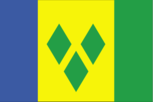
three vertical bands of blue (hoist side), gold (double width), and green; the gold band bears three green diamonds arranged in a V pattern
Government type
parliamentary democracy
Independence
27 October 1979 (from UK)
International organization participation
ACP, C, Caricom, CDB, FAO, G-77, IBRD, ICAO, ICCt, ICRM, IDA, IFAD, IFRCS, ILO, IMF, IMO, Interpol, IOC, ISO (subscriber), ITU, ITUC, MIGA, NAM, OAS, OECS, OPANAL, OPCW, UN, UNCTAD, UNESCO, UNIDO, UPU, WCL, WFTU, WHO, WIPO, WTO
Judicial branch
Eastern Caribbean Supreme Court (based on Saint Lucia; one judge of the Supreme Court resides in Saint Vincent and the Grenadines)
Legal system
based on English common law; has not accepted compulsory ICJ jurisdiction
Legislative branch
unicameral House of Assembly (21 seats, 15 elected representatives and six appointed senators; representatives are elected by popular vote to serve five-year terms) elections: last held 7 December 2005 (next to be held in 2010) election results: percent of vote by party - ULP 55.3%, NDP 44.7%; seats by party - ULP 12, NDP 3
National holiday
Independence Day, 27 October (1979)
Political parties and leaders
New Democratic Party or NDP [Arnhim EUSTACE]; Unity Labor Party or ULP [Ralph GONSALVES] (formed by the coalition of Saint Vincent Labor Party or SVLP and the Movement for National Unity or MNU)
Political pressure groups and leaders
NA
Suffrage
18 years of age; universal
Economy
Agriculture - products
bananas, coconuts, sweet potatoes, spices; small numbers of cattle, sheep, pigs, goats; fish
Budget
revenues: $94.6 million expenditures: $85.8 million (2000 est.)
Central bank discount rate
6.5% (31 December 2007)
Commercial bank prime lending rate
9.61% (31 December 2007)
Currency (code)
East Caribbean dollar (XCD)
Currency code
XCD
Current account balance
-$149 million (2007 est.)
Debt - external
$223 million (2004)
Economic aid - recipient
$4.89 million (1995); note - EU $34.5 million (2005)
Economy - overview
Economic growth slowed slightly in 2007 after reaching a 10 year high of nearly 7% in 2006, but is expected to remain robust, hinging upon seasonal variations in the agricultural and tourism sectors and a recent increase in construction activity. This lower-middle-income country is vulnerable to natural disasters - tropical storms wiped out substantial portions of crops in 1994, 1995, and 2002. In 2007, the islands had more than 200,000 tourist arrivals, mostly to the Grenadines. Saint Vincent is home to a small offshore banking sector and has moved to adopt international regulatory standards. The government's ability to invest in social programs and respond to external shocks is constrained by its high debt burden - 25 percent of current revenues are directed towards debt servicing.
Electricity - consumption
120 million kWh (2006 est.)
Electricity - exports
0 kWh (2007 est.)
Electricity - imports
0 kWh (2007 est.)
Electricity - production
129 million kWh (2006 est.)
Electricity - production by source
fossil fuel: 69.3% hydro: 30.7% nuclear: 0% other: 0% (2001)
Exchange rates
East Caribbean dollars (XCD) per US dollar - 2.7 (2007), 2.7 (2006), 2.7 (2005), 2.7 (2004), 2.7 (2003)
Exports
$193 million (2006)
Exports - commodities
bananas, eddoes and dasheen (taro), arrowroot starch; tennis racquets
Exports - partners
Greece 28.4%, Italy 14.6%, France 12%, UK 7.5%, Trinidad and Tobago 4.8%, Spain 4.6%, Germany 4.3%, Saint Lucia 4.2% (2007)
Fiscal year
calendar year
GDP - composition by sector
agriculture: 10% industry: 26% services: 64% (2001 est.)
GDP - per capita (PPP)
$9,800 (2007 est.)
GDP - real growth rate
6.6% (2007 est.)
GDP (official exchange rate)
$559 million (2007 est.)
GDP (purchasing power parity)
$1.042 billion (2007 est.)
Household income or consumption by percentage share
lowest 10%: NA% highest 10%: NA%
Imports
$578 million (2006)
Imports - commodities
foodstuffs, machinery and equipment, chemicals and fertilizers, minerals and fuels
Imports - partners
Singapore 15.9%, Trinidad and Tobago 14.9%, Italy 13.3%, US 13%, China 5% (2007)
Industrial production growth rate
-0.9% (1997 est.)
Industries
food processing, cement, furniture, clothing, starch
Inflation rate (consumer prices)
6.1% (2007 est.)
Labor force
41,680 (1991 est.)
Labor force - by occupation
agriculture: 26% industry: 17% services: 57% (1980 est.)
Natural gas - consumption
0 cu m (2007 est.)
Natural gas - exports
0 cu m (2007 est.)
Natural gas - imports
0 cu m (2007 est.)
Natural gas - production
0 cu m (2007 est.)
Natural gas - proved reserves
0 cu m (1 January 2006 est.)
Oil - consumption
1,570 bbl/day (2006 est.)
Oil - exports
0 bbl/day (2005)
Oil - imports
1,460 bbl/day (2005)
Oil - production
0 bbl/day (2007 est.)
Oil - proved reserves
0 bbl (1 January 2006 est.)
Population below poverty line
NA%
Stock of domestic credit
$387.8 million (31 December 2007)
Stock of money
$155.5 million (31 December 2007)
Stock of quasi money
$280.2 million (31 December 2007)
Unemployment rate
15% (2001 est.)
Communications
Internet country code
.vc
Internet hosts
124 (2008)
Internet Service Providers (ISPs)
15 (2000)
Internet users
57,000 (2007)
Radio broadcast stations
AM 1, FM 6, shortwave 0 (2004)
Radios
77,000 (1997)
Telephone system
general assessment: adequate system domestic: islandwide, fully automatic telephone system; VHF/UHF radiotelephone from Saint Vincent to the other islands of the Grenadines; mobile-cellular teledensity roughly 100 telephones per 100 persons international: country code - 1-784; the East Caribbean Fiber Optic System (ECFS) and Southern Caribbean fiber optic system (SCF) submarine cables carry international calls; connectivity also provided by VHF/UHF radiotelephone from Saint Vincent to Barbados; SHF radiotelephone to Grenada and Saint Lucia; access to Intelsat earth station in Martinique through Saint Lucia
Telephones - main lines in use
22,800 (2007)
Telephones - mobile cellular
104,000 (2007)
Television broadcast stations
1 (plus 3 repeaters) (2004)
Televisions
18,000 (1997)
Transportation
Airports
6 (2007)
Airports - with paved runways
total: 5 914 to 1,523 m: 4 under 914 m: 1 (2007)
Airports - with unpaved runways
total: 1 under 914 m: 1 (2007)
Merchant marine
total: 525 by type: barge carrier 1, bulk carrier 83, cargo 315, carrier 20, chemical tanker 2, liquefied gas 6, passenger 3, passenger/cargo 17, petroleum tanker 17, refrigerated cargo 20, roll on/roll off 18, specialized tanker 2, container 21 foreign-owned: 476 (Austria 2, Barbados 1, Belgium 8, Bulgaria 15, Canada 1, China 94, Croatia 7, Cyprus 1, Czech Republic 1, Denmark 16, Egypt 3, Estonia 16, France 6, Germany 3, Gibraltar 1, Greece 71, Guyana 2, Hong Kong 6, Iceland 7, India 7, Iran 1, Israel 2, Italy 17, Japan 3, Kenya 2, Latvia 17, Lebanon 6, Lithuania 9, Monaco 5, Montenegro 1, Namibia 1, Netherlands 3, Norway 13, Poland 1, Puerto Rico 1, Romania 1, Russia 21, Singapore 4, Slovenia 5, South Africa 1, Sweden 2, Switzerland 6, Syria 13, Turkey 20, Ukraine 11, UAE 9, UK 13, UK 1, US 18, Venezuela 1) (2008)
Ports and terminals
Kingstown
Roadways
total: 829 km paved: 580 km unpaved: 249 km (2003)
Military and Security
Manpower available for military service
males age 16-49: 34,373 (2008 est.)
Manpower fit for military service
males age 16-49: 28,518 (2008 est.)
Manpower reaching militarily significant age annually
male: 1,224 female: 1,169 (2008 est.)
Military branches
no regular military forces; Royal Saint Vincent and the Grenadines Police Force, Coast Guard (2007)
Military expenditures
NA
Transnational Issues
Disputes - international
joins other Caribbean states to counter Venezuela's claim that Aves Island sustains human habitation, a criterion under UNCLOS, which permits Venezuela to extend its EEZ/continental shelf over a large portion of the eastern Caribbean Sea
Illicit drugs
transshipment point for South American drugs destined for the US and Europe; small-scale cannabis cultivation This page was last updated on 18 December, 2008