1994 Edition
CIA World Factbook 1994 (Project Gutenberg)
Introduction
Administrative divisions
6 parishes; Charlotte, Grenadines, Saint Andrew, Saint David, Saint George, Saint Patrick
Agriculture
accounts for 15% of GDP and 60% of labor force; provides bulk of exports; products - bananas, coconuts, sweet potatoes, spices; small numbers of cattle, sheep, hogs, goats; small fish catch used locally
Airports
total: 6 usable: 6 with permanent-surface runways: 5 with runways over 3,659 m: with runways 2,440-3,659 m: with runways 1,220-2,439 m: 1
Area
total area: 340 sq km land area: 340 sq km comparative area: slightly less than twice the size of Washington, DC
Birth rate
20.27 births/1,000 population (1994 est.)
Branches
Royal Saint Vincent and the Grenadines Police Force, Coast Guard
Budget
revenues: $62 million expenditures: $67 million, including capital expenditures of $21 million (1990 est.)
Capital
Kingstown
Climate
tropical; little seasonal temperature variation; rainy season (May to November)
Coastline
84 km
Constitution
27 October 1979
Currency
1 EC dollar (EC$) = 100 cents
Death rate
5.2 deaths/1,000 population (1994 est.)
Defense expenditures
$NA, NA% of GDP
Digraph
VC
Diplomatic representation in US
chief of mission: Ambassador Kingsley C.A. LAYNE chancery: 1717 Massachusetts Avenue NW, Suite 102, Washington, DC 20036 telephone: (202) 462-7806 or 7846
Economic aid
recipient: US commitments, including Ex-Im (FY70-87), $11 million; Western (non-US) countries, ODA and OOF bilateral commitments (1970-89), $81 million
Electricity
capacity: 16,600 kW production: 64 million kWh consumption per capita: 555 kWh (1992)
Environment
current issues: pollution of coastal waters and shorelines from discharges by pleasure yachts and other effluents natural hazards: subject to hurricanes; Soufriere volcano is a constant threat international agreements: party to - Law of the Sea, Ship Pollution, Whaling
Ethnic divisions
black African descent, white, East Indian, Carib Indian
Exchange rates
East Caribbean dollars (EC$) per US$1 - 2.70 (fixed rate since 1976)
Executive branch
chief of state: Queen ELIZABETH II (since 6 February 1952), represented by Governor General David JACK (since 29 September 1989) head of government: Prime Minister James F. MITCHELL (since 30 July 1984); Deputy Prime Minister Allan C. CRUICKSHANK (since NA); note - governor general appoints leader of the majority party to position of prime minister cabinet: Cabinet; appointed by the governor general on the advice of the prime minister
Exports
$77.5 million (f.o.b., 1992) commodities: bananas, eddoes and dasheen (taro), arrowroot starch, tennis racquets partners: UK 54%, CARICOM 34%, US 10%
External debt
$62.6 million (1992)
FAX
(202) 462-7807
Fiscal year
calendar year
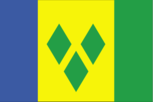
Flag
three vertical bands of blue (hoist side), gold (double width), and green; the gold band bears three green diamonds arranged in a V pattern
Highways
total: 1,000 km paved: 300 km unpaved: improved earth 400 km; unimproved earth 300 km
House of Assembly
elections last held 21 February 1994 (next to be held NA July 1999); results - percent of vote by party NA; seats - (21 total; 15 elected representatives and 6 appointed senators) NDP 10, MNU 2, SVLP 3
Illicit drugs
transshipment point for South American drugs destined for the US and Europe
Imports
$118.6 million (f.o.b., 1992) commodities: foodstuffs, machinery and equipment, chemicals and fertilizers, minerals and fuels partners: US 36%, CARICOM 21%, UK 18%, Trinidad and Tobago 13%
Independence
27 October 1979 (from UK)
Industrial production
growth rate 0% (1989); accounts for 8% of GDP
Industries
food processing, cement, furniture, clothing, starch
Infant mortality rate
17.2 deaths/1,000 live births (1994 est.)
Inflation rate (consumer prices)
3.3% (1993 est.)
International disputes
none
Irrigated land
10 sq km (1989 est.)
Judicial branch
Eastern Caribbean Supreme Court
Labor force
67,000 (1984 est.) by occupation: NA
Land boundaries
0 km
Land use
arable land: 38% permanent crops: 12% meadows and pastures: 6% forest and woodland: 41% other: 3%
Languages
English, French patois
Legal system
based on English common law
Legislative branch
unicameral
Life expectancy at birth
total population: 72.28 years male: 70.77 years female: 73.84 years (1994 est.)
Literacy
age 15 and over having ever attended school (1970) total population: 96% male: 96% female: 96%
Location
Caribbean, in the eastern Caribbean Sea about three-fourths of the way between Puerto Rico and Trinidad and Tobago
Map references
Central America and the Caribbean, South America, Standard Time Zones of the World
Maritime claims
contiguous zone: 24 nm exclusive economic zone: 200 nm territorial sea: 12 nm
Member of
ACP, C, CARICOM, CDB, ECLAC, FAO, G-77, GATT, IBRD, ICAO, ICFTU, IDA, IFAD, IMF, IMO, INTELSAT (nonsignatory user), INTERPOL, IOC, ITU, LORCS, OAS, OECS, OPANAL, UN, UNCTAD, UNESCO, UNIDO, UPU, WCL, WFTU, WHO
Merchant marine
555 ships (1,000 GRT or over) totaling 5,575,652 GRT/9,262,250 DWT, bulk 96, cargo 280, chemical tanker 13, combination bulk 12, combination ore/oil 2, container 31, liquefied gas 7, livestock carrier 1, multi-function large load carrier 1, oil tanker 56, passenger 2, passenger-cargo 5, refrigerated cargo 19, roll-on/roll-off cargo 26, short-sea passenger 2, specialized tanker 1, vehicle carrier 1 note: China owns 5 ships, Croatia owns 58, Russia owns 16; a flag of convenience registry
Names
conventional long form: none conventional short form: Saint Vincent and the Grenadines
National holiday
Independence Day, 27 October (1979)
National product
GDP - purchasing power equivalent - $215 million (1992 est.)
National product per capita
$2,000 (1992 est.)
National product real growth rate
6.5% (1992 est.)
Nationality
noun: Saint Vincentian(s) or Vincentian(s) adjective: Saint Vincentian or Vincentian
Natural resources
negligible
Net migration rate
-7.4 migrant(s)/1,000 population (1994 est.)
Note
some islands of the Grenadines group are administered by Grenada
Overview
Agriculture, dominated by banana production, is the most important sector of the economy. The services sector, based mostly on a growing tourist industry, is also important. The government has been relatively unsuccessful at introducing new industries, and high unemployment rates of 35%-40% continue.
Political parties and leaders
New Democratic Party (NDP), James (Son) MITCHELL; Saint Vincent Labor Party (SVLP), Stanley JOHN; United People's Movement (UPM), Adrian SAUNDERS; Movement for National Unity (MNU), Ralph GONSALVES; National Reform Party (NRP), Joel MIGUEL
Population
115,437 (July 1994 est.)
Population growth rate
0.77% (1994 est.)
Ports
Kingstown
Religions
Anglican, Methodist, Roman Catholic, Seventh-Day Adventist
Suffrage
18 years of age; universal
Telecommunications
islandwide fully automatic telephone system; 6,500 telephones; VHF/UHF interisland links from Saint Vincent to the other islands of the Grenadines and Barbados; new SHF links to Grenada and Saint Lucia; broadcast stations - 2 AM, no FM, 1 TV (cable)
Terrain
volcanic, mountainous; Soufriere volcano on the island of Saint Vincent
Total fertility rate
2.08 children born/woman (1994 est.)
Type
constitutional monarchy
Unemployment rate
35%-40% (1992 est.)
US diplomatic representation
no official presence since the Ambassador resides in Bridgetown (Barbados)