2003 Edition
CIA World Factbook 2003 (Project Gutenberg)
Introduction
Administrative divisions
- 49 oblasts (oblastey, singular - oblast), 21 republics* (respublik, singular - respublika), 10 autonomous okrugs**(avtonomnykh okrugov, singular - avtonomnyy okrug), 6 krays*** (krayev, singular - kray), 2 federal cities (singular - gorod)****, and 1 autonomous oblast*****(avtonomnaya oblast'); Adygeya (Maykop)*, Aginskiy Buryatskiy (Aginskoye)**, Altay (Gorno-Altaysk)*, Altayskiy (Barnaul)***, Amurskaya (Blagoveshchensk), Arkhangel'skaya, Astrakhanskaya, Bashkortostan (Ufa)*, Belgorodskaya, Bryanskaya, Buryatiya (Ulan-Ude)*, Chechnya (Groznyy)*, Chelyabinskaya, Chitinskaya, Chukotskiy (Anadyr')**, Chuvashiya (Cheboksary)*, Dagestan (Makhachkala)*, Evenkiyskiy (Tura)**, Ingushetiya (Nazran')*, Irkutskaya, Ivanovskaya, Kabardino-Balkariya (Nal'chik)*, Kaliningradskaya, Kalmykiya (Elista)*, Kaluzhskaya, Kamchatskaya (Petropavlovsk-Kamchatskiy), Karachayevo-Cherkesiya (Cherkessk)*, Kareliya (Petrozavodsk)*, Kemerovskaya, Khabarovskiy***, Khakasiya (Abakan)*, Khanty-Mansiyskiy (Khanty-Mansiysk)**, Kirovskaya, Komi (Syktyvkar)*, Koryakskiy (Palana)**, Kostromskaya, Krasnodarskiy***, Krasnoyarskiy***, Kurganskaya, Kurskaya, Leningradskaya, Lipetskaya, Magadanskaya, Mariy-El (Yoshkar-Ola)*, Mordoviya (Saransk)*, Moskovskaya, Moskva (Moscow)****, Murmanskaya, Nenetskiy (Nar'yan-Mar)**, Nizhegorodskaya, Novgorodskaya, Novosibirskaya, Omskaya, Orenburgskaya, Orlovskaya (Orel), Penzenskaya, Permskaya, Komi-Permyatskiy (Kudymkar)**, Primorskiy (Vladivostok)***, Pskovskaya, Rostovskaya, Ryazanskaya, Sakha (Yakutiya)*, Sakhalinskaya (Yuzhno-Sakhalinsk), Samarskaya, Sankt-Peterburg (Saint Petersburg)****, Saratovskaya, Severnaya Osetiya-Alaniya [North Ossetia] (Vladikavkaz)*, Smolenskaya, Stavropol'skiy***, Sverdlovskaya (Yekaterinburg), Tambovskaya, Tatarstan (Kazan')*, Taymyrskiy (Dudinka)**, Tomskaya, Tul'skaya, Tverskaya, Tyumenskaya, Tyva (Kyzyl)*, Udmurtiya (Izhevsk)*, Ul'yanovskaya, Ust'-Ordynskiy Buryatskiy (Ust'-Ordynskiy)**, Vladimirskaya, Volgogradskaya, Vologodskaya, Voronezhskaya, Yamalo-Nenetskiy (Salekhard)**, Yaroslavskaya, Yevreyskaya*****; note - when using a place name with an adjectival ending 'skaya' or 'skiy,' the word Oblast' or Avonomnyy Okrug or Kray should be added to the place name
- note
- administrative divisions have the same names as their administrative centers (exceptions have the administrative center name following in parentheses)
Age structure
0-14 years: 16% (male 11,815,360; female 11,335,715) 15-64 years: 70.4% (male 49,399,322; female 52,367,194) 65 years and over: 13.6% (male 6,394,411; female 13,214,276) (2003 est.)
Agriculture - products
grain, sugar beets, sunflower seed, vegetables, fruits; beef, milk
Airports
2,743 (2002)
Airports - with paved runways
- over 3,047 m
- 56 2,438 to 3,047 m: 178 1,524 to 2,437 m: 76 914 to 1,523 m: 69
- total
- 471
- under 914 m
- 92 (2002)
Airports - with unpaved runways
- over 3,047 m
- 28 2,438 to 3,047 m: 118 1,524 to 2,437 m: 204 914 to 1,523 m: 324
- total
- 2,272
- under 914 m
- 1,598 (2002) Military Russia
Area
- land
- 16,995,800 sq km
- total
- 17,075,200 sq km
- water
- 79,400 sq km
Area - comparative
approximately 1.8 times the size of the US
Background
Repeated devastating defeats of the Russian army in World War I led to widespread rioting in the major cities of the Russian Empire and to the overthrow in 1917 of the 300-year old Romanov Dynasty. The Communists under Vladimir LENIN seized power soon after and formed the USSR. The brutal rule of Josef STALIN (1928-53) strengthened Russian dominance of the Soviet Union at a cost of tens of millions of lives. The Soviet economy and society stagnated in the following decades until General Secretary Mikhail GORBACHEV (1985-91) introduced glasnost (openness) and perestroika (restructuring) in an attempt to modernize Communism, but his initiatives inadvertently released forces that by December 1991 splintered the USSR into 15 independent republics. Since then, Russia has struggled in its efforts to build a democratic political system and market economy to replace the strict social, political, and economic controls of the Communist period. A determined guerrilla conflict still plagues Russia in Chechnya. Geography Russia
Birth rate
10.09 births/1,000 population (2003 est.)
Budget
- expenditures
- $62 billion, including capital expenditures of $NA (2002 est.)
- revenues
- $70 billion
Capital
Moscow
Climate
ranges from steppes in the south through humid continental in much of European Russia; subarctic in Siberia to tundra climate in the polar north; winters vary from cool along Black Sea coast to frigid in Siberia; summers vary from warm in the steppes to cool along Arctic coast
Coastline
37,653 km
Constitution
adopted 12 December 1993
Country name
- conventional long form
- Russian Federation
- conventional short form
- Russia
- former
- Russian Empire, Russian Soviet Federative Socialist Republic
- local long form
- Rossiyskaya Federatsiya
- local short form
- Rossiya
Currency
Russian ruble (RUR)
Currency code
RUR
Death rate
13.99 deaths/1,000 population (2003 est.)
Debt - external
$153.5 billion (yearend 2002)
Diplomatic representation from the US
- chief of mission
- Ambassador Alexander VERSHBOW
- embassy
- Bolshoy Devyatinskiy Pereulok No. 8, 121099 Moscow
- mailing address
- PSC-77, APO AE 09721
- telephone
- [7] (095) 728-5000
Diplomatic representation in the US
- chancery
- 2650 Wisconsin Avenue NW, Washington, DC 20007
- chief of mission
- Ambassador Yuriy Viktorovich USHAKOV
- consulate(s) general
- New York, San Francisco, and Seattle
Disputes - international
China continues to seek a mutually acceptable solution to the disputed alluvial islands at the confluence of the Amur and Ussuri rivers and a small island on the Argun River as part of the 2001 Treaty of Good Neighborliness, Friendship, and Cooperation; the islands of Etorofu, Kunashiri, Shikotan, and the Habomai group identified by the Russians as the "Southern Kurils" and by Japan as the "Northern Territories" occupied by the Soviet Union in 1945, now administered by Russia, claimed by Japan; boundary with Georgia has been largely delimited but not demarcated with several small, strategic segments remaining in dispute and OSCE observers monitoring volatile areas such as the Pankisi Gorge in the Akhmeti region and the Argun Gorge in Abkhazia; equidistant seabed treaties have been signed with Azerbaijan and Kazakhstan in the Caspian Sea but no resolution on dividing the water column among any of the littoral states; Russia and Norway dispute their maritime limits in the Barents Sea and Russia's fishing rights beyond Svalbard's territorial limits within the Svalbard Treaty zone; Russia continues to reject signing and ratifying the joint 1996 technical border agreement with Estonia; the Russian Parliament refuses to consider ratification of the boundary treaties with Estonia and Latvia, but in May 2003, ratified land and maritime boundary treaty with Lithuania, which ratified the 1997 treaty in 1999, legalizing limits of former Soviet republic borders; discussions are still ongoing among Russia, Lithuania and the EU concerning a simplified transit document for residents of the Kaliningrad coastal exclave to transit through Lithuania to Russia; land delimitation with Ukraine is ratified, but maritime regime of the Sea of Azov and Kerch Strait is unresolved; delimitation with Kazakhstan is scheduled for completion in 2003; Russian Duma has not yet ratified 1990 Maritime Boundary Agreement with the US in the Bering Sea
Distribution of family income - Gini index
39.9 (2001)
Economic aid - recipient
in FY01 from US, $979 million (including $750 million in non-proliferation subsidies); in 2001 from EU, $200 million
Economy - overview
A decade after the implosion of the Soviet Union in December 1991, Russia is still struggling to establish a modern market economy and achieve strong economic growth. In contrast to its trading partners in Central Europe - which were able within 3 to 5 years to overcome the initial production declines that accompanied the launch of market reforms - Russia saw its economy contract for five years, as the executive and legislature dithered over the implementation of many of the basic foundations of a market economy. Russia achieved a slight recovery in 1997, but the government's stubborn budget deficits and the country's poor business climate made it vulnerable when the global financial crisis swept through in 1998. The crisis culminated in the August depreciation of the ruble, a debt default by the government, and a sharp deterioration in living standards for most of the population. The economy subsequently has rebounded, growing by an average of more than 6% annually in 1999-2002 on the back of higher oil prices and the 60% depreciation of the ruble in 1998. These GDP numbers, along with a renewed government effort to advance lagging structural reforms, have raised business and investor confidence over Russia's prospects in its second decade of transition. Yet serious problems persist. Oil, natural gas, metals, and timber account for more than 80% of exports, leaving the country vulnerable to swings in world prices. Russia's industrial base is increasingly dilapidated and must be replaced or modernized if the country is to maintain vigorous economic growth. Other problems include a weak banking system, a poor business climate that discourages both domestic and foreign investors, corruption, local and regional government intervention in the courts, and widespread lack of trust in institutions. In 2003 President PUTIN further tightened his control over the "oligarchs," especially in the realm of political expression.
Electricity - consumption
773 billion kWh (2001)
Electricity - exports
21.16 billion kWh (2001)
Electricity - imports
7 billion kWh (2001)
Electricity - production
846.5 billion kWh (2001)
Electricity - production by source
- fossil fuel
- 64.3%
- hydro
- 20.5%
- nuclear
- 14.8%
- other
- 0.4% (2001)
Elevation extremes
- highest point
- Gora El'brus 5,633 m
- lowest point
- Caspian Sea -28 m
Environment - current issues
air pollution from heavy industry, emissions of coal-fired electric plants, and transportation in major cities; industrial, municipal, and agricultural pollution of inland waterways and seacoasts; deforestation; soil erosion; soil contamination from improper application of agricultural chemicals; scattered areas of sometimes intense radioactive contamination; groundwater contamination from toxic waste; urban solid waste management; abandoned stocks of obsolete pesticides
Environment - international agreements
- party to
- Air Pollution, Air Pollution-Nitrogen Oxides, Air Pollution-Sulphur 85, Antarctic-Environmental Protocol, Antarctic-Marine Living Resources, Antarctic Seals, Antarctic Treaty, Biodiversity, Climate Change, Endangered Species, Environmental Modification, Hazardous Wastes, Law of the Sea, Marine Dumping, Nuclear Test Ban, Ozone Layer Protection, Ship Pollution, Tropical Timber 83, Wetlands, Whaling
- signed, but not ratified
- Air Pollution-Sulphur 94, Climate Change-Kyoto Protocol, Persistent Organic Pollutants
Ethnic groups
Russian 81.5%, Tatar 3.8%, Ukrainian 3%, Chuvash 1.2%, Bashkir 0.9%, Belarusian 0.8%, Moldavian 0.7%, other 8.1% (1989)
Exchange rates
- Russian rubles per US dollar - 31.27 (2002), 29.17 (2001), 28.13 (2000), 24.62 (1999), 9.71 (1998)
- note
- the post-1 January 1998 ruble is equal to 1,000 of the pre-1 January 1998 rubles
Executive branch
- cabinet
- Ministries of the Government or "Government" composed of the premier and his deputies, ministers, and selected other individuals; all are appointed by the president
- chief of state
- President Vladimir Vladimirovich PUTIN (acting president since 31 December 1999, president since 7 May 2000)
- election results
- Vladimir Vladimirovich PUTIN elected president; percent of vote - Vladimir Vladimirovich PUTIN 52.9%, Gennadiy Andreyevich ZYUGANOV 29.2%, Grigoriy Alekseyevich YAVLINSKIY 5.8%
- elections
- president elected by popular vote for a four-year term; election last held 26 March 2000 (next to be held March 2004); note - no vice president; if the president dies in office, cannot exercise his powers because of ill health, is impeached, or resigns, the premier succeeds him; the premier serves as acting president until a new presidential election is held, which must be within three months; premier appointed by the president with the approval of the Duma
- head of government
- Premier Mikhail Mikhaylovich KASYANOV (since 7 May 2000); Deputy Premiers Viktor Borisovich KHRISTENKO (since 31 May 1999), Aleksey Leonidovich KUDRIN (since 18 May 2000), Aleksey Vasilyevich GORDEYEV (since 20 May 2000), Boris Sergeyevich ALESHIN (since 24 April 2003), Galina Nikolayevna KARELOVA (since 24 April 2003), Vladimir Anatolyevich YAKOVLEV (since 16 June 2003)
- note
- there is also a Presidential Administration (PA) that provides staff and policy support to the president, drafts presidential decrees, and coordinates policy among government agencies; a Security Council also reports directly to the president
Exports
$104.6 billion (2002 est.)
Exports - commodities
petroleum and petroleum products, natural gas, wood and wood products, metals, chemicals, and a wide variety of civilian and military manufactures
Exports - partners
Germany 7.5%, Italy 6.9%, Netherlands 6.7%, China 6.3%, US 6.1%, Ukraine 5.5%, Belarus 5.4%, Switzerland 5% (2002)
FAX
- [1] (202) 298-5735
- [7] (095) 728-5090
- consulate(s) general
- Saint Petersburg, Vladivostok, Yekaterinburg
- telephone
- [1] (202) 298-5700, 5701, 5704, 5708
Fiscal year
calendar year Communications Russia
Flag description
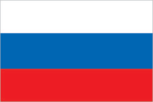
three equal horizontal bands of white (top), blue, and red Economy Russia
GDP
purchasing power parity - $1.409 trillion (2002 est.)
GDP - composition by sector
- agriculture
- 5.8%
- industry
- 34.6%
- services
- 59.6% (2002 est.)
GDP - per capita
purchasing power parity - $9,700 (2002 est.)
GDP - real growth rate
4.3% (2002 est.)
Geographic coordinates
60 00 N, 100 00 E
Geography - note
largest country in the world in terms of area but unfavorably located in relation to major sea lanes of the world; despite its size, much of the country lacks proper soils and climates (either too cold or too dry) for agriculture; Mount Elbrus is Europe's tallest peak People Russia
Government type
federation
Highways
- paved
- 358,833 km
- total
- 532,393 km
- unpaved
- 173,560 km (2000)
HIV/AIDS - adult prevalence rate
0.9% (2001 est.)
HIV/AIDS - deaths
9,000 (2001 est.)
HIV/AIDS - people living with HIV/AIDS
700,000 (2001 est.)
Household income or consumption by percentage share
- highest 10%
- 47% (2001)
- lowest 10%
- 5.9%
Illicit drugs
limited cultivation of illicit cannabis and opium poppy and producer of methamphetamine, mostly for domestic consumption; government has active illicit crop eradication program; used as transshipment point for Asian opiates, cannabis, and Latin American cocaine bound for growing domestic markets, to a lesser extent Western and Central Europe, and occasionally to the US; major source of heroin precursor chemicals; corruption and organized crime are key concerns; heroin increasingly popular in domestic market This page was last updated on 18 December, 2003
Imports
$60.7 billion (2002 est.)
Imports - commodities
machinery and equipment, consumer goods, medicines, meat, sugar, semifinished metal products
Imports - partners
Germany 14.3%, Belarus 8.9%, Ukraine 7.1%, US 6.4%, China 5.2%, Italy 4.8%, Kazakhstan 4.3%, France 4.1% (2002)
Independence
24 August 1991 (from Soviet Union)
Industrial production growth rate
3.7% (2002 est.)
Industries
complete range of mining and extractive industries producing coal, oil, gas, chemicals, and metals; all forms of machine building from rolling mills to high-performance aircraft and space vehicles; shipbuilding; road and rail transportation equipment; communications equipment; agricultural machinery, tractors, and construction equipment; electric power generating and transmitting equipment; medical and scientific instruments; consumer durables, textiles, foodstuffs, handicrafts
Infant mortality rate
- female
- 17.4 deaths/1,000 live births (2003 est.)
- male
- 21.53 deaths/1,000 live births
- total
- 19.51 deaths/1,000 live births
Inflation rate (consumer prices)
15% (2002 est.)
International organization participation
APEC, ARF (dialogue partner), ASEAN (dialogue partner), BIS, BSEC, CBSS, CE, CERN (observer), CIS, EAPC, EBRD, ECE, ESCAP, G- 8, GEF, IAEA, IBRD, ICAO, ICC, ICCt (signatory), ICFTU, ICRM, IDA, IFC, IFRCS, IHO, ILO, IMF, IMO, Interpol, IOC, IOM (observer), ISO, ITU, LAIA (observer), MINURSO, MONUC, NAM (guest), NSG, OAS (observer), OPCW, OSCE, PCA, PFP, SCO, UN, UN Security Council, UNAMSIL, UNCTAD, UNDP, UNHCR, UNIDO, UNIKOM, UNITAR, UNMEE, UNMIBH, UNMIK, UNMISET, UNMOP, UNMOVIC, UNOMIG, UNTSO, UPU, WFTU, WHO, WIPO, WMO, WToO, WTrO (observer), ZC
Internet country code
.ru; Russia also has responsibility for a legacy domain ".su" that was allocated to the Soviet Union, its legal status and ownership are contested by the Russian Government, ICANN, and several Russian commercial entities
Internet Service Providers (ISPs)
300 (June 2000)
Internet users
18 million (2002) Transportation Russia
Irrigated land
46,630 sq km (1998 est.)
Judicial branch
Constitutional Court; Supreme Court; Superior Court of Arbitration; judges for all courts are appointed for life by the Federation Council on the recommendation of the president
Labor force
71.8 million (2002 est.)
Labor force - by occupation
agriculture 12.3%, industry 22.7%, services 65% (2002 est.)
Land boundaries
- border countries
- Azerbaijan 284 km, Belarus 959 km, China (southeast) 3,605 km, China (south) 40 km, Estonia 294 km, Finland 1,313 km, Georgia 723 km, Kazakhstan 6,846 km, North Korea 19 km, Latvia 217 km, Lithuania (Kaliningrad Oblast) 227 km, Mongolia 3,485 km, Norway 196 km, Poland (Kaliningrad Oblast) 206 km, Ukraine 1,576 km
- total
- 19,990 km
Land use
- arable land
- 7.46%
- other
- 92.43% (1998 est.)
- permanent crops
- 0.11%
Languages
Russian, other
Legal system
based on civil law system; judicial review of legislative acts
Legislative branch
- bicameral Federal Assembly or Federalnoye Sobraniye consists of the Federation Council or Sovet Federatsii (178 seats; as of July 2000, members appointed by the top executive and legislative officials in each of the 89 federal administrative units - oblasts, krays, republics, autonomous okrugs and oblasts, and the federal cities of Moscow and Saint Petersburg; members serve four-year terms) and the State Duma or Gosudarstvennaya Duma (450 seats; 225 seats elected by proportional representation from party lists winning at least 5% of the vote, and 225 seats from single-member constituencies; members are elected by direct, popular vote to serve four-year terms)
- election results
- State Duma - percent of vote received by parties clearing the 5% threshold entitling them to a proportional share of the 225 party list seats - United Russia 37.1%, KPRF 12.7%, LDPR 11.6%, Motherland 9.1%; seats by party - United Russia 222, KPRF 53, LDPR 38, Motherland 37, People's Party 19, Yabloko 4, Union of Rightist Forces 2, other 7, independents 65, repeat election required 3
- elections
- State Duma - last held 7 December 2003 (next to be held NA December 2007)
Life expectancy at birth
- female
- 73.11 years (2003 est.)
- male
- 62.46 years
- total population
- 67.66 years
Literacy
- definition
- age 15 and over can read and write
- female
- 99.5% (2003 est.) Government Russia
- male
- 99.7%
- total population
- 99.6%
Location
Northern Asia (that part west of the Urals is included with Europe), bordering the Arctic Ocean, between Europe and the North Pacific Ocean
Map references
Asia
Maritime claims
- continental shelf
- 200-m depth or to the depth of exploitation
- exclusive economic zone
- 200 NM
- territorial sea
- 12 NM
Median age
- female
- 40.3 years (2002)
- male
- 34.7 years
- total
- 37.6 years
Merchant marine
- convenience
- Belize 1, Cambodia 1, Cyprus 9, Denmark 1, Estonia 4, Greece 3, Honduras 1, Latvia 4, Lithuania 3, Moldova 3, Netherlands 1, South Korea 1, Turkey 18, Turkmenistan 2, Ukraine 10, UK 5, US 1 (2002 est.)
- note
- includes some foreign-owned ships registered here as a flag of
- ships by type
- barge carrier 1, bulk 22, cargo 553, chemical tanker 12, combination bulk 21, combination ore/oil 36, container 30, multi-functional large-load carrier 1, passenger 38, passenger/cargo 3, petroleum tanker 167, refrigerated cargo 21, roll on/roll off 20, short-sea passenger 7, specialized tanker 1
- total
- 933 ships (1,000 GRT or over) 4,495,122 GRT/5,490,103 DWT
Military branches
Ground Forces, Navy, Air Forces; Airborne troops, Strategic Rocket Forces, and Military Space Forces are classified as independent combat arms, not subordinate to any of the three branches :
Military expenditures - dollar figure
$NA
Military expenditures - percent of GDP
NA% Transnational Issues Russia
Military manpower - availability
- males age 15-49
- 36 million (2003 est.)
Military manpower - fit for military service
- males age 15-49
- 24 million (2003 est.)
Military manpower - military age
18 years of age (2003)
Military manpower - reaching military age annually
- males
- 1.243 million (2003 est.)
National holiday
Russia Day, 12 June (1990)
Nationality
- adjective
- Russian
- noun
- Russian(s)
Natural gas - consumption
408.1 billion cu m (2001 est.)
Natural gas - exports
205.4 billion cu m (2001 est.)
Natural gas - imports
32.7 billion cu m (2001 est.)
Natural gas - production
580.8 billion cu m (2001 est.)
Natural gas - proved reserves
47.86 trillion cu m (37257)
Natural hazards
permafrost over much of Siberia is a major impediment to development; volcanic activity in the Kuril Islands; volcanoes and earthquakes on the Kamchatka Peninsula; spring floods and summer/autumn forest fires throughout Siberia and parts of European Russia
Natural resources
- wide natural resource base including major deposits of oil, natural gas, coal, and many strategic minerals, timber
- note
- formidable obstacles of climate, terrain, and distance hinder exploitation of natural resources
Net migration rate
0.91 migrant(s)/1,000 population (2003 est.)
Oil - consumption
2.595 million bbl/day (2001 est.)
Oil - exports
NA (2001)
Oil - imports
NA (2001)
Oil - production
7.286 million bbl/day (2001 est.)
Oil - proved reserves
51.22 billion bbl (37257)
Pipelines
gas 135,771 km; oil 70,833 km; refined products 11,536 km; water 23 km (2003)
Political parties and leaders
Communist Party of the Russian Federation or KPRF [Gennadiy Andreyevich ZYUGANOV]; Liberal Democratic Party of Russia or LDPR [Vladimir Volfovich ZHIRINOVSKIY]; Motherland Bloc (Rodina) [Sergey GLAZYEV and Dmitriy ROGOZIN]; People's Party [Gennadiy RAYKOV]; Union of Rightist Forces or SPS [Anatoliy Borisovich CHUBAYS, Yegor Timurovich GAYDAR, Irina Mutsuovna KHAKAMADA, Boris Yefimovich NEMTSOV]; United Russia [Boris Vyacheslavovich GRYZLOV]; Yabloko Party [Grigoriy Alekseyevich YAVLINSKIY]
Political pressure groups and leaders
NA
Population
144,526,278 (July 2003 est.)
Population below poverty line
25% (37622 est.)
Population growth rate
-0.3% (2003 est.)
Ports and harbors
Aleksandrovsk-Sakhalinsky, Arkhangel'sk, Astrakhan', De-Kastri, Indigirskiy, Kaliningrad, Kandalaksha, Kazan', Khabarovsk, Kholmsk, Krasnoyarsk, Lazarev, Mago, Mezen', Moscow, Murmansk, Nakhodka, Nevel'sk, Novorossiysk, Onega, Petropavlovsk-Kamchatskiy, Rostov, Shakhtersk, Saint Petersburg, Sochi, Taganrog, Tuapse, Uglegorsk, Vanino, Vladivostok, Volgograd, Vostochnyy, Vyborg
Radio broadcast stations
AM 420, FM 447, shortwave 56 (1998)
Radios
61.5 million (1997)
Railways
- broad gauge
- 86,200 km 1.520-m gauge (40,300 km electrified)
- narrow gauge
- 957 km 1.067-m gauge (on Sakhalin Island) note:: an additional 30,000 km of non-common carrrier lines serve industries (2002)
- total
- 87,157 km
Religions
Russian Orthodox, Muslim, other
Sex ratio
- at birth
- 1.05 male(s)/female
- total population
- 0.88 male(s)/female (2003 est.)
- under 15 years
- 1.04 male(s)/female 15-64 years: 0.94 male(s)/female 65 years and over: 0.48 male(s)/female
Suffrage
18 years of age; universal
Telephone system
- domestic
- cross-country digital trunk lines run from Saint Petersburg to Khabarovsk, and from Moscow to Novorossiysk; the telephone systems in 60 regional capitals have modern digital infrastructures; cellular services, both analog and digital, are available in many areas; in rural areas, the telephone services are still outdated, inadequate, and low density
- general assessment
- the telephone system has undergone significant changes in the 1990s; there are more than 1,000 companies licensed to offer communication services; access to digital lines has improved, particularly in urban centers; Internet and e-mail services are improving; Russia has made progress toward building the telecommunications infrastructure necessary for a market economy; however, a large demand for main line service remains unsatisfied
- international
- Russia is connected internationally by three undersea fiber-optic cables; digital switches in several cities provide more than 50,000 lines for international calls; satellite earth stations provide access to Intelsat, Intersputnik, Eutelsat, Inmarsat, and Orbita systems
Telephones - main lines in use
30 million (1998)
Telephones - mobile cellular
19 million (January 2003)
Television broadcast stations
7,306 (1998)
Televisions
60.5 million (1997)
Terrain
broad plain with low hills west of Urals; vast coniferous forest and tundra in Siberia; uplands and mountains along southern border regions
Total fertility rate
1.33 children born/woman (2003 est.)
Unemployment rate
7.9% plus considerable underemployment (2002)
Waterways
- 95,900 km (total routes in general use)
- note
- routes with navigation guides serving the Russian River Fleet - 95,900 km; routes with night navigational aids - 60,400 km; man-made navigable routes - 16,900 km (January 1994)