2018 Edition
CIA World Factbook 2018 Archive (Wayback Machine)
Introduction
Background
Paraguay achieved its independence from Spain in 1811. In the disastrous War of the Triple Alliance (1865-70) - between Paraguay and Argentina, Brazil, and Uruguay - Paraguay lost two-thirds of its adult males and much of its territory. The country stagnated economically for the next half century. Following the Chaco War of 1932-35 with Bolivia, Paraguay gained a large part of the Chaco lowland region. The 35-year military dictatorship of Alfredo STROESSNER ended in 1989, and Paraguay has held relatively free and regular presidential elections since the country's return to democracy.
Geography
Area
- land
- 397,302 sq km
- total
- 406,752 sq km
- water
- 9,450 sq km
Area Comparative
about three times the size of New York state; slightly smaller than California
Climate
subtropical to temperate; substantial rainfall in the eastern portions, becoming semiarid in the far west
Coastline
0 km (landlocked)
Elevation
- elevation extremes
- 46 m lowest point: junction of Rio Paraguay and Rio Parana
- mean elevation
- 178 m
- note
- 842 highest point: Cerro Pero
Environment Current Issues
deforestation; water pollution; rivers suffer from toxic dumping; tanneries release mercury and chromium into rivers and streams; loss of wetlands; inadequate means for waste disposal pose health risks for many urban residents
Environment International Agreements
- party to
- Biodiversity, Climate Change, Climate Change-Kyoto Protocol, Desertification, Endangered Species, Hazardous Wastes, Law of the Sea, Ozone Layer Protection, Wetlands
- signed, but not ratified
- none of the selected agreements
Geographic Coordinates
23 00 S, 58 00 W
Geography Note
landlocked; lies between Argentina, Bolivia, and Brazil; population concentrated in eastern and southern part of country
Irrigated Land
1,362 sq km (2012)
Land Boundaries
- border countries (3)
- Argentina 2531 km, Bolivia 753 km, Brazil 1371 km
- total
- 4,655 km
Land Use
- arable land: 10.8% (2011 est.) / permanent crops: 0.2% (2011 est.) / permanent pasture: 42.8% (2011 est.)
- agricultural land
- 53.8% (2011 est.)
- forest
- 43.8% (2011 est.)
- other
- 2.4% (2011 est.)
Location
Central South America, northeast of Argentina, southwest of Brazil
Map References
South America
Maritime Claims
- note
- none (landlocked)
Natural Hazards
local flooding in southeast (early September to June); poorly drained plains may become boggy (early October to June)
Natural Resources
hydropower, timber, iron ore, manganese, limestone
Population Distribution
most of the population resides in the eastern half of the country; to the west lies the Gran Chaco (a semi-arid lowland plain), which accounts for 60% of the land territory, but only 2% of the overall population
Terrain
grassy plains and wooded hills east of Rio Paraguay; Gran Chaco region west of Rio Paraguay mostly low, marshy plain near the river, and dry forest and thorny scrub elsewhere
People and Society
Age Structure
- 0-14 years
- 24.13% (male 862,803 /female 832,325)
- 15-24 years
- 18.8% (male 664,086 /female 656,947)
- 25-54 years
- 41.59% (male 1,461,657 /female 1,460,565)
- 55-64 years
- 8.13% (male 290,719 /female 280,328)
- 65 years and over
- 7.35% (male 242,783 /female 273,550) (2018 est.)
Birth Rate
16.6 births/1,000 population (2018 est.)
Children Under The Age Of 5 Years Underweight
1.3% (2016)
Contraceptive Prevalence Rate
68.4% (2016)
Death Rate
4.8 deaths/1,000 population (2018 est.)
Demographic Profile
Paraguay falls below the Latin American average in several socioeconomic categories, including immunization rates, potable water, sanitation, and secondary school enrollment, and has greater rates of income inequality and child and maternal mortality. Paraguay's poverty rate has declined in recent years but remains high, especially in rural areas, with more than a third of the population below the poverty line. However, the well-being of the poor in many regions has improved in terms of housing quality and access to clean water, telephone service, and electricity. The fertility rate continues to drop, declining sharply from an average 4.3 births per woman in the late 1990s to about 2 in 2013, as a result of the greater educational attainment of women, increased use of contraception, and a desire for smaller families among young women.Paraguay is a country of emigration; it has not attracted large numbers of immigrants because of political instability, civil wars, years of dictatorship, and the greater appeal of neighboring countries. Paraguay first tried to encourage immigration in 1870 in order to rebound from the heavy death toll it suffered during the War of the Triple Alliance, but it received few European and Middle Eastern immigrants. In the 20th century, limited numbers of immigrants arrived from Lebanon, Japan, South Korea, and China, as well as Mennonites from Canada, Russia, and Mexico. Large flows of Brazilian immigrants have been arriving since the 1960s, mainly to work in agriculture. Paraguayans continue to emigrate to Argentina, Brazil, Uruguay, the United States, Italy, Spain, and France.
Dependency Ratios
- elderly dependency ratio
- 9.4 (2015 est.)
- potential support ratio
- 10.6 (2015 est.)
- total dependency ratio
- 56.6 (2015 est.)
- youth dependency ratio
- 47.2 (2015 est.)
Drinking Water Source
- improved: urban: 100% of population
- rural: 94.9% of population
- total: 98% of population
- unimproved: urban: 0% of population
- rural: 5.1% of population
- total: 2% of population (2015 est.)
Education Expenditures
5% of GDP (2012)
Ethnic Groups
mestizo (mixed Spanish and Amerindian) 95%, other 5%
Health Expenditures
9.8% of GDP (2014)
Hiv Aids Adult Prevalence Rate
0.5% (2017 est.)
Hiv Aids Deaths
<1000 (2016 est.)
Hiv Aids People Living With Hiv Aids
20,000 (2017 est.)
Hospital Bed Density
1.3 beds/1,000 population (2011)
Infant Mortality Rate
- female
- 14.7 deaths/1,000 live births (2018 est.)
- male
- 21.4 deaths/1,000 live births (2018 est.)
- total
- 18.1 deaths/1,000 live births (2018 est.)
Languages
Spanish (official), Guarani (official)
Life Expectancy At Birth
- female
- 80.4 years (2018 est.)
- male
- 74.9 years (2018 est.)
- total population
- 77.6 years (2018 est.)
Literacy
- definition
- age 15 and over can read and write (2015 est.)
- female
- 94.3% (2015 est.)
- male
- 95.8% (2015 est.)
- total population
- 95.1% (2015 est.)
Major Infectious Diseases
- degree of risk
- intermediate (2016)
- food or waterborne diseases
- bacterial diarrhea, hepatitis A, and typhoid fever (2016)
- note
- active local transmission of Zika virus by Aedes species mosquitoes has been identified in this country (as of August 2016); it poses an important risk (a large number of cases possible) among US citizens if bitten by an infective mosquito; other less common ways to get Zika are through sex, via blood transfusion, or during pregnancy, in which the pregnant woman passes Zika virus to her fetus
- vectorborne diseases
- dengue fever (2016)
Major Urban Areas Population
3.222 million ASUNCION (capital) (2018)
Maternal Mortality Rate
132 deaths/100,000 live births (2015 est.)
Median Age
- female
- 28.9 years (2018 est.)
- male
- 28.5 years
- total
- 28.7 years
Mother S Mean Age At First Birth
- 22.9 years (2008 est.)
- note
- median age at first birth among women 25-29
Nationality
- adjective
- Paraguayan
- noun
- Paraguayan(s)
Net Migration Rate
-0.1 migrant(s)/1,000 population (2017 est.)
Obesity Adult Prevalence Rate
20.3% (2016)
Physicians Density
1.29 physicians/1,000 population (2012)
Population
7,025,763 (July 2018 est.)
Population Growth Rate
1.17% (2018 est.)
Religions
Roman Catholic 89.6%, Protestant 6.2%, other Christian 1.1%, other or unspecified 1.9%, none 1.1% (2002 census)
Sanitation Facility Access
- improved: urban: 95.5% of population (2015 est.)
- rural: 78.4% of population (2015 est.)
- total: 88.6% of population (2015 est.)
- unimproved: urban: 4.5% of population (2015 est.)
- rural: 21.6% of population (2015 est.)
- total: 11.4% of population (2015 est.)
School Life Expectancy Primary To Tertiary Education
- female
- 13 years (2010)
- male
- 12 years (2010)
- total
- 12 years (2010)
Sex Ratio
- 0-14 years
- 1.04 male(s)/female (2017 est.)
- 15-24 years
- 1.01 male(s)/female (2017 est.)
- 25-54 years
- 1 male(s)/female (2017 est.)
- 55-64 years
- 1.04 male(s)/female (2017 est.)
- 65 years and over
- 0.88 male(s)/female (2017 est.)
- at birth
- 1.04 male(s)/female (2017 est.)
- total population
- 1.01 male(s)/female (2017 est.)
Total Fertility Rate
1.9 children born/woman (2018 est.)
Unemployment Youth Ages 15 24
- female
- 25.5% (2016 est.)
- male
- 16.9% (2016 est.)
- total
- 20.8% (2016 est.)
Urbanization
- rate of urbanization
- 1.71% annual rate of change (2015-20 est.)
- urban population
- 61.6% of total population (2018)
Government
Administrative Divisions
17 departments (departamentos, singular - departamento) and 1 capital city*; Alto Paraguay, Alto Parana, Amambay, Asuncion*, Boqueron, Caaguazu, Caazapa, Canindeyu, Central, Concepcion, Cordillera, Guaira, Itapua, Misiones, Neembucu, Paraguari, Presidente Hayes, San Pedro
Capital
- daylight saving time
- +1hr, begins first Sunday in October; ends last Sunday in March
- geographic coordinates
- 25 16 S, 57 40 W
- name
- Asuncion
- time difference
- UTC-4 (1 hour ahead of Washington, DC, during Standard Time)
Citizenship
- citizenship by birth
- yes
- citizenship by descent only
- at least one parent must be a native-born citizen of Paraguay
- dual citizenship recognized
- yes
- residency requirement for naturalization
- 3 years
Constitution
- amendments
- proposed at the initiative of at least one-quarter of either chamber of the National Congress, by the president of the republic, or by petition of at least 30,000 voters; passage requires absolute majority vote by both chambers and approval in a referendum; amended 2011, 2014; note - in April 2017, a proposed amendment to extend presidential term limits was defeated by the lower house of the National Congress (2018)
- history
- several previous; latest approved and promulgated 20 June 1992 (2018)
Country Name
- conventional long form
- Republic of Paraguay
- conventional short form
- Paraguay
- etymology
- the precise meaning of the name Paraguay is unclear, but it seems to derive from the river of the same name; one explanation has the name meaning "water of the Payagua" (an indigenous tribe that lived along the river)
- local long form
- Republica del Paraguay
- local short form
- Paraguay
Diplomatic Representation From The Us
- chief of mission
- Ambassador Lee MCCLENNY (since 20 February 2018)
- embassy
- 1776 Avenida Mariscal Lopez, Casilla Postal 402, Asuncion
- FAX
- [595] (21) 213-728
- mailing address
- Unit 4711, DPO AA 34036-0001
- telephone
- [595] (21) 213-715
Diplomatic Representation In The Us
- chancery
- 2400 Massachusetts Avenue NW, Washington, DC 20008
- chief of mission
- Ambassador German Hugo ROJAS Irigoyen (since 28 December 2016)
- consulate(s) general
- Los Angeles, Miami, New York
- FAX
- [1] (202) 234-4508
- telephone
- [1] (202) 483-6960 through 6962
Executive Branch
- cabinet
- Council of Ministers appointed by the president
- chief of state
- President Mario Abdo BENITEZ (since 15 August 2018); Vice President Hugo Adalberto VELAZQUEZ Moreno (since 15 August 2018); note - the president is both chief of state and head of government
- election results
- Mario Abdo BENITEZ elected president; percent of vote - Mario Abdo BENITEZ (ANR) 46.4%, Efrain ALEGRE (PLRA) 42.7%, Juan Bautista YBANEZ 3.3%, other 7.6%
- elections/appointments
- president and vice president directly elected on the same ballot by simple majority popular vote for a single 5-year term; election last held on 22 April 2018 (next to be held in April 2023)
- head of government
- President Mario Abdo BENITEZ (since 15 August 2018); Vice President Hugo Adalberto VELAZQUEZ Moreno (since 15 August 2018)
Flag Description
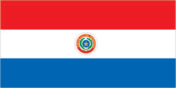
- three equal, horizontal bands of red (top), white, and blue with an emblem centered in the white band; unusual flag in that the emblem is different on each side; the obverse (hoist side at the left) bears the national coat of arms (a yellow five-pointed star within a green wreath capped by the words REPUBLICA DEL PARAGUAY, all within two circles); the reverse (hoist side at the right) bears a circular seal of the treasury (a yellow lion below a red Cap of Liberty and the words PAZ Y JUSTICIA (Peace and Justice)); red symbolizes bravery and patriotism, white represents integrity and peace, and blue denotes liberty and generosity
- note
- the three color bands resemble those on the flag of the Netherlands; one of only three national flags that differ on their obverse and reverse sides - the others are Moldova and Saudi Arabia
Government Type
presidential republic
Independence
14 May 1811 (from Spain)
International Law Organization Participation
accepts compulsory ICJ jurisdiction; accepts ICCt jurisdiction
International Organization Participation
CAN (associate), CD, CELAC, FAO, G-11, G-77, IADB, IAEA, IBRD, ICAO, ICC (national committees), ICCt, ICRM, IDA, IFAD, IFC, IFRCS, ILO, IMF, IMO, Interpol, IOC, IOM, IPU, ISO (correspondent), ITSO, ITU, ITUC (NGOs), LAES, LAIA, Mercosur, MIGA, MINURSO, MINUSTAH, MONUSCO, NAM (observer), OAS, OPANAL, OPCW, Pacific Alliance (observer), PCA, UN, UNASUR, UNCTAD, UNESCO, UNFICYP, UNIDO, Union Latina, UNISFA, UNMIL, UNMISS, UNOCI, UNWTO, UPU, WCO, WHO, WIPO, WMO, WTO
Judicial Branch
- highest courts
- Supreme Court of Justice or Corte Suprema de Justicia (consists of 9 justices divided 3 each into the Constitutional Court, Civil and Commercial Chamber, and Criminal Division)
- judge selection and term of office
- justices proposed by the Council of Magistrates or Consejo de la Magistratura, a 6-member independent body, and appointed by the Chamber of Senators with presidential concurrence; judges can serve until mandatory retirement at age 75
- subordinate courts
- appellate courts; first instance courts; minor courts, including justices of the peace
Legal System
civil law system with influences from Argentine, Spanish, Roman, and French civil law models; judicial review of legislative acts in Supreme Court of Justice
Legislative Branch
- description
- bicameral National Congress or Congreso Nacional consists of:Chamber of Senators or Camara de Senadores (45 seats; members directly elected in a single nationwide constituency by proportional representation vote to serve 5-year terms) Chamber of Deputies or Camara de Diputados (80 seats; members directly elected in 18 multi-seat constituencies - corresponding to the country's 17 departments and capital city - by proportional representation vote to serve 5-year terms)
- election results
- Chamber of Senators - percent of vote by party/coalition - ANR 32.52%, PLRA 24.18%, FG 11.83%, PPQ 6.77%, MH 4.47%, PDP 3.66%, MCN 2.48%, UNACE 2.12%, other 11.97%; seats by party/coalition - ANR 17, PLRA 13, FG 6, PPQ 3, MH 2, PDP 2, MCN 1, UNACE 1; Chamber of Deputies - percent of vote by party/coalition - ANR 39.1%, PLRA 17.74%, Ganar Alliance 12.08%, PPQ 4.46%, MH 3.19%; other 23.43%; seats by party/coalition - ANR 42, PLRA 17, Ganar Alliance 13, PPQ 3, MH 2, other 3
- elections
- Chamber of Senators - last held on 22 April 2018 (next to be held in April 2023) Chamber of Deputies - last held on 22 April 2018 (next to be held in April 2023)
National Anthem
- lyrics/music
- Francisco Esteban ACUNA de Figueroa/disputed
- name
- "Paraguayos, Republica o muerte!" (Paraguayans, The Republic or Death!)
- note
- adopted 1934, in use since 1846; officially adopted following its re-arrangement in 1934
National Holiday
Independence Day, 14-15 May (1811) (observed 15 May)
National Symbol S
lion; national colors: red, white, blue
Political Parties And Leaders
Asociacion Nacional Republicana - Colorado Party or ANR [Pedro ALLIANA]Avanza Pais coalition or AP [Adolfo FERREIRO]Broad Front coalition (Frente Guasu) or FG [Esperanza MARTINEZ]Ganar Alliance (alliance between PLRA and Guasu Front)Movimiento Cruzada Nacional or MCNMovimiento Hagamos or MH [Antonio "Tony" APURIL]Movimiento Union Nacional de Ciudadanos Eticos or UNACE [Jorge OVIEDO MATTO]Partido del Movimiento al Socialismo or P-MAS [Camilo Ernesto SOARES Machado]Partido Democratica Progresista or PDP [Rafael FILIZZOLA]Partido Encuentro Nacional or PEN [Hermann RATZLAFFIN Klippemstein]Partido Liberal Radical Autentico or PLRA [Efrain ALEGRE]Partido Pais Solidario or PPS [Carlos Alberto FILIZZOLA Pallares]Partido Popular Tekojoja or PPT [Sixto PEREIRA Galeano]Patria Querida (Beloved Fatherland Party) or PPQ [Miguel CARRIZOSA]
Suffrage
18 years of age; universal and compulsory until the age of 75
Economy
Agriculture Products
cotton, sugarcane, soybeans, corn, wheat, tobacco, cassava (manioc, tapioca), fruits, vegetables; beef, pork, eggs, milk; timber
Budget
- expenditures
- 5.968 billion (2017 est.)
- revenues
- 5.524 billion (2017 est.)
Budget Surplus Or Deficit
-1.1% (of GDP) (2017 est.)
Central Bank Discount Rate
- 5.5% (31 December 2012)
- 6% (31 December 2011)
Commercial Bank Prime Lending Rate
- 17% (31 December 2017 est.)
- 18.08% (31 December 2016 est.)
Current Account Balance
- -$298 million (2017 est.)
- $416 million (2016 est.)
Debt External
- $17.7 billion (31 December 2017 est.)
- $16.48 billion (31 December 2016 est.)
Distribution Of Family Income Gini Index
- 51.7 (2014)
- 53.2 (2009)
Economy Overview
Landlocked Paraguay has a market economy distinguished by a large informal sector, featuring re-export of imported consumer goods to neighboring countries, as well as the activities of thousands of microenterprises and urban street vendors. A large percentage of the population, especially in rural areas, derives its living from agricultural activity, often on a subsistence basis. Because of the importance of the informal sector, accurate economic measures are difficult to obtain.On a per capita basis, real income has grown steadily over the past five years as strong world demand for commodities, combined with high prices and favorable weather, supported Paraguay's commodity-based export expansion. Paraguay is the fifth largest soy producer in the world. Drought hit in 2008, reducing agricultural exports and slowing the economy even before the onset of the global recession. The economy fell 3.8% in 2009, as lower world demand and commodity prices caused exports to contract. Severe drought and outbreaks of hoof-and-mouth disease in 2012 led to a brief drop in beef and other agricultural exports. Since 2014, however, Paraguay’s economy has grown at a 4% average annual rate due to strong production and high global prices, at a time when other countries in the region have contracted.The Paraguayan Government recognizes the need to diversify its economy and has taken steps in recent years to do so. In addition to looking for new commodity markets in the Middle East and Europe, Paraguayan officials have promoted the country’s low labor costs, cheap energy from its massive Itaipu Hydroelectric Dam, and single-digit tax rate on foreign firms. As a result, the number of factories operating in the country – mostly transplants from Brazil - has tripled since 2014.Corruption, limited progress on structural reform, and deficient infrastructure are the main obstacles to long-term growth. Judicial corruption is endemic and is seen as the greatest barrier to attracting more foreign investment. Paraguay has been adverse to public debt throughout its history, but has recently sought to finance infrastructure improvements to attract foreign investment.
Exchange Rates
- guarani (PYG) per US dollar -
- 5,628.1 (2017 est.)
- 5,680.7 (2016 est.)
- 5,680.7 (2015 est.)
- 5,160.4 (2014 est.)
- 4,462.2 (2013 est.)
Exports
- $11.73 billion (2017 est.)
- $10.86 billion (2016 est.)
Exports Commodities
soybeans, livestock feed, cotton, meat, edible oils, wood, leather, gold
Exports Partners
Brazil 31.9%, Argentina 15.9%, Chile 6.9%, Russia 5.9% (2017)
Fiscal Year
calendar year
Gdp Composition By End Use
- exports of goods and services
- 46.6% (2017 est.)
- government consumption
- 11.3% (2017 est.)
- household consumption
- 66.7% (2017 est.)
- imports of goods and services
- -42.2% (2017 est.)
- investment in fixed capital
- 17.3% (2017 est.)
- investment in inventories
- 0.3% (2017 est.)
Gdp Composition By Sector Of Origin
- agriculture
- 17.9% (2017 est.)
- industry
- 27.7% (2017 est.)
- services
- 54.5% (2017 est.)
Gdp Official Exchange Rate
$38.94 billion (2017 est.) (2017 est.)
Gdp Per Capita Ppp
- $12,800 (2017 est.)
- $12,400 (2016 est.)
- $12,000 (2015 est.)
- note
- data are in 2017 dollars
Gdp Purchasing Power Parity
- $88.91 billion (2017 est.)
- $84.87 billion (2016 est.)
- $81.36 billion (2015 est.)
- note
- data are in 2017 dollars
Gdp Real Growth Rate
- 4.8% (2017 est.)
- 4.3% (2016 est.)
- 3.1% (2015 est.)
Gross National Saving
- 18.6% of GDP (2017 est.)
- 20.9% of GDP (2016 est.)
- 20% of GDP (2015 est.)
Household Income Or Consumption By Percentage Share
- highest 10%
- 37.6% (2013 est.)
- lowest 10%
- 37.6% (2013 est.)
Imports
- $11.35 billion (2017 est.)
- $9.617 billion (2016 est.)
Imports Commodities
road vehicles, consumer goods, tobacco, petroleum products, electrical machinery, tractors, chemicals, vehicle parts
Imports Partners
China 31.3%, Brazil 23.4%, Argentina 12.9%, US 7.4% (2017)
Industrial Production Growth Rate
2% (2017 est.)
Industries
sugar processing, cement, textiles, beverages, wood products, steel, base metals, electric power
Inflation Rate Consumer Prices
- 3.6% (2017 est.)
- 4.1% (2016 est.)
Labor Force
3.428 million (2017 est.)
Labor Force By Occupation
- agriculture
- 26.5%
- industry
- 18.5%
- services
- 55% (2008)
Market Value Of Publicly Traded Shares
- $962.3 million (31 December 2012 est.)
- $958.1 million (31 December 2011 est.)
- $42 million (31 December 2010 est.)
Population Below Poverty Line
22.2% (2015 est.)
Public Debt
- 19.5% of GDP (2017 est.)
- 18.9% of GDP (2016 est.)
Reserves Of Foreign Exchange And Gold
- $7.877 billion (31 December 2017 est.)
- $6.881 billion (31 December 2016 est.)
Stock Of Broad Money
- $5.117 billion (31 December 2017 est.)
- $4.307 billion (31 December 2016 est.)
Stock Of Direct Foreign Investment Abroad
- $705.1 million (31 December 2017 est.)
- $591.3 million (31 December 2016 est.)
Stock Of Direct Foreign Investment At Home
- $6.235 billion (31 December 2017 est.)
- $5.276 billion (31 December 2016 est.)
Stock Of Domestic Credit
- $12.91 billion (31 December 2017 est.)
- $12.18 billion (31 December 2016 est.)
Stock Of Narrow Money
- $5.117 billion (31 December 2017 est.)
- $4.307 billion (31 December 2016 est.)
Taxes And Other Revenues
14.2% (of GDP) (2017 est.)
Unemployment Rate
- 5.7% (2017 est.)
- 6% (2016 est.)
Energy
Carbon Dioxide Emissions From Consumption Of Energy
7.74 million Mt (2017 est.)
Crude Oil Exports
0 bbl/day (2015 est.)
Crude Oil Imports
0 bbl/day (2015 est.)
Crude Oil Production
0 bbl/day (2017 est.)
Crude Oil Proved Reserves
0 bbl (1 January 2018 est.)
Electricity Access
- electrification - rural areas
- 96% (2013)
- electrification - total population
- 98% (2013)
- electrification - urban areas
- 99% (2013)
- population without electricity
- 100,000 (2013)
Electricity Consumption
10.9 billion kWh (2016 est.)
Electricity Exports
41.13 billion kWh (2015 est.)
Electricity From Fossil Fuels
0% of total installed capacity (2016 est.)
Electricity From Hydroelectric Plants
99% of total installed capacity (2017 est.)
Electricity From Nuclear Fuels
0% of total installed capacity (2017 est.)
Electricity From Other Renewable Sources
1% of total installed capacity (2017 est.)
Electricity Imports
0 kWh (2016 est.)
Electricity Installed Generating Capacity
8.87 million kW (2016 est.)
Electricity Production
63.13 billion kWh (2016 est.)
Natural Gas Consumption
0 cu m (2017 est.)
Natural Gas Exports
0 cu m (2017 est.)
Natural Gas Imports
0 cu m (2017 est.)
Natural Gas Production
0 cu m (2017 est.)
Natural Gas Proved Reserves
0 cu m (1 January 2014 est.)
Refined Petroleum Products Consumption
43,000 bbl/day (2016 est.)
Refined Petroleum Products Exports
0 bbl/day (2015 est.)
Refined Petroleum Products Imports
40,760 bbl/day (2015 est.)
Refined Petroleum Products Production
0 bbl/day (2015 est.)
Communications
Broadband Fixed Subscriptions
- subscriptions per 100 inhabitants
- 4 (2017 est.)
- total
- 278,169 (2017 est.)
Broadcast Media
6 privately owned TV stations; about 75 commercial and community radio stations; 1 state-owned radio network (2010)
Internet Country Code
.py
Internet Users
- percent of population
- 51.3% (July 2016 est.)
- total
- 3,524,045 (July 2016 est.)
Telephone System
- domestic
- deficiencies in provision of fixed-line service have resulted in a rapid expansion of mobile-cellular services fostered by competition among multiple providers; Internet market also open to competition (2016)
- general assessment
- the fixed-line market is a state monopoly and fixed-line telephone service is meager; principal switching center is in Asuncion (2016)
- international
- country code - 595; satellite earth station - 1 Intelsat (Atlantic Ocean) (2016)
Telephones Fixed Lines
- subscriptions per 100 inhabitants
- 4 (2017 est.)
- total subscriptions
- 290,109 (2017 est.)
Telephones Mobile Cellular
- subscriptions per 100 inhabitants
- 108 (2017 est.)
- total subscriptions
- 7,468,275 (2017 est.)
Transportation
Airports
799 (2013)
Airports With Paved Runways
- 1,524 to 2,437 m
- 7 (2017)
- 914 to 1,523 m
- 5 (2017)
- over 3,047 m
- 3 (2017)
- total
- 15 (2017)
Airports With Unpaved Runways
- 1,524 to 2,437 m
- 23 (2013)
- 914 to 1,523 m
- 290 (2013)
- total
- 784 (2013)
- under 914 m
- 471 (2013)
Civil Aircraft Registration Country Code Prefix
ZP (2016)
Merchant Marine
- by type
- container ship 3, general cargo 22, oil tanker 6, other 47
- note
- as of 2017, Paraguay registered 2,012 fluvial vessels of which 1,741 were commercial barges
- total
- 78
National Air Transport System
- annual freight traffic on registered air carriers
- 1,641,624 mt-km (2015)
- annual passenger traffic on registered air carriers
- 452,004 (2015)
- inventory of registered aircraft operated by air carriers
- 5 (2015)
- number of registered air carriers
- 1 (2015)
Ports And Terminals
- river port(s)
- Asuncion, Villeta, San Antonio, Encarnacion (Parana)
Railways
- standard gauge
- 30 km 1.435-m gauge (2014)
- total
- 30 km (2014)
Roadways
- paved
- 4,860 km (2010)
- total
- 32,059 km (2010)
- unpaved
- 27,199 km (2010)
Waterways
3,100 km (primarily on the Paraguay and Paraná River systems) (2012)
Military and Security
Military Branches
Armed Forces Command (Commando de las Fuerzas Militares): Army, National Navy (Armada Nacional, includes Marine Corps, Naval Aviation, and Coast Guard), Paraguayan Air Force (Fuerza Aerea Paraguay, FAP), Logistics Command, War Materiel Directorate (2012)
Military Expenditures
- 1.25% of GDP (2016)
- 1.42% of GDP (2015)
- 1.29% of GDP (2014)
- 1.28% of GDP (2013)
- 1.3% of GDP (2012)
Military Service Age And Obligation
18 years of age for compulsory and voluntary military service; conscript service obligation is 12 months for Army, 24 months for Navy; volunteers for the Air Force must be younger than 22 years of age with a secondary school diploma (2012)
Transnational Issues
Disputes International
unruly region at convergence of Argentina-Brazil-Paraguay borders is locus of money laundering, smuggling, arms and illegal narcotics trafficking, and fundraising for violent extremist organizations
Illicit Drugs
major illicit producer of cannabis, most or all of which is consumed in Brazil, Argentina, and Chile; transshipment country for Andean cocaine headed for Brazil, other Southern Cone markets, and Europe; weak border controls, extensive corruption and money-laundering activity, especially in the Tri-Border Area; weak anti-money-laundering laws and enforcement