Introduction
Several Indigenous groups, principally belonging to the Guarani language family, inhabited the area of modern Paraguay before the arrival of the Spanish in the early 16th century, when the territory was incorporated into the Viceroyalty of Peru. Paraguay achieved its independence from Spain in 1811 with the help of neighboring states. In the aftermath of independence, a series of military dictators ruled the country until 1870. During the disastrous War of the Triple Alliance (1864-70) -- fought against Argentina, Brazil, and Uruguay -- Paraguay lost two thirds of its adult males and much of its territory. The country stagnated economically for the next half-century and experienced a tumultuous series of political regimes. Following the Chaco War of 1932-35 with Bolivia, Paraguay gained a large part of the Chaco lowland region. The 35-year military dictatorship of Alfredo STROESSNER ended in 1989, and Paraguay has held relatively free and regular presidential elections since the country's return to democracy.
Geography
- Land
- 397,302 sq km
- Total
- 406,752 sq km
- Water
- 9,450 sq km
about three times the size of New York State; slightly smaller than California
subtropical to temperate; substantial rainfall in the eastern portions, becoming semiarid in the far west
0 km (landlocked)
South America
- Highest point
- Cerro Pero 842 m
- Lowest point
- junction of Río Paraguay and Río Paraná 46 m
- Mean elevation
- 178 m
23 00 S, 58 00 W
landlocked; lies between Argentina, Bolivia, and Brazil; population concentrated in eastern and southern part of country
1,362 sq km (2012)
- Border countries
- Argentina 2,531 km; Bolivia 753 km; Brazil 1,371 km
- number of neighbors
- 3
- Total
- 4,655 km
- Agricultural land
- 54.1% (2023 est.)
- Agricultural land: arable land
- arable land: 11.5% (2023 est.)
- Agricultural land: permanent crops
- permanent crops: 0.2% (2023 est.)
- Agricultural land: permanent pasture
- permanent pasture: 42.4% (2023 est.)
- arable land
- 11.52%
- Forest
- 36.9% (2023 est.)
- Other
- 7% (2023 est.)
- permanent crops
- 0.21%
Yes
Central South America, northeast of Argentina, southwest of Brazil
Guarani Aquifer System
Río de la Plata/Paraná (shared with Brazil [s], Argentina, and Uruguay [m]) - 4,880 km; Paraguay river mouth (shared with Brazil [s] and Argentina) - 2,549 km<br><br><strong>note:</strong> [s] after country name indicates river source; [m] after country name indicates river mouth
- Atlantic Ocean drainage
- Paraná (2,582,704 sq km)
- Google Maps
- https://goo.gl/maps/JtnqG73WJn1Gx6mz6
- OpenStreetMap
- https://www.openstreetmap.org/relation/287077
South America
none (landlocked)
local flooding in southeast (early September to June); poorly drained plains may become boggy (early October to June)
hydropower, timber, iron ore, manganese, limestone
most of the population resides in the eastern half of the country; to the west lies the Gran Chaco (a semi-arid lowland plain), which accounts for 60% of the land territory, but only 2% of the overall population
South America
grassy plains and wooded hills east of Rio Paraguay; Gran Chaco region west of Rio Paraguay mostly low, marshy plain near the river, and dry forest and thorny scrub elsewhere
- UTC-04:00
- number of time zones
- 1
People and Society
- 0-14 years
- 22.2% (male 850,191/female 821,237)
- 15-64 years
- 68.4% (male 2,582,021/female 2,561,962)
- 65 years and over
- 9.4% (2024 est.) (male 337,164/female 369,974)
- Beer
- 3.27 liters of pure alcohol (2019 est.)
- Other alcohols
- 0.03 liters of pure alcohol (2019 est.)
- Spirits
- 1.59 liters of pure alcohol (2019 est.)
- Total
- 5.47 liters of pure alcohol (2019 est.)
- Wine
- 0.59 liters of pure alcohol (2019 est.)
15.66 births/1,000 population (2025 est.)
- Women married by age 15
- 3.6% (2016)
- Women married by age 18
- 21.6% (2016)
1.3% (2016 est.)
54.8% (2022 est.)
- 4.97 deaths/1,000 population (2025 est.)
- adult female
- 96 per 1,000
- adult male
- 179 per 1,000
- Elderly dependency ratio
- 14.3 (2025 est.)
- Potential support ratio
- 7 (2025 est.)
- Total dependency ratio
- 46.7 (2025 est.)
- Youth dependency ratio
- 32.4 (2025 est.)
- improved total
- 64.36%
- Improved: rural
- rural: 99.1% of population (2022 est.)
- Improved: total
- total: 99.6% of population (2022 est.)
- Improved: urban
- urban: 99.9% of population (2022 est.)
- Unimproved: rural
- rural: 0.9% of population (2022 est.)
- Unimproved: total
- total: 0.4% of population (2022 est.)
- Unimproved: urban
- urban: 0.1% of population (2022 est.)
- Education expenditure (% GDP)
- 3.4% of GDP (2023 est.)
- Education expenditure (% national budget)
- 11.7% national budget (2025 est.)
3 % of GDP
Mestizo (mixed Spanish and Indigenous ancestry) 95%, other 5%
0.92 (2025 est.)
- 8 % of GDP
- Health expenditure (as % of GDP)
- 8% of GDP (2021)
- Health expenditure (as % of national budget)
- 17.4% of national budget (2022 est.)
0.3%
1 beds/1,000 population (2020 est.)
- Female
- 17.7 deaths/1,000 live births
- Male
- 26.1 deaths/1,000 live births
- neonatal
- 9 deaths/1,000 live births
- Total
- 21.4 deaths/1,000 live births (2025 est.)
- Languages
- Spanish (official) and Guarani (official) 46.3%, only Guarani 34%, only Spanish 15.2%, other (includes Portuguese, German, other Indigenous languages) 4.1%, no response 0.4% (2012 est.)
- Major-language sample(s)
- <br>La Libreta Informativa del Mundo, la fuente indispensable de información básica. (Spanish)<br><br>The World Factbook, the indispensable source for basic information.
- Note
- <strong>note:</strong> data represent predominant household language
- number of languages
- 2
- Female
- 81.6 years
- Male
- 76.2 years
- Total population
- 78.8 years (2024 est.)
- Female
- 94.3% (2024 est.)
- Male
- 95.4% (2024 est.)
- Total population
- 94.9% (2024 est.)
3.511 million ASUNCION (capital) (2023)
58 deaths/100,000 live births (2023 est.)
- Female
- 32 years
- Male
- 31.6 years
- Total
- 32.3 years (2025 est.)
- 22.9 years (2008 est.)
- note
- <strong>note:</strong> data represents median age at first birth among women 25-29
- Adjective
- Paraguayan
- Noun
- Paraguayan(s)
-0.07 migrant(s)/1,000 population (2025 est.)
20.3% (2016)
3.89 physicians/1,000 population (2022)
- Female
- 3,794,637
- Male
- 3,809,407
- Total
- 7,604,044 (2025 est.)
1.06% (2025 est.)
Roman Catholic 80.4%, Protestant 7% (Evangelical (non-specific) 6.7%, Evangelical Pentecostal <0.1%, Adventist <0.1%, Protestant (non-specific) <0.1%), Believer (not belonging to the church) 5.7%, other 0.6%, agnostic <0.1%, none 0.2%, unspecified 6.2% (2023 est.)
- improved total
- 58.53%
- Improved: rural
- rural: 94.9% of population (2022 est.)
- Improved: total
- total: 98.1% of population (2022 est.)
- Improved: urban
- urban: 100% of population (2022 est.)
- Unimproved: rural
- rural: 5.1% of population (2022 est.)
- Unimproved: total
- total: 1.9% of population (2022 est.)
- Unimproved: urban
- urban: 0% of population (2022 est.)
- 0-14 years
- 1.04 male(s)/female
- 15-64 years
- 1.01 male(s)/female
- 65 years and over
- 0.91 male(s)/female
- At birth
- 1.05 male(s)/female
- Total population
- 1 male(s)/female (2024 est.)
- Female
- 3.3% (2025 est.)
- Male
- 15.5% (2025 est.)
- Total
- 9.3% (2025 est.)
1.88 children born/woman (2025 est.)
- Rate of urbanization
- 1.64% annual rate of change (2020-25 est.)
- Urban population
- 63.1% of total population (2023)
- measles
- 90%
Government
17 departments (<em>departamentos</em>, singular - <em>departamento</em>) and 1 capital city*; Alto Paraguay, Alto Parana, Amambay, Asuncion*, Boquerón, Caaguazú, Caazapá, Canindeyú, Central, Concepcion, Cordillera, Guairá, Itapúa, Misiones, Ñeembucú, Paraguarí, Presidente Hayes, San Pedro
- Etymology
- the name means "assumption" in Spanish; the Spanish founded the city on August 15, 1537, the Catholic feast day for the Assumption of the Virgin Mary
- Geographic coordinates
- 25 16 S, 57 40 W
- Name
- Asunción
- Time difference
- UTC-3 (2 hour ahead of Washington, DC, during Standard Time)
- Citizenship by birth
- yes
- Citizenship by descent only
- at least one parent must be a native-born citizen of Paraguay
- Dual citizenship recognized
- yes
- Residency requirement for naturalization
- 3 years
- svg
- https://mainfacts.com/media/images/coats_of_arms/py.svg
- Amendment process
- proposed at the initiative of at least one quarter of either chamber of the National Congress, by the president of the republic, or by petition of at least 30,000 voters; passage requires a two-thirds majority vote by both chambers and approval in a referendum
- History
- several previous; latest approved and promulgated 20 June 1992
- alternative spellings
- PY, Republic of Paraguay, República del Paraguay, Tetã Paraguái
- Conventional long form
- Republic of Paraguay
- Conventional short form
- Paraguay
- Etymology
- derives from the river of the same name; the river's name may come from the Guarani words <em>para </em>(water or river) and <em>guay </em>(born)
- FIFA code
- PAR
- Local long form
- República del Paraguay
- local long form (grn)
- Tetã Paraguái
- Local short form
- Paraguay
- Chief of mission
- Ambassador (vacant); Chargé d’Affaires Robert ALTER (since July 2025)
- Email address and website
- <br>ParaguayACS@state.gov<br><br>https://py.usembassy.gov/
- Embassy
- 1776 Mariscal Lopez Avenue, Asuncion
- FAX
- [595] (21) 213-728
- Mailing address
- 3020 Asuncion Place, Washington DC 20521-3020
- Telephone
- [595] (21) 248-3000
- Chancery
- 2209 Massachusetts Avenue, NW, Washington DC 20008
- Chief of mission
- Ambassador Gustavo Alfredo LEITE Gusinky (since 5 September 2025)
- Consulate(s) general
- Los Angeles, Miami, New York
- Email address and website
- <br>gabineteembaparusa@mre.gov.py<br><br>Embajada de la República del Paraguay ante los Estados Unidos de América :: The Embassy (mre.gov.py)
- FAX
- [1] (202) 234-4508
- Telephone
- [1] (202) 483-6960
- Cabinet
- Council of Ministers appointed by the president
- Chief of state
- President Santiago PEÑA Palacios (since 15 August 2023)
- Election results
- <br><em>2023: </em>Santiago PEÑA Palacios elected president; percent of vote - Santiago PEÑA Palacios (ANR) 43.9%, Efraín ALEGRE (PLRA) 28.3%, Paraguayo "Payo" CUBAS Colomés (PCN) 23.6%, other 4.2%<em><br><br>2018:</em> Mario ABDO BENÍTEZ elected president; percent of vote - Mario ABDO BENÍTEZ (ANR) 49%, Efraín ALEGRE (PLRA) 45.1%, other 5.9%
- Election/appointment process
- president and vice president directly elected on the same ballot by simple-majority popular vote for a single 5-year term
- Expected date of next election
- April 2028
- Head of government
- President Santiago PEÑA Palacios (since 15 August 2023)
- Most recent election date
- 30 April 2023
- Note
- <strong>note</strong>: the president is both chief of state and head of government
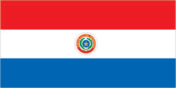
- <strong>description:</strong> three equal horizontal bands of red (top), white, and blue, with an emblem centered on the white band; the emblem on one side of the flag is the national coat of arms, which has a five-pointed yellow star in a green wreath with the words REPUBLICA DEL PARAGUAY around it, all inside two circles; the other side of the flag has a circular treasury seal (a yellow lion below a red Cap of Liberty and the words PAZ Y JUSTICIA)<br><br><strong>meaning:</strong> red stands for bravery and patriotism, white for integrity and peace, and blue for liberty and generosity
- note
- <strong>note 1:</strong> resembles the flag of the Netherlands, which does not have a central emblem<br><br><strong>note 2:</strong> one of three national flags that differ on each side -- the others are Moldova and Saudi Arabia
The flag of Paraguay features three equal horizontal bands of red, white and blue, with an emblem centered in the white band. On the obverse side of the flag depicted, this emblem is the national coat of arms.
- svg
- https://flagcdn.com/py.svg
presidential republic
- 14-15 May 1811 (from Spain)
- note
- <strong>note:</strong> the uprising against Spanish authorities took place during the night of 14-15 May 1811, so both days are celebrated in Paraguay
accepts compulsory ICJ jurisdiction; accepts ICCt jurisdiction
CAN (associate), CD, CELAC, FAO, G-11, G-77, IADB, IAEA, IBRD, ICAO, ICC (national committees), ICCt, ICRM, IDA, IFAD, IFC, IFRCS, ILO, IMF, IMO, Interpol, IOC, IOM, IPU, ISO (correspondent), ITSO, ITU, ITUC (NGOs), LAES, LAIA, Mercosur, MIGA, MINURSO, MINUSTAH, MONUSCO, NAM (observer), OAS, OPANAL, OPCW, Pacific Alliance (observer), PCA, PROSUR, UN, UNASUR, UNCTAD, UNESCO, UNFICYP, UNHRC, UNIDO, Union Latina, UNISFA, UNMIL, UNMISS, UNOCI, UNOOSA, UNWTO, UPU, WCO, WHO, WIPO, WMO, WTO
- Highest court(s)
- Supreme Court of Justice or Corte Suprema de Justicia (consists of 9 justices divided 3 each into the Constitutional Court, Civil and Commercial Chamber, and Criminal Division)
- Judge selection and term of office
- justices proposed by the Council of Magistrates or Consejo de la Magistratura, a 6-member independent body, and appointed by the Chamber of Senators with presidential concurrence; judges can serve until mandatory retirement at age 75
- Subordinate courts
- appellate courts; first instance courts; minor courts, including justices of the peace
civil law system with influences from Argentine, Spanish, Roman, and French civil law models; Supreme Court of Justice reviews legislative acts
- Legislative structure
- bicameral
- Legislature name
- Congress (Congreso)
- Chamber name
- Chamber of Deputies (Cámara de Diputados)
- Electoral system
- proportional representation
- Expected date of next election
- April 2028
- Most recent election date
- 4/30/2023
- Number of seats
- 80 (all directly elected)
- Parties elected and seats per party
- National Republican Association/Colorado Party (ANR) (48); Authentic Radical Liberal Party (PLRA) - Alliances (23); National Crusade Party (CN) (4); Other (5)
- Percentage of women in chamber
- 23.8%
- Scope of elections
- full renewal
- Term in office
- 5 years
- Chamber name
- Senate (Cámara de Senadores)
- Electoral system
- proportional representation
- Expected date of next election
- April 2028
- Most recent election date
- 4/30/2023
- Number of seats
- 45 (all directly elected)
- Parties elected and seats per party
- National Republican Association/Colorado Party (ANR) (23); Authentic Radical Liberal Party (PLRA) - Alliances (12); National Crusade Party (CN) (5); Other (5)
- Percentage of women in chamber
- 22.2%
- Scope of elections
- full renewal
- Term in office
- 5 years
red, white, blue
- Selected World Heritage Site locales
- Jesuit Missions of La Santísima Trinidad de Paraná and Jesús de Tavarangue
- Total World Heritage Sites
- 1 (cultural)
Independence Day, 14-15 May (1811) (observed 15 May); 14 May is celebrated as Flag Day
lion
Asociacion Nacional Republicana (National Republican Association) - Colorado Party or ANR<br>Avanza Pais coalition or AP<br>Frente Guasu (Broad Front coalition) or FG<br>GANAR Alliance (Great Renewed National Alliance) (alliance between PLRA and Guasú Front)<br>Movimiento Hagamos or MH<br>Movimiento Union Nacional de Ciudadanos Eticos (National Union of Ethical Citizens) or UNACE<br>Partido Cruzada Nacional (National Crusade Party) or PCN; note - formerly Movimiento Cruzada Nacional<br>Partido del Movimiento al Socialismo or P-MAS<br>Partido Democratica Progresista (Progressive Democratic Party) or PDP<br>Partido Encuentro Nacional or PEN<br>Partido Liberal Radical Autentico (Authentic Radical Liberal Party) or PLRA<br>Partido Pais Solidario or PPS<br>Partido Popular Tekojoja or PPT<br>Patria Querida (Beloved Fatherland Party) or PPQ
Monday
18 years of age; universal and compulsory until the age of 75
Yes
Economy
- soybeans, sugarcane, maize, cassava, wheat, rice, milk, beef, oranges, bananas (2023)
- note
- <b>note:</b> top ten agricultural products based on tonnage
- On alcohol and tobacco
- 4.2% of household expenditures (2023 est.)
- On food
- 29.3% of household expenditures (2023 est.)
- Expenditures
- $9.397 billion (2023 est.)
- Note
- <b>note:</b> central government revenues (excluding grants) and expenditures converted to US dollars at average official exchange rate for year indicated
- Revenues
- $7.751 billion (2023 est.)
- code
- PYG
- name
- Paraguayan guaraní (PYG) [₲]
- $-1,527,604,954
- Current account balance 2022
- -$2.948 billion (2022 est.)
- Current account balance 2023
- -$176.597 million (2023 est.)
- Current account balance 2024
- -$1.666 billion (2024 est.)
- Note
- <b>note:</b> balance of payments - net trade and primary/secondary income in current dollars
- $29.96 billion
- Debt - external 2023
- $13.783 billion (2023 est.)
- Note
- <b>note:</b> present value of external debt in current US dollars
upper middle-income South American economy; COVID-19 hit while still recovering from 2019 Argentina-driven recession; global hydroelectricity leader; major corruption and money-laundering locale; highly agrarian economy; significant income inequality
- Currency
- guarani (PYG) per US dollar -
- Exchange rates 2020
- 6,771.097 (2020 est.)
- Exchange rates 2021
- 6,774.163 (2021 est.)
- Exchange rates 2022
- 6,982.752 (2022 est.)
- Exchange rates 2023
- 7,288.872 (2023 est.)
- Exchange rates 2024
- 7,560.248 (2024 est.)
- $16.54 billion
- Exports 2022
- $14.971 billion (2022 est.)
- Exports 2023
- $18.581 billion (2023 est.)
- Exports 2024
- $17.395 billion (2024 est.)
- Note
- <b>note:</b> balance of payments - exports of goods and services in current dollars
- soybeans, beef, electricity, corn, soybean meal (2023)
- note
- <b>note:</b> top five export commodities based on value in dollars
- Argentina 33%, Brazil 25%, Chile 10%, USA 2%, Uruguay 2% (2023)
- note
- <b>note:</b> top five export partners based on percentage share of exports
- net inflows
- $1.1 billion
- Exports of goods and services
- 37.2% (2024 est.)
- Government consumption
- 12.6% (2024 est.)
- Household consumption
- 67% (2024 est.)
- Imports of goods and services
- -39.6% (2024 est.)
- Investment in fixed capital
- 21% (2024 est.)
- Investment in inventories
- 1.8% (2024 est.)
- Note
- <b>note:</b> figures may not total 100% due to rounding or gaps in data collection
- Agriculture
- 10.7% (2024 est.)
- Industry
- 32.5% (2024 est.)
- Note
- <b>note:</b> figures may not total 100% due to non-allocated consumption not captured in sector-reported data
- Services
- 48.7% (2024 est.)
- $44.458 billion (2024 est.)
- note
- <b>note:</b> data in current dollars at official exchange rate
$6,416
- 45.7 (2019)
- Gini Index coefficient - distribution of family income 2023
- 44.4 (2023 est.)
- Note
- <b>note:</b> index (0-100) of income distribution; higher values represent greater inequality
$43.03 billion
$6,300
23 % of GDP
- Highest 10%
- 34.4% (2023 est.)
- Lowest 10%
- 1.8% (2023 est.)
- Note
- <b>note:</b> % share of income accruing to lowest and highest 10% of population
- $17.62 billion
- Imports 2022
- $17.088 billion (2022 est.)
- Imports 2023
- $17.848 billion (2023 est.)
- Imports 2024
- $18.377 billion (2024 est.)
- Note
- <b>note:</b> balance of payments - imports of goods and services in current dollars
- broadcasting equipment, refined petroleum, fertilizers, cars, pesticides (2023)
- note
- <b>note:</b> top five import commodities based on value in dollars
- China 33%, Brazil 24%, USA 8%, Argentina 7%, Germany 2% (2023)
- note
- <b>note:</b> top five import partners based on percentage share of imports
- 2.2% (2024 est.)
- note
- <b>note:</b> annual % change in industrial value added based on constant local currency
sugar processing, cement, textiles, beverages, wood products, steel, base metals, electric power
- 3.84%
- Inflation rate (consumer prices) 2022
- 9.8% (2022 est.)
- Inflation rate (consumer prices) 2023
- 4.6% (2023 est.)
- Inflation rate (consumer prices) 2024
- 3.8% (2024 est.)
- Note
- <b>note:</b> annual % change based on consumer prices
- 3.502 million (2024 est.)
- note
- <b>note:</b> number of people ages 15 or older who are employed or seeking work
- total
- 3.53 million persons
- agriculture
- 15.97%
- industry
- 18.95%
- services
- 65.08%
- 24.7% (2022 est.)
- note
- <b>note:</b> % of population with income below national poverty line
- Public debt 2016
- 18.9% of GDP (2016 est.)
- $128.35 billion
- Note
- <b>note:</b> data in 2021 dollars
- Real GDP (purchasing power parity) 2022
- $103.159 billion (2022 est.)
- Real GDP (purchasing power parity) 2023
- $108.316 billion (2023 est.)
- Real GDP (purchasing power parity) 2024
- $112.919 billion (2024 est.)
- 4.25%
- Note
- <b>note:</b> annual GDP % growth based on constant local currency
- Real GDP growth rate 2022
- 0.2% (2022 est.)
- Real GDP growth rate 2023
- 5% (2023 est.)
- Real GDP growth rate 2024
- 4.2% (2024 est.)
- $18,524
- Note
- <b>note:</b> data in 2021 dollars
- Real GDP per capita 2022
- $15,300 (2022 est.)
- Real GDP per capita 2023
- $15,800 (2023 est.)
- Real GDP per capita 2024
- $16,300 (2024 est.)
- $1.14 billion
- Note
- <b>note:</b> personal transfers and compensation between resident and non-resident individuals/households/entities
- Remittances 2022
- 1.4% of GDP (2022 est.)
- Remittances 2023
- 1.7% of GDP (2023 est.)
- Remittances 2024
- 2% of GDP (2024 est.)
- $9.89 billion
- Note
- <b>note:</b> holdings of gold (year-end prices)/foreign exchange/special drawing rights in current dollars
- Reserves of foreign exchange and gold 2021
- $9.661 billion (2021 est.)
- Reserves of foreign exchange and gold 2022
- $9.519 billion (2022 est.)
- Reserves of foreign exchange and gold 2023
- $9.886 billion (2023 est.)
19 % of GDP
11 % of GDP
- 10.1% (of GDP) (2023 est.)
- note
- <b>note:</b> central government tax revenue as a % of GDP
- 4.8%
- Note
- <b>note:</b> % of labor force seeking employment
- Unemployment rate 2022
- 6.8% (2022 est.)
- Unemployment rate 2023
- 5.8% (2023 est.)
- Unemployment rate 2024
- 6.1% (2024 est.)
- Female
- 18.8% (2024 est.)
- Male
- 11% (2024 est.)
- Note
- <b>note:</b> % of labor force ages 15-24 seeking employment
- Total
- 14.1% (2024 est.)
Energy
- Consumption
- 700 metric tons (2023 est.)
- Exports
- 10 metric tons (2023 est.)
- Imports
- 100 metric tons (2023 est.)
- Consumption
- 14.835 billion kWh (2023 est.)
- consumption per capita
- 2,389 kWh
- Exports
- 24.202 billion kWh (2023 est.)
- Installed generating capacity
- 8.928 million kW (2023 est.)
- Transmission/distribution losses
- 5.209 billion kWh (2023 est.)
- Electrification - total population
- 100% (2022 est.)
- Biomass and waste
- 0.5% of total installed capacity (2023 est.)
- fossil fuels
- 0%
- hydroelectric
- 99.57%
- Hydroelectricity
- 99.4% of total installed capacity (2023 est.)
- nuclear
- 0%
- 1,044 kg of oil equivalent
- Total energy consumption per capita 2023
- 25.733 million Btu/person (2023 est.)
- Refined petroleum consumption
- 52,000 bbl/day (2023 est.)
- Total petroleum production
- 2,000 bbl/day (2023 est.)
58.8%
Communications
- per 100 inhabitants
- 13 per 100
- Subscriptions per 100 inhabitants
- 13 (2023 est.)
- Total
- 878,000 (2023 est.)
6 privately owned TV stations; about 75 commercial and community radio stations; 1 state-owned radio network (2019)
.py
- Percent of population
- 78% (2023 est.)
######
+595
- Subscriptions per 100 inhabitants
- 3 (2023 est.)
- Total subscriptions
- 206,000 (2023 est.)
- subscriptions per 100
- 127 per 100
- Subscriptions per 100 inhabitants
- 127 (2023 est.)
- Total subscriptions
- 8.67 million (2023 est.)
Transportation
- passengers carried
- 407,865 passengers
- registered carrier departures
- 5,926 departures
83 (2025)
ZP
Right
29 (2025)
- By type
- container ship 2, general cargo 22, oil tanker 5, other 79
- Total
- 108 (2023)
- Key ports
- Puerto de Asuncion
- Large
- 0
- Medium
- 0
- Ports with oil terminals
- 0
- Small
- 0
- Total ports
- 1 (2024)
- Very small
- 1
- Standard gauge
- 30 km (2014) 1.435-m gauge
- Total
- 30 km (2014)
PY
Military and Security
- armored vehicles
- tanks
the Paraguayan military is responsible for external defense and has a role in domestic security duties; it provides support for natural disasters and cooperates with the National Police and other internal security organizations in combating the Paraguayan People’s Army (Ejército del Pueblo Paraguayo or EPP) and transnational criminal organizations, largely narcotics traffickers; the EPP is a small, domestic criminal/guerrilla group operating in the rural northern part of the country along the border with Brazil; the activities of the EPP and its offshoots—Marsical López’s Army (EML) and the Armed Peasant Association (ACA)—have consisted largely of isolated attacks on remote police and army posts, or against ranchers and peasants accused of aiding Paraguayan security forces<br><br>the Paraguayan military has deployed small numbers of troops on UN peacekeeping missions and cooperates with neighboring countries, such as Argentina and Brazil, on security issues, particularly organized crime and narco-trafficking in what is known as the Tri-Border Area; Paraguay has not fought a war against a neighboring country since the Chaco War with Bolivia in the 1930s (2025)
- Armed Forces of Paraguay (Fuerzas Armadas de Paraguay; aka Armed Forces of the Nation or Fuerzas Armadas de la Nación): Paraguayan Army (Ejército Paraguayo), Paraguayan Navy (Armada Paraguaya; includes marines), Paraguayan Air Force (Fuerza Aérea Paraguaya)<br><br>Ministry of Internal Affairs: National Police of Paraguay (Policía Nacional del Paraguay, PNP) (2025)
- active duty personnel
- 29,000
- percent of total labor force
- 0.88 %
approximately 15,000 active duty Armed Forces (2025)
the military's inventory is comprised of mostly older or obsolescent equipment from a variety of foreign suppliers, particularly Brazil and the US; in recent years, the military has received small quantities of more modern equipment, such as light attack aircraft from Brazil and secondhand helicopters from Taiwan (2025)
- 1 % of GDP
- current USD
- $413,971,348
- Military Expenditures 2020
- 1% of GDP (2020 est.)
- Military Expenditures 2021
- 1% of GDP (2021 est.)
- Military Expenditures 2022
- 0.8% of GDP (2022 est.)
- Military Expenditures 2023
- 0.8% of GDP (2023 est.)
- Military Expenditures 2024
- 0.8% of GDP (2024 est.)
- percent of central government expenditure
- 4.47 %
- percent of GDP
- 0.93 % of GDP
18-25 years of age for voluntary service for men and women; all men 18-25 are required to perform military service for at least 12 months (2025)
- PowerIndex score
- 1.7974
Transnational Issues
- IDPs
- 141 (2024 est.)
- Refugees
- 7,649 (2024 est.)
- Stateless persons
- 5 (2024 est.)
Space
2017 - organized country’s first international conference on space issues<br><br>2021 - first research/technology-demonstrator cube satellite (Guaranisat-1) built jointly with Japan, launched by US, and deployed from International Space Station; signed protocols for the establishment of the Latin American and Caribbean Space Agency<br><br>2025 - developing Guarani-Sat-2, which will be Paraguay's second satellite and the first designed and built domestically
Space Agency of Paraguay (Agencia Especial del Paraguay, AEP; established 2014) (2025)
has a small, recently established space program focused on the acquisition of satellites, satellite data, and the technologies and capabilities to manufacture satellites, as well as promoting domestic expertise and industry; a priority is acquiring remote sensing capabilities to support socio-economic development, including resource mapping, weather, and crop monitoring; has built a cube satellite with foreign assistance; operates satellites; cooperates with foreign space agencies and industries, including those of India, Japan, Taiwan, the US, and member states of the Latin American and Caribbean Space Agency (2025)
Terrorism
- Hizballah
- note
- <strong>note:</strong> details about the history, aims, leadership, organization, areas of operation, tactics, targets, weapons, size, and sources of support of the group(s) appear(s) in the Terrorism reference guide
Environment
- From coal and metallurgical coke
- 2,000 metric tonnes of CO2 (2023 est.)
- From petroleum and other liquids
- 7.507 million metric tonnes of CO2 (2023 est.)
- Total emissions
- 7.509 million metric tonnes of CO2 (2023 est.)
deforestation; water pollution; toxic dumping in rivers and streams; loss of wetlands; inadequate means for waste disposal in urban areas
- Party to
- Biodiversity, Climate Change, Climate Change-Kyoto Protocol, Climate Change-Paris Agreement, Comprehensive Nuclear Test Ban, Desertification, Endangered Species, Hazardous Wastes, Law of the Sea, Ozone Layer Protection, Wetlands
- Signed, but not ratified
- Nuclear Test Ban, Tropical Timber 2006
- Agriculture
- 813 kt (2019-2021 est.)
- Energy
- 37.3 kt (2022-2024 est.)
- Other
- 10 kt (2019-2021 est.)
- Waste
- 101.2 kt (2019-2021 est.)
12.5 micrograms per cubic meter (2019 est.)
15 % of total land area
1 % of total
387.77 billion cubic meters (2022 est.)
- 2 % of internal resources
- Agricultural
- 1.897 billion cubic meters (2022 est.)
- Industrial
- 154 million cubic meters (2022 est.)
- Municipal
- 362 million cubic meters (2022 est.)
- Municipal solid waste generated annually
- 1.819 million tons (2024 est.)
- Percent of municipal solid waste recycled
- 18.1% (2022 est.)