1998 Edition
CIA World Factbook 1998 (Internet Archive)
Geography
Area
total: 406,750 sq km land: 397,300 sq km water: 9,450 sq km
Area-comparative
slightly smaller than California
Climate
subtropical; substantial rainfall in the eastern portions, becoming semiarid in the far west
Coastline
0 km (landlocked)
Elevation extremes
lowest point: junction of Rio Paraguay and Rio Parana 46 m highest point: Cerro San Rafael 850 m
Environment-current issues
deforestation (an estimated 2 million hectares of forest land have been lost from 1958-85); water pollution; inadequate means for waste disposal present health risks for many urban residents
Environment-international agreements
party to: Biodiversity, Climate Change, Desertification, Endangered Species, Hazardous Wastes, Law of the Sea, Ozone Layer Protection, Wetlands signed, but not ratified: Nuclear Test Ban
Geographic coordinates
23 00 S, 58 00 W
Geography-note
landlocked; lies between Argentina, Bolivia, and Brazil
Irrigated land
670 sq km (1993 est.)
Land boundaries
total: 3,920 km border countries: Argentina 1,880 km, Bolivia 750 km, Brazil 1,290 km
Land use
arable land: 6% permanent crops: 0% permanent pastures: 55% forests and woodland: 32% other: 7% (1993 est.)
Location
Central South America, northeast of Argentina
Map references
South America
Maritime claims
none (landlocked)
Natural hazards
local flooding in southeast (early September to June); poorly drained plains may become boggy (early October to June)
Natural resources
hydropower, timber, iron ore, manganese, limestone
Terrain
grassy plains and wooded hills east of Rio Paraguay; Gran Chaco region west of Rio Paraguay mostly low, marshy plain near the river, and dry forest and thorny scrub elsewhere
People and Society
Age structure
0-14 years: 39% (male 1,061,972; female 1,026,983) 15-64 years: 56% (male 1,483,089; female 1,473,372) 65 years and over: 5% (male 113,298; female 132,306) (July 1998 est.)
Birth rate
32.21 births/1,000 population (1998 est.)
Death rate
5.29 deaths/1,000 population (1998 est.)
Ethnic groups
mestizo (mixed Spanish and Amerindian) 95%, white plus Amerindian 5%
Infant mortality rate
37.39 deaths/1,000 live births (1998 est.)
Languages
Spanish (official), Guarani
Life expectancy at birth
total population: 72.23 years male: 70.27 years female: 74.29 years (1998 est.)
Literacy
definition: age 15 and over can read and write total population: 92.1% male: 93.5% female: 90.6% (1995 est.)
Nationality
noun: Paraguayan(s) adjective: Paraguayan
Net migration rate
-0.1 migrant(s)/1,000 population (1998 est.)
Population
5,291,020 (July 1998 est.)
Population growth rate
2.68% (1998 est.)
Religions
Roman Catholic 90%, Mennonite and other Protestant denominations
Sex ratio
at birth: 1.05 male(s)/female under 15 years: 1.03 male(s)/female 15-64 years: 1.01 male(s)/female 65 years and over: 0.86 male(s)/female (1998 est.)
Total fertility rate
4.26 children born/woman (1998 est.)
Government
Administrative divisions
18 departments (departamentos, singular-departamento); Alto Paraguay, Alto Parana, Amambay, Asuncion, Boqueron, Caaguazu, Caazapa, Canindeyu, Central, Concepcion, Cordillera, Guaira, Itapua, Misiones, Neembucu, Paraguari, Presidente Hayes, San Pedro
Constitution
promulgated 20 June 1992
Country name
conventional long form: Republic of Paraguay conventional short form: Paraguay local long form: Republica del Paraguay local short form: Paraguay
Data code
PA
Executive branch
chief of state: President Juan Carlos WASMOSY (since 15 August 1993) and Vice President Roberto Angel SEIFART (since 15 August 1993); note-the president is both the chief of state and head of government head of government: President Juan Carlos WASMOSY (since 15 August 1993) and Vice President Roberto Angel SEIFART (since 15 August 1993); note-the president is both the chief of state and head of government cabinet: Council of Ministers nominated by the president elections: president and vice president elected on the same ticket by popular vote for five-year terms; election last held 9 May 1993 (next to be held 10 May 1998) election results: Juan Carlos WASMOSY elected president; percent of vote-Juan Carlos WASMOSY 40.09%, Domingo LAINO 32.06%, Guillermo CABALLERO VARGAS 23.04%
FAX
- [1] (202) 234-4508 consulate(s) general: Los Angeles, Miami, New Orleans, New York Diplomatic representation from the US: chief of mission: Ambassador Maura A. HARTY embassy: 1776 Avenida Mariscal Lopez, Casilla Postal 402, Asuncion mailing address: Unit 4711, APO AA 34036-0001 telephone: [595] (21) 213-715
- [595] (21) 213-728
Flag description
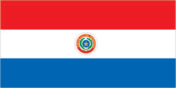
three equal, horizontal bands of red (top), white, and blue with an emblem centered in the white band; unusual flag in that the emblem is different on each side; the obverse (hoist side at the left) bears the national coat of arms (a yellow five-pointed star within a green wreath capped by the words REPUBLICA DEL PARAGUAY, all within two circles); the reverse (hoist side at the right) bears the seal of the treasury (a yellow lion below a red Cap of Liberty and the words Paz y Justicia (Peace and Justice) capped by the words REPUBLICA DEL PARAGUAY, all within two circles)
Government type
republic
Independence
14 May 1811 (from Spain)
International organization participation
AG (observer), CCC, ECLAC, FAO, G-77, IADB, IAEA, IBRD, ICAO, ICFTU, ICRM, IDA, IFAD, IFC, IFRCS, ILO, IMF, IMO, Intelsat, Interpol, IOC, IOM, ISO (correspondent), ITU, LAES, LAIA, Mercosur, OAS, OPANAL, PCA, RG, UN, UNCTAD, UNESCO, UNIDO, UPU, WCL, WHO, WIPO, WMO, WToO, WTrO Diplomatic representation in the US: chief of mission: Ambassador Jorge G. Andres PRIETO CONTI chancery: 2400 Massachusetts Avenue NW, Washington, DC 20008 telephone: [1] (202) 483-6960 through 6962
Judicial branch
Supreme Court of Justice (Corte Suprema de Justicia), judges appointed on the proposal of the Counsel of Magistrates (Consejo de la Magistratura) Political parties and leaders: Colorado Party, Luis Maria ARGANA, president; Authentic Radical Liberal Party (PLRA), Domingo LAINO; National Encounter (EN), Carlos FILIZZOLA; Christian Democratic Party (PDC), Miguel MONTANER; Febrerista Revolutionary Party (PRF), Victor SANCHEZ Villagra; Popular Democratic Party (PDP), Hugo Richer Political pressure groups and leaders: Unitary Workers Central (CUT); Roman Catholic Church; National Workers Central (CNT); Paraguayan Workers Confederation (CPT)
Legal system
based on Argentine codes, Roman law, and French codes; judicial review of legislative acts in Supreme Court of Justice; does not accept compulsory ICJ jurisdiction
Legislative branch
bicameral Congress or Congreso consists of the Chamber of Senators or Camara de Senadores (45 seats; members are elected by popular vote to serve five-year terms) and the Chamber of Deputies or Camara de Diputados (80 seats; members are elected by popular vote to serve five-year terms) elections: Chamber of Senators-last held 9 May 1993 (next to be held 10 May 1998); Chamber of Deputies-last held 9 May 1993 (next to be held 10 May 1998) election results: Chamber of Senators-percent of vote by party-NA; seats by party - Colorado Party 20, PLRA 17, EN 8; Chamber of Deputies-percent of vote by party-NA; seats by party-Colorado Party 38, PLRA 33, EN 9
National capital
Asuncion
National holiday
Independence Days, 14-15 May (1811)
Suffrage
18 years of age; universal and compulsory up to age 60
Economy
Agriculture-products
cotton, sugarcane, soybeans, corn, wheat, tobacco, cassava (tapioca), fruits, vegetables; beef, pork, eggs, milk; timber
Budget
revenues: $1.25 billion expenditures: $1.66 billion, including capital expenditures of $357 million (1995 est.)
Currency
1 guarani (G) = 100 centimos
Debt-external
$1.3 billion (1996)
Economic aid
recipient: ODA, $38 million (1993)
Economy-overview
Paraguay has a market economy marked by a large informal sector. The informal sector features both reexport of imported consumer goods (electronics, whiskeys, perfumes, cigarettes, and office equipment) to neighboring countries as well as the activities of thousands of microenterprises and urban street vendors. The formal sector is largely oriented toward services. A large percentage of the population derive their living from agricultural activity, often on a subsistence basis. The formal economy has grown an average of about 3% over the past five years. However, population has increased at about the same rate over the same period, leaving per capita income nearly stagnant. The WASMOSY government has continued to pursue its economic reform agenda, albeit with limited success because of in-fighting in the ruling party and resistance from the opposition. Paraguay's ongoing integration into Mercosur (the Southern Cone Common Market) offers potential for investment and growth.
Electricity-capacity
6.533 million kW (1995)
Electricity-consumption per capita
577 kWh (1995)
Electricity-production
40.05 billion kWh (1995) note: exported about 36.96 billion kWh of electricity to Brazil
Exchange rates
guaranies (G) per US$-2,528.8 (January 1998), 2,191.0 (1997), 2,062.8 (1996), 1,970.4 (1995), 1,911.5 (1994), 1,744.3 (1993)
Exports
total value: $1.1 billion (f.o.b., 1997 est.) commodities: cotton, soybeans, timber, vegetable oils, meat products, coffee, tung oil partners: Brazil 48%, Netherlands 22%, Argentina 9%, US 4%, Uruguay 3%, Chile 2% (1997)
Fiscal year
calendar year Communications
GDP
purchasing power parity-$21.9 billion (1997 est.)
GDP-composition by sector
agriculture: 26.4% industry: 24.9% services: 48.7% (1995)
GDP-per capita
purchasing power parity-$3,900 (1997 est.)
GDP-real growth rate
2.6% (1997 est.)
Imports
total value: $2.5 billion (c.i.f., 1996 est.) commodities: capital goods, consumer goods, foodstuffs, raw materials, fuels partners: Brazil 29%, US 22%, Argentina 14%, Hong Kong 9% (1995)
Industrial production growth rate
5.1% (1995)
Industries
meat packing, oilseed crushing, milling, brewing, textiles, other light consumer goods, cement, construction
Inflation rate-consumer price index
6.2% (1997)
Labor force
total: 1.8 million (1995 est.) by occupation: agriculture 45%
Radio broadcast stations
AM 40, FM 0, shortwave 7
Radios
775,000 (1992 est.)
Telephone system
meager telephone service; principal switching center is Asuncion domestic: fair microwave radio relay network international: satellite earth station-1 Intelsat (Atlantic Ocean)
Telephones
88,730 (1985 est.)
Television broadcast stations
5
Televisions
370,000 (1992 est.)
Unemployment rate
8.2% (urban) (1996 est.)
Transportation
Airports
948 (1997 est.) Airports-with paved runways: total: 10 over 3,047 m: 3 1,524 to 2,437 m: 3 914 to 1,523 m: 4 (1997 est.) Airports-with unpaved runways: total: 938 over 3,047 m: 1 1,524 to 2,437 m: 29 914 to 1,523 m: 353 under 914 m: 555 (1997 est.)
Highways
total: 29,500 km paved: 2,803 km unpaved: 26,697 km (1996 est.)
Merchant marine
total: 19 ships (1,000 GRT or over) totaling 26,442 GRT/32,510 DWT ships by type: cargo 14, chemical tanker 1, oil tanker 3, roll-on/roll-off 1 (1997 est.)
Railways
total: 971 km standard gauge: 441 km 1.435-m gauge narrow gauge: 60 km 1.000-m gauge other gauge: 470 km various gauges (privately owned)
Waterways
3,100 km Ports and harbors: Asuncion, Villeta, San Antonio, Encarnacion
Military and Security
Military branches
Army, Navy (includes Naval Air and Marines), Air Force
Military expenditures-dollar figure
$94 million (1994)
Military expenditures-percent of GDP
0.6% (1994)
Military manpower-availability
males age 15-49: 1,274,297 (1998 est.) Military manpower-fit for military service: males: 921,323 (1998 est.)
Military manpower-military age
17 years of age
Military manpower-reaching military age annually
males: 53,514 (1998 est.)
Transnational Issues
Disputes-international
short section of the boundary with Brazil, just west of Salto del Guaira (Guaira Falls) on the Rio Parana, has not been precisely delimited
Illicit drugs
illicit producer of cannabis for the international drug trade; transshipment country for Bolivian cocaine headed for Europe and the US