1990 Edition
CIA World Factbook 1990 (Project Gutenberg)
Geography
Climate
varies from temperate in east to semiarid in far west
Coastline
none--landlocked
Comparative area
slightly smaller than California
Disputes
short section of the boundary with Brazil (just west of Guaira Falls on the Rio Parana) is in dispute
Environment
local flooding in southeast (early September to June); poorly drained plains may become boggy (early October to June)
Land boundaries
3,920 km total; Argentina 1,880 km, Bolivia 750 km, Brazil 1,290 km
Land use
20% arable land; 1% permanent crops; 39% meadows and pastures; 35% forest and woodland; 5% other; includes NEGL% irrigated
Maritime claims
none--landlocked
Natural resources
iron ore, manganese, limestone, hydropower, timber
Note
landlocked; buffer between Argentina and Brazil
Terrain
grassy plains and wooded hills east of Rio Paraguay; Gran Chaco region west of Rio Paraguay mostly low, marshy plain near the river, and dry forest and thorny scrub elsewhere
Total area
406,750 km2; land area: 397,300 km2
People and Society
Birth rate
36 births/1,000 population (1990)
Death rate
6 deaths/1,000 population (1990)
Ethnic divisions
95% mestizo (Spanish and Indian), 5% white and Indian
Infant mortality rate
48 deaths/1,000 live births (1990)
Labor force
1,300,000; 44% agriculture, 34% industry and commerce, 18% services, 4% government (1986)
Language
Spanish (official) and Guarani
Life expectancy at birth
67 years male, 72 years female (1990)
Literacy
81%
Nationality
noun--Paraguayan(s); adjective--Paraguayan
Net migration rate
NEGL migrants/1,000 population (1990)
Organized labor
about 2% of labor force
Population
4,660,270 (July 1990), growth rate 3.0% (1990)
Religion
90% Roman Catholic; Mennonite and other Protestant denominations
Total fertility rate
4.8 children born/woman (1990)
Government
Administrative divisions
19 departments (departamentos, singular--departamento); Alto Paraguay, Alto Parana, Amambay, Boqueron, Caaguazu, Caazapa, Canendiyu, Central, Chaco, Concepcion, Cordillera, Guaira, Itapua, Misiones, Neembucu, Nueva Asuncion, Paraguari, Presidente Hayes, San Pedro
Capital
Asuncion
Communists
Oscar Creydt faction and Miguel Angel Soler faction (both illegal); 3,000 to 4,000 (est.) party members and sympathizers in Paraguay, very few are hard core; party beginning to return from exile is small and deeply divided
Diplomatic representation
Ambassador Marcos MARTINEZ MENDIETA; Chancery at 2400 Massachusetts Avenue NW, Washington DC 20008; telephone (202) 483-6960 through 6962; there are Paraguayan Consulates General in New Orleans and New York, and a Consulate in Houston; US--Ambassador Timothy L. TOWELL; Embassy at 1776 Avenida Mariscal Lopez, Asuncion (mailing address is C. P. 402, Asuncion, or APO Miami 34036-0001); telephone [595] (21) 201-041 or 049
Elections
President--last held 1 May 1989 (next to be held February 1993); results--Gen. Rodriguez 75.8%, Domingo Laino 19.4%; Senate--last held 1 May 1989 (next to be held by May 1993); results--percent of vote by party NA; seats--(36 total) Colorado Party 24, PLRA 10, PLR 1, PRF 1; Chamber of Deputies--last held on 1 May 1989 (next to be held by May 1994); results--percent of vote by party NA; seats--(72 total) Colorado Party 48, PLRA 19, PRF 2, PDC 1, PL 1, PLR 1
Executive branch
president, Council of Ministers (cabinet), Council of State
Flag
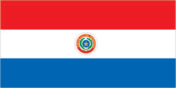
three equal, horizontal bands of red (top), white, and blue with an emblem centered in the white band; unusual flag in that the emblem is different on each side; the obverse (hoist side at the left) bears the national coat of arms (a yellow five-pointed star within a green wreath capped by the words REPUBLICA DEL PARAGUAY, all within two circles); the reverse (hoist side at the right) bears the seal of the treasury (a yellow lion below a red Cap of Liberty and the words Paz y Justica (Peace and Justice) capped by the words REPUBLICA DEL PARAGUAY, all within two circles)
Independence
14 May 1811 (from Spain) Constitution 25 August 1967
Judicial branch
Supreme Court of Justice (Corte Suprema de Justicia)
Leaders
Chief of State and Head of Government--President Gen. Andres RODRIGUEZ Pedotti (since 15 May 1989)
Legal system
based on Argentine codes, Roman law, and French codes; judicial review of legislative acts in Supreme Court of Justice; does not accept compulsory ICJ jurisdiction
Legislative branch
bicameral National Congress (Congreso Nacional) consists of an upper chamber or Senate and a lower chamber or Chamber of Deputies
Long-form name
Republic of Paraguay
Member of
CCC, FAO, G-77, IADB, IAEA, IBRD, ICAO, ICO, IDA, IDB--Inter-American Development Bank, IFAD, IFC, ILO, IMF, INTELSAT, INTERPOL, IPU, IRC, ITU, LAIA, OAS, SELA, UN, UNESCO, UPU, WHO, WMO, WSG
National holiday
Independence Days, 14-15 May (1811)
Other political or pressure groups
Febrerista; Authentic Radical Liberal; Christian Democratic Parties; Confederation of Workers (CUT); Roman Catholic Church
Political parties and leaders
Colorado Party, Juan Ramon Chaves; Authentic Radical Liberal Party (PLRA), Domingo Laino; Christian Democratic Party (PDC), Jorge Dario Cristaldo; Febrerista Revolutionary Party (PRF), Euclides Acevedo; Liberal Party (PL), Reinaldo Odone; Popular Colorado Movement (MOPOCO), Miguel Angel Gonzalez Casabianca; Radical Liberal Party
Suffrage
universal and compulsory at age 18 and up to age 60
Type
republic
Economy
Agriculture
accounts for 25% of GDP and 50% of labor force; cash crops--cotton, sugarcane; other crops--corn, wheat, tobacco, soybeans, cassava, fruits, and vegetables; animal products--beef, pork, eggs, milk; surplus producer of timber; self-sufficient in most foods
Aid
US commitments, including Ex-Im (FY70-88), $168 million; Western (non-US) countries, ODA and OOF bilateral commitments (1970-87), $994 million
Budget
revenues $609 million; expenditures $909 million, including capital expenditures of $401 million (1988)
Currency
guarani (plural--guaranies); 1 guarani (G) = 100 centimos
Electricity
5,169,000 kW capacity; 15,140 million kWh produced, 3,350 kWh per capita (1989)
Exchange rates
guaranies (G) per US$1--1,200.20 (November 1989; floated in February 1989), 550.00 (fixed rate 1986-February 1989), 339.17 (1986), 306.67 (1985)
Exports
$1,020 million (registered f.o.b., 1989 est.); commodities--cotton, soybean, timber, vegetable oils, coffee, tung oil, meat products; partners--EC 37%, Brazil 25%, Argentina 10%, Chile 6%, US 6%
External debt
$2.9 billion (1989 est.)
Fiscal year
calendar year
GDP
$8.9 billion, per capita $1,970; real growth rate 5.2% (1989 est.)
Illicit drugs
illicit producer of cannabis for the international drug trade with an estimated 300 hectares cultivated in 1988; important transshipment point for Bolivian cocaine headed for the US and Europe
Imports
$1,010 million (registered c.i.f., 1989 est.); commodities--capital goods 35%, consumer goods 20%, fuels and lubricants 19%, raw materials 16%, foodstuffs, beverages, and tobacco 10%; partners--Brazil 30%, EC 20%, US 18%, Argentina 8%, Japan 7%
Industrial production
growth rate 2% (1987)
Industries
meat packing, oilseed crushing, milling, brewing, textiles, other light consumer goods, cement, construction
Inflation rate (consumer prices)
30% (1989 est.)
Overview
The economy is predominantly agricultural. Agriculture, including forestry, accounts for about 25% of GNP, employs about 45% of the labor force, and provides the bulk of exports. Paraguay has no known significant mineral or petroleum resources, but does have a large hydropower potential. Since 1981 economic performance has declined compared with the boom period of 1976-81, when real GDP grew at an average annual rate of nearly 11%. During 1982-86 real GDP fell three out of five years, inflation jumped to an annual rate of 32%, and foreign debt rose. Factors responsible for the erratic behavior of the economy were the completion of the Itaipu hydroelectric dam, bad weather for crops, and weak international commodity prices for agricultural exports. In 1987 the economy experienced a modest recovery because of improved weather conditions and stronger international prices for key agricultural exports. The recovery continued through 1988, with a bumper soybean crop and record cotton production. The government, however, must follow through on promises of reforms needed to deal with large fiscal deficits, growing debt arrearages, and falling reserves.
Unemployment rate
12% (1989 est.)
Communications
Airports
873 total, 753 usable; 6 with permanent-surface runways; 1 with runways over 3,659 m; 2 with runways 2,440-3,659 m; 52 with runways 1,220-2,439 m
Civil air
4 major transport aircraft
Highways
21,960 km total; 1,788 km paved, 474 km gravel, and 19,698 km earth
Inland waterways
3,100 km
Merchant marine
15 ships (1,000 GRT or over) totaling 20,735 GRT/26,043 DWT; includes 13 cargo, 2 petroleum, oils, and lubricants (POL) tanker; note--1 naval cargo ship is sometimes used commercially
Ports
Asuncion
Railroads
970 km total; 440 km 1.435-meter standard gauge, 60 km 1.000-meter gauge, 470 km various narrow gauge (privately owned)
Telecommunications
principal center in Asuncion; fair intercity microwave net; 78,300 telephones; stations--40 AM, no FM, 5 TV, 7 shortwave; 1 Atlantic Ocean INTELSAT earth station
Military and Security
Branches
Paraguayan Army, Paraguayan Navy, Paraguayan Air Force
Defense expenditures
NA
Military manpower
males 15-49, 1,096,227; 798,750 fit for military service; 49,791 reach military age (17) annually