2023 Edition
CIA World Factbook 2023 (factbook.json @ 0d4fa4984ecb)
Introduction
Background
Papua New Guinea (PNG) was first settled between 50,000 and 60,000 years ago. PNG’s harsh geography consisting of mountains, jungles, and numerous river valleys, kept many of the arriving groups isolated, giving rise to PNG’s significant ethnic and linguistic diversity. Agriculture was independently developed by some of these groups. Around 500 B.C., Austronesian voyagers settled along the coast. Spanish and Portuguese explorers periodically visited the island starting in the 1500s, but none made it into the country’s interior. American and British whaling ships frequented the islands off the coast of New Guinea in the mid-1800s. In 1884, Germany declared a protectorate - and eventually a colony - over the northern part of what would become PNG and named it German New Guinea; days later the UK followed suit on the southern part and nearby islands and called it Papua. Most of their focus was on the coastal regions, leaving the highlands largely unexplored.The UK put its colony under Australian administration in 1902 and formalized the act in 1906. At the outbreak of World War I, Australia occupied German New Guinea and continued to rule it after the war as a League of Nations Mandate. The discovery of gold along the Bulolo River in the 1920s led prospectors to venture into the highlands, where they found about 1 million people living in isolated communities. Japan invaded New Guinea in 1941 and reached Papua the following year. Allied victories during the New Guinea campaign pushed out the Japanese, and after the end of the war, Australia combined the two territories into one administration. Sir Michael SOMARE won elections in 1972 on the promise of achieving independence, which was realized in 1975. A secessionist movement in Bougainville, an island well endowed in copper and gold resources, reignited in 1988 with debates about land use, profits, and an influx of outsiders at the Panguna Copper Mine. Following elections in 1992, the PNG Government took a hardline stance against Bougainville rebels and the resulting civil war led to about 20,000 deaths. In 1997, the PNG Government hired mercenaries to support its troops in Bougainville, sparking an army mutiny and forcing the prime minister to resign. PNG and Bougainville signed a truce in 1997 and a peace agreement in 2001, which granted Bougainville autonomy. An internationally-monitored nonbinding referendum asking Bougainvilleans to chose independence or greater self-rule occurred in November 2019, with 98% of voters opting for independence. However, the PNG Government and Bougainville officials remain in negotiations about the status of the island.
Geography
Area
- land
- 452,860 sq km
- total
- 462,840 sq km
- water
- 9,980 sq km
Area - comparative
slightly larger than California
Climate
tropical; northwest monsoon (December to March), southeast monsoon (May to October); slight seasonal temperature variation
Coastline
5,152 km
Elevation
- highest point
- Mount Wilhelm 4,509 m
- lowest point
- Pacific Ocean 0 m
- mean elevation
- 667 m
Geographic coordinates
6 00 S, 147 00 E
Geography - note
note 1: shares island of New Guinea with Indonesia; generally east-west trending highlands break up New Guinea into diverse ecoregions; one of world's largest swamps along southwest coastnote 2: two major food crops apparently developed on the island of New Guinea: bananas and sugarcane note 3: Papua New Guinea is one of the countries along the Ring of Fire, a belt of active volcanoes and earthquake epicenters bordering the Pacific Ocean; up to 90% of the world's earthquakes and some 75% of the world's volcanoes occur within the Ring of Fire
Irrigated land
0 sq km (2022)
Land boundaries
- border countries
- Indonesia 824 km
- total
- 824 km
Land use
- agricultural land
- 2.6% (2018 est.)
- agricultural land: arable land
- arable land: 0.7% (2018 est.)
- agricultural land: permanent crops
- permanent crops: 1.5% (2018 est.)
- agricultural land: permanent pasture
- permanent pasture: 0.4% (2018 est.)
- forest
- 63.1% (2018 est.)
- other
- 34.3% (2018 est.)
Location
Oceania, group of islands including the eastern half of the island of New Guinea between the Coral Sea and the South Pacific Ocean, east of Indonesia
Major rivers (by length in km)
Sepik river source and mouth (shared with Indonesia) - 1,126 km; Fly river source and mouth (shared with Indonesia) - 1,050 km
Map references
Oceania
Maritime claims
- continental shelf
- 200-m depth or to the depth of exploitation
- exclusive fishing zone
- 200 nm
- note
- measured from claimed archipelagic baselines
- territorial sea
- 12 nm
Natural hazards
active volcanism; the country is subject to frequent and sometimes severe earthquakes; mud slides; tsunamisvolcanism: severe volcanic activity; Ulawun (2,334 m), one of Papua New Guinea's potentially most dangerous volcanoes, has been deemed a Decade Volcano by the International Association of Volcanology and Chemistry of the Earth's Interior, worthy of study due to its explosive history and close proximity to human populations; Rabaul (688 m) destroyed the city of Rabaul in 1937 and 1994; Lamington erupted in 1951 killing 3,000 people; Manam's 2004 eruption forced the island's abandonment; other historically active volcanoes include Bam, Bagana, Garbuna, Karkar, Langila, Lolobau, Long Island, Pago, St. Andrew Strait, Victory, and Waiowa; see note 2 under "Geography - note"
Natural resources
gold, copper, silver, natural gas, timber, oil, fisheries
Population distribution
population concentrated in the highlands and eastern coastal areas on the island of New Guinea; predominantly a rural distribution with only about one-fifth of the population residing in urban areas
Terrain
mostly mountains with coastal lowlands and rolling foothills
People and Society
Age structure
- 0-14 years
- 37.34% (male 1,871,227/female 1,795,700)
- 15-64 years
- 58.75% (male 2,917,668/female 2,851,691)
- 65 years and over
- 3.9% (2023 est.) (male 189,851/female 193,213)
Alcohol consumption per capita
- beer
- 0.6 liters of pure alcohol (2019 est.)
- other alcohols
- 0 liters of pure alcohol (2019 est.)
- spirits
- 0.6 liters of pure alcohol (2019 est.)
- total
- 1.26 liters of pure alcohol (2019 est.)
- wine
- 0.06 liters of pure alcohol (2019 est.)
Birth rate
28.5 births/1,000 population (2023 est.)
Child marriage
- men married by age 18
- 3.7% (2018 est.)
- women married by age 15
- 8%
- women married by age 18
- 27.3%
Contraceptive prevalence rate
36.7% (2016/18)
Current health expenditure
2.5% of GDP (2020)
Currently married women (ages 15-49)
65.5% (2023 est.)
Death rate
5.5 deaths/1,000 population (2023 est.)
Dependency ratios
- elderly dependency ratio
- 5
- potential support ratio
- 20.1 (2021 est.)
- total dependency ratio
- 60.5
- youth dependency ratio
- 55.5
Drinking water source
- improved: rural
- rural: 41.5% of population
- improved: total
- total: 47.5% of population
- improved: urban
- urban: 86.2% of population
- unimproved: rural
- rural: 58.5% of population
- unimproved: total
- total: 52.5% of population (2020 est.)
- unimproved: urban
- urban: 13.8% of population
Education expenditures
1.4% of GDP (2020 est.)
Ethnic groups
Melanesian, Papuan, Negrito, Micronesian, Polynesian
Gross reproduction rate
1.88 (2023 est.)
Infant mortality rate
- female
- 29.3 deaths/1,000 live births
- male
- 36.1 deaths/1,000 live births
- total
- 32.8 deaths/1,000 live births (2023 est.)
Languages
- Tok Pisin (official), English (official), Hiri Motu (official), some 839 indigenous languages spoken (about 12% of the world's total); many languages have fewer than 1,000 speakers
- note
- note: Tok Pisin, a creole language, is widely used and understood; English is spoken by 1%-2%; Hiri Motu is spoken by less than 2%
Life expectancy at birth
- female
- 71.5 years
- male
- 68 years
- total population
- 69.7 years (2023 est.)
Literacy
- definition
- age 15 and over can read and write
- female
- 62.8% (2015)
- male
- 65.6%
- total population
- 64.2%
Major infectious diseases
- degree of risk
- very high (2023)
- food or waterborne diseases
- bacterial diarrhea, hepatitis A, and typhoid fever
- vectorborne diseases
- dengue fever and malaria
Major urban areas - population
410,000 PORT MORESBY (capital) (2023)
Maternal mortality ratio
192 deaths/100,000 live births (2020 est.)
Median age
- female
- 21.8 years
- male
- 21.4 years
- total
- 21.6 years (2023 est.)
Mother's mean age at first birth
- 21.9 years (2016/18)
- note
- note: data represents median age a first birth among women 25-49
Nationality
- adjective
- Papua New Guinean
- noun
- Papua New Guinean(s)
Net migration rate
0 migrant(s)/1,000 population (2023 est.)
Obesity - adult prevalence rate
21.3% (2016)
People - note
the indigenous population of Papua New Guinea (PNG) is one of the most heterogeneous in the world; PNG has several thousand separate communities, most with only a few hundred people; divided by language, customs, and tradition, some of these communities have engaged in low-scale tribal conflict with their neighbors for millennia; the advent of modern weapons and modern migrants into urban areas has greatly magnified the impact of this lawlessness
Physicians density
0.07 physicians/1,000 population (2019)
Population
9,819,350 (2023 est.)
Population distribution
population concentrated in the highlands and eastern coastal areas on the island of New Guinea; predominantly a rural distribution with only about one-fifth of the population residing in urban areas
Population growth rate
2.31% (2023 est.)
Religions
- Protestant 64.3% (Evangelical Lutheran 18.4%, Seventh Day Adventist 12.9%, Pentecostal 10.4%, United Church 10.3%, Evangelical Alliance 5.9%, Anglican 3.2%, Baptist 2.8%, Salvation Army 0.4%), Roman Catholic 26%, other Christian 5.3%, non-Christian 1.4%, unspecified 3.1% (2011 est.)
- note
- note: data represent only the citizen population; roughly 0.3% of the population are non-citizens, consisting of Christian 52% (predominantly Roman Catholic), other 10.7% , none 37.3%
Sanitation facility access
- improved: rural
- rural: 18.2% of population
- improved: total
- total: 23.5% of population
- improved: urban
- urban: 57.8% of population
- unimproved: rural
- rural: 81.8% of population
- unimproved: total
- total: 76.5% of population (2020 est.)
- unimproved: urban
- urban: 42.2% of population
Sex ratio
- 0-14 years
- 1.04 male(s)/female
- 15-64 years
- 1.02 male(s)/female
- 65 years and over
- 0.98 male(s)/female
- at birth
- 1.05 male(s)/female
- total population
- 1.03 male(s)/female (2023 est.)
Tobacco use
- female
- 25.1% (2020 est.)
- male
- 53.5% (2020 est.)
- total
- 39.3% (2020 est.)
Total fertility rate
3.85 children born/woman (2023 est.)
Urbanization
- rate of urbanization
- 2.91% annual rate of change (2020-25 est.)
- urban population
- 13.7% of total population (2023)
Government
Administrative divisions
20 provinces, 1 autonomous region*, and 1 district**; Bougainville*, Central, Chimbu, Eastern Highlands, East New Britain, East Sepik, Enga, Gulf, Hela, Jiwaka, Madang, Manus, Milne Bay, Morobe, National Capital**, New Ireland, Northern, Southern Highlands, Western, Western Highlands, West New Britain, West Sepik
Capital
- etymology
- named in 1873 by Captain John MORESBY (1830-1922) in honor of his father, British Admiral Sir Fairfax MORESBY (1786-1877)
- geographic coordinates
- 9 27 S, 147 11 E
- name
- Port Moresby
- time difference
- UTC+10 (15 hours ahead of Washington, DC, during Standard Time)
- time zone note
- Papua New Guinea has two time zones, including Bougainville (UTC+11)
Citizenship
- citizenship by birth
- no
- citizenship by descent only
- at least one parent must be a citizen of Papua New Guinea
- dual citizenship recognized
- no
- residency requirement for naturalization
- 8 years
Constitution
- amendments
- proposed by the National Parliament; passage has prescribed majority vote requirements depending on the constitutional sections being amended – absolute majority, two-thirds majority, or three-fourths majority; amended many times, last in 2016
- history
- adopted 15 August 1975, effective at independence 16 September 1975
Country name
- abbreviation
- PNG
- conventional long form
- Independent State of Papua New Guinea
- conventional short form
- Papua New Guinea
- etymology
- the word "papua" derives from the Malay "papuah" describing the frizzy hair of the Melanesians; Spanish explorer Ynigo ORTIZ de RETEZ applied the term "Nueva Guinea" to the island of New Guinea in 1545 after noting the resemblance of the locals to the peoples of the Guinea coast of Africa
- former
- German New Guinea, British New Guinea, Territory of Papua and New Guinea
- local short form
- Papuaniugini
Diplomatic representation from the US
- chief of mission
- Ambassador (vacant); Chargé d'Affaires Katherine Elizabeth "Kemy" MONAHAN (since 26 September 2023); note - also accredited to the Solomon Islands and Vanuatu
- email address and website
- ConsularPortMoresby@state.govhttps://pg.usembassy.gov/
- embassy
- Harbour City Road, Port Moresby 121, NCD, Papua New Guinea
- mailing address
- Harbour City Road, Port Moresby 121, NCD, Papua New Guinea
- telephone
- [675] 308-2100
Diplomatic representation in the US
- chancery
- 1825 K Street NW, Suite 1010, Washington, DC 20006
- chief of mission
- Ambassador (vacant); Chargé d’Affaires Cephas KAYO, Minister (since 31 January 2018)
- email address and website
- info@pngembassy.orghttp://www.pngembassy.org/
- FAX
- [1] (202) 745-3679
- telephone
- [1] (202) 745-3680
Executive branch
- cabinet
- National Executive Council appointed by the governor general on the recommendation of the prime minister
- chief of state
- King CHARLES III (since 8 September 2022); represented by Governor General Grand Chief Sir Bob DADAE (since 28 February 2017)
- election results
- James MARAPE reelected prime minister; National Parliament vote - 105 out of 118
- elections/appointments
- the monarchy is hereditary; governor general nominated by the National Parliament and appointed by the chief of state; following legislative elections, the leader of the majority party or majority coalition usually appointed prime minister by the governor general pending the outcome of a National Parliament vote
- head of government
- Prime Minister James MARAPE (since 30 May 2019); Deputy Prime Minister John ROSSO (since 25 May 2022)
Flag description
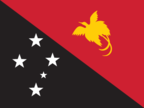
divided diagonally from upper hoist-side corner; the upper triangle is red with a soaring yellow bird of paradise centered; the lower triangle is black with five, white, five-pointed stars of the Southern Cross constellation centered; red, black, and yellow are traditional colors of Papua New Guinea; the bird of paradise - endemic to the island of New Guinea - is an emblem of regional tribal culture and represents the emergence of Papua New Guinea as a nation; the Southern Cross, visible in the night sky, symbolizes Papua New Guinea's connection with Australia and several other countries in the South Pacific
Government type
parliamentary democracy under a constitutional monarchy; a Commonwealth realm
Independence
16 September 1975 (from the Australia-administered UN trusteeship)
International law organization participation
has not submitted an ICJ jurisdiction declaration; non-party state to the ICCt
International organization participation
ACP, ADB, AOSIS, APEC, ARF, ASEAN (observer), C, CD, CP, EITI (candidate country), FAO, G-77, IAEA, IBRD, ICAO, ICRM, IDA, IFAD, IFC, IFRCS, IHO, ILO, IMF, IMO, Interpol, IOC, IOM, IPU, ISO (correspondent), ITSO, ITU, MIGA, NAM, OPCW, PIF, Sparteca, SPC, UN, UNCTAD, UNESCO, UNIDO, UNMISS, UNWTO, UPU, WCO, WFTU (NGOs), WHO, WIPO, WMO, WTO
Judicial branch
- highest court(s)
- Supreme Court (consists of the chief justice, deputy chief justice, 35 justices, and 5 acting justices); National Courts (consists of 13 courts located in the provincial capitals, with a total of 19 resident judges)
- judge selection and term of office
- Supreme Court chief justice appointed by the governor general upon advice of the National Executive Council (cabinet) after consultation with the National Justice Administration minister; deputy chief justice and other justices appointed by the Judicial and Legal Services Commission, a 5-member body that includes the Supreme Court chief and deputy chief justices, the chief ombudsman, and a member of the National Parliament; full-time citizen judges appointed for 10-year renewable terms; non-citizen judges initially appointed for 3-year renewable terms and after first renewal can serve until age 70; appointment and tenure of National Court resident judges NA
- subordinate courts
- district, village, and juvenile courts, military courts, taxation courts, coronial courts, mining warden courts, land courts, traffic courts, committal courts, grade five courts
Legal system
mixed legal system of English common law and customary law
Legislative branch
- description
- unicameral National Parliament (118 seats; members directly elected in single-seat constituencies - 89 local, 20 provincial, the autonomous province of Bouganville, and the National Capital District - by majority preferential vote; members serve 5-year terms); note - the constitution allows up to 126 seats
- election results
- percent of vote by party - NA; seats by party - PANGU PATI - 38, PNC - 17, URP - 11, NAP - 5, PNC - 4, SDP - 4, PFP - 3, ULP - 3, Advance PNG - 2, National Party - 2, AP - 1, Destiny Party - 1, Greens - 1, Liberal Party - 1, MAP - 1, NGP - 1, ODP - 1, PLP - 1, PMC - 1, PPP - 1, PRP - 1, THE - 1, independents - 9; composition - NA
- elections
- last held from 4-22 July 2022 (next to be held in June 2027)
National anthem
- lyrics/music
- Thomas SHACKLADY
- name
- "O Arise All You Sons"
- note
- note: adopted 1975
National heritage
- selected World Heritage Site locales
- Kuk Early Agricultural Site
- total World Heritage Sites
- 1 (cultural)
National holiday
Independence Day, 16 September (1975)
National symbol(s)
bird of paradise; national colors: red, black
Political parties and leaders
Advance PNG [Muglua DILU]Allegiance Party or AP [Bryan KRAMER]Destiny Party [Marsh NARAWEC]Liberal Party [John PUNDARI]Melanesian Alliance Party or MAP [Joseph YOPYYOPY]National Alliance Party or NAP [Patrick PRUAITCH]New Generation Party or NGP [Keith IDUHU]Our Development Party or ODP [Charles ABEL]Papua and Niugini Union Party or PANGU PATI [James MARAPE]Papua New Guinea Country Party or PNGCP [Chris HAIVETA]Papua New Guinea Greens Party [Richard MASERE]Papua New Guinea National Party [Kerenga KUA]Papua New Guinea Party or PNGP [Belden NAMAH]People's First Party or PFP [Richard MARU]People's Labor Party or PLP [Peter YAMA]People's Movement for Change or PMC [Gary JAFFA]People's National Congress Party or PNC [Peter Paire O'NEILL]People's Party or PP [Peter IPATAS]People's Progress Party or PPP [Sir Julius CHAN]People's Reform Party or PRP [James DONALD]Social Democratic Party or SDP [Powes PARKOP]Triumph Heritage Empowerment Party or THE [Don POLYE]United Labor Party or ULP [Lekwa GURE]United Resources Party or URP [William DUMA]
Suffrage
18 years of age; universal
Economy
Agricultural products
oil palm fruit, bananas, coconuts, fruit, sweet potatoes, game meat, yams, roots/tubers nes, vegetables, taro
Budget
- expenditures
- $5.135 billion (2019 est.)
- revenues
- $4.039 billion (2019 est.)
Budget surplus (+) or deficit (-)
-4.8% (of GDP) (2017 est.)
Credit ratings
- Moody's rating
- B2 (2016)
- note
- note: The year refers to the year in which the current credit rating was first obtained.
- Standard & Poors rating
- B- (2020)
Current account balance
- Current account balance 2016
- $5.175 billion (2016 est.)
- Current account balance 2017
- $5.348 billion (2017 est.)
- Current account balance 2018
- $5.451 billion (2018 est.)
Debt - external
- Debt - external 31 December 2016
- $18.28 billion (31 December 2016 est.)
- Debt - external 31 December 2017
- $17.94 billion (31 December 2017 est.)
Economic overview
lower middle-income Pacific island economy; primarily informal agrarian sector; natural resource-rich; key liquified natural gas exporter; growing young workforce; slow post-pandemic recovery; increasingly impoverished citizenry; sustainable inflation
Exchange rates
- Currency
- kina (PGK) per US dollar -
- Exchange rates 2017
- 3.189 (2017 est.)
- Exchange rates 2018
- 3.293 (2018 est.)
- Exchange rates 2019
- 3.388 (2019 est.)
- Exchange rates 2020
- 3.46 (2020 est.)
- Exchange rates 2021
- 3.509 (2021 est.)
Exports
- Exports 2019
- $11 billion (2019 est.)
- Exports 2020
- $9.36 billion (2020 est.)
- Exports 2021
- $11 billion (2021 est.)
- note
- note: data are in current year dollars
Exports - commodities
natural gas, gold, copper, palm oil, nickel, crude petroleum, lumber, refined petroleum, tuna, coffee (2021)
Exports - partners
Japan 25%, China 25%, Australia 16%, Taiwan 6%, South Korea 6% (2021)
Fiscal year
calendar year
GDP - composition, by end use
- exports of goods and services
- 49.3% (2017 est.)
- government consumption
- 19.7% (2017 est.)
- household consumption
- 43.7% (2017 est.)
- imports of goods and services
- -22.3% (2017 est.)
- investment in fixed capital
- 10% (2017 est.)
- investment in inventories
- 0.4% (2017 est.)
GDP - composition, by sector of origin
- agriculture
- 22.1% (2017 est.)
- industry
- 42.9% (2017 est.)
- services
- 35% (2017 est.)
GDP (official exchange rate)
$19.82 billion (2017 est.)
Gini Index coefficient - distribution of family income
- Gini Index coefficient - distribution of family income 2009
- 41.9 (2009 est.)
Household income or consumption by percentage share
- highest 10%
- 40.5% (1996)
- lowest 10%
- 1.7%
Imports
- Imports 2019
- $4.14 billion (2019 est.)
- Imports 2020
- $3.77 billion (2020 est.)
- Imports 2021
- $4.25 billion (2021 est.)
Imports - commodities
refined petroleum, rice, delivery trucks, excavation machinery, motor vehicle parts (2021)
Imports - partners
Australia 27%, China 25%, Singapore 13%, Malaysia 8%, Indonesia 5% (2021)
Industrial production growth rate
-7.5% (2020 est.)
Industries
oil and gas; mining (gold, copper, and nickel); palm oil processing; plywood and wood chip production; copra crushing; construction; tourism; fishing; livestock (pork, poultry, cattle) and dairy farming; spice products (turmeric, vanilla, ginger, cardamom, chili, pepper, citronella, and nutmeg)
Inflation rate (consumer prices)
- Inflation rate (consumer prices) 2019
- 3.93% (2019 est.)
- Inflation rate (consumer prices) 2020
- 4.87% (2020 est.)
- Inflation rate (consumer prices) 2021
- 4.48% (2021 est.)
Labor force
3.073 million (2021 est.)
Population below poverty line
37% (2002 est.)
Public debt
- Public debt 2018
- 36.67% of GDP (2018 est.)
- Public debt 2019
- 40.15% of GDP (2019 est.)
- Public debt 2020
- 48.68% of GDP (2020 est.)
Real GDP (purchasing power parity)
- note
- note: data are in 2017 dollars
- Real GDP (purchasing power parity) 2019
- $37.672 billion (2019 est.)
- Real GDP (purchasing power parity) 2020
- $36.479 billion (2020 est.)
- Real GDP (purchasing power parity) 2021
- $36.589 billion (2021 est.)
Real GDP growth rate
- Real GDP growth rate 2019
- 4.48% (2019 est.)
- Real GDP growth rate 2020
- -3.17% (2020 est.)
- Real GDP growth rate 2021
- 0.3% (2021 est.)
Real GDP per capita
- note
- note: data are in 2017 dollars
- Real GDP per capita 2019
- $3,900 (2019 est.)
- Real GDP per capita 2020
- $3,700 (2020 est.)
- Real GDP per capita 2021
- $3,700 (2021 est.)
Reserves of foreign exchange and gold
- Reserves of foreign exchange and gold 31 December 2017
- $1.762 billion (31 December 2017 est.)
- Reserves of foreign exchange and gold 31 December 2018
- $2.239 billion (31 December 2018 est.)
- Reserves of foreign exchange and gold 31 December 2019
- $2.339 billion (31 December 2019 est.)
Taxes and other revenues
11.88% (of GDP) (2020 est.)
Unemployment rate
- Unemployment rate 2019
- 2.45% (2019 est.)
- Unemployment rate 2020
- 2.6% (2020 est.)
- Unemployment rate 2021
- 2.75% (2021 est.)
Youth unemployment rate (ages 15-24)
- female
- 4.2%
- male
- 6.3%
- total
- 5.3% (2021 est.)
Energy
Carbon dioxide emissions
- from coal and metallurgical coke
- 0 metric tonnes of CO2 (2019 est.)
- from consumed natural gas
- 526,000 metric tonnes of CO2 (2019 est.)
- from petroleum and other liquids
- 5.965 million metric tonnes of CO2 (2019 est.)
- total emissions
- 6.491 million metric tonnes of CO2 (2019 est.)
Coal
- consumption
- 0 metric tons (2020 est.)
- exports
- 0 metric tons (2020 est.)
- imports
- 0 metric tons (2020 est.)
- production
- 0 metric tons (2020 est.)
- proven reserves
- 0 metric tons (2019 est.)
Electricity
- consumption
- 3,701,693,000 kWh (2019 est.)
- exports
- 0 kWh (2019 est.)
- imports
- 0 kWh (2019 est.)
- installed generating capacity
- 1.139 million kW (2020 est.)
- transmission/distribution losses
- 340 million kWh (2019 est.)
Electricity access
- electrification - rural areas
- 14% (2021)
- electrification - total population
- 20.9% (2021)
- electrification - urban areas
- 65.1% (2021)
Electricity generation sources
- biomass and waste
- 1% of total installed capacity (2020 est.)
- fossil fuels
- 80.2% of total installed capacity (2020 est.)
- geothermal
- 0% of total installed capacity (2020 est.)
- hydroelectricity
- 18.9% of total installed capacity (2020 est.)
- nuclear
- 0% of total installed capacity (2020 est.)
- solar
- 0% of total installed capacity (2020 est.)
- tide and wave
- 0% of total installed capacity (2020 est.)
- wind
- 0% of total installed capacity (2020 est.)
Energy consumption per capita
- Total energy consumption per capita 2019
- 11.316 million Btu/person (2019 est.)
Natural gas
- consumption
- 166.984 million cubic meters (2020 est.)
- exports
- 11,764,498,000 cubic meters (2020 est.)
- imports
- 0 cubic meters (2021 est.)
- production
- 11,784,065,000 cubic meters (2020 est.)
- proven reserves
- 183.125 billion cubic meters (2021 est.)
Petroleum
- crude oil and lease condensate exports
- 60,300 bbl/day (2018 est.)
- crude oil and lease condensate imports
- 27,400 bbl/day (2018 est.)
- crude oil estimated reserves
- 159.7 million barrels (2021 est.)
- refined petroleum consumption
- 38,200 bbl/day (2019 est.)
- total petroleum production
- 37,200 bbl/day (2021 est.)
Refined petroleum products - exports
0 bbl/day (2015 est.)
Refined petroleum products - imports
17,110 bbl/day (2015 est.)
Refined petroleum products - production
22,170 bbl/day (2015 est.)
Communications
Broadband - fixed subscriptions
- subscriptions per 100 inhabitants
- 0.2 (2020 est.)
- total
- 21,000 (2020 est.)
Broadcast media
4 TV stations: 1 commercial station operating since 1987, 1 state-run station launched in 2008, 1 digital free-to-view network launched in 2014, and 1 satellite network Click TV (PNGTV) launched in 2015; the state-run National Broadcasting Corporation operates 3 radio networks with multiple repeaters and about 20 provincial stations; several commercial radio stations with multiple transmission points as well as several community stations; transmissions of several international broadcasters are accessible (2018)
Internet country code
.pg
Internet users
- percent of population
- 32% (2021 est.)
- total
- 3.168 million (2021 est.)
Telecommunication systems
- domestic
- fixed-line nearly 2 per 100 and mobile-cellular is 48 per 100 persons (2021)
- general assessment
- fixed-line teledensity in Papua New Guinea has seen little change over the past two decades; progress in the country’s telecom sector has come primarily from mobile networks, where accessibility has expanded considerably in recent years, with population coverage increasing from less than 3% in 2006 to more than 90% by early 2021; the MNOs operate networks offering services based on GSM, 3G, and LTE, depending on location; GSM is prevalent in many rural and remote areas, while 3G and LTE are centered more on urban areas; MNOs’ investments in 4G are growing, though GSM still represents the bulk of all mobile connections owing to the low penetration of smartphones and the concentration of high-speed data networks predominantly in high value urban areas; a lack of sufficient competition and investment in the wire line segment has driven up prices and hampered network coverage and quality; infrastructure deployment costs are high, partly due to the relatively low subscriber base, the difficult terrain, and the high proportion of the population living in rural areas; fixed telecom infrastructure is almost non-existent outside urban centers, leaving most of the population under served; PNG is the Pacific region’s largest poorly developed telecom market, with only around 22% of its people connected to the internet; this falls far behind the recommended targets set in the country’s National Broadband Policy drafted in 2013, which aimed to provide broadband access to 90% of the total population by 2018; the existing submarine cable infrastructure is insufficient to serve the country’s needs; low international capacity has meant that internet services are expensive and slow; the cable links PNG to the Solomon Islands and Australia (landing at Sydney); despite the improvement in recent years, the country is still impacted by a connectivity infrastructure deficit, making it reliant on more expensive alternatives such as satellites, also weighing on the affordability of services for end-users (2022)
- international
- country code - 675; landing points for the Kumul Domestic Submarine Cable System, PNG-LNG, APNG-2, CSCS and the PPC-1 submarine cables to Australia, Guam, PNG and Solomon Islands; satellite earth station - 1 Intelsat (Pacific Ocean) (2019)
Telephones - fixed lines
- subscriptions per 100 inhabitants
- 2 (2021 est.)
- total subscriptions
- 170,000 (2021 est.)
Telephones - mobile cellular
- subscriptions per 100 inhabitants
- 48 (2021 est.)
- total subscriptions
- 4.8 million (2021 est.)
Transportation
Airports
561 (2021)
Airports - with paved runways
- 21
- note
- note: paved runways have a concrete or asphalt surface but not all have facilities for refueling, maintenance, or air traffic control; the length of a runway required for aircraft to safely operate depends on a number of factors including the type of aircraft, the takeoff weight (including passengers, cargo, and fuel), engine types, flap settings, landing speed, elevation of the airport, and average maximum daily air temperature; paved runways can reach a length of 5,000 m (16,000 ft.), but the “typical” length of a commercial airline runway is between 2,500-4,000 m (8,000-13,000 ft.)
Airports - with unpaved runways
- 540
- note
- note: unpaved runways have a surface composition such as grass or packed earth and are most suited to the operation of light aircraft; unpaved runways are usually short, often less than 1,000 m (3,280 ft.) in length; airports with unpaved runways often lack facilities for refueling, maintenance, or air traffic control
Civil aircraft registration country code prefix
P2
Heliports
2 (2021)
Merchant marine
- by type
- container ship 6, general cargo 87, oil tanker 3, other 103
- total
- 199 (2022)
National air transport system
- annual freight traffic on registered air carriers
- 30.93 million (2018) mt-km
- annual passenger traffic on registered air carriers
- 964,713 (2018)
- inventory of registered aircraft operated by air carriers
- 48
- number of registered air carriers
- 6 (2020)
Pipelines
264 km oil (2013)
Ports and terminals
- LNG terminal(s) (export)
- Port Moresby
- major seaport(s)
- Kimbe, Lae, Madang, Rabaul, Wewak
Roadways
- paved
- 3,000 km (2011)
- total
- 9,349 km (2011)
- unpaved
- 6,349 km (2011)
Waterways
11,000 km (2011)
Military and Security
Military - note
the PNGDF is a small and lightly armed force tasked with defense of the country and its territories against external attack, as well as internal security and socio-economic development duties; the Land Element includes two infantry battalions, plus small supporting engineer, communications, explosive ordnance disposal, and medical forces; the Air Element is a small air wing operating a light transport aircraft and two leased helicopters, while the Maritime Element consists of a few patrol boats and landing craftthe PNGDF was established in 1973, and its primary combat unit, the Royal Pacific Islands Regiment (RPIR), is descended from Australian Army infantry battalions comprised of native soldiers and led by Australian officers and non-commissioned officers formed during World War II to help fight the Japanese; the RPIR was disbanded after the war, but reestablished in 1951 as part of the Australian Army where it continued to serve until Papua New Guinea gained its independence in 1975, when it became part of the PNGDFPapua New Guinea's traditional security partners are Australia, Indonesia, New Zealand, and the US; Australia and the US are assisting the country with expanding and improving the Defense Force naval base at Lombrum on Manus Island; the US first established a Lombrum base in 1944 during World War II; in recent years, Papua New Guinea has established security ties with France and the UK; the US and PNG signed a defense cooperation agreement in May 2023, which included a shiprider agreement that provides the opportunity for PNG personnel to work on US Coast Guard and US Navy vessels, and vice versa, to tackle maritime crime such as illegal fishing (2023)
Military and security forces
Papua New Guinea Defense Force (PNGDF): Land Element, Maritime Element, Air ElementMinistry of Internal Security: Royal Papua New Guinea Constabulary (RPNGC) (2023)
Military and security service personnel strengths
approximately 2,500 active-duty PNGDF troops (2023)
Military equipment inventories and acquisitions
the PNGDF is lightly armed; most of its military assistance has come from Australia (2023)
Military expenditures
- Military Expenditures 2018
- 0.3% of GDP (2018 est.)
- Military Expenditures 2019
- 0.3% of GDP (2019 est.)
- Military Expenditures 2020
- 0.4% of GDP (2020 est.)
- Military Expenditures 2021
- 0.4% of GDP (2021 est.)
- Military Expenditures 2022
- 0.3% of GDP (2022 est.)
Military service age and obligation
18-27 for voluntary military service for men and women; no conscription (2023)
Transnational Issues
Disputes - international
Papua New Guinea-Australia: relies on assistance from Australia to keep out illegal cross-border activities from primarily Indonesia, including goods smuggling, illegal narcotics trafficking, and squatters and secessionists
Illicit drugs
transit point for smuggling drugs such as methamphetamine and cocaine; major consumer of cannabis
Refugees and internally displaced persons
- IDPs
- 91,000 (tribal conflict, inter-communal violence) (2022)
- refugees (country of origin)
- 11,432 (Indonesia) (mid-year 2022)
- stateless persons
- 15 (2022)
Trafficking in persons
- tier rating
- Tier 2 Watch List — Papua New Guinea does not fully meet the minimum standards for the elimination of trafficking but is making significant efforts to do so; for the first time in four years, the government initiated prosecutions against four alleged traffickers, and identified and provided protective services to a child sex trafficking victim; however, the government did not demonstrate overall increasing efforts compared to the previous year; officials did not convict any traffickers, nor provide shelter or services to victims or help NGOs do so; endemic corruption and complicity, particularly in the logging and fishing sectors, left foreigners and locals vulnerable to sex trafficking and forced labor; the lack of resources for anti-trafficking efforts, low awareness among officials and the public, and lack of training activities continued to hinder progress; the government did not update standard operating procedures for victim identification or allocate funding to its national action plan; therefore, Papua New Guinea remained on Tier 2 Watch List for the second consecutive year (2022)
- trafficking profile
- human traffickers exploit domestic and foreign victims in Papua New Guinea, and Papua New Guineans are exploited abroad; traffickers use Papua New Guinea as a transit point to exploit foreign victims in other countries; foreign and local women and children are exploited in sex trafficking and in forced labor in domestic service, the tourism sector, manual labor, begging, and street vending; families or tribe members reportedly exploit children in sex trafficking or forced labor; some parents force their daughters in to marriages or child sex trafficking to resolve debts or disputes; Chinese, Malaysian, and local men are forced to work in logging and mining camps; migrant women from Malaysia, Thailand, China, and the Philippines are subjected to sex trafficking and domestic servitude at logging and mining camps, fisheries, and entertainment sites (2022)
Environment
Air pollutants
- carbon dioxide emissions
- 7.54 megatons (2016 est.)
- methane emissions
- 11.05 megatons (2020 est.)
- particulate matter emissions
- 8.89 micrograms per cubic meter (2019 est.)
Climate
tropical; northwest monsoon (December to March), southeast monsoon (May to October); slight seasonal temperature variation
Environment - current issues
rain forest loss as a result of growing commercial demand for tropical timber; unsustainable logging practices result in soil erosion, water quality degredation, and loss of habitat and biodiversity; large-scale mining projects cause adverse impacts on forests and water quality (discharge of heavy metals, cyanide, and acids into rivers); severe drought; inappropriate farming practices accelerate land degradion (soil erosion, siltation, loss of soil fertility); destructive fishing practices and coastal pollution due to run-off from land-based activities and oil spills
Environment - international agreements
- party to
- Antarctic Treaty, Biodiversity, Climate Change, Climate Change-Kyoto Protocol, Climate Change-Paris Agreement, Desertification, Endangered Species, Environmental Modification, Hazardous Wastes, Law of the Sea, Marine Dumping-London Convention, Nuclear Test Ban, Ozone Layer Protection, Ship Pollution, Tropical Timber 2006, Wetlands
- signed, but not ratified
- Comprehensive Nuclear Test Ban
Land use
- agricultural land
- 2.6% (2018 est.)
- agricultural land: arable land
- arable land: 0.7% (2018 est.)
- agricultural land: permanent crops
- permanent crops: 1.5% (2018 est.)
- agricultural land: permanent pasture
- permanent pasture: 0.4% (2018 est.)
- forest
- 63.1% (2018 est.)
- other
- 34.3% (2018 est.)
Major rivers (by length in km)
Sepik river source and mouth (shared with Indonesia) - 1,126 km; Fly river source and mouth (shared with Indonesia) - 1,050 km
Revenue from coal
0% of GDP (2018 est.)
Revenue from forest resources
2.08% of GDP (2018 est.)
Total renewable water resources
801 billion cubic meters (2020 est.)
Total water withdrawal
- agricultural
- 1 million cubic meters (2020 est.)
- industrial
- 170 million cubic meters (2020 est.)
- municipal
- 220 million cubic meters (2020 est.)
Urbanization
- rate of urbanization
- 2.91% annual rate of change (2020-25 est.)
- urban population
- 13.7% of total population (2023)
Waste and recycling
- municipal solid waste generated annually
- 1 million tons (2014 est.)
- municipal solid waste recycled annually
- 20,000 tons (2016 est.)
- percent of municipal solid waste recycled
- 2% (2016 est.)