Introduction
<p>Papua New Guinea (PNG) occupies the eastern half of the island of New Guinea; the western half is part of Indonesia. PNG was first settled between 50,000 and 60,000 years ago. Its harsh geography of mountains, jungles, and numerous river valleys kept many of the arriving groups isolated, giving rise to PNG’s ethnic and linguistic diversity. Around 500 B.C., Austronesian voyagers settled along the coast. Spanish and Portuguese explorers periodically visited the island starting in the 1500s, but none made it into the country’s interior. American and British whaling ships frequented the islands off the coast of New Guinea in the mid-1800s. In 1884, Germany declared a protectorate -- and eventually a colony -- over the northern part of what would become PNG and named it German New Guinea; days later the UK followed suit on the southern part and nearby islands and called it Papua. Most of their focus was on the coastal regions, leaving the highlands largely unexplored.<br><br>The UK put its colony under Australian administration in 1902 and formalized the act in 1906. At the outbreak of World War I, Australia occupied German New Guinea and continued to rule it after the war as a League of Nations Mandate. The discovery of gold along the Bulolo River in the 1920s led prospectors to venture into the highlands, where they found about 1 million people living in isolated communities. The New Guinea campaign of World War II lasted from January 1942 to the Japanese surrender in August 1945. After the war, Australia combined the two territories and administered PNG as a UN trusteeship. In 1975, PNG gained independence and became a member of the Commonwealth. <br><br>Between 1988-1997, a secessionist movement on the island province of Bougainville, located off the eastern PNG coast, fought the PNG Government, resulting in 15,000-20,000 deaths. In 1997, the PNG Government and Bougainville leaders reached a cease-fire and subsequently signed a peace agreement in 2001. The Autonomous Bougainville Government was formally established in 2005. Bougainvilleans voted in favor of independence in a 2019 non-binding referendum. The Bougainville and PNG governments are in the process of negotiating a roadmap for independence, which requires approval by the PNG parliament. </p>
Geography
- Land
- 452,860 sq km
- Total
- 462,840 sq km
- Water
- 9,980 sq km
slightly larger than California
tropical; northwest monsoon (December to March), southeast monsoon (May to October); slight seasonal temperature variation
5,152 km
Oceania
- Highest point
- Mount Wilhelm 4,509 m
- Lowest point
- Pacific Ocean 0 m
- Mean elevation
- 667 m
6 00 S, 147 00 E
<strong>note 1:</strong> shares island of New Guinea with Indonesia; highlands that trend from east to west break up New Guinea into diverse ecoregions; one of world's largest swamps lies along the southwest coast <br><br><strong>note 2:</strong> Papua New Guinea is one of the countries along the Ring of Fire, which is a belt bordering the Pacific Ocean that contains about 75% of the world's volcanoes and up to 90% of the world's earthquakes
0 sq km (2022)
- Border countries
- Indonesia 824 km
- number of neighbors
- 1
- Total
- 824 km
- Agricultural land
- 3.1% (2023 est.)
- Agricultural land: arable land
- arable land: 0.7% (2023 est.)
- Agricultural land: permanent crops
- permanent crops: 2% (2023 est.)
- Agricultural land: permanent pasture
- permanent pasture: 0.4% (2023 est.)
- arable land
- 0.73%
- Forest
- 75.2% (2023 est.)
- Other
- 21.7% (2023 est.)
- permanent crops
- 1.95%
No
Oceania, group of islands including the eastern half of the island of New Guinea between the Coral Sea and the South Pacific Ocean, east of Indonesia
Sepik river source and mouth (shared with Indonesia) - 1,126 km; Fly river source and mouth (shared with Indonesia) - 1,050 km
- Google Maps
- https://goo.gl/maps/ChGmzZBjZ3vnBwR2A
- OpenStreetMap
- https://goo.gl/maps/ChGmzZBjZ3vnBwR2A
Oceania
- Continental shelf
- 200-m depth or to the depth of exploitation
- Exclusive fishing zone
- 200 nm
- Note
- <strong>note: </strong>measured from claimed archipelagic baselines
- Territorial sea
- 12 nm
active volcanism; frequent and sometimes severe earthquakes; mud slides; tsunamis <br><br><strong>volcanism:</strong> severe volcanic activity; Ulawun (2,334 m), one of Papua New Guinea's potentially most dangerous volcanoes, has been deemed a Decade Volcano by the International Association of Volcanology and Chemistry of the Earth's Interior, worthy of study due to its explosive history and close proximity to human populations; Rabaul (688 m) destroyed the city of Rabaul in 1937 and 1994; Lamington erupted in 1951, killing 3,000 people; Manam's 2004 eruption forced the island's abandonment; other historically active volcanoes include Bam, Bagana, Garbuna, Karkar, Langila, Lolobau, Long Island, Pago, St. Andrew Strait, Victory, and Waiowa; see note 2 under "Geography - note"
gold, copper, silver, natural gas, timber, oil, fisheries
population concentrated in the highlands and eastern coastal areas on the island of New Guinea; predominantly a rural distribution with only about one fifth of the population residing in urban areas
Melanesia
mostly mountains with coastal lowlands and rolling foothills
- UTC+10:00
- number of time zones
- 1
People and Society
- 0-14 years
- 37.1% (male 1,902,272/female 1,825,471)
- 15-64 years
- 58.9% (male 2,991,479/female 2,923,410)
- 65 years and over
- 4% (2024 est.) (male 198,511/female 205,090)
- Beer
- 0.6 liters of pure alcohol (2019 est.)
- Other alcohols
- 0 liters of pure alcohol (2019 est.)
- Spirits
- 0.6 liters of pure alcohol (2019 est.)
- Total
- 1.26 liters of pure alcohol (2019 est.)
- Wine
- 0.06 liters of pure alcohol (2019 est.)
27.57 births/1,000 population (2025 est.)
- Men married by age 18
- 3.7% (2018)
- Women married by age 15
- 8% (2018)
- Women married by age 18
- 27.3% (2018)
66.9% (2018 est.)
- 5.36 deaths/1,000 population (2025 est.)
- adult female
- 177 per 1,000
- adult male
- 267 per 1,000
- Elderly dependency ratio
- 7 (2025 est.)
- Potential support ratio
- 14.2 (2025 est.)
- Total dependency ratio
- 69.4 (2025 est.)
- Youth dependency ratio
- 62.4 (2025 est.)
- Improved: rural
- rural: 44.5% of population (2022 est.)
- Improved: total
- total: 50.2% of population (2022 est.)
- Improved: urban
- urban: 86.9% of population (2022 est.)
- Unimproved: rural
- rural: 55.5% of population (2022 est.)
- Unimproved: total
- total: 49.8% of population (2022 est.)
- Unimproved: urban
- urban: 13.1% of population (2022 est.)
- Education expenditure (% GDP)
- 0.8% of GDP (2023 est.)
- Education expenditure (% national budget)
- 3.5% national budget (2023 est.)
1 % of GDP
Melanesian, Papuan, Negrito, Micronesian, Polynesian
1.82 (2025 est.)
- 3 % of GDP
- Health expenditure (as % of GDP)
- 2.3% of GDP (2021)
- Health expenditure (as % of national budget)
- 7% of national budget (2022 est.)
1.4%
0.2 beds/1,000 population (2019 est.)
- Female
- 28.6 deaths/1,000 live births
- Male
- 35.3 deaths/1,000 live births
- neonatal
- 21 deaths/1,000 live births
- Total
- 31.3 deaths/1,000 live births (2025 est.)
- Tok Pisin (official), English (official), Hiri Motu (official), some 839 living indigenous languages are spoken (about 12% of the world's total)
- languages
- English, Hiri Motu, Tok Pisin
- note
- <strong>note:</strong> Tok Pisin, a creole language, is widely used and understood; English is spoken by 1%-2%; Hiri Motu is spoken by less than 2%
- number of languages
- 3
- Female
- 71.9 years
- Male
- 68.3 years
- Total population
- 70.1 years (2024 est.)
- Female
- 61.6% (2017 est.)
- Male
- 78.4% (2017 est.)
- Total population
- 70.1% (2017 est.)
410,000 PORT MORESBY (capital) (2023)
189 deaths/100,000 live births (2023 est.)
- Female
- 21.9 years
- Male
- 21.6 years
- Total
- 21.9 years (2025 est.)
- 21.9 years (2016/18)
- note
- <strong>note:</strong> data represents median age a first birth among women 25-49
- Adjective
- Papua New Guinean
- Noun
- Papua New Guinean(s)
0 migrant(s)/1,000 population (2025 est.)
21.3% (2016)
the indigenous population of Papua New Guinea (PNG) is one of the most heterogeneous in the world; PNG has several thousand separate communities, most with only a few hundred people; divided by language, customs, and tradition, some of these communities have engaged in low-scale tribal conflict with their neighbors for millennia; the advent of modern weapons and modern migrants into urban areas has greatly magnified the impact of this lawlessness
0.06 physicians/1,000 population (2023)
- Female
- 5,067,785
- Male
- 5,206,211
- Total
- 10,273,996 (2025 est.)
2.22% (2025 est.)
- Protestant 64.3% (Evangelical Lutheran 18.4%, Seventh Day Adventist 12.9%, Pentecostal 10.4%, United Church 10.3%, Evangelical Alliance 5.9%, Anglican 3.2%, Baptist 2.8%, Salvation Army 0.4%), Roman Catholic 26%, other Christian 5.3%, non-Christian 1.4%, unspecified 3.1% (2011 est.)
- note
- <strong>note:</strong> data represent only the citizen population; roughly 0.3% of the population are non-citizens, consisting of Christian 52% (predominantly Roman Catholic), other 10.7% , none 37.3%
- improved total
- 16.66%
- Improved: rural
- rural: 18.2% of population (2022 est.)
- Improved: total
- total: 23.6% of population (2022 est.)
- Improved: urban
- urban: 57.8% of population (2022 est.)
- Unimproved: rural
- rural: 81.8% of population (2022 est.)
- Unimproved: total
- total: 76.4% of population (2022 est.)
- Unimproved: urban
- urban: 42.2% of population (2022 est.)
- 0-14 years
- 1.04 male(s)/female
- 15-64 years
- 1.02 male(s)/female
- 65 years and over
- 0.97 male(s)/female
- At birth
- 1.05 male(s)/female
- Total population
- 1.03 male(s)/female (2024 est.)
- Female
- 23.8% (2025 est.)
- Male
- 53.4% (2025 est.)
- Total
- 38.9% (2025 est.)
3.72 children born/woman (2025 est.)
- Rate of urbanization
- 2.91% annual rate of change (2020-25 est.)
- Urban population
- 13.7% of total population (2023)
- measles
- 44%
Government
20 provinces, 1 autonomous region*, and 1 district**; Bougainville*, Central, Chimbu, Eastern Highlands, East New Britain, East Sepik, Enga, Gulf, Hela, Jiwaka, Madang, Manus, Milne Bay, Morobe, National Capital**, New Ireland, Northern, Southern Highlands, Western, Western Highlands, West New Britain, West Sepik
- Etymology
- named in 1873 by Captain John MORESBY in honor of his father, British Admiral Sir Fairfax MORESBY (1786-1877)
- Geographic coordinates
- 9 27 S, 147 11 E
- Name
- Port Moresby
- Time difference
- UTC+10 (15 hours ahead of Washington, DC, during Standard Time)
- Time zone note
- Papua New Guinea has two time zones, including Bougainville (UTC+11)
- Citizenship by birth
- no
- Citizenship by descent only
- at least one parent must be a citizen of Papua New Guinea
- Dual citizenship recognized
- no
- Residency requirement for naturalization
- 8 years
- svg
- https://mainfacts.com/media/images/coats_of_arms/pg.svg
- Amendment process
- proposed by the National Parliament; passage has prescribed majority vote requirements depending on the constitutional sections being amended – absolute majority, two-thirds majority, or three-fourths majority
- History
- adopted 15 August 1975, effective at independence 16 September 1975
- Abbreviation
- PNG
- alternative spellings
- PG, Independent State of Papua New Guinea, Independen Stet bilong Papua Niugini
- Conventional long form
- Independent State of Papua New Guinea
- Conventional short form
- Papua New Guinea
- Etymology
- the name derives from the Malay word <em>pua-pua</em>, describing the tightly curled hair of the Papuan people; Spanish explorer Ynigo ORTIZ de RETEZ applied the term "Nueva Guinea" to the island in 1545 because he thought the locals resembled the peoples of the Guinea coast of Africa
- FIFA code
- PNG
- Former
- German New Guinea, British New Guinea, Territory of Papua and New Guinea
- local long form (eng)
- Independent State of Papua New Guinea
- Local short form
- Papuaniugini
- Chief of mission
- Ambassador Ann Marie YASTISHOCK (since 22 February 2024); note - also accredited to the Solomon Islands and Vanuatu
- Email address and website
- <br>ConsularPortMoresby@state.gov<br><br>https://pg.usembassy.gov/
- Embassy
- Harbour City Road, Konedobu, Port Moresby, NCD, Papua New Guinea
- Mailing address
- 4240 Port Moresby Pl, Washington DC 20521-4240
- Telephone
- [675] 308-9100
- Chancery
- 1825 K Street NW, Suite 1010, Washington, DC 20006
- Chief of mission
- Ambassador Arnold Karibone AMET (since 5 September 2025)
- Email address and website
- <br>info@pngembassy.org<br><br>http://www.pngembassy.org/
- FAX
- [1] (202) 745-3679
- Telephone
- [1] (202) 745-3680
- Cabinet
- National Executive Council appointed by the governor general on the recommendation of the prime minister
- Chief of state
- King CHARLES III (since 8 September 2022); represented by Governor General Grand Chief Sir Bob DADAE (since 28 February 2017)
- Election results
- James MARAPE reelected prime minister; National Parliament vote - 105 out of 118
- Election/appointment process
- the monarchy is hereditary; governor general nominated by the National Parliament and appointed by the chief of state; following legislative elections, the governor general usually appoints the leader of the majority party or majority coalition as prime minister, pending a National Parliament vote
- Head of government
- Prime Minister James MARAPE (since 30 May 2019)
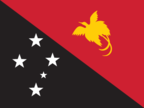
<strong>description:</strong> divided diagonally from upper-left corner; the upper triangle is red and has a soaring yellow bird of paradise in the center; the lower triangle is black with five five-pointed white stars of the Southern Cross constellation<br><br><strong>meaning: </strong>red, black, and yellow are the country's traditional colors; the bird of paradise is an emblem of regional tribal culture and represents the emergence of Papua New Guinea as a nation; the Southern Cross symbolizes the country's connection with Australia and several other countries in the South Pacific
The flag of Papua New Guinea is divided diagonally, from the upper hoist-side corner to the lower fly-side corner, into a lower black and an upper red triangle. On the hoist side of the lower black triangle is a representation of the Southern Cross constellation made up of one small and four larger five-pointed white stars. A golden Raggiana bird-of-paradise is situated on the fly side of the upper red triangle.
- svg
- https://flagcdn.com/pg.svg
parliamentary democracy under a constitutional monarchy; a Commonwealth realm
16 September 1975 (from the Australia-administered UN trusteeship)
has not submitted an ICJ jurisdiction declaration; non-party state to the ICCt
ACP, ADB, AOSIS, APEC, ARF, ASEAN (observer), C, CD, CP, EITI (candidate country), FAO, G-77, IAEA, IBRD, ICAO, ICRM, IDA, IFAD, IFC, IFRCS, IHO, ILO, IMF, IMO, Interpol, IOC, IOM, IPU, ISO (correspondent), ITSO, ITU, MIGA, NAM, OPCW, PIF, Sparteca, SPC, UN, UNCTAD, UNESCO, UNIDO, UNMISS, UNWTO, UPU, WCO, WFTU (NGOs), WHO, WIPO, WMO, WTO
- Highest court(s)
- Supreme Court (consists of the chief justice, deputy chief justice, 35 justices, and 5 acting justices); National Courts (consists of 13 courts located in the provincial capitals, with a total of 19 resident judges)
- Judge selection and term of office
- Supreme Court chief justice appointed by the governor general on advice of the National Executive Council (cabinet) after consultation with the National Justice Administration minister; deputy chief justice and other justices appointed by the Judicial and Legal Services Commission, a 5-member body that includes the Supreme Court chief and deputy chief justices, the chief ombudsman, and a member of the National Parliament; full-time citizen judges appointed for 10-year renewable terms; non-citizen judges initially appointed for 3-year renewable terms and after first renewal can serve until age 70; appointment and tenure of National Court resident judges NA
- Subordinate courts
- district, village, and juvenile courts, military courts, taxation courts, coronial courts, mining warden courts, land courts, traffic courts, committal courts, grade five courts
mixed system of English common law and customary law
- Electoral system
- plurality/majority
- Expected date of next election
- July 2027
- Legislative structure
- unicameral
- Legislature name
- National Parliament
- Most recent election date
- 7/4/2022 to 7/22/2022
- Number of seats
- 118 (all directly elected)
- Parties elected and seats per party
- Papua & Niugini Union Pati (PANGU) (39); People's National Congress Party (PNC) (15); United Resource Party (URP) (11); Others (40); Independents (10)
- Percentage of women in chamber
- 2.7%
- Scope of elections
- full renewal
- Term in office
- 5 years
Papua New Guinea's coat of arms was adopted on July 1, 1971, and features the country's national symbol, the Raggiana bird-of-paradise; the bird stands for the nation's freedom and rich natural environment; the traditional spear under the bird represents the country's ethnic groups and the protection of its heritage, and the Kundu drum, which is used in ceremonies, represents local artistic traditions and communication
red, black
- Selected World Heritage Site locales
- Kuk Early Agricultural Site
- Total World Heritage Sites
- 1 (cultural)
Independence Day, 16 September (1975)
bird of paradise
Destiny Party <br>Liberal Party <br>Melanesian Alliance Party or MAP <br>Melanesian Liberal Party or MLP <br>National Alliance Party or NAP <br>Our Development Party or ODP <br>Papua and Niugini Union Party or PANGU PATI <br>Papua New Guinea Greens Party <br>Papua New Guinea National Party <br>Papua New Guinea Party or PNGP <br>People's First Party or PFP <br>People's Movement for Change or PMC <br>People's National Congress Party or PNC <br>People’s National Party <br>People's Party or PP <br>People's Progress Party or PPP <br>People's Reform Party or PRP <br>Social Democratic Party or SDP <br>Triumph Heritage Empowerment Party or THE <br>United Labor Party or ULP <br>United Resources Party or URP
Monday
18 years of age; universal
Yes
Economy
- oil palm fruit, coconuts, bananas, fruits, sweet potatoes, game meat, yams, root vegetables, vegetables, sugarcane (2023)
- note
- <b>note:</b> top ten agricultural products based on tonnage
- Expenditures
- $6.856 billion (2023 est.)
- Note
- <b>note:</b> central government revenues and expenses (excluding grants/extrabudgetary units/social security funds) converted to US dollars at average official exchange rate for year indicated
- Revenues
- $5.518 billion (2023 est.)
- code
- PGK
- name
- Papua New Guinean kina (PGK) [K]
- $4.77 billion
- Current account balance 2021
- $3.284 billion (2021 est.)
- Current account balance 2022
- $4.567 billion (2022 est.)
- Current account balance 2023
- $4.183 billion (2023 est.)
- Note
- <b>note:</b> balance of payments - net trade and primary/secondary income in current dollars
- $12.85 billion
- Debt - external 2023
- $7.011 billion (2023 est.)
- Note
- <b>note:</b> present value of external debt in current US dollars
<p>lower-middle-income Pacific island economy; primarily informal agrarian sector; natural-resource-rich and key exporter of liquified natural gas; collapse in betel nut prices, tighter monetary policy, and improved foreign-exchange availability contributing to declining inflation; challenges include lack of progress in infrastructure, agricultural reform, and corruption</p>
- Currency
- kina (PGK) per US dollar -
- Exchange rates 2019
- 3.388 (2019 est.)
- Exchange rates 2020
- 3.46 (2020 est.)
- Exchange rates 2021
- 3.509 (2021 est.)
- Exchange rates 2022
- 3.519 (2022 est.)
- Exchange rates 2023
- 3.59 (2023 est.)
- Exports 2021
- $11.032 billion (2021 est.)
- Exports 2022
- $14.862 billion (2022 est.)
- Exports 2023
- $12.93 billion (2023 est.)
- Note
- <b>note:</b> balance of payments - exports of goods and services in current dollars
- natural gas, gold, copper ore, palm oil, nickel (2023)
- note
- <b>note:</b> top five export commodities based on value in dollars
- China 28%, Japan 25%, Australia 17%, Taiwan 8%, India 4% (2023)
- note
- <b>note:</b> top five export partners based on percentage share of exports
- net inflows
- $-198,317,386
- Exports of goods and services
- 49.3% (2017 est.)
- Government consumption
- 19.7% (2017 est.)
- Household consumption
- 43.7% (2017 est.)
- Imports of goods and services
- -22.3% (2017 est.)
- Investment in fixed capital
- 10% (2017 est.)
- Investment in inventories
- 0.4% (2017 est.)
- Agriculture
- 17.2% (2024 est.)
- Industry
- 37.2% (2024 est.)
- Note
- <b>note:</b> figures may not total 100% due to non-allocated consumption not captured in sector-reported data
- Services
- 41.5% (2024 est.)
- $32.538 billion (2024 est.)
- note
- <b>note:</b> data in current dollars at official exchange rate
$3,007
41.9 (2009)
$29.89 billion
$2,900
- Imports 2021
- $6.43 billion (2021 est.)
- Imports 2022
- $8.568 billion (2022 est.)
- Imports 2023
- $7.192 billion (2023 est.)
- Note
- <b>note:</b> balance of payments - imports of goods and services in current dollars
- refined petroleum, trucks, rice, plastic products, excavation machinery (2023)
- note
- <b>note:</b> top five import commodities based on value in dollars
- Australia 27%, China 24%, Singapore 15%, Malaysia 9%, Japan 4% (2023)
- note
- <b>note:</b> top five import partners based on percentage share of imports
- 3.6% (2024 est.)
- note
- <b>note:</b> annual % change in industrial value added based on constant local currency
oil and gas; mining (gold, copper, and nickel); palm oil processing; plywood and wood chip production; copra crushing; construction; tourism; fishing; livestock (pork, poultry, cattle) and dairy farming; spice products (turmeric, vanilla, ginger, cardamom, chili, pepper, citronella, and nutmeg)
- 0.6%
- Inflation rate (consumer prices) 2022
- 5.3% (2022 est.)
- Inflation rate (consumer prices) 2023
- 2.3% (2023 est.)
- Inflation rate (consumer prices) 2024
- 0.6% (2024 est.)
- Note
- <b>note:</b> annual % change based on consumer prices
- 3.66 million (2024 est.)
- note
- <b>note:</b> number of people ages 15 or older who are employed or seeking work
- total
- 3.75 million persons
- agriculture
- 36.86%
- industry
- 7.87%
- services
- 55.27%
- 52 % of GDP
- Note
- <b>note:</b> central government debt as a % of GDP
- Public debt 2023
- 52.4% of GDP (2023 est.)
- $51.56 billion
- Note
- <b>note:</b> data in 2021 dollars
- Real GDP (purchasing power parity) 2022
- $42.093 billion (2022 est.)
- Real GDP (purchasing power parity) 2023
- $43.697 billion (2023 est.)
- Real GDP (purchasing power parity) 2024
- $45.487 billion (2024 est.)
- 3.8%
- Note
- <b>note:</b> annual GDP % growth based on constant local currency
- Real GDP growth rate 2022
- 5.7% (2022 est.)
- Real GDP growth rate 2023
- 3.8% (2023 est.)
- Real GDP growth rate 2024
- 4.1% (2024 est.)
- $4,875
- Note
- <b>note:</b> data in 2021 dollars
- Real GDP per capita 2022
- $4,100 (2022 est.)
- Real GDP per capita 2023
- $4,200 (2023 est.)
- Real GDP per capita 2024
- $4,300 (2024 est.)
- $3.87 million
- Note
- <b>note:</b> personal transfers and compensation between resident and non-resident individuals/households/entities
- Remittances 2021
- 0% of GDP (2021 est.)
- Remittances 2022
- 0% of GDP (2022 est.)
- Remittances 2023
- 0% of GDP (2023 est.)
- $3.9 billion
- Note
- <b>note:</b> holdings of gold (year-end prices)/foreign exchange/special drawing rights in current dollars
- Reserves of foreign exchange and gold 2021
- $3.24 billion (2021 est.)
- Reserves of foreign exchange and gold 2022
- $3.983 billion (2022 est.)
- Reserves of foreign exchange and gold 2023
- $3.901 billion (2023 est.)
17 % of GDP
16 % of GDP
- 15.9% (of GDP) (2023 est.)
- note
- <b>note:</b> central government tax revenue as a % of GDP
- 2.57%
- Note
- <b>note:</b> % of labor force seeking employment
- Unemployment rate 2022
- 2.7% (2022 est.)
- Unemployment rate 2023
- 2.7% (2023 est.)
- Unemployment rate 2024
- 2.8% (2024 est.)
- Female
- 3% (2024 est.)
- Male
- 4.6% (2024 est.)
- Note
- <b>note:</b> % of labor force ages 15-24 seeking employment
- Total
- 3.8% (2024 est.)
Energy
- Imports
- 2,000 metric tons (2023 est.)
- Consumption
- 4.399 billion kWh (2023 est.)
- Installed generating capacity
- 1.148 million kW (2023 est.)
- Transmission/distribution losses
- 328.234 million kWh (2023 est.)
- Electrification - rural areas
- 14.2%
- Electrification - total population
- 19% (2022 est.)
- Electrification - urban areas
- 65.1%
- Biomass and waste
- 0.3% of total installed capacity (2023 est.)
- Fossil fuels
- 76.4% of total installed capacity (2023 est.)
- Geothermal
- 2% of total installed capacity (2023 est.)
- hydroelectric
- 35.29%
- Hydroelectricity
- 21.2% of total installed capacity (2023 est.)
- nuclear
- 0%
- renewable
- 39.96%
- Solar
- 0.1% of total installed capacity (2023 est.)
- Total energy consumption per capita 2023
- 8.781 million Btu/person (2023 est.)
- Consumption
- 677.736 million cubic meters (2023 est.)
- Exports
- 10.892 billion cubic meters (2023 est.)
- Production
- 11.57 billion cubic meters (2023 est.)
- Proven reserves
- 183.125 billion cubic meters (2021 est.)
- Crude oil estimated reserves
- 159.656 million barrels (2021 est.)
- Refined petroleum consumption
- 30,000 bbl/day (2023 est.)
- Total petroleum production
- 32,000 bbl/day (2023 est.)
54.6%
Communications
- per 100 inhabitants
- 0 per 100
- Subscriptions per 100 inhabitants
- (2022 est.) less than 1
- Total
- 22,000 (2022 est.)
5 TV stations: 1 commercial (TV Wan), 2 state-run (National Broadcasting Corporation and EMTV); 1 digital free-to-view network, and 1 satellite network (Click TV or PNGTV); the state-run NBC operates 3 radio networks with multiple repeaters and about 20 provincial stations; several commercial radio stations with multiple transmission points as well as several community stations; transmissions of several international broadcasters are accessible (2023)
.pg
- Percent of population
- 24% (2023 est.)
###
+675
- Subscriptions per 100 inhabitants
- 2 (2022 est.)
- Total subscriptions
- 166,000 (2021 est.)
- subscriptions per 100
- 34 per 100
- Subscriptions per 100 inhabitants
- 39 (2024 est.)
- Total subscriptions
- 4.1 million (2024 est.)
Transportation
- passengers carried
- 1.55 million passengers
- registered carrier departures
- 34,416 departures
569 (2025)
P2
Left
3 (2025)
- By type
- container ship 6, general cargo 89, oil tanker 4, other 106
- Total
- 205 (2023)
- Key ports
- Kavieng Harbor, Kieta, Port Moresby, Rabaul, Vanimo, Wewak Harbor
- Large
- 0
- Medium
- 0
- Ports with oil terminals
- 8
- Small
- 6
- Total ports
- 22 (2024)
- Very small
- 16
PNG
Military and Security
the Papua New Guinea Defense Force (PNGDF) is tasked with defense of the country and its territories against external attack, as well as internal security and socio-economic development duties; following some inter-tribal violence in Wapenamanda in 2024, the PNGDF was given arrest powers<br><br>since 2023, Papua New Guinea has signed bilateral defense cooperation agreements with Australia, Indonesia, the UK, and the US; the 2023 defense cooperation agreement with the US allowed the US military to develop and operate out of bases in PNG with the PNG Government’s approval; PNG has also military relations with France and New Zealand and has discussed a security cooperation agreement with China <br><br>the PNGDF was established in 1973, and its primary combat unit, the Royal Pacific Islands Regiment (RPIR), is descended from Australian Army infantry battalions comprised of native soldiers and led by Australian officers and non-commissioned officers formed during World War II to help fight the Japanese; the RPIR was disbanded after the war, but reestablished in 1951 as part of the Australian Army where it continued to serve until PNG gained its independence in 1975, when it became part of the PNGDF (2025)
- Papua New Guinea Defense Force (PNGDF): Land, Air, Maritime elements<br><br>Ministry of Internal Security: Royal Papua New Guinea Constabulary (RPNGC) (2025)
- active duty personnel
- 4,000
- percent of total labor force
- 0.12 %
estimated 4,000 active PNGDF (2025)
the PNGDF is lightly armed; the Land Force has no heavy weapons while the Air and the Maritime forces have a handful of light aircraft and small patrol boats provided by Australia and New Zealand (2025)
- 0 % of GDP
- current USD
- $91,005,056
- Military Expenditures 2020
- 0.4% of GDP (2020 est.)
- Military Expenditures 2021
- 0.4% of GDP (2021 est.)
- Military Expenditures 2022
- 0.3% of GDP (2022 est.)
- Military Expenditures 2023
- 0.3% of GDP (2023 est.)
- Military Expenditures 2024
- 0.3% of GDP (2024 est.)
- percent of central government expenditure
- 1.29 %
- percent of GDP
- 0.31 % of GDP
18-27 (30 for officers) for voluntary military service for men and women; no conscription (2025)
Transnational Issues
- IDPs
- 107,985 (2024 est.)
- Refugees
- 10,983 (2024 est.)
- Tier rating
- Tier 3 — Papua New Guinea does not fully meet the minimum standards for the elimination of trafficking and is not making significant efforts to do so; therefore, Papua New Guinea remained on Tier 3; for more details, go to: https://www.state.gov/reports/2025-trafficking-in-persons-report/papua-new-guinea/
Environment
- From coal and metallurgical coke
- 1,000 metric tonnes of CO2 (2023 est.)
- From consumed natural gas
- 1.33 million metric tonnes of CO2 (2023 est.)
- From petroleum and other liquids
- 4.467 million metric tonnes of CO2 (2023 est.)
- Total emissions
- 5.798 million metric tonnes of CO2 (2023 est.)
rainforest loss as a result of commercial demand for tropical timber; soil erosion, water-quality degradation, and loss of habitat from logging; effects of large-scale mining projects (discharge of heavy metals, cyanide, and acids into rivers); severe drought; land degradation from poor farming practices; poor fishing practices; coastal pollution due to runoff and oil spills
- Party to
- Antarctic Treaty, Biodiversity, Climate Change, Climate Change-Kyoto Protocol, Climate Change-Paris Agreement, Desertification, Endangered Species, Environmental Modification, Hazardous Wastes, Law of the Sea, Marine Dumping-London Convention, Nuclear Test Ban, Ozone Layer Protection, Ship Pollution, Tropical Timber 2006, Wetlands
- Signed, but not ratified
- Comprehensive Nuclear Test Ban
8.8 micrograms per cubic meter (2019 est.)
1 % of total land area
5 % of total
801 billion cubic meters (2022 est.)
- 0 % of internal resources
- Agricultural
- 1 million cubic meters (2022 est.)
- Industrial
- 167.6 million cubic meters (2022 est.)
- Municipal
- 223.5 million cubic meters (2022 est.)
- Municipal solid waste generated annually
- 1 million tons (2024 est.)
- Percent of municipal solid waste recycled
- 6.3% (2022 est.)