1992 Edition
CIA World Factbook 1992 (Project Gutenberg)
Geography
Climate
tropical; northwest monsoon (December to March), southeast monsoon (May to October); slight seasonal temperature variation
Coastline
5,152 km
Comparative area
slightly larger than California
Continental shelf
200 m (depth) or to depth of exploitation
Disputes
none
Environment
one of world's largest swamps along southwest coast; some active volcanos; frequent earthquakes
Exclusive economic zone
200 nm
Land area
451,710 km2
Land boundaries
820 km; Indonesia 820 km
Land use
arable land NEGL%; permanent crops 1%; meadows and pastures NEGL%; forest and woodland 71%; other 28%
Maritime claims
(measured from claimed archipelagic baselines)
Natural resources
gold, copper, silver, natural gas, timber, oil potential
Note
shares island of New Guinea with Indonesia
Terrain
mostly mountains with coastal lowlands and rolling foothills
Territorial sea
12 nm
Total area
461,690 km2
People and Society
Birth rate
34 births/1,000 population (1992)
Death rate
11 deaths/1,000 population (1992)
Ethnic divisions
predominantly Melanesian and Papuan; some Negrito, Micronesian, and Polynesian
Infant mortality rate
67 deaths/1,000 live births (1992)
Labor force
NA
Languages
715 indigenous languages; English spoken by 1-2%, pidgin English widespread, Motu spoken in Papua region
Life expectancy at birth
55 years male, 56 years female (1992)
Literacy
52% (male 65%, female 38%) age 15 and over can read and write (1990 est.)
Nationality
noun - Papua New Guinean(s); adjective - Papua New Guinean
Net migration rate
0 migrants/1,000 population (1992)
Organized labor
more than 50 trade unions, some with fewer than 20 members
Population
4,006,509 (July 1992), growth rate 2.3% (1992)
Religions
Roman Catholic 22%, Lutheran 16%, Presbyterian/Methodist/London Missionary Society 8%, Anglican 5%, Evangelical Alliance 4%, Seventh-Day Adventist 1%, other Protestant sects 10%; indigenous beliefs 34%
Total fertility rate
4.9 children born/woman (1992)
Government
Administrative divisions
20 provinces; Central, Chimbu, Eastern Highlands, East New Britain, East Sepik, Enga, Gulf, Madang, Manus, Milne Bay, Morobe, National Capital, New Ireland, Northern, North Solomons, Sandaun, Southern Highlands, Western, Western Highlands, West New Britain
Capital
Port Moresby
Chief of State
Queen Elizabeth II (since 6 February 1952), represented by Governor General Wiwa KOROWI (since NA November 1991)
Constitution
16 September 1975
Diplomatic representation
Ambassador Margaret TAYLOR; Chancery at 3rd floor, 1615 New Hampshire Avenue NW, Washington, DC 20009; telephone (202) 745-3680 US: Ambassador Robert W. FARRAND; Embassy at Armit Street, Port Moresby (mailing address is P. O. Box 1492, Port Moresby, or APO AE 96553); telephone [675] 211-455 or 594, 654; FAX [675] 213-423
Executive branch
British monarch, governor general, prime minister, deputy prime minister, National Executive Council (cabinet)
Flag
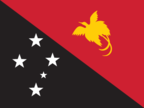
divided diagonally from upper hoist-side corner; the upper triangle is red with a soaring yellow bird of paradise centered; the lower triangle is black with five white five-pointed stars of the Southern Cross constellation centered
Head of Government
Prime Minister Paias WINGTI (since 17 July 1992)
Independence
16 September 1975 (from UN trusteeship under Australian administration)
Judicial branch
Supreme Court
Legal system
based on English common law
Legislative branch
unicameral National Parliament (sometimes referred to as the House of Assembly)
Long-form name
Independent State of Papua New Guinea
Member of
ACP, AsDB, ASEAN (observer), C, CP, ESCAP, FAO, G-77, IBRD, ICAO, ICFTU, IDA, IFAD, IFC, ILO, IMF, IMO, INTELSAT, INTERPOL, IOC, ISO, ITU, LORCS, NAM (observer), SPC, SPF, UN, UNCTAD, UNESCO, UNIDO, UPU, WHO, WMO
National holiday
Independence Day, 16 September (1975)
National Parliament
last held 13-26 June 1992 (next to be held NA 1997); results - percent by party NA; seats - (109 total) Pangu Party 24, PDM 17, PPP 10, PAP 10, independents 30, others 18
Political parties and leaders
Papua New Guinea United Party (Pangu Party), Rabbie NAMALIU; People's Democratic Movement (PDM), Paias WINGTI; People's Action Party (PAP), Akoka DOI; People's Progress Party (PPP), Sir Julius CHAN; United Party (UP), Paul TORATO; Papua Party (PP), Galeva KWARARA; National Party (NP), Paul PORA; Melanesian Alliance (MA), Fr. John MOMIS
Suffrage
universal at age 18
Type
parliamentary democracy
Economy
Agriculture
one-third of GDP; livelihood for 85% of population; fertile soils and favorable climate permits cultivating a wide variety of crops; cash crops - coffee, cocoa, coconuts, palm kernels; other products - tea, rubber, sweet potatoes, fruit, vegetables, poultry, pork; net importer of food for urban centers
Budget
revenues $1.26 billion; expenditures $1.46 billion, including capital expenditures of $273 million (1992 est.)
Currency
kina (plural - kina); 1 kina (K) = 100 toea
Economic aid
US commitments, including Ex-Im (FY70-89), $40.6 million; Western (non-US) countries, ODA and OOF bilateral commitments (1970-89), $6.5 billion; OPEC bilateral aid (1979-89), $17 million
Electricity
397,000 kW capacity; 1,510 million kWh produced, 400 kWh per capita (1990)
Exchange rates
kina (K) per US$1 - 1.0413 (March 1992), 1.0508 (1991), 1.0467 (1990), 1.1685 (1989), 1.1538 (1988), 1.1012 (1987)
Exports
$1.14 billion (f.o.b., 1990) commodities: copper ore, gold, coffee, logs, palm oil, cocoa, lobster partners: FRG, Japan, Australia, UK, Spain, US
External debt
$2.2 billion (April 1991)
Fiscal year
calendar year
GDP
exchange rate conversion - $3.1 billion, per capita $800; real growth rate 9% (1991)
Imports
$1.18 billion (c.i.f., 1990) commodities: machinery and transport equipment, food, fuels, chemicals, consumer goods partners: Australia, Singapore, Japan, US, New Zealand, UK
Industrial production
growth rate 2.4% (1990 est.); accounts for 25% of GDP
Industries
copra crushing, oil palm processing, plywood processing, wood chip production, gold, silver, copper, construction, tourism
Inflation rate (consumer prices)
6.8% (first half 1991)
Overview
Papua New Guinea is richly endowed with natural resources, but exploitation has been hampered by the rugged terrain and the high cost of developing an infrastructure. Agriculture provides a subsistence livelihood for 85% of the population. Mining of numerous deposits, including copper and gold, accounts for about 60% of export earnings. Budgetary support from Australia and development aid under World Bank auspices have helped sustain the economy. Robust growth in 1991 was led by the mining sector; the opening of a large new gold mine featured in the advance.
Unemployment rate
5% (1988)
Communications
Airports
503 total, 460 usable; 18 with permanent-surface runways; none with runways over 3,659 m; 1 with runways 2,440-3,659 m; 39 with runways 1,220-2,439 m
Civil air
about 15 major transport aircraft
Highways
19,200 km total; 640 km paved, 10,960 km gravel, crushed stone, or stabilized-soil surface, 7,600 km unimproved earth
Inland waterways
10,940 km
Merchant marine
8 ships (1,000 GRT or over) totaling 14,102 GRT/16,016 DWT; includes 2 cargo, 1 roll-on/roll-off cargo, 3 combination ore/oil, 1 bulk, 1 container
Ports
Anewa Bay, Lae, Madang, Port Moresby, Rabaul
Railroads
none
Telecommunications
services are adequate and being improved; facilities provide radiobroadcast, radiotelephone and telegraph, coastal radio, aeronautical radio, and international radiocommunication services; submarine cables extend to Australia and Guam; 51,700 telephones (1985); broadcast stations - 31 AM, 2 FM, 2 TV (1987); 1 Pacific Ocean INTELSAT earth station
Military and Security
Branches
Papua New Guinea Defense Force (including Army, Navy, Air Force)
Defense expenditures
exchange rate conversion - $42 million, 1.3% of GDP (1989 est.)
Manpower availability
males 15-49, 1,013,812; 564,081 fit for military service