2021 Edition
CIA World Factbook 2021 (factbook.json @ e0d5604b9e27)
Introduction
Background
In ancient and pre-colonial times, the area of present-day Nigeria was occupied by a great diversity of ethnic groups with very different languages and traditions. British influence and control over what would become Nigeria and Africa's most populous country grew through the 19th century. A series of constitutions after World War II granted Nigeria greater autonomy. After independence in 1960, politics were marked by coups and mostly military rule, until the death of a military head of state in 1998 allowed for a political transition. In 1999, a new constitution was adopted and a peaceful transition to civilian government was completed. The government continues to face the daunting task of institutionalizing democracy and reforming a petroleum-based economy, whose revenues have been squandered through decades of corruption and mismanagement. In addition, Nigeria continues to experience longstanding ethnic and religious tensions. Although both the 2003 and 2007 presidential elections were marred by significant irregularities and violence, Nigeria is currently experiencing its longest period of civilian rule since independence. The general elections of 2007 marked the first civilian-to-civilian transfer of power in the country's history. National and state elections in 2011 and 2015 were generally regarded as credible. The 2015 election was also heralded for the fact that the then-umbrella opposition party, the All Progressives Congress, defeated the long-ruling People's Democratic Party that had governed since 1999, and assumed the presidency, marking the first peaceful transfer of power from one party to another. Presidential and legislative elections were held in early 2019 and deemed broadly free and fair despite voting irregularities, intimidation, and violence.
Geography
Area
- land
- 910,768 sq km
- total
- 923,768 sq km
- water
- 13,000 sq km
Area - comparative
about six times the size of Georgia; slightly more than twice the size of California
Climate
varies; equatorial in south, tropical in center, arid in north
Coastline
853 km
Elevation
- highest point
- Chappal Waddi 2,419 m
- lowest point
- Atlantic Ocean 0 m
- mean elevation
- 380 m
Geographic coordinates
10 00 N, 8 00 E
Geography - note
the Niger River enters the country in the northwest and flows southward through tropical rain forests and swamps to its delta in the Gulf of Guinea
Irrigated land
2,930 sq km (2012)
Land boundaries
- border countries
- Benin 809 km, Cameroon 1975 km, Chad 85 km, Niger 1608 km
- total
- 4,477 km
Land use
- agricultural land
- 78% (2018 est.)
- agricultural land: arable land
- arable land: 37.3% (2018 est.)
- agricultural land: permanent crops
- permanent crops: 7.4% (2018 est.)
- agricultural land: permanent pasture
- permanent pasture: 33.3% (2018 est.)
- forest
- 9.5% (2018 est.)
- other
- 12.5% (2018 est.)
Location
Western Africa, bordering the Gulf of Guinea, between Benin and Cameroon
Major aquifers
Lake Chad Basin, Lullemeden-Irhazer Aquifer System
Major lakes (area sq km)
- Fresh water lake(s)
- Lake Chad (endorheic lake shared with Niger, Chad, and Cameroon) - 10,360-25,900 sq kmnote - area varies by season and year to year
Major rivers (by length in km)
Niger river mouth (shared with Guinea [s], Mali, Benin, and Niger) - 4,200 kmnote – [s] after country name indicates river source; [m] after country name indicates river mouth
Major watersheds (area sq km)
Atlantic Ocean drainage: Niger (2,261,741 sq km)Internal (endorheic basin) drainage: Lake Chad (2,497,738 sq km)
Map references
Africa
Maritime claims
- continental shelf
- 200-m depth or to the depth of exploitation
- exclusive economic zone
- 200 nm
- territorial sea
- 12 nm
Natural hazards
periodic droughts; flooding
Natural resources
natural gas, petroleum, tin, iron ore, coal, limestone, niobium, lead, zinc, arable land
Population distribution
largest population of any African nation; significant population clusters are scattered throughout the country, with the highest density areas being in the south and southwest as shown in this population distribution map
Terrain
southern lowlands merge into central hills and plateaus; mountains in southeast, plains in north
People and Society
Age structure
- 0-14 years
- 41.7% (male 45,571,738/female 43,674,769)
- 15-24 years
- 20.27% (male 22,022,660/female 21,358,753)
- 25-54 years
- 30.6% (male 32,808,913/female 32,686,474)
- 55-64 years
- 4.13% (male 4,327,847/female 4,514,264)
- 65 years and over
- 3.3% (male 3,329,083/female 3,733,801) (2020 est.)
Birth rate
34.38 births/1,000 population (2021 est.)
Children under the age of 5 years underweight
18.4% (2019/20)
Contraceptive prevalence rate
16.6% (2018)
Current Health Expenditure
3.9% (2018)
Death rate
8.89 deaths/1,000 population (2021 est.)
Demographic profile
Nigeria’s population is projected to grow from more than 186 million people in 2016 to 392 million in 2050, becoming the world’s fourth most populous country. Nigeria’s sustained high population growth rate will continue for the foreseeable future because of population momentum and its high birth rate. Abuja has not successfully implemented family planning programs to reduce and space births because of a lack of political will, government financing, and the availability and affordability of services and products, as well as a cultural preference for large families. Increased educational attainment, especially among women, and improvements in health care are needed to encourage and to better enable parents to opt for smaller families.Nigeria needs to harness the potential of its burgeoning youth population in order to boost economic development, reduce widespread poverty, and channel large numbers of unemployed youth into productive activities and away from ongoing religious and ethnic violence. While most movement of Nigerians is internal, significant emigration regionally and to the West provides an outlet for Nigerians looking for economic opportunities, seeking asylum, and increasingly pursuing higher education. Immigration largely of West Africans continues to be insufficient to offset emigration and the loss of highly skilled workers. Nigeria also is a major source, transit, and destination country for forced labor and sex trafficking.
Dependency ratios
- elderly dependency ratio
- 5.1
- potential support ratio
- 19.6 (2020 est.)
- total dependency ratio
- 86
- youth dependency ratio
- 80.9
Drinking water source
- improved: rural
- rural: 63.6% of population
- improved: total
- total: 77.9% of population
- improved: urban
- urban: 92.6% of population
- unimproved: rural
- rural: 36.4% of population
- unimproved: total
- total: 22.1% of population (2017 est.)
- unimproved: urban
- urban: 7.4% of population
Education expenditures
NA
Ethnic groups
- Hausa 30%, Yoruba 15.5%, Igbo (Ibo) 15.2%, Fulani 6%, Tiv 2.4%, Kanuri/Beriberi 2.4%, Ibibio 1.8%, Ijaw/Izon 1.8%, other 24.7% (2018 est.)
- note
- note: Nigeria, Africa's most populous country, is composed of more than 250 ethnic groups
HIV/AIDS - adult prevalence rate
1.3% (2020 est.)
HIV/AIDS - deaths
49,000 (2020 est.)
HIV/AIDS - people living with HIV/AIDS
1.7 million (2020 est.)
Infant mortality rate
- female
- 52.46 deaths/1,000 live births (2021 est.)
- male
- 63.67 deaths/1,000 live births
- total
- 58.23 deaths/1,000 live births
Languages
English (official), Hausa, Yoruba, Igbo (Ibo), Fulani, over 500 additional indigenous languages
Life expectancy at birth
- female
- 62.78 years (2021 est.)
- male
- 59.07 years
- total population
- 60.87 years
Literacy
- definition
- age 15 and over can read and write
- female
- 52.7% (2018)
- male
- 71.3%
- total population
- 62%
Major infectious diseases
- aerosolized dust or soil contact diseases
- Lassa fever
- animal contact diseases
- rabies
- degree of risk
- very high (2020)
- food or waterborne diseases
- bacterial and protozoal diarrhea, hepatitis A and E, and typhoid fever
- note
- note: on 7 October 2019, the Centers for Disease Control and Prevention issued a Travel Health Notice for a Yellow Fever outbreak in Nigeria; a large, ongoing outbreak of yellow fever in Nigeria began in September 2017; the outbreak is now spread throughout the country with the Nigerian Ministry of Health reporting cases of the disease in all 36 states and the Federal Capital Territory; the CDC recommends travelers going to Nigeria should receive vaccination against yellow fever at least 10 days before travel and should take steps to prevent mosquito bites while there; those never vaccinated against yellow fever should avoid travel to Nigeria during the outbreaknote: widespread ongoing transmission of a respiratory illness caused by the novel coronavirus (COVID-19) is occurring throughout Nigeria; as of 6 October 2021, Nigeria has reported a total of 206,561 cases of COVID-19 or 100.2 cumulative cases of COVID-19 per 100,000 population with 1.32 cumulative death per 100,000 population; as of 30 September 2021, 2.27% of the population has received at least one dose of COVID-19 vaccine
- respiratory diseases
- meningococcal meningitis
- vectorborne diseases
- malaria, dengue fever, and yellow fever
- water contact diseases
- leptospirosis and schistosomiasis
Major urban areas - population
14.862 million Lagos, 4.103 million Kano, 3.649 million Ibadan, 3.464 million ABUJA (capital), 3.171 million Port Harcourt, 1.782 million Benin City (2021)
Maternal mortality ratio
917 deaths/100,000 live births (2017 est.)
Median age
- female
- 18.9 years (2020 est.)
- male
- 18.4 years
- total
- 18.6 years
Mother's mean age at first birth
- 20.4 years (2018 est.)
- note
- note: median age at first birth among women 25-49
Nationality
- adjective
- Nigerian
- noun
- Nigerian(s)
Net migration rate
-0.21 migrant(s)/1,000 population (2021 est.)
Obesity - adult prevalence rate
8.9% (2016)
Physicians density
0.38 physicians/1,000 population (2018)
Population
- 219,463,862 (July 2021 est.)
- note
- note: estimates for this country explicitly take into account the effects of excess mortality due to AIDS; this can result in lower life expectancy, higher infant mortality, higher death rates, lower population growth rates, and changes in the distribution of population by age and sex than would otherwise be expected
Population distribution
largest population of any African nation; significant population clusters are scattered throughout the country, with the highest density areas being in the south and southwest as shown in this population distribution map
Population growth rate
2.53% (2021 est.)
Religions
Muslim 53.5%, Roman Catholic 10.6%, other Christian 35.3%, other .6% (2018 est.)
Sanitation facility access
- improved: rural
- rural: 39.5% of population
- improved: total
- total: 59.7% of population
- improved: urban
- urban: 80.2% of population
- unimproved: rural
- rural: 60.5% of population
- unimproved: total
- total: 40.3% of population (2017 est.)
- unimproved: urban
- urban: 19.8% of population
School life expectancy (primary to tertiary education)
- female
- 8 years (2011)
- male
- 9 years
- total
- 9 years
Sex ratio
- 0-14 years
- 1.04 male(s)/female
- 15-24 years
- 1.03 male(s)/female
- 25-54 years
- 1 male(s)/female
- 55-64 years
- 0.96 male(s)/female
- 65 years and over
- 0.89 male(s)/female
- at birth
- 1.06 male(s)/female
- total population
- 1.02 male(s)/female (2020 est.)
Total fertility rate
4.67 children born/woman (2021 est.)
Unemployment, youth ages 15-24
- female
- 18.2% NA (2019 est.)
- male
- 18.4% NA
- total
- 18.3%
Urbanization
- rate of urbanization
- 3.92% annual rate of change (2020-25 est.)
- urban population
- 52.7% of total population (2021)
Government
Administrative divisions
36 states and 1 territory*; Abia, Adamawa, Akwa Ibom, Anambra, Bauchi, Bayelsa, Benue, Borno, Cross River, Delta, Ebonyi, Edo, Ekiti, Enugu, Federal Capital Territory*, Gombe, Imo, Jigawa, Kaduna, Kano, Katsina, Kebbi, Kogi, Kwara, Lagos, Nasarawa, Niger, Ogun, Ondo, Osun, Oyo, Plateau, Rivers, Sokoto, Taraba, Yobe, Zamfara
Capital
- etymology
- Abuja is a planned capital city, it replaced Lagos in 1991; situated in the center of the country, Abuja takes its name from a nearby town, now renamed Suleja
- geographic coordinates
- 9 05 N, 7 32 E
- name
- Abuja
- time difference
- UTC+1 (6 hours ahead of Washington, DC, during Standard Time)
Citizenship
- citizenship by birth
- no
- citizenship by descent only
- at least one parent must be a citizen of Nigeria
- dual citizenship recognized
- yes
- residency requirement for naturalization
- 15 years
Constitution
- amendments
- proposed by the National Assembly; passage requires at least two-thirds majority vote of both houses and approval by the Houses of Assembly of at least two thirds of the states; amendments to constitutional articles on the creation of a new state, fundamental constitutional rights, or constitution-amending procedures requires at least four-fifths majority vote by both houses of the National Assembly and approval by the Houses of Assembly in at least two thirds of the states; passage of amendments limited to the creation of a new state require at least two-thirds majority vote by the proposing National Assembly house and approval by the Houses of Assembly in two thirds of the states; amended several times, last in 2018
- history
- several previous; latest adopted 5 May 1999, effective 29 May 1999
Country name
- conventional long form
- Federal Republic of Nigeria
- conventional short form
- Nigeria
- etymology
- named for the Niger River that flows through the west of the country to the Atlantic Ocean; from a native term "Ni Gir" meaning "River Gir"
Diplomatic representation from the US
- chief of mission
- Ambassador Mary Beth LEONARD (since 24 December 2019)
- consulate(s) general
- Lagos
- email address and website
- AbujaACS@state.govhttps://ng.usembassy.gov/
- embassy
- Plot 1075 Diplomatic Drive, Central District Area, Abuja
- FAX
- [234] (9) 461-4036
- mailing address
- 8320 Abuja Place, Washington DC 20521-8320
- telephone
- [234] (9) 461-4000
Diplomatic representation in the US
- chancery
- 3519 International Court NW, Washington, DC 20008
- chief of mission
- Ambassador Uzoma Elizabeth EMENIKE (since 7 July 2021)
- consulate(s) general
- Atlanta, New York
- email address and website
- info@nigeriaembassyusa.orghttps://www.nigeriaembassyusa.org/
- FAX
- [1] (202) 362-6541
- telephone
- [1] (202) 800-7201 (ext. 100)
Executive branch
- cabinet
- Federal Executive Council appointed by the president but constrained constitutionally to include at least one member from each of the 36 states
- chief of state
- President Maj. Gen. (ret.) Muhammadu BUHARI (since 29 May 2015); Vice President Oluyemi "Yemi" OSINBAJO (since 29 May 2015); note - the president is both chief of state, head of government, and commander-in-chief of the armed forces
- election results
- Muhammadu BUHARI elected president; percent of vote - Muhammadu BUHARI (APC) 53%, Atiku ABUBAKER (PDP) 39%, other 8%
- elections/appointments
- president directly elected by qualified majority popular vote and at least 25% of the votes cast in 24 of Nigeria's 36 states; president elected for a 4-year term (eligible for a second term); election last held on 23 February 2019 (next to be held in February 2023); note: the election was scheduled for 16 February 2019, but postponed on 16 February 2019
- head of government
- President Maj.Gen. (ret.) Muhammadu BUHARI (since 29 May 2015); Vice President Oluyemi "Yemi" OSINBAJO (since 29 May 2015)
Flag description
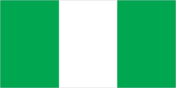
three equal vertical bands of green (hoist side), white, and green; the color green represents the forests and abundant natural wealth of the country, white stands for peace and unity
Government type
federal presidential republic
Independence
1 October 1960 (from the UK)
International law organization participation
accepts compulsory ICJ jurisdiction with reservations; accepts ICCt jurisdiction
International organization participation
ACP, AfDB, AU, C, CD, D-8, ECOWAS, EITI (compliant country), FAO, G-15, G-24, G-77, IAEA, IBRD, ICAO, ICC (national committees), ICCt, ICRM, IDA, IDB, IFAD, IFC, IFRCS, IHO, ILO, IMF, IMO, IMSO, Interpol, IOC, IOM, IPU, ISO, ITSO, ITU, ITUC (NGOs), MIGA, MINURSO, MINUSMA, MONUSCO, NAM, OAS (observer), OIC, OPCW, OPEC, PCA, UN, UNAMID, UNCTAD, UNESCO, UNHCR, UNIDO, UNIFIL, UNISFA, UNITAR, UNMIL, UNMISS, UNOCI, UNWTO, UPU, WCO, WFTU (NGOs), WHO, WIPO, WMO, WTO
Judicial branch
- highest courts
- Supreme Court (consists of the chief justice and 15 justices)
- judge selection and term of office
- judges appointed by the president upon the recommendation of the National Judicial Council, a 23-member independent body of federal and state judicial officials; judge appointments confirmed by the Senate; judges serve until age 70
- subordinate courts
- Court of Appeal; Federal High Court; High Court of the Federal Capital Territory; Sharia Court of Appeal of the Federal Capital Territory; Customary Court of Appeal of the Federal Capital Territory; state court system similar in structure to federal system
Legal system
mixed legal system of English common law, Islamic law (in 12 northern states), and traditional law
Legislative branch
- description
- bicameral National Assembly consists of:Senate (109 seats - 3 each for the 36 states and 1 for Abuja-Federal Capital Territory; members directly elected in single-seat constituencies by simple majority vote to serve 4-year terms) House of Representatives (360 seats; members directly elected in single-seat constituencies by simple majority vote to serve 4-year terms)
- election results
- Senate - percent of vote by party - NA; seats by party - APC 65, PDP 39, YPP 1, TBD 3; composition - men 103, women 6, percent of women 5.5% House of Representatives - percent of vote by party - NA; seats by party - APC 217, PDP 115, other 20, TBD 8; composition - men 346, women 14, percent of women 3.9%; note - total National Assembly percent of women 4.3%
- elections
- Senate - last held on 23 February 2019 (next to be held on 23 February 2023); note: election was scheduled for 16 February 2019 but was postponed on 15 February 2019 House of Representatives - last held on 23 February 2019 (next to be held on 23 February 2023); note: election was scheduled for 16 February 2019 but was postponed on 15 February 2019
National anthem
- lyrics/music
- John A. ILECHUKWU, Eme Etim AKPAN, B.A. OGUNNAIKE, Sotu OMOIGUI and P.O. ADERIBIGBE/Benedict Elide ODIASE
- name
- Arise Oh Compatriots, Nigeria's Call Obey
- note
- note: adopted 1978; lyrics are a mixture of the five top entries in a national contest
National holiday
Independence Day (National Day), 1 October (1960)
National symbol(s)
eagle; national colors: green, white
Political parties and leaders
Accord Party or ACC [Mohammad Lawal MALADO]Africa Democratic Congress (ADC) [Ralph Okey NWOSU] All Progressives Congress or APC [Mai Mala BUNI, caretaker]All Progressives Grand Alliance or APGA [Victor Ike OYE]Labor Party or LP [Alhai Abdulkadir ABDULSALAM]Peoples Democratic Party or PDP [Iyourchia AYU]Young Progressive Party or YPP [Olufemi FOLAYAN]
Suffrage
18 years of age; universal
Economy
Agricultural products
cassava, yams, maize, oil palm fruit, rice, vegetables, sorghum, groundnuts, fruit, sweet potatoes
Budget
- expenditures
- 19.54 billion (2017 est.)
- revenues
- 12.92 billion (2017 est.)
Budget surplus (+) or deficit (-)
-1.8% (of GDP) (2017 est.)
Credit ratings
- Fitch rating
- B (2020)
- Moody's rating
- B2 (2017)
- Standard & Poors rating
- B- (2020)
Current account balance
- Current account balance 2016
- $2.714 billion (2016 est.)
- Current account balance 2017
- $10.38 billion (2017 est.)
Debt - external
- Debt - external 2018
- $22.755 billion (2018 est.)
- Debt - external 2019
- $26.847 billion (2019 est.)
Economic overview
Nigeria is Sub Saharan Africa’s largest economy and relies heavily on oil as its main source of foreign exchange earnings and government revenues. Following the 2008-09 global financial crises, the banking sector was effectively recapitalized and regulation enhanced. Since then, Nigeria’s economic growth has been driven by growth in agriculture, telecommunications, and services. Economic diversification and strong growth have not translated into a significant decline in poverty levels; over 62% of Nigeria's over 180 million people still live in extreme poverty.Despite its strong fundamentals, oil-rich Nigeria has been hobbled by inadequate power supply, lack of infrastructure, delays in the passage of legislative reforms, an inefficient property registration system, restrictive trade policies, an inconsistent regulatory environment, a slow and ineffective judicial system, unreliable dispute resolution mechanisms, insecurity, and pervasive corruption. Regulatory constraints and security risks have limited new investment in oil and natural gas, and Nigeria's oil production had been contracting every year since 2012 until a slight rebound in 2017.President BUHARI, elected in March 2015, has established a cabinet of economic ministers that includes several technocrats, and he has announced plans to increase transparency, diversify the economy away from oil, and improve fiscal management, but has taken a primarily protectionist approach that favors domestic producers at the expense of consumers. President BUHARI ran on an anti-corruption platform, and has made some headway in alleviating corruption, such as implementation of a Treasury Single Account that allows the government to better manage its resources and a more transparent government payroll and personnel system that eliminated duplicate and "ghost workers." The government also is working to develop stronger public-private partnerships for roads, agriculture, and power.Nigeria entered recession in 2016 as a result of lower oil prices and production, exacerbated by militant attacks on oil and gas infrastructure in the Niger Delta region, coupled with detrimental economic policies, including foreign exchange restrictions. GDP growth turned positive in 2017 as oil prices recovered and output stabilized.
Exchange rates
- currency
- nairas (NGN) per US dollar -
- Exchange rates 2013
- 158.55 (2013 est.)
- Exchange rates 2014
- 192.73 (2014 est.)
- Exchange rates 2018
- 363 (2018 est.)
- Exchange rates 2019
- 362.75 (2019 est.)
- Exchange rates 2020
- 383.5 (2020 est.)
Exports
- Exports 2018
- $66.04 billion note: data are in current year dollars (2018 est.)
- Exports 2019
- $69.93 billion note: data are in current year dollars (2019 est.)
- Exports 2020
- $39.94 billion note: data are in current year dollars (2020 est.)
Exports - commodities
crude petroleum, natural gas, scrap vessels, flexible metal tubing, cocoa beans (2019)
Exports - partners
India 16%, Spain 10%, United States 7%, France 7%, Netherlands 6% (2019)
Fiscal year
calendar year
GDP - composition, by end use
- exports of goods and services
- 11.9% (2017 est.)
- government consumption
- 5.8% (2017 est.)
- household consumption
- 80% (2017 est.)
- imports of goods and services
- -13.2% (2017 est.)
- investment in fixed capital
- 14.8% (2017 est.)
- investment in inventories
- 0.7% (2017 est.)
GDP - composition, by sector of origin
- agriculture
- 21.1% (2016 est.)
- industry
- 22.5% (2016 est.)
- services
- 56.4% (2017 est.)
GDP (official exchange rate)
$475.062 billion (2019 est.)
Gini Index coefficient - distribution of family income
- Gini Index coefficient - distribution of family income 1997
- 50.6 (1997)
- Gini Index coefficient - distribution of family income 2018
- 35.1 (2018 est.)
Household income or consumption by percentage share
- highest 10%
- 38.2% (2010 est.)
- lowest 10%
- 1.8%
Imports
- Imports 2018
- $71.64 billion note: data are in current year dollars (2018 est.)
- Imports 2019
- $100.82 billion note: data are in current year dollars (2019 est.)
- Imports 2020
- $72.18 billion note: data are in current year dollars (2020 est.)
Imports - commodities
refined petroleum, cars, wheat, laboratory glassware, packaged medicines (2019)
Imports - partners
China 30%, Netherlands 11%, United States 6%, Belgium 5% (2019)
Industrial production growth rate
2.2% (2017 est.)
Industries
crude oil, coal, tin, columbite; rubber products, wood; hides and skins, textiles, cement and other construction materials, food products, footwear, chemicals, fertilizer, printing, ceramics, steel
Inflation rate (consumer prices)
- Inflation rate (consumer prices) 2017
- 16.5% (2017 est.)
- Inflation rate (consumer prices) 2018
- 12.1% (2018 est.)
- Inflation rate (consumer prices) 2019
- 11.3% (2019 est.)
Labor force
60.08 million (2017 est.)
Labor force - by occupation
- agriculture
- 70%
- industry
- 10%
- services
- 20% (1999 est.)
Population below poverty line
40.1% (2018 est.)
Public debt
- Public debt 2016
- 19.6% of GDP (2016 est.)
- Public debt 2017
- 21.8% of GDP (2017 est.)
Real GDP (purchasing power parity)
- note
- note: data are in 2017 dollars
- Real GDP (purchasing power parity) 2018
- $1,009,750,000,000 note: data are in 2017 dollars (2018 est.)
- Real GDP (purchasing power parity) 2019
- $1,032,050,000,000 note: data are in 2017 dollars (2019 est.)
- Real GDP (purchasing power parity) 2020
- $1,013,530,000,000 note: data are in 2017 dollars (2020 est.)
Real GDP growth rate
- Real GDP growth rate 2015
- 2.7% (2015 est.)
- Real GDP growth rate 2016
- -1.6% (2016 est.)
- Real GDP growth rate 2017
- 0.8% (2017 est.)
Real GDP per capita
- note
- note: data are in 2017 dollars
- Real GDP per capita 2018
- $5,200 note: data are in 2017 dollars (2018 est.)
- Real GDP per capita 2019
- $5,100 note: data are in 2017 dollars (2019 est.)
- Real GDP per capita 2020
- $4,900 note: data are in 2017 dollars (2020 est.)
Reserves of foreign exchange and gold
- Reserves of foreign exchange and gold 31 December 2016
- $25.84 billion (31 December 2016 est.)
- Reserves of foreign exchange and gold 31 December 2017
- $38.77 billion (31 December 2017 est.)
Taxes and other revenues
3.4% (of GDP) (2017 est.)
Unemployment rate
- Unemployment rate 2016
- 13.9% (2016 est.)
- Unemployment rate 2017
- 16.5% (2017 est.)
Unemployment, youth ages 15-24
- female
- 18.2% NA (2019 est.)
- male
- 18.4% NA
- total
- 18.3%
Energy
Crude oil - exports
2.096 million bbl/day (2015 est.)
Crude oil - imports
0 bbl/day (2015 est.)
Crude oil - production
1.989 million bbl/day (2018 est.)
Crude oil - proved reserves
37.45 billion bbl (1 January 2018 est.)
Electricity - consumption
24.72 billion kWh (2016 est.)
Electricity - exports
0 kWh (2016 est.)
Electricity - from fossil fuels
80% of total installed capacity (2016 est.)
Electricity - from hydroelectric plants
19% of total installed capacity (2017 est.)
Electricity - from nuclear fuels
0% of total installed capacity (2017 est.)
Electricity - from other renewable sources
0% of total installed capacity (2017 est.)
Electricity - imports
0 kWh (2016 est.)
Electricity - installed generating capacity
10.52 million kW (2016 est.)
Electricity - production
29.35 billion kWh (2016 est.)
Electricity access
- electrification - rural areas
- 30% (2019)
- electrification - total population
- 62% (2019)
- electrification - urban areas
- 91% (2019)
Natural gas - consumption
17.24 billion cu m (2017 est.)
Natural gas - exports
27.21 billion cu m (2017 est.)
Natural gas - imports
0 cu m (2017 est.)
Natural gas - production
44.48 billion cu m (2017 est.)
Natural gas - proved reserves
5.475 trillion cu m (1 January 2018 est.)
Refined petroleum products - consumption
325,000 bbl/day (2016 est.)
Refined petroleum products - exports
2,332 bbl/day (2015 est.)
Refined petroleum products - imports
223,400 bbl/day (2015 est.)
Refined petroleum products - production
35,010 bbl/day (2017 est.)
Communications
Broadband - fixed subscriptions
- subscriptions per 100 inhabitants
- less than 1 (2018 est.)
- total
- 83,360
Broadcast media
nearly 70 federal government-controlled national and regional TV stations; all 36 states operate TV stations; several private TV stations operational; cable and satellite TV subscription services are available; network of federal government-controlled national, regional, and state radio stations; roughly 40 state government-owned radio stations typically carry their own programs except for news broadcasts; about 20 private radio stations; transmissions of international broadcasters are available; digital broadcasting migration process completed in three states in 2018 (2019)
Internet country code
.ng
Internet users
- percent of population
- 42% (2019 est.)
- total
- 104.4 million (2021 est.)
Telecommunication systems
- domestic
- fixed-line subscribership remains less than 1 per 100 persons; mobile-cellular services growing rapidly, in part responding to the shortcomings of the fixed-line network; multiple cellular providers operate nationally with subscribership base over 88 per 100 persons (2019)
- general assessment
- one of the larger telecom markets in Africa subject to sporadic access to electricity and vandalism of infrastructure; most Internet connections are via mobile networks; foreign investment presence, particularly from China; market competition with affordable access; LTE technologies available but GSM is dominate; mobile penetration high due to use of multiple SIM cards and phones; government committed to expanding broadband penetration; operators to deploy fiber optic cable in six geopolitical zones and Lagos; operators invested in base stations to deplete network congestion; submarine cable break in 2020 slowed speeds and interrupted connectivity; importer of phones and broadcast equipment from China (2020)
- international
- country code - 234; landing point for the SAT-3/WASC, NCSCS, MainOne, Glo-1 & 2, ACE, and Equiano fiber-optic submarine cable that provides connectivity to Europe and South and West Africa; satellite earth stations - 3 Intelsat (2 Atlantic Ocean and 1 Indian Ocean) (2019)
- note
- note: the COVID-19 pandemic continues to have a significant impact on production and supply chains globally; since 2020, some aspects of the telecom sector have experienced downturn, particularly in mobile device production; many network operators delayed upgrades to infrastructure; progress towards 5G implementation was postponed or slowed in some countries; consumer spending on telecom services and devices was affected by large-scale job losses and the consequent restriction on disposable incomes; the crucial nature of telecom services as a tool for work and school from home became evident, and received some support from governments
Telephones - fixed lines
- subscriptions per 100 inhabitants
- less than 1 (2020 est.)
- total subscriptions
- 107,031 (2020)
Telephones - mobile cellular
- subscriptions per 100 inhabitants
- 99.07 (2020 est.)
- total subscriptions
- 204,228,678 (2020)
Transportation
Airports
- total
- 54 (2013)
Airports - with paved runways
- 1,524 to 2,437 m
- 9
- 2,438 to 3,047 m
- 12
- 914 to 1,523 m
- 6
- over 3,047 m
- 10
- total
- 40
- under 914 m
- 3 (2017)
Airports - with unpaved runways
- 1,524 to 2,437 m
- 2
- 914 to 1,523 m
- 9
- total
- 14
- under 914 m
- 3 (2013)
Civil aircraft registration country code prefix
5N
Heliports
5 (2013)
Merchant marine
- by type
- general cargo 14, oil tanker 110, other 667 (2021)
- total
- 791
National air transport system
- annual freight traffic on registered air carriers
- 19.42 million mt-km (2018)
- annual passenger traffic on registered air carriers
- 8,169,192 (2018)
- inventory of registered aircraft operated by air carriers
- 104
- number of registered air carriers
- 13 (2020)
Pipelines
124 km condensate, 4045 km gas, 164 km liquid petroleum gas, 4441 km oil, 3940 km refined products (2013)
Ports and terminals
- LNG terminal(s) (export)
- Bonny Island
- major seaport(s)
- Bonny Inshore Terminal, Calabar, Lagos
- oil terminal(s)
- Bonny Terminal, Brass Terminal, Escravos Terminal, Forcados Terminal, Pennington Terminal, Qua Iboe Terminal
Railways
- narrow gauge
- 3,505 km 1.067-m gauge (2014)
- note
- note: as of the end of 2018, there were only six operational locomotives in Nigeria primarily used for passenger service; the majority of the rail lines are in a severe state of disrepair and need to be replaced
- standard gauge
- 293 km 1.435-m gauge (2014)
- total
- 3,798 km (2014)
Roadways
- paved
- 60,000 km (2017)
- total
- 195,000 km (2017)
- unpaved
- 135,000 km (2017)
Waterways
8,600 km (Niger and Benue Rivers and smaller rivers and creeks) (2011)
Military and Security
Maritime threats
the International Maritime Bureau reports the territorial and offshore waters in the Niger Delta and Gulf of Guinea remain a very high risk for piracy and armed robbery of ships; in 2020, there were 98 reported incidents of piracy and armed robbery at sea in the Gulf of Guinea region; although a 24% decrease from the total number of incidents in 2019, it included all three hijackings and 9 of 11 ships fired upon worldwide; while boarding and attempted boarding to steal valuables from ships and crews are the most common types of incidents, almost a third of all incidents involve a hijacking and/or kidnapping; in 2020, a record 130 crew members were kidnapped in 22 separate incidents in the Gulf of Guinea, representing 95% of kidnappings worldwide; approximately 51% of all incidents of piracy and armed robbery are taking place off Nigeria, which is a decrease from the 71% in 2019 and an indication pirates are traveling further to target vessels; Nigerian pirates are well armed and very aggressive, operating as far as 200 nm offshore; the Maritime Administration of the US Department of Transportation has issued a Maritime Advisory (2021-002 - Gulf of Guinea-Piracy/Armed Robbery/Kidnapping for Ransom) effective 9 January 2021, which states in part, "Piracy, armed robbery, and kidnapping for ransom continue to serve as significant threats to US-flagged vessels transiting or operating in the Gulf of Guinea.”
Military - note
as of 2021, the Nigerian military was sub-Saharan Africa’s largest and regarded as one of its most capable forces; it was focused largely on internal security and faced a number of challenges that have stretched its resources, however; in the northeast, the military was conducting counterinsurgency/counter-terrorist operations against the Boko Haram (BH) and Islamic State in West Africa (ISWA) terrorist groups, where it has deployed as many as 70,000 troops at times and jihadist-related violence has killed an estimated 35,000 people, mostly civilians, since 2009 (as of Dec 2020); in the northwest, it faced growing threats from criminal gangs, bandits, and violence associated with historical and ongoing farmer-herder conflicts, as well as BH and ISWA terrorists; bandits in the northwest are estimated to number in the low 10,000s and violence there has killed more than 10,000 since the mid-2010s; in 2021, the military also continued to protect the oil industry in the Niger Delta region against militants and criminal activity, although the levels of violence there have decreased in recent years; in May 2021, a contingent of military troops and police were deployed to eastern Nigeria to quell renewed agitation for a state of Biafra (Biafra seceded from Nigeria in the late 1960s, sparking a civil war that caused more than 1 million deaths) the Nigerian military traces its origins to the Nigeria Regiment of the West African Frontier Force (WAFF), a multi-regiment force formed by the British colonial office in 1900 to garrison the West African colonies of Nigeria (Lagos and the protectorates of Northern and Southern Nigeria), Gold Coast, Sierra Leone, and Gambia; the WAFF served with distinction in both East and West Africa during World War I; in 1928, it received royal recognition and was re-named the Royal West African Frontier Force (RWAFF); the RWAFF went on to serve in World War II as part of the British 81st and 82nd (West African) divisions in the East Africa and Burma campaigns; in 1956, the Nigeria Regiment of the RWAFF was renamed the Nigerian Military Forces (NMF) and in 1958, the colonial government of Nigeria took over control of the NMF from the British War Office; the Nigerian Armed Forces were established following independence in 1960
Military and security forces
Nigerian Armed Forces: Army, Navy (includes Coast Guard), Air Force; Ministry of Interior: Nigeria Security and Civil Defence Corps (NSCDC, a paramilitary agency commissioned to assist the military in the management of threats to internal security, including attacks and natural disasters) (2021)
Military and security service personnel strengths
size estimates for the Nigerian Armed Forces vary; approximately 135,000 active personnel (100,000 Army; 20,000 Navy/Coast Guard; 15,000 Air Force); est. 80,000 Security and Civil Defense Corps (2020)
Military deployments
200 Ghana (ECOMIG); Multinational Joint Task Force (MNJTF; 1 brigade or approximately 3,000 troops committed; note - the national MNJTF troop contingents are deployed within their own country territories, although cross‐border operations are conducted periodically) (2021)
Military equipment inventories and acquisitions
the Nigerian Armed Forces' inventory consists of a wide variety of imported weapons systems of Chinese, European, Middle Eastern, Russian (including Soviet-era), and US origin; since 2010, Nigeria has undertaken a considerable military modernization program, and has received equipment from some 20 countries with China, Russia, and the US as the leading suppliers; Nigeria has been the largest arms importer in sub-Saharan Africa since 2014; Nigeria is also developing a defense-industry capacity, including small arms, armored personnel vehicles, and small-scale naval production (2021)
Military expenditures
- Military Expenditures 2016
- 0.4% of GDP (2016)
- Military Expenditures 2017
- 0.4% of GDP (2017)
- Military Expenditures 2018
- 0.5% of GDP (2018)
- Military Expenditures 2019
- 0.5% of GDP (2019)
- Military Expenditures 2020
- 0.6% of GDP (2020)
Military service age and obligation
18-26 years of age for voluntary military service; no conscription (2019)
Transnational Issues
Disputes - international
Joint Border Commission with Cameroon reviewed 2002 ICJ ruling on the entire boundary and bilaterally resolved differences, including June 2006 Greentree Agreement that immediately cedes sovereignty of the Bakassi Peninsula to Cameroon with a phaseout of Nigerian control within two years while resolving patriation issues; the ICJ ruled on an equidistance settlement of Cameroon-Equatorial Guinea-Nigeria maritime boundary in the Gulf of Guinea, but imprecisely defined coordinates in the ICJ decision and a sovereignty dispute between Equatorial Guinea and Cameroon over an island at the mouth of the Ntem River all contribute to the delay in implementation; only Nigeria and Cameroon have heeded the Lake Chad Commission's admonition to ratify the delimitation treaty which also includes the Chad-Niger and Niger-Nigeria boundaries; location of Benin-Niger-Nigeria tripoint is unresolved
Illicit drugs
a significant source for cannabis cultivation and methamphetamine production; a major place for transnational drug trafficking networks that supply cocaine to Asia and Europe, heroin to Europe and North America, and methamphetamine to South Africa, Southeast Asia, Australia, and New Zealand; traffickers also involved in the transportation, facilitation, and distribution of illicitly diverted tramadol
Refugees and internally displaced persons
- IDPs
- 3,015,619 (northeast Nigeria; Boko Haram attacks and counterinsurgency efforts in northern Nigeria; communal violence between Christians and Muslims in the middle belt region, political violence; flooding; forced evictions; cattle rustling; competition for resources) (2021)
- refugees (country of origin)
- 69,380 (Cameroon) (2021)
Trafficking in persons
- current situation
- human traffickers exploit domestic and foreign victims in Nigeria along with victims from Nigeria abroad; internal trafficking involving recruiting victims from rural areas for commercial sex and forced labor in domestic work, street vending, mining, agriculture, begging and textile manufacturing; traffickers operate “baby factories” where women held against their will are raped and children are sold into forced labor or sex trafficking or rented to beggars to increase their profits; women are often taken to other West and Central African countries, South Africa, Europe and the Middle East for commercial sex; Boko Haram and ISIS-WA forcibly recruit, abduct, and use child soldiers as young as 12 as cooks, spies, messengers, bodyguards, armed combatants, and suicide bombers; they abduct women and girls in the northern region of Nigeria for sexual slavery and forced labor
- tier rating
- Tier 2 Watch List — Nigeria does not fully meet the minimum standards for the elimination of trafficking but is making significant efforts to do so; the government is continuing to train officials and raise public awareness; the government established anti-trafficking task forces in Borno and Ekiti states and used new technology to collect victim testimony; authorities prosecuted three government officials complicit in human trafficking; the government is drafting a memoranda of understanding that will improve coordination between government agencies; however, security forces used at least two children in support roles; some security officials were involved in sex trafficking; no criminal charges were made against military officials or members of the Civilian Joint Task Force for sex trafficking or the use of child soldiers; no protections were given to female and child trafficking victims allegedly associated with insurgencies; fewer traffickers were convicted; Nigeria was downgraded to Tier 2 Watch List (2020)
Terrorism
Terrorist group(s)
- Boko Haram; Islamic State of Iraq and ash-Sham – West Africa; Jama’atu Ansarul Muslimina Fi Biladis-Sudan (Ansaru)
- note
- note: details about the history, aims, leadership, organization, areas of operation, tactics, targets, weapons, size, and sources of support of the group(s) appear(s) in Appendix-T
Environment
Air pollutants
- carbon dioxide emissions
- 120.37 megatons (2016 est.)
- methane emissions
- 143.99 megatons (2020 est.)
- particulate matter emissions
- 48.73 micrograms per cubic meter (2016 est.)
Climate
varies; equatorial in south, tropical in center, arid in north
Environment - current issues
serious overpopulation and rapid urbanization have led to numerous environmental problems; urban air and water pollution; rapid deforestation; soil degradation; loss of arable land; oil pollution - water, air, and soil have suffered serious damage from oil spills
Environment - international agreements
- party to
- Biodiversity, Climate Change, Climate Change-Kyoto Protocol, Climate Change-Paris Agreement, Comprehensive Nuclear Test Ban, Desertification, Endangered Species, Hazardous Wastes, Law of the Sea, Marine Dumping-London Convention, Marine Dumping-London Protocol, Marine Life Conservation, Nuclear Test Ban, Ozone Layer Protection, Ship Pollution, Wetlands
- signed, but not ratified
- Tropical Timber 2006
Food insecurity
- widespread lack of access
- due to persistent civil conflict in the northern areas - according to the latest analysis, about 12.8 million people are assessed to be in need of humanitarian assistance in the June−August 2021 period as a result of worsening conflict that is driving new population displacements; over 2.8 million people are estimated to be internally displaced in northeastern states of Adamawa, Borno and Yobe, due to communal clashes in northwestern/northcentral zones and natural disasters; the areas inaccessible to humanitarian interventions are facing the worst food insecurity conditions (2021)
Land use
- agricultural land
- 78% (2018 est.)
- agricultural land: arable land
- arable land: 37.3% (2018 est.)
- agricultural land: permanent crops
- permanent crops: 7.4% (2018 est.)
- agricultural land: permanent pasture
- permanent pasture: 33.3% (2018 est.)
- forest
- 9.5% (2018 est.)
- other
- 12.5% (2018 est.)
Major aquifers
Lake Chad Basin, Lullemeden-Irhazer Aquifer System
Major infectious diseases
- aerosolized dust or soil contact diseases
- Lassa fever
- animal contact diseases
- rabies
- degree of risk
- very high (2020)
- food or waterborne diseases
- bacterial and protozoal diarrhea, hepatitis A and E, and typhoid fever
- note
- note: on 7 October 2019, the Centers for Disease Control and Prevention issued a Travel Health Notice for a Yellow Fever outbreak in Nigeria; a large, ongoing outbreak of yellow fever in Nigeria began in September 2017; the outbreak is now spread throughout the country with the Nigerian Ministry of Health reporting cases of the disease in all 36 states and the Federal Capital Territory; the CDC recommends travelers going to Nigeria should receive vaccination against yellow fever at least 10 days before travel and should take steps to prevent mosquito bites while there; those never vaccinated against yellow fever should avoid travel to Nigeria during the outbreaknote: widespread ongoing transmission of a respiratory illness caused by the novel coronavirus (COVID-19) is occurring throughout Nigeria; as of 6 October 2021, Nigeria has reported a total of 206,561 cases of COVID-19 or 100.2 cumulative cases of COVID-19 per 100,000 population with 1.32 cumulative death per 100,000 population; as of 30 September 2021, 2.27% of the population has received at least one dose of COVID-19 vaccine
- respiratory diseases
- meningococcal meningitis
- vectorborne diseases
- malaria, dengue fever, and yellow fever
- water contact diseases
- leptospirosis and schistosomiasis
Major lakes (area sq km)
- Fresh water lake(s)
- Lake Chad (endorheic lake shared with Niger, Chad, and Cameroon) - 10,360-25,900 sq kmnote - area varies by season and year to year
Major rivers (by length in km)
Niger river mouth (shared with Guinea [s], Mali, Benin, and Niger) - 4,200 kmnote – [s] after country name indicates river source; [m] after country name indicates river mouth
Major watersheds (area sq km)
Atlantic Ocean drainage: Niger (2,261,741 sq km)Internal (endorheic basin) drainage: Lake Chad (2,497,738 sq km)
Revenue from coal
- coal revenues
- 0% of GDP (2018 est.)
Revenue from forest resources
- forest revenues
- 1.02% of GDP (2018 est.)
Total renewable water resources
286.2 billion cubic meters (2017 est.)
Total water withdrawal
- agricultural
- 5.51 billion cubic meters (2017 est.)
- industrial
- 1.965 billion cubic meters (2017 est.)
- municipal
- 5 billion cubic meters (2017 est.)
Urbanization
- rate of urbanization
- 3.92% annual rate of change (2020-25 est.)
- urban population
- 52.7% of total population (2021)
Waste and recycling
- municipal solid waste generated annually
- 27,614,830 tons (2009 est.)