Introduction
<p>In ancient and pre-colonial times, the area of present-day Nigeria was occupied by a variety of ethnic groups with different languages and traditions. These included large Islamic kingdoms such as Borno, Kano, and the Sokoto Caliphate dominating the north, the Benin and Oyo Empires that controlled much of modern western Nigeria, and more decentralized political entities and city states in the south and southeast. In 1914, the British amalgamated their separately administered northern and southern territories into a Colony and Protectorate of Nigeria. <br><br>Nigeria achieved independence from Britain in 1960 and transitioned to a federal republic with three constituent states in 1963 under President Nnamdi AZIKIWE. This structure served to enflame regional and ethnic tension, contributing to a bloody coup led by predominately southeastern military officers in 1966 and a countercoup later that year masterminded by northern officers. In the aftermath of this tension, the governor of Nigeria’s Eastern Region, centered on the southeast, declared the region independent as the Republic of Biafra. The ensuring civil war (1967-1970), resulted in more than a million deaths, many from starvation. While the war forged a stronger Nigerian state and national identity, it contributed to long-lasting mistrust of the southeast’s predominantly Igbo population. Wartime military leader Yakubu GOWON ruled until a bloodless coup by frustrated junior officers in 1975. This generation of officers, including Olusegun OBASANJO, Ibrahim BABANGIDA, and Muhammadu BUHARI, who would all later serve as president, continue to exert significant influence in Nigeria to the present day. <br><br>Military rule predominated until the first durable transition to civilian government and adoption of a new constitution in 1999. The elections of 2007 marked the first civilian-to-civilian transfer of power in the country's history. National and state elections in 2011 and 2015 were generally regarded as credible. The 2015 election was also heralded for the fact that the then-umbrella opposition party, the All Progressives Congress, defeated the long-ruling (since 1999) People's Democratic Party and assumed the presidency, marking the first peaceful transfer of power from one party to another. Presidential and legislative elections in 2019 and 2023 were deemed broadly free and fair despite voting irregularities, intimidation, and violence. The government of Africa's most populous nation continues to face the daunting task of institutionalizing democracy and reforming a petroleum-based economy whose revenues have been squandered through decades of corruption and mismanagement. In addition, Nigeria faces increasing violence from Islamic terrorism, largely in the northeast, large scale criminal banditry, secessionist violence in the southeast, and competition over land and resources nationwide.</p>
Geography
- Land
- 910,768 sq km
- Total
- 923,768 sq km
- Water
- 13,000 sq km
about six times the size of Georgia; slightly more than twice the size of California
varies; equatorial in south, tropical in center, arid in north
853 km
Africa
- Highest point
- Chappal Waddi 2,419 m
- Lowest point
- Atlantic Ocean 0 m
- Mean elevation
- 380 m
10 00 N, 8 00 E
the Niger River enters the country in the northwest and flows southward through tropical rainforests and swamps to its delta in the Gulf of Guinea
2,188 sq km (2017)
- Border countries
- Benin 809 km; Cameroon 1,975 km; Chad 85 km; Niger 1,608 km
- number of neighbors
- 4
- Total
- 4,477 km
- Agricultural land
- 76.2% (2023 est.)
- Agricultural land: arable land
- arable land: 40.5% (2023 est.)
- Agricultural land: permanent crops
- permanent crops: 8.1% (2023 est.)
- Agricultural land: permanent pasture
- permanent pasture: 27.6% (2023 est.)
- arable land
- 40.48%
- Forest
- 19.1% (2023 est.)
- Other
- 4.7% (2023 est.)
- permanent crops
- 8.07%
No
Western Africa, bordering the Gulf of Guinea, between Benin and Cameroon
Lake Chad Basin, Lullemeden-Irhazer Aquifer System
- Fresh water lake(s)
- Lake Chad (endorheic lake shared with Niger, Chad, and Cameroon) - 10,360-25,900 sq km<br>note - area varies by season and year to year
Niger river mouth (shared with Guinea [s], Mali, Benin, and Niger) - 4,200 km<br><br><strong>note:</strong> [s] after country name indicates river source; [m] after country name indicates river mouth
- Atlantic Ocean drainage
- Niger (2,261,741 sq km)
- Internal (endorheic basin) drainage
- Lake Chad (2,497,738 sq km)
- Google Maps
- https://goo.gl/maps/LTn417qWwBPFszuV9
- OpenStreetMap
- https://www.openstreetmap.org/relation/192787
Africa
- Continental shelf
- 200-m depth or to the depth of exploitation
- Exclusive economic zone
- 200 nm
- Territorial sea
- 12 nm
periodic droughts; flooding
natural gas, petroleum, tin, iron ore, coal, limestone, niobium, lead, zinc, arable land
largest population of any African nation; significant population clusters are scattered throughout the country, with the highest density areas being in the south and southwest, as shown in this population distribution map
Western Africa
southern lowlands merge into central hills and plateaus; mountains in southeast, plains in north
- UTC+01:00
- number of time zones
- 1
People and Society
- 0-14 years
- 40.4% (male 48,856,606/female 46,770,810)
- 15-64 years
- 56.2% (male 66,897,900/female 66,187,584)
- 65 years and over
- 3.4% (2024 est.) (male 3,759,943/female 4,274,287)
- Beer
- 0.73 liters of pure alcohol (2019 est.)
- Other alcohols
- 3.27 liters of pure alcohol (2019 est.)
- Spirits
- 0.4 liters of pure alcohol (2019 est.)
- Total
- 4.49 liters of pure alcohol (2019 est.)
- Wine
- 0.09 liters of pure alcohol (2019 est.)
33.56 births/1,000 population (2025 est.)
- Men married by age 18
- 1.6% (2021)
- Note
- <strong>note:</strong> due to prolonged insecurity concerns, some parts of states, including Borno state, were not sampled
- Women married by age 15
- 12.3% (2021)
- Women married by age 18
- 30.3% (2021)
33.8%
24.4% (2021 est.)
67.6% (2018 est.)
- 9.42 deaths/1,000 population (2025 est.)
- adult female
- 343 per 1,000
- adult male
- 356 per 1,000
- Elderly dependency ratio
- 5.9 (2025 est.)
- Potential support ratio
- 17 (2025 est.)
- Total dependency ratio
- 78 (2025 est.)
- Youth dependency ratio
- 72.2 (2025 est.)
- improved total
- 29.9%
- Improved: rural
- rural: 63.5% of population (2022 est.)
- Improved: total
- total: 79.6% of population (2022 est.)
- Improved: urban
- urban: 93.7% of population (2022 est.)
- Unimproved: rural
- rural: 36.5% of population (2022 est.)
- Unimproved: total
- total: 20.4% of population (2022 est.)
- Unimproved: urban
- urban: 6.3% of population (2022 est.)
- Education expenditure (% GDP)
- 0.3% of GDP (2023 est.)
- Education expenditure (% national budget)
- 3% national budget (2024 est.)
0 % of GDP
- Hausa 30%, Yoruba 15.5%, Igbo (Ibo) 15.2%, Fulani 6%, Tiv 2.4%, Kanuri/Beriberi 2.4%, Ibibio 1.8%, Ijaw/Izon 1.8%, other 24.9% (2018 est.)
- note
- <strong>note:</strong> Nigeria, Africa's most populous country, is composed of more than 250 ethnic groups
2.23 (2025 est.)
- 4 % of GDP
- Health expenditure (as % of GDP)
- 4.1% of GDP (2021)
- Health expenditure (as % of national budget)
- 4.3% of national budget (2022 est.)
0.26%
- Female
- 48.2 deaths/1,000 live births
- Male
- 58.9 deaths/1,000 live births
- neonatal
- 34 deaths/1,000 live births
- Total
- 65.6 deaths/1,000 live births (2025 est.)
- English (official), Hausa, Yoruba, Igbo (Ibo), Fulani, over 500 additional indigenous languages
- languages
- English
- number of languages
- 1
- Female
- 64.2 years
- Male
- 60.4 years
- Total population
- 62.2 years (2024 est.)
- Female
- 53.3% (2021 est.)
- Male
- 73.7% (2021 est.)
- Total population
- 63.2% (2021 est.)
15.946 million Lagos, 4.348 million Kano, 3.875 million Ibadan, 3.840 million ABUJA (capital), 3.480 million Port Harcourt, 1.905 million Benin City (2023)
993 deaths/100,000 live births (2023 est.)
- Female
- 19.6 years
- Male
- 19.1 years
- Total
- 19.4 years (2025 est.)
- 20.4 years (2018 est.)
- note
- <strong>note:</strong> data represents median age at first birth among women 25-49
- Adjective
- Nigerian
- Noun
- Nigerian(s)
-0.24 migrant(s)/1,000 population (2025 est.)
8.9% (2016)
0.38 physicians/1,000 population (2023)
- Female
- 120,832,508
- Male
- 123,511,557
- Total
- 244,344,065 (2025 est.)
2.39% (2025 est.)
Muslim 53.5%, Roman Catholic 10.6%, other Christian 35.3%, other 0.6% (2018 est.)
- improved total
- 32.21%
- Improved: rural
- rural: 41.1% of population (2022 est.)
- Improved: total
- total: 62.9% of population (2022 est.)
- Improved: urban
- urban: 81.9% of population (2022 est.)
- Unimproved: rural
- rural: 58.9% of population (2022 est.)
- Unimproved: total
- total: 37.1% of population (2022 est.)
- Unimproved: urban
- urban: 18.1% of population (2022 est.)
- 0-14 years
- 1.04 male(s)/female
- 15-64 years
- 1.01 male(s)/female
- 65 years and over
- 0.88 male(s)/female
- At birth
- 1.06 male(s)/female
- Total population
- 1.02 male(s)/female (2024 est.)
- Female
- 0.3% (2025 est.)
- Male
- 4.8% (2025 est.)
- Total
- 2.6% (2025 est.)
4.59 children born/woman (2025 est.)
- Rate of urbanization
- 3.92% annual rate of change (2020-25 est.)
- Urban population
- 54.3% of total population (2023)
- measles
- 57%
Government
36 states and 1 territory*; Abia, Adamawa, Akwa Ibom, Anambra, Bauchi, Bayelsa, Benue, Borno, Cross River, Delta, Ebonyi, Edo, Ekiti, Enugu, Federal Capital Territory*, Gombe, Imo, Jigawa, Kaduna, Kano, Katsina, Kebbi, Kogi, Kwara, Lagos, Nasarawa, Niger, Ogun, Ondo, Osun, Oyo, Plateau, Rivers, Sokoto, Taraba, Yobe, Zamfara
- Etymology
- the newly built city of Abuja replaced Lagos as the capital city in 1991; Abuja takes its name from a nearby town, now renamed Suleja, that was named after Abu JA ("Abu the Red") in 1828
- Geographic coordinates
- 9 05 N, 7 32 E
- Name
- Abuja
- Time difference
- UTC+1 (6 hours ahead of Washington, DC, during Standard Time)
- Citizenship by birth
- no
- Citizenship by descent only
- at least one parent must be a citizen of Nigeria
- Dual citizenship recognized
- yes
- Residency requirement for naturalization
- 15 years
- svg
- https://mainfacts.com/media/images/coats_of_arms/ng.svg
- Amendment process
- proposed by the National Assembly; passage requires at least two-thirds majority vote of both houses and approval by the Houses of Assembly of at least two thirds of the states; amendments to constitutional articles on the creation of a new state, fundamental constitutional rights, or constitution-amending procedures requires at least four-fifths majority vote by both houses of the National Assembly and approval by the Houses of Assembly in at least two thirds of the states; passage of amendments limited to the creation of a new state require at least two-thirds majority vote by the proposing National Assembly house and approval by the Houses of Assembly in two thirds of the states
- History
- several previous; latest adopted 5 May 1999, effective 29 May 1999
- alternative spellings
- NG, Nijeriya, Naíjíríà, Federal Republic of Nigeria
- Conventional long form
- Federal Republic of Nigeria
- Conventional short form
- Nigeria
- Etymology
- named for the Niger River that flows through the west of the country to the Atlantic Ocean; the name of the river probably comes from the local Tuareg name, <em>egereou n-igereouen </em>(big rivers)
- FIFA code
- NGA
- local long form (eng)
- Federal Republic of Nigeria
- Chief of mission
- Ambassador Richard MILLS, Jr. (since 25 July 2024)
- Consulate(s) general
- Lagos
- Email address and website
- <br>AbujaACS@state.gov<br><br>https://ng.usembassy.gov/
- Embassy
- Plot 1075 Diplomatic Drive, Central District Area, Abuja
- FAX
- [234] (9) 461-4036
- Mailing address
- 8320 Abuja Place, Washington DC 20521-8320
- Telephone
- [234] (9) 461-4000
- Chancery
- 3519 International Court NW, Washington, DC 20008
- Chief of mission
- Ambassador (vacant); Chargé d'Affaires Samson Sunday ITEGBOJE (since 22 October 2024)
- Consulate(s) general
- Atlanta, New York
- Email address and website
- <br>info@nigeriaembassyusa.org<br><br>https://www.nigeriaembassyusa.org/
- FAX
- [1] (202) 362-6541
- Telephone
- [1] (202) 800-7201 (ext. 100)
- Cabinet
- Federal Executive Council appointed by the president but constitutionally required to include at least one member from each of the 36 states
- Chief of state
- President Bola Ahmed Adekunle TINUBU (since 29 May 2023)
- Election results
- <br><em>2023:</em> Bola Ahmed Adekunle TINUBU elected president; percent of vote - Bola Ahmed Adekunle TINUBU (APC) 36.6%, Atiku ABUBAKAR (PDP) 29.1%, Peter OBI (LP) 25.4%, Rabiu KWANKWASO (NNPP) 6.4%, other 2.5%<br><br><em>2019: </em>Muhammadu BUHARI elected president; percent of vote - Muhammadu BUHARI (APC) 53%, Atiku ABUBAKAR (PDP) 39%, other 8%
- Election/appointment process
- president directly elected by qualified-majority popular vote with at least 25% of the votes cast in 24 of Nigeria's 36 states; president elected for a 4-year term (eligible for a second term)
- Expected date of next election
- 27 February 2027
- Head of government
- President Bola Ahmed Adekunle TINUBU (since 29 May 2023)
- Most recent election date
- 25 February 2023
- Note
- <strong>note:</strong> the president is chief of state, head of government, and commander-in-chief of the armed forces
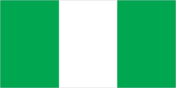
<strong>description:</strong> three equal vertical bands of green (left side), white, and green<br><br><strong>meaning:</strong> green stands for the country's forests and natural resources, and white for peace and unity
The flag of Nigeria is composed of three equal vertical bands of green, white and green.
- svg
- https://flagcdn.com/ng.svg
federal presidential republic
1 October 1960 (from the UK)
accepts compulsory ICJ jurisdiction with reservations; accepts ICCt jurisdiction
ACP, AfDB, ATMIS, AU, C, CD, D-8, ECOWAS, EITI (compliant country), FAO, G-15, G-24, G-77, IAEA, IBRD, ICAO, ICC (national committees), ICCt, ICRM, IDA, IDB, IFAD, IFC, IFRCS, IHO, ILO, IMF, IMO, IMSO, Interpol, IOC, IOM, IPU, ISO, ITSO, ITU, ITUC (NGOs), LCBC, MIGA, MINURSO, MNJTF, MONUSCO, NAM, OAS (observer), OIC, OPCW, OPEC, PCA, UN, UNAMID, UNCTAD, UNESCO, UNHCR, UNIDO, UNIFIL, UNISFA, UNITAR, UNMIL, UNMISS, UNOCI, UNOOSA, UNWTO, UPU, WCO, WFTU (NGOs), WHO, WIPO, WMO, WTO
- Highest court(s)
- Supreme Court (consists of the chief justice and 15 justices)
- Judge selection and term of office
- judges appointed by the president upon the recommendation of the National Judicial Council, a 23-member independent body of federal and state judicial officials; judge appointments confirmed by the Senate; judges serve until age 70
- Subordinate courts
- Court of Appeal; Federal High Court; High Court of the Federal Capital Territory; Sharia Court of Appeal of the Federal Capital Territory; Customary Court of Appeal of the Federal Capital Territory; state court system similar in structure to federal system
mixed system of English common law, Islamic law (in 12 northern states), and traditional law
- Legislative structure
- bicameral
- Legislature name
- National Assembly
- Chamber name
- House of Representatives
- Electoral system
- plurality/majority
- Expected date of next election
- February 2027
- Most recent election date
- 2/25/2023
- Number of seats
- 360 (all directly elected)
- Parties elected and seats per party
- All Progressives Congress (APC) (180); People's Democratic Party (PDP) (116); Labour Party (LP) (35); New Nigeria Peoples Party (NNPP) (19); Other (10)
- Percentage of women in chamber
- 4.2%
- Scope of elections
- full renewal
- Term in office
- 4 years
- Chamber name
- Senate
- Electoral system
- plurality/majority
- Expected date of next election
- February 2027
- Most recent election date
- 2/25/2023
- Number of seats
- 109 (all directly elected)
- Parties elected and seats per party
- All Progressives Congress (APC) (59); People's Democratic Party (PDP) (36); Labour Party (LP) (8); Other (6)
- Percentage of women in chamber
- 3.7%
- Scope of elections
- full renewal
- Term in office
- 4 years
green, white
- Selected World Heritage Site locales
- Sukur Cultural Landscape; Osun-Osogbo Sacred Grove
- Total World Heritage Sites
- 2 (both cultural)
Independence Day (National Day), 1 October (1960)
eagle
Accord Party or ACC <br>Africa Democratic Congress or ADC <br>All Progressives Congress or APC <br>All Progressives Grand Alliance or APGA <br>Labor Party or LP <br>New Nigeria People’s Party or NNPP <br>Peoples Democratic Party or PDP <br>Young Progressive Party or YPP
Monday
18 years of age; universal
Yes
Economy
- cassava, yams, maize, oil palm fruit, rice, taro, bananas, vegetables, sorghum, groundnuts (2023)
- note
- <b>note:</b> top ten agricultural products based on tonnage
- On alcohol and tobacco
- 0.9% of household expenditures (2023 est.)
- On food
- 59.3% of household expenditures (2023 est.)
- Expenditures
- $59.868 billion (2019 est.)
- Revenues
- $37.298 billion (2019 est.)
- code
- NGN
- name
- Nigerian naira (NGN) [₦]
- $17.22 billion
- Current account balance 2022
- $1.019 billion (2022 est.)
- Current account balance 2023
- $6.423 billion (2023 est.)
- Current account balance 2024
- $17.215 billion (2024 est.)
- Note
- <b>note:</b> balance of payments - net trade and primary/secondary income in current dollars
- $108.76 billion
- Debt - external 2023
- $45.009 billion (2023 est.)
- Note
- <b>note:</b> present value of external debt in current US dollars
largest African market economy; enormous but mostly lower middle income labor force; major oil exporter; key telecommunications and finance industries; susceptible to global energy price shocks; regional leader in critical infrastructure; primarily agrarian employment
- Currency
- nairas (NGN) per US dollar -
- Exchange rates 2020
- 358.811 (2020 est.)
- Exchange rates 2021
- 401.152 (2021 est.)
- Exchange rates 2022
- 425.979 (2022 est.)
- Exchange rates 2023
- 645.194 (2023 est.)
- Exchange rates 2024
- 1,478.965 (2024 est.)
- Exports 2022
- $69.091 billion (2022 est.)
- Exports 2023
- $60.261 billion (2023 est.)
- Exports 2024
- $57.536 billion (2024 est.)
- Note
- <b>note:</b> balance of payments - exports of goods and services in current dollars
- crude petroleum, natural gas, gold, fertilizers, cocoa beans (2023)
- note
- <b>note:</b> top five export commodities based on value in dollars
- USA 10%, Spain 9%, France 8%, Netherlands 7%, India 6% (2023)
- note
- <b>note:</b> top five export partners based on percentage share of exports
- net inflows
- $1.08 billion
- Agriculture
- 20.4% (2024 est.)
- Industry
- 29.6% (2024 est.)
- Note
- <b>note:</b> figures may not total 100% due to non-allocated consumption not captured in sector-reported data
- Services
- 47% (2024 est.)
- $187.76 billion (2024 est.)
- note
- <b>note:</b> data in current dollars at official exchange rate
$1,084
- 35.1 (2018)
- Gini Index coefficient - distribution of family income 2018
- 35.1 (2018 est.)
- Note
- <b>note:</b> index (0-100) of income distribution; higher values represent greater inequality
$245.63 billion
$1,700
- Highest 10%
- 26.7% (2018 est.)
- Lowest 10%
- 2.9% (2018 est.)
- Note
- <b>note:</b> % share of income accruing to lowest and highest 10% of population
- Imports 2022
- $77.049 billion (2022 est.)
- Imports 2023
- $65.423 billion (2023 est.)
- Imports 2024
- $57.73 billion (2024 est.)
- Note
- <b>note:</b> balance of payments - imports of goods and services in current dollars
- refined petroleum, tanks and armored vehicles, wheat, plastics, cars (2023)
- note
- <b>note:</b> top five import commodities based on value in dollars
- China 26%, Singapore 14%, Belgium 8%, India 6%, USA 4% (2023)
- note
- <b>note:</b> top five import partners based on percentage share of imports
- 2.4% (2024 est.)
- note
- <b>note:</b> annual % change in industrial value added based on constant local currency
crude oil, coal, tin, columbite; rubber products, wood; hides and skins, textiles, cement and other construction materials, food products, footwear, chemicals, fertilizer, printing, ceramics, steel
- 33.24%
- Inflation rate (consumer prices) 2022
- 18.8% (2022 est.)
- Inflation rate (consumer prices) 2023
- 24.7% (2023 est.)
- Inflation rate (consumer prices) 2024
- 33.2% (2024 est.)
- Note
- <b>note:</b> annual % change based on consumer prices
- 113.35 million (2024 est.)
- note
- <b>note:</b> number of people ages 15 or older who are employed or seeking work
- total
- 116.58 million persons
- agriculture
- 33.53%
- industry
- 17.01%
- services
- 49.46%
- 40.1% (2018 est.)
- note
- <b>note:</b> % of population with income below national poverty line
- Public debt 2016
- 19.6% of GDP (2016 est.)
- $2.11 trillion
- Note
- <b>note:</b> data in 2021 dollars
- Real GDP (purchasing power parity) 2022
- $1.239 trillion (2022 est.)
- Real GDP (purchasing power parity) 2023
- $1.275 trillion (2023 est.)
- Real GDP (purchasing power parity) 2024
- $1.318 trillion (2024 est.)
- 4.06%
- Note
- <b>note:</b> annual GDP % growth based on constant local currency
- Real GDP growth rate 2022
- 3.3% (2022 est.)
- Real GDP growth rate 2023
- 2.9% (2023 est.)
- Real GDP growth rate 2024
- 3.4% (2024 est.)
- $9,087
- Note
- <b>note:</b> data in 2021 dollars
- Real GDP per capita 2022
- $5,600 (2022 est.)
- Real GDP per capita 2023
- $5,600 (2023 est.)
- Real GDP per capita 2024
- $5,700 (2024 est.)
- $21.29 billion
- Note
- <b>note:</b> personal transfers and compensation between resident and non-resident individuals/households/entities
- Remittances 2022
- 4.2% of GDP (2022 est.)
- Remittances 2023
- 5.4% of GDP (2023 est.)
- Remittances 2024
- 11.3% of GDP (2024 est.)
- $38.61 billion
- Note
- <b>note:</b> holdings of gold (year-end prices)/foreign exchange/special drawing rights in current dollars
- Reserves of foreign exchange and gold 2022
- $35.564 billion (2022 est.)
- Reserves of foreign exchange and gold 2023
- $32.035 billion (2023 est.)
- Reserves of foreign exchange and gold 2024
- $38.612 billion (2024 est.)
- 3.06%
- Note
- <b>note:</b> % of labor force seeking employment
- Unemployment rate 2022
- 3.9% (2022 est.)
- Unemployment rate 2023
- 3.1% (2023 est.)
- Unemployment rate 2024
- 3% (2024 est.)
- Female
- 6.5% (2024 est.)
- Male
- 3.7% (2024 est.)
- Note
- <b>note:</b> % of labor force ages 15-24 seeking employment
- Total
- 5.1% (2024 est.)
Energy
- Consumption
- 1.326 million metric tons (2023 est.)
- Exports
- 17 metric tons (2023 est.)
- Imports
- 600 metric tons (2023 est.)
- Production
- 1.322 million metric tons (2023 est.)
- Proven reserves
- 2.144 billion metric tons (2023 est.)
- Consumption
- 34.135 billion kWh (2023 est.)
- consumption per capita
- 136 kWh
- Exports
- 2.4 billion kWh (2023 est.)
- Installed generating capacity
- 4.094 million kW (2023 est.)
- Transmission/distribution losses
- 5.974 billion kWh (2023 est.)
- Electrification - rural areas
- 27%
- Electrification - total population
- 60.5% (2022 est.)
- Electrification - urban areas
- 89%
- Biomass and waste
- 0.1% of total installed capacity (2023 est.)
- Fossil fuels
- 77.1% of total installed capacity (2023 est.)
- hydroelectric
- 24.28%
- Hydroelectricity
- 22.5% of total installed capacity (2023 est.)
- nuclear
- 0%
- renewable
- 23.8%
- Solar
- 0.2% of total installed capacity (2023 est.)
- 333 kg of oil equivalent
- Total energy consumption per capita 2023
- 7.993 million Btu/person (2023 est.)
- Consumption
- 19.885 billion cubic meters (2023 est.)
- Exports
- 16.324 billion cubic meters (2023 est.)
- Production
- 38.248 billion cubic meters (2023 est.)
- Proven reserves
- 5.761 trillion cubic meters (2021 est.)
- Crude oil estimated reserves
- 36.89 billion barrels (2021 est.)
- Refined petroleum consumption
- 527,000 bbl/day (2023 est.)
- Total petroleum production
- 1.514 million bbl/day (2023 est.)
80.3%
Communications
- per 100 inhabitants
- 0 per 100
- Subscriptions per 100 inhabitants
- (2023 est.) less than 1
- Total
- 117,000 (2023 est.)
nearly 70 federal government-controlled national and regional TV stations; all 36 states operate TV stations; several private TV stations; cable and satellite TV subscription services are available; network of federal government-controlled national, regional, and state radio stations; roughly 40 state government-owned radio stations; about 20 private radio stations; transmissions of international broadcasters are available; transition to digital completed in three states in 2018 (2019)
.ng
- Percent of population
- 39% (2023 est.)
######
+234
- Subscriptions per 100 inhabitants
- (2023 est.) less than 1
- Total subscriptions
- 112,000 (2023 est.)
- subscriptions per 100
- 98 per 100
- Subscriptions per 100 inhabitants
- 71 (2024 est.)
- Total subscriptions
- 165 million (2024 est.)
Transportation
- passengers carried
- 5.27 million passengers
- registered carrier departures
- 61,466 departures
50 (2025)
5N
Right
15 (2025)
- By type
- general cargo 23, oil tanker 128, other 777
- Total
- 928 (2023)
- Key ports
- Antan Oil Terminal, Bonny, Lagos, Pennington Oil Terminal
- Large
- 2
- Medium
- 1
- Ports with oil terminals
- 23
- Small
- 1
- Total ports
- 28 (2024)
- Very small
- 24
- Narrow gauge
- 3,505 km (2014) 1.067-m gauge
- Note
- <strong>note:</strong> as of the end of 2018, there were only six operational locomotives in Nigeria primarily used for passenger service; the majority of the rail lines are in a severe state of disrepair and need to be replaced
- Standard gauge
- 293 km (2014) 1.435-m gauge
- Total
- 3,798 km (2014)
WAN
Military and Security
- armored vehicles
- tanks
the Nigerian military is responsible for defending against external aggression, maintaining the country's territorial integrity, securing national borders, participating in international peacekeeping and other security missions, suppressing insurrection, and aiding civil authorities in restoring order, as well as other duties such as providing humanitarian assistance; its primary concerns are internal and maritime security; in the northeast part of the country, the military is conducting operations against the Boko Haram (BH) and Islamic State of Iraq and ash-Sham in West Africa (ISIS-WA) terrorist groups, where it has deployed as many as 70,000 troops at times and terrorist-related violence has killed an estimated 35-40,000 people, mostly civilians, since 2009; in the northwest, the military faces threats from criminal gangs--locally referred to as bandits--and violence associated with long-standing farmer-herder conflicts, as well as BH and ISIS-WA terrorists; the military also continues to protect the oil industry in the Niger Delta region against militants and criminal activity and since 2021, has deployed troops alongside other security forces to quell renewed agitation in the state of Biafra; maritime security concerns include piracy and the protection of natural resources in the Gulf of Guinea <br><br>the Nigerian military traces its origins to the Nigeria Regiment of the West African Frontier Force (WAFF), a multi-regiment force formed by the British colonial office in 1900 to garrison Great Britain's West African colonies; the WAFF (the honorary title "Royal" was added later) served in both World Wars; in 1956, the Nigeria Regiment of the Royal WAFF was renamed the Nigerian Military Forces (NMF) and in 1958, the colonial government of Nigeria took over control of the NMF from the British War Office; the Nigerian Armed Forces were established following independence in 1960 (2025)
- Armed Forces of Nigeria (AFN): Nigerian Army, Nigerian Navy (includes Coast Guard), Nigerian Air Force<br><br>Ministry of Interior: Nigeria Security and Civil Defense Corps (NSCDC); Ministry of Police Affairs: Nigeria Police Force (NPF) (2025)
- active duty personnel
- 223,000
- note
- <strong>note 1: </strong>the NSCDC is a paramilitary agency commissioned to assist the military in the management of threats to internal security, including attacks and natural disasters<br><br><strong>note 2: </strong>some states have created local security forces in response to increased violence, insecurity, and criminality that have exceeded the response capacity of federal government security forces, but official security forces remained the constitutional prerogative of the federal government; in 2023, the federal government began deploying thousands of "agro rangers" across 19 states and the Federal Capital Territory to help safeguard farmland and mediate conflicts, especially in areas hit by farmer-herder clashes
- percent of total labor force
- 0.23 %
information varies; estimated 140,000 active Armed Forces (2025)
- 180 Sudan/South Sudan (UNISFA); 200 Gambia (ECOWAS); 150 Guinea-Bissau (ECOWAS) (2025)
- note
- <strong>note:</strong> Nigeria has committed an Army combat brigade (approximately 3,000 troops) to the Multinational Joint Task Force (MNJTF), a regional counter-terrorism force comprised of troops from Benin, Cameroon, Chad, and Niger; MNJTF conducts operations against Boko Haram and other terrorist groups operating in the general area of the Lake Chad Basin and along Nigeria's northeast border; national MNJTF troop contingents are deployed within their own country territories, although cross‐border operations are conducted periodically
the military's inventory consists primarily of imported weapons systems from a range of countries, including Brazil, China, France, Russia/former Soviet Union, South Korea, Türkiye, and the US; Nigeria is developing a defense-industry capacity, including small arms, light armored personnel vehicles, and small-scale naval production (2025)
- 1 % of GDP
- current USD
- $1,133,303,623
- Military Expenditures 2020
- 0.6% of GDP (2020 est.)
- Military Expenditures 2021
- 0.6% of GDP (2021 est.)
- Military Expenditures 2022
- 0.6% of GDP (2022 est.)
- Military Expenditures 2023
- 0.7% of GDP (2023 est.)
- Military Expenditures 2024
- 0.6% of GDP (2024)
- percent of central government expenditure
- 3.07 %
- percent of GDP
- 0.56 % of GDP
18-25 years of age for voluntary military service for men and women; no conscription (2025)
- PowerIndex score
- 0.6097
Transnational Issues
- USG identification
- <br>major precursor-chemical producer (2025)
- IDPs
- 3,709,022 (2024 est.)
- Refugees
- 127,131 (2024 est.)
Space
2003 - first remote sensing (RS) microsatellite (NigeriaSat-1) built jointly with the UK and launched by Russia<br><br>2007 - first communications satellite (NigSatCom-1) built and launched by China (failed in orbit, 2008)<br><br>2011 - first domestically built remote sensing (RS) satellite (NigeriaSat-X) launched by Russia<br><br>2019 - inaugurated a geospatial data analysis center<br><br>2022 - signed US-led Artemis Accords for space exploration<br><br>2023 - first military reconnaissance RS satellite (DelSat-1) launched by China
- National Space Research and Development Agency (NARSDA; established 1999); Defense Space Administration (DSA; established 2014) (2025)
- note
- <strong>note:</strong> NARSDA originated from the National Centre for Remote Sensing, the National Committee on Space Applications (both established in 1987), and the Directorate of Science (established 1993)
has a national space program that focuses on acquiring satellites for agricultural and environmental applications, meteorology, mining and disaster monitoring, security, and socio-economic development; designs, builds (mostly with foreign assistance), and operates satellites; processes overhead imagery data for analysis and sharing; developing additional capabilities in satellite and satellite payload production, including remote sensing technologies; has a sounding rocket program for researching rockets and rocket propulsion, with goal of launching domestically produced satellites into space from a Nigerian spaceport by 2030; works with a variety of foreign space agencies and industries, including those of Algeria, Bangladesh, Belarus, China, Ghana, India, Japan, Kenya, Mongolia, South Africa, Thailand, Turkey, the UK, the US, and Vietnam; has a government-owned satellite company and a small commercial aerospace sector (2025)
Terrorism
- Boko Haram; Islamic State of Iraq and ash-Sham – West Africa; Jama’atu Ansarul Muslimina Fi Biladis-Sudan (Ansaru)
- note
- <strong>note:</strong> details about the history, aims, leadership, organization, areas of operation, tactics, targets, weapons, size, and sources of support of the group(s) appear(s) in the Terrorism reference guide
Environment
- From coal and metallurgical coke
- 2.962 million metric tonnes of CO2 (2023 est.)
- From consumed natural gas
- 39.01 million metric tonnes of CO2 (2023 est.)
- From petroleum and other liquids
- 72.425 million metric tonnes of CO2 (2023 est.)
- Total emissions
- 114.397 million metric tonnes of CO2 (2023 est.)
urban air and water pollution; rapid deforestation; soil degradation; loss of arable land; water, air, and soil pollution from oil spills
- Party to
- Biodiversity, Climate Change, Climate Change-Kyoto Protocol, Climate Change-Paris Agreement, Comprehensive Nuclear Test Ban, Desertification, Endangered Species, Hazardous Wastes, Law of the Sea, Marine Dumping-London Convention, Marine Dumping-London Protocol, Marine Life Conservation, Nuclear Test Ban, Ozone Layer Protection, Ship Pollution, Wetlands
- Signed, but not ratified
- Tropical Timber 2006
- Agriculture
- 1,991.9 kt (2019-2021 est.)
- Energy
- 2,794.3 kt (2022-2024 est.)
- Other
- 362.7 kt (2019-2021 est.)
- Waste
- 729.4 kt (2019-2021 est.)
56 micrograms per cubic meter (2019 est.)
12 % of total land area
4 % of total
286.2 billion cubic meters (2022 est.)
- 6 % of internal resources
- Agricultural
- 5.51 billion cubic meters (2022 est.)
- Industrial
- 1.965 billion cubic meters (2022 est.)
- Municipal
- 5 billion cubic meters (2022 est.)
- Municipal solid waste generated annually
- 27.615 million tons (2024 est.)
- Percent of municipal solid waste recycled
- 4.7% (2022 est.)