2010 Edition
CIA World Factbook 2010 (Project Gutenberg)
Introduction
Background
British influence and control over what would become Nigeria and Africa's most populous country grew through the 19th century. A series of constitutions after World War II granted Nigeria greater autonomy; independence came in 1960. Following nearly 16 years of military rule, a new constitution was adopted in 1999, and a peaceful transition to civilian government was completed. The government continues to face the daunting task of reforming a petroleum-based economy, whose revenues have been squandered through corruption and mismanagement, and institutionalizing democracy. In addition, Nigeria continues to experience longstanding ethnic and religious tensions. Although both the 2003 and 2007 presidential elections were marred by significant irregularities and violence, Nigeria is currently experiencing its longest period of civilian rule since independence. The general elections of April 2007 marked the first civilian-to-civilian transfer of power in the country's history. In January 2010, Nigeria assumed a nonpermanent seat on the UN Security Council for the 2010-11 term.
Geography
Area
- land
- 910,768 sq km
- total
- 923,768 sq km
- water
- 13,000 sq km
Area - comparative
slightly more than twice the size of California
Climate
varies; equatorial in south, tropical in center, arid in north
Coastline
853 km
Elevation extremes
- highest point
- Chappal Waddi 2,419 m
- lowest point
- Atlantic Ocean 0 m
Environment - current issues
soil degradation; rapid deforestation; urban air and water pollution; desertification; oil pollution - water, air, and soil; has suffered serious damage from oil spills; loss of arable land; rapid urbanization
Environment - international agreements
- party to
- Biodiversity, Climate Change, Climate Change-Kyoto Protocol, Desertification, Endangered Species, Hazardous Wastes, Law of the Sea, Marine Dumping, Marine Life Conservation, Ozone Layer Protection, Ship Pollution, Wetlands signed, but not ratified: none of the selected agreements
Freshwater withdrawal (domestic/industrial/agricultural)
- per capita
- 61 cu m/yr (2000)
- total
- 8.01 cu km/yr (21%/10%/69%)
Geographic coordinates
10 00 N, 8 00 E
Geography - note
the Niger enters the country in the northwest and flows southward through tropical rain forests and swamps to its delta in the Gulf of Guinea
Irrigated land
2,820 sq km (2003)
Land boundaries
- border countries
- Benin 773 km, Cameroon 1,690 km, Chad 87 km, Niger 1,497 km
- total
- 4,047 km
Land use
- arable land
- 33.02%
- other
- 63.84% (2005)
- permanent crops
- 3.14%
Location
Western Africa, bordering the Gulf of Guinea, between Benin and Cameroon
Map references
Africa
Maritime claims
- continental shelf
- 200 m depth or to the depth of exploitation
- exclusive economic zone
- 200 nm
- territorial sea
- 12 nm
Natural hazards
periodic droughts; flooding
Natural resources
natural gas, petroleum, tin, iron ore, coal, limestone, niobium, lead, zinc, arable land
Terrain
southern lowlands merge into central hills and plateaus; mountains in southeast, plains in north
Total renewable water resources
286.2 cu km (2003)
People and Society
Age structure
0-14 years: 41.5% (male 31,624,050/female 30,242,637) 15-64 years: 55.5% (male 42,240,641/female 40,566,672) 65 years and over: 3.1% (male 2,211,840/female 2,343,250) (2010 est.)
Birth rate
36.07 births/1,000 population (2010 est.)
Death rate
16.31 deaths/1,000 population (July 2010 est.)
Education expenditures
0.9% of GDP (1991)
Ethnic groups
- Nigeria, Africa's most populous country, is composed of more than 250 ethnic groups; the following are the most populous and
- politically influential
- Hausa and Fulani 29%, Yoruba 21%, Igbo (Ibo) 18%, Ijaw 10%, Kanuri 4%, Ibibio 3.5%, Tiv 2.5%
HIV/AIDS - adult prevalence rate
3.1% (2007 est.)
HIV/AIDS - deaths
170,000 (2007 est.)
HIV/AIDS - people living with HIV/AIDS
2.6 million (2007 est.)
Infant mortality rate
- female
- 86.69 deaths/1,000 live births (2010 est.)
- male
- 98.94 deaths/1,000 live births
- total
- 92.99 deaths/1,000 live births
Languages
English (official), Hausa, Yoruba, Igbo (Ibo), Fulani, over 500 additional indigenous languages
Life expectancy at birth
- female
- 48.08 years (2010 est.)
- male
- 46.46 years
- total population
- 47.24 years
Literacy
- definition: age 15 and over can read and write
- female
- 60.6% (2003 est.)
- male
- 75.7%
- total population
- 68%
Major infectious diseases
- aerosolized dust or soil contact disease
- one of the most highly endemic areas for Lassa fever
- animal contact disease
- rabies note: highly pathogenic H5N1 avian influenza has been identified in this country; it poses a negligible risk with extremely rare cases possible among US citizens who have close contact with birds (2009)
- degree of risk
- very high
- food or waterborne diseases
- bacterial and protozoal diarrhea, hepatitis A and E, and typhoid fever
- respiratory disease
- meningococcal meningitis
- vectorborne disease
- malaria and yellow fever
- water contact disease
- leptospirosis and shistosomiasis
Median age
- female
- 19.2 years (2010 est.)
- male
- 19 years
- total
- 19.1 years
Nationality
- adjective
- Nigerian
- noun
- Nigerian(s)
Net migration rate
-0.1 migrant(s)/1,000 population (2010 est.)
Population
152,217,341 note: estimates for this country explicitly take into account the effects of excess mortality due to AIDS; this can result in lower life expectancy, higher infant mortality, higher death rates, lower population growth rates, and changes in the distribution of population by age and sex than would otherwise be expected (July 2010 est.)
Population growth rate
1.966% (2010 est.)
Religions
Muslim 50%, Christian 40%, indigenous beliefs 10%
School life expectancy (primary to tertiary education)
- female
- 8 years (2005)
- male
- 10 years
- total
- 9 years
Sex ratio
- at birth
- 1.06 male(s)/female under 15 years: 1.05 male(s)/female 15-64 years: 1.04 male(s)/female 65 years and over: 0.94 male(s)/female
- total population
- 1.04 male(s)/female (2010 est.)
Total fertility rate
4.82 children born/woman (2010 est.)
Urbanization
- rate of urbanization
- 3.8% annual rate of change (2005-10 est.)
- urban population
- 48% of total population (2008)
Government
Administrative divisions
36 states and 1 territory*; Abia, Adamawa, Akwa Ibom, Anambra, Bauchi, Bayelsa, Benue, Borno, Cross River, Delta, Ebonyi, Edo, Ekiti, Enugu, Federal Capital Territory*, Gombe, Imo, Jigawa, Kaduna, Kano, Katsina, Kebbi, Kogi, Kwara, Lagos, Nassarawa, Niger, Ogun, Ondo, Osun, Oyo, Plateau, Rivers, Sokoto, Taraba, Yobe, Zamfara
Capital
- geographic coordinates
- 9 05 N, 7 32 E
- name
- Abuja
- time difference
- UTC+1 (6 hours ahead of Washington, DC during Standard Time)
Constitution
adopted 5 May 1999; effective 29 May 1999
Country name
- conventional long form
- Federal Republic of Nigeria
- conventional short form
- Nigeria
Diplomatic representation from the US
- chief of mission
- Ambassador Robin R. SANDERS
- embassy
- 1075 Diplomatic Drive, Central District Area, Abuja
- FAX
- [234] (9) 461-4036
- mailing address
- P. O. Box 5760, Garki, Abuja
- telephone
- [234] (9) 461-4000
Diplomatic representation in the US
- chancery
- 3519 International Court NW, Washington, DC 20008
- chief of mission
- Ambassador Adebowale Ibidapo ADEFUYE
- consulate(s) general
- Atlanta, New York
- FAX
- [1] (202) 775-1385
- telephone
- [1] (202) 986-8400
Executive branch
- cabinet
- Federal Executive Council (For more information visit the World Leaders website )
- chief of state
- President Goodluck JONATHAN (since 5 May 2010, acting since 9 February 2010); note - the president is both the chief of state and head of government; JONATHAN assumed the presidency on 5 May 2010 following the death of President YAR'ADUA, he was declared Acting President on 9 February 2010 by the National Assembly during the extended illness of the former president
- election results
- Umaru Musa YAR'ADUA elected president; percent of vote - Umaru Musa YAR'ADUA 69.8%, Muhammadu BUHARI 18.7%, Atiku ABUBAKAR 7.5%, Orji Uzor KALU 1.7%, other 2.3%
- elections
- president elected by popular vote for a four-year term (eligible for a second term); election last held on 21 April 2007 (next to be held on 22 January 2011)
- head of government
- President Goodluck JONATHAN (since 5 May 2010, acting since 9 February 2010)
Flag description
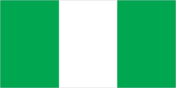
three equal vertical bands of green (hoist side), white, and green; the color green represents the forests and abundant natural wealth of the country, white stands for peace and unity
Government type
federal republic
Independence
1 October 1960 (from the UK)
International organization participation
ACP, AfDB, AU, C, D-8, ECOWAS, FAO, G-15, G-24, G-77, IAEA, IBRD, ICAO, ICC, ICCt, ICRM, IDA, IDB, IFAD, IFC, IFRCS, IHO, ILO, IMF, IMO, IMSO, Interpol, IOC, IOM, IPU, ISO, ITSO, ITU, ITUC, MIGA, MINURSO, MONUSCO, NAM, OAS (observer), OIC, OPCW, OPEC, PCA, UN, UN Security Council (temporary), UNAMID, UNCTAD, UNESCO, UNHCR, UNIDO, UNIFIL, UNITAR, UNMIL, UNOCI, UNWTO, UPU, WCO, WFTU, WHO, WIPO, WMO, WTO
Judicial branch
Supreme Court (judges recommended by the National Judicial Council and appointed by the president); Federal Court of Appeal (judges are appointed by the federal government from a pool of judges recommended by the National Judicial Council)
Legal system
based on English common law, Islamic law (in 12 northern states), and traditional law; accepts compulsory ICJ jurisdiction with reservations
Legislative branch
- bicameral National Assembly consists of the Senate (109 seats, 3 from each state plus 1 from Abuja; members elected by popular vote to serve four-year terms) and House of Representatives (360 seats; members elected by popular vote to serve four-year terms)
- election results
- Senate - percent of vote by party - NA; seats by party - PDP 85, ANPP 16, AC 6, PPA 1, ACCORD 1; House of Representatives - percent of vote by party - PDP 65.1%, ANPP 21.6%, AC 8.8%, PPA 0.8%, LP 0.8%; seats by party - PDP 263, ANPP 63, AC 30, PPA 3, LP 1
- elections
- Senate - last held on 21 April 2007 (next to be held in April 2011); House of Representatives - last held on 21 April 2007 (next to be held on 15 January 2011)
National anthem
- lyrics/music
- John A. ILECHUKWU, Eme Etim AKPAN, B. A. OGUNNAIKE, Sotu OMOIGUI and P. O. ADERIBIGBE/Benedict Elide ODIASE note: adopted 1978; the lyrics are a mixture of five of the top entries in a national contest
- name
- "Arise Oh Compatriots, Nigeria's Call Obey"
National holiday
Independence Day (National Day), 1 October (1960)
Political parties and leaders
Accord Party [Augustine MAZIE, acting]; Action Congress or AC [Bisi AKANDE]; All Nigeria Peoples Party or ANPP [Edwin UME-EZEOKE]; All Progressives Grand Alliance or APGA [Victor C. UMEH]; Alliance for Democracy or AD [Mojisoluwa AKINFENWA]; Conference of Nigerian Political Parities or CNPP [Abdulkadir Balarabe MUSA]; Democratic Peoples Party or DPP [Jeremiah USENI]; Fresh Democratic Party [Chris OKOTIE]; Labor Party [Dan NWANYANWU]; National Democratic Party or NDP [Aliyu Habu FARI]; Peoples Democratic Party or PDP [Vincent OGBULAFOR]; Peoples Progressive Alliance [Larry ESIN]
Political pressure groups and leaders
Academic Staff Union for Universities or ASUU; Campaign for Democracy or CD; Civil Liberties Organization or CLO; Committee for the Defense of Human Rights or CDHR; Constitutional Right Project or CRP; Human Right Africa; National Association of Democratic Lawyers or NADL; National Association of Nigerian Students or NANS; Nigerian Bar Association or NBA; Nigerian Labor Congress or NLC; Nigerian Medical Association or NMA; the press; Universal Defenders of Democracy or UDD
Suffrage
18 years of age; universal
Economy
Agriculture - products
cocoa, peanuts, cotton, palm oil, corn, rice, sorghum, millet, cassava (tapioca), yams, rubber; cattle, sheep, goats, pigs; timber; fish
Central bank discount rate
6% (31 December 2009) 9.75% (31 December 2008)
Commercial bank prime lending rate
18.36% (31 December 2009 est.) 15.48% (31 December 2008 est.)
Current account balance
$27.77 billion (2010 est.) $22.89 billion (2009 est.)
Debt - external
$11.02 billion (31 December 2010 est.) $10.11 billion (31 December 2009 est.)
Distribution of family income - Gini index
43.7 (2003) 50.6 (1997)
Economy - overview
Oil-rich Nigeria has been hobbled by political instability, corruption, inadequate infrastructure, and poor macroeconomic management but in 2008 began pursuing economic reforms. Nigeria's former military rulers failed to diversify the economy away from its overdependence on the capital-intensive oil sector, which provides 95% of foreign exchange earnings and about 80% of budgetary revenues. Following the signing of an IMF stand-by agreement in August 2000, Nigeria received a debt-restructuring deal from the Paris Club and a $1 billion credit from the IMF, both contingent on economic reforms. Nigeria pulled out of its IMF program in April 2002, after failing to meet spending and exchange rate targets, making it ineligible for additional debt forgiveness from the Paris Club. In November 2005, Abuja won Paris Club approval for a debt-relief deal that eliminated $18 billion of debt in exchange for $12 billion in payments - a total package worth $30 billion of Nigeria's total $37 billion external debt. Since 2008 the government has begun to show the political will to implement the market-oriented reforms urged by the IMF, such as modernizing the banking system, curbing inflation by blocking excessive wage demands, and resolving regional disputes over the distribution of earnings from the oil industry. GDP rose strongly in 2007-10 because of increased oil exports and high global crude prices in 2010. President JONATHAN has pledged to continue the economic reforms of his predecessor with emphasis on infrastructure improvements. Infrastructure is the main impediment to growth and in August 2010 JONATHAN unveiled a power sector blueprint that includes privatization of the state-run electricity generation and distribution facilities. The government also is working toward developing stronger public-private partnerships for roads. Nigeria's financial sector was hurt by the global financial and economic crises and the Central Bank governor has taken measures to strengthen that sector.
Electricity - consumption
19.21 billion kWh (2007 est.)
Electricity - exports
0 kWh (2008 est.)
Electricity - imports
0 kWh (2008 est.)
Electricity - production
21.92 billion kWh (2007 est.)
Exchange rates
nairas (NGN) per US dollar - 150.88 (2010), 148.84 (2009), 117.8 (2008), 127.46 (2007), 127.38 (2006)
Exports
$76.33 billion (2010 est.) $59.32 billion (2009 est.)
Exports - commodities
petroleum and petroleum products 95%, cocoa, rubber
Exports - partners
US 35.08%, India 10.43%, Brazil 9.32%, Spain 7.19%, France 4.65% (2009)
GDP - composition by sector
- agriculture
- 31.9%
- industry
- 32.9%
- services
- 35.2% (2010 est.)
GDP - per capita (PPP)
$2,400 (2010 est.) $2,300 (2009 est.) $2,200 (2008 est.) note: data are in 2010 US dollars
GDP - real growth rate
6.8% (2010 est.) 5.6% (2009 est.) 6% (2008 est.)
GDP (official exchange rate)
$206.7 billion (2010 est.)
GDP (purchasing power parity)
$369.8 billion (2010 est.) $346.2 billion (2009 est.) $327.9 billion (2008 est.) note: data are in 2010 US dollars
Household income or consumption by percentage share
lowest 10%: 2% highest 10%: 32.4% (2004)
Imports
$34.18 billion (2010 est.) $29.05 billion (2009 est.)
Imports - commodities
machinery, chemicals, transport equipment, manufactured goods, food and live animals
Imports - partners
China 14.89%, US 8.88%, Netherlands 8.18%, South Korea 5.46%, UK 4.63%, France 4.19% (2009)
Industrial production growth rate
4% (2010 est.)
Industries
crude oil, coal, tin, columbite; rubber products, wood; hides and skins, textiles, cement and other construction materials, food products, footwear, chemicals, fertilizer, printing, ceramics, steel
Inflation rate (consumer prices)
13.9% (2010 est.) 11.5% (2009 est.)
Investment (gross fixed)
11.6% of GDP (2010 est.)
Labor force
48.33 million (2010 est.)
Labor force - by occupation
- agriculture
- 70%
- industry
- 10%
- services
- 20% (1999 est.)
Market value of publicly traded shares
$33.32 billion (31 December 2009) $49.8 billion (31 December 2008) $86.35 billion (31 December 2007)
Natural gas - consumption
12.28 billion cu m (2008 est.)
Natural gas - exports
20.55 billion cu m (2008 est.)
Natural gas - imports
0 cu m (2008 est.)
Natural gas - production
32.82 billion cu m (2008 est.)
Natural gas - proved reserves
5.246 trillion cu m (1 January 2010 est.)
Oil - consumption
280,000 bbl/day (2009 est.)
Oil - exports
2.327 million bbl/day (2007 est.)
Oil - imports
170,000 bbl/day (2007 est.)
Oil - production
2.211 million bbl/day (2009 est.)
Oil - proved reserves
37.5 billion bbl (1 January 2010 est.)
Population below poverty line
70% (2007 est.)
Public debt
13.4% of GDP (2010 est.) 11.8% of GDP (2009 est.)
Reserves of foreign exchange and gold
$43.36 billion (31 December 2010 est.) $44.76 billion (31 December 2009 est.)
Stock of broad money
$91.97 billion (31 December 2010 est.) $72.31 billion (31 December 2009 est.)
Stock of direct foreign investment - abroad
$6.071 billion (31 December 2010 est.) $5.821 billion (31 December 2009 est.)
Stock of direct foreign investment - at home
$67.23 billion (31 December 2010 est.) $61.23 billion (31 December 2009 est.)
Stock of domestic credit
$77.43 billion (31 December 2010 est.) $62.18 billion (31 December 2009 est.)
Stock of narrow money
$40.41 billion (31 December 2010 est) $33.61 billion (31 December 2009 est)
Unemployment rate
4.9% (2007 est.)
Communications
Broadcast media
nearly 70 federal-government-controlled national and regional TV stations; all 36 states operate TV stations; several private TV stations operational; cable and satellite TV subscription services are available; network of federal-government-controlled national, regional, and state radio stations; roughly 40 state-government-owned radio stations typically carry their own programs except for news broadcasts; about 20 private radio stations also operate; transmissions of international broadcasters are available (2007)
Internet country code
.ng
Internet hosts
1,378 (2010)
Internet users
43.989 million (2009)
Telephone system
- domestic
- the addition of a second fixed-line provider in 2002 resulted in faster growth but subscribership remains only about 1 per 100 persons; mobile-cellular services growing rapidly, in part responding to the shortcomings of the fixed-line network; multiple cellular providers operate nationally with subscribership reaching 50 per 100 persons in 2009
- general assessment
- further expansion and modernization of the fixed-line telephone network is needed; network quality remains a problem
- international
- country code - 234; landing point for the SAT-3/WASC fiber-optic submarine cable that provides connectivity to Europe and Asia; satellite earth stations - 3 Intelsat (2 Atlantic Ocean and 1 Indian Ocean) (2009)
Telephones - main lines in use
1.419 million (2009)
Telephones - mobile cellular
73.099 million (2009)
Transportation
Airports
54 (2010)
Airports - with paved runways
- total
- 38 over 3,047 m: 9 2,438 to 3,047 m: 11 1,524 to 2,437 m: 10 914 to 1,523 m: 5 under 914 m: 3 (2010)
Airports - with unpaved runways
- total
- 16 over 3,047 m: 1 1,524 to 2,437 m: 2 914 to 1,523 m: 11 under 914 m: 2 (2010)
Heliports
4 (2010)
Merchant marine
- by type
- cargo 4, chemical tanker 30, liquefied gas 2, passenger/cargo 1, petroleum tanker 60, specialized tanker 1
- foreign-owned
- 4 (India 1, Spain 1, UK 2)
- registered in other countries
- 37 (Bahamas 2, Belize 2, Bermuda 11, Comoros 1, Italy 1, Liberia 4, Malaysia 1, Malta 1, North Korea 1, Panama 7, Saint Vincent and the Grenadines 1, Seychelles 1, unknown 4) (2010)
- total
- 98
Pipelines
condensate 26 km; gas 2,565 km; liquid petroleum gas 97 km; oil 3,424 km; refined products 4,090 km (2009)
Ports and terminals
Bonny Inshore Terminal, Calabar, Lagos
Railways
- narrow gauge
- 3,505 km 1.067-m gauge (2008)
- total
- 3,505 km
Roadways
- paved
- 28,980 km
- total
- 193,200 km
- unpaved
- 164,220 km (2004)
Transportation - note
the International Maritime Bureau reports the territorial and offshore waters in the Niger Delta and Gulf of Guinea as high risk for piracy and armed robbery against ships; numerous commercial vessels have been attacked and hijacked both at anchor and while underway; crews have been robbed and stores or cargoes stolen
Waterways
8,600 km (Niger and Benue rivers and smaller rivers and creeks) (2009)
Military and Security
Manpower available for military service
males age 16-49: 36,203,921 females age 16-49: 34,409,821 (2010 est.)
Manpower fit for military service
males age 16-49: 20,298,351 females age 16-49: 19,355,456 (2010 est.)
Manpower reaching militarily significant age annually
- female
- 1,652,632 (2010 est.)
- male
- 1,731,734
Military branches
- Nigerian Armed Forces
- Army, Navy, Air Force (2008)
Military expenditures
1.5% of GDP (2006)
Military service age and obligation
18 years of age for voluntary military service (2007)
Transnational Issues
Disputes - international
Joint Border Commission with Cameroon reviewed 2002 ICJ ruling on the entire boundary and bilaterally resolved differences, including June 2006 Greentree Agreement that immediately cedes sovereignty of the Bakassi Peninsula to Cameroon with a phase-out of Nigerian control within two years while resolving patriation issues; the ICJ ruled on an equidistance settlement of Cameroon-Equatorial Guinea-Nigeria maritime boundary in the Gulf of Guinea, but imprecisely defined coordinates in the ICJ decision and a sovereignty dispute between Equatorial Guinea and Cameroon over an island at the mouth of the Ntem River all contribute to the delay in implementation; only Nigeria and Cameroon have heeded the Lake Chad Commission's admonition to ratify the delimitation treaty which also includes the Chad-Niger and Niger-Nigeria boundaries
Illicit drugs
a transit point for heroin and cocaine intended for European, East Asian, and North American markets; consumer of amphetamines; safe haven for Nigerian narcotraffickers operating worldwide; major money-laundering center; massive corruption and criminal activity; Nigeria has improved some anti-money-laundering controls, resulting in its removal from the Financial Action Task Force's (FATF's) Noncooperative Countries and Territories List in June 2006; Nigeria's anti-money-laundering regime continues to be monitored by FATF page last updated on January 24, 2011 ======================================================================
Refugees and internally displaced persons
- IDPs
- undetermined (communal violence between Christians and Muslims since President OBASANJO's election in 1999; displacement is mostly short-term) (2007)
- refugees (country of origin)
- 5,778 (Liberia)