1999 Edition
CIA World Factbook 1999 (Internet Archive)
Geography
Area
total: 923,770 sq km land: 910,770 sq km water: 13,000 sq km
Area--comparative
slightly more than twice the size of California
Climate
varies; equatorial in south, tropical in center, arid in north
Coastline
853 km
Elevation extremes
lowest point: Atlantic Ocean 0 m highest point: Chappal Waddi 2,419 m
Environment--current issues
soil degradation; rapid deforestation; desertification; recent droughts in north severely affecting marginal agricultural activities
Environment--international agreements
party to: Biodiversity, Climate Change, Desertification, Endangered Species, Hazardous Wastes, Law of the Sea, Marine Dumping, Marine Life Conservation, Nuclear Test Ban, Ozone Layer Protection signed, but not ratified: none of the selected agreements
Geographic coordinates
10 00 N, 8 00 E
Irrigated land
9,570 sq km (1993 est.)
Land boundaries
total: 4,047 km border countries: Benin 773 km, Cameroon 1,690 km, Chad 87 km, Niger 1,497 km
Land use
arable land: 33% permanent crops: 3% permanent pastures: 44% forests and woodland: 12% other: 8% (1993 est.)
Location
Western Africa, bordering the Gulf of Guinea, between Benin and Cameroon
Map references
Africa
Maritime claims
continental shelf: 200-m depth or to the depth of exploitation exclusive economic zone: 200 nm territorial sea: 30 nm
Natural hazards
periodic droughts
Natural resources
petroleum, tin, columbite, iron ore, coal, limestone, lead, zinc, natural gas
Terrain
southern lowlands merge into central hills and plateaus; mountains in southeast, plains in north
People and Society
Age structure
0-14 years: 45% (male 25,613,974; female 25,397,166) 15-64 years: 52% (male 30,272,539; female 29,197,611) 65 years and over: 3% (male 1,678,732; female 1,668,565) (1999 est.)
Birth rate
41.84 births/1,000 population (1999 est.)
Death rate
12.98 deaths/1,000 population (1999 est.)
Ethnic groups
Hausa, Fulani, Yoruba, Ibo, Ijaw, Kanuri, Ibibio, Tiv
Infant mortality rate
69.46 deaths/1,000 live births (1999 est.)
Languages
English (official), Hausa, Yoruba, Ibo, Fulani
Life expectancy at birth
total population: 53.3 years male: 52.55 years female: 54.06 years (1999 est.)
Literacy
definition: age 15 and over can read and write total population: 57.1% male: 67.3% female: 47.3% (1995 est.)
Nationality
noun: Nigerian(s) adjective: Nigerian
Net migration rate
0.31 migrant(s)/1,000 population (1999 est.)
Population
113,828,587 (July 1999 est.)
Population growth rate
2.92% (1999 est.)
Religions
Muslim 50%, Christian 40%, indigenous beliefs 10%
Sex ratio
at birth: 1.03 male(s)/female under 15 years: 1.01 male(s)/female 15-64 years: 1.04 male(s)/female 65 years and over: 1.01 male(s)/female total population: 1.02 male(s)/female (1999 est.)
Total fertility rate
6.02 children born/woman (1999 est.)
Government
Administrative divisions
30 states and 1 territory*; Abia, Abuja Federal Capital Territory*, Adamawa, Akwa Ibom, Anambra, Bauchi, Benue, Borno, Cross River, Delta, Edo, Enugu, Imo, Jigawa, Kaduna, Kano, Katsina, Kebbi, Kogi, Kwara, Lagos, Niger, Ogun, Ondo, Osun, Oyo, Plateau, Rivers, Sokoto, Taraba, Yobe note: the government has announced the creation of six additional states named Bayelsa, Ebonyi, Ekiti, Gombe, Nassarawa, and Zamfara as part of the process of transition to a civilian government
Capital
Abuja note: on 12 December 1991 the capital was officially moved from Lagos to Abuja; many government offices remain in Lagos pending completion of facilities in Abuja
Constitution
1979 constitution still partially in force
Country name
conventional long form: Federal Republic of Nigeria conventional short form: Nigeria
Data code
NI
Executive branch
chief of state: Chairman of the Provisional Ruling Council and Commander in Chief of Armed Forces Gen. Abdulsalami ABUBAKAR (since 9 June 1998) will remain chief of state and head of government until 29 May 1999 when President-elect Olusegun OBASANJO will be inaugurated head of government: Chairman of the Provisional Ruling Council and Commander in Chief of Armed Forces Gen. Abdulsalami ABUBAKAR (since 9 June 1998) will remain chief of state and head of government until 29 May 1999 when President-elect Olusegun OBASANJO will be inaugurated cabinet: Federal Executive Council elections: the president is elected by popular vote for no more than two four-year terms; election last held 27 February 1999 (next election to be held NA 2003) election results: Olusegun OBASANJO (PDP) won the election with NA% of the vote, Olu FALAE (APP-AD) NA%
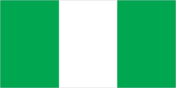
Flag description
three equal vertical bands of green (hoist side), white, and green
Government type
republic transitioning from military to civilian rule
Independence
1 October 1960 (from UK)
International organization participation
ACP, AfDB, C (suspended), CCC, ECA, ECOWAS, FAO, G-15, G-19, G-24, G-77, IAEA, IBRD, ICAO, ICC, ICRM, IDA, IFAD, IFC, IFRCS, IHO, ILO, IMF, IMO, Inmarsat, Intelsat, Interpol, IOC, ISO, ITU, MINURSO, MONUA, NAM, OAU, OIC, OPCW, OPEC, PCA, UN, UNCTAD, UNESCO, UNHCR, UNIDO, UNIKOM, UNITAR, UNMIBH, UNMOP, UNMOT, UNPREDEP, UNU, UPU, WCL, WFTU, WHO, WIPO, WMO, WToO, WTrO Diplomatic representation in the US: chief of mission: Ambassador Wakili Hassan ADAMU chancery: 1333 16th Street NW, Washington, DC 20036 consulate(s) general: New York Diplomatic representation from the US: chief of mission: Ambassador William H. TWADDELL embassy: 2 Eleke Crescent, Lagos mailing address: P. O. Box 554, Lagos
Judicial branch
Supreme Court, judges appointed by the Provisional Ruling Council; Federal Court of Appeal, judges are appointed by the federal government on the advice of the Advisory Judicial Committee Political parties and leaders: political parties, suppressed by the military government, were allowed to form in July 1998; three parties were registered by the Provisional Ruling Council for participation in local, state and national elections; All People's
Legal system
based on English common law, Islamic law, and tribal law
Legislative branch
bicameral National Assembly consists of Senate (109 seats, three from each state and one from the Federal Capital Territory; members elected by popular vote to serve seven-year terms) and House of Representatives (360 seats, members elected by popular vote to serve seven-year terms) elections: Senate--last held 20-24 February 1999 (next to be held NA 2006); House of Representatives--last held 20-24 February 1999 (next to be held NA 2006) election results: Senate--percent of vote by party--NA; seats by party--PDP 61, APP 24, AD 20, other 4; House of Representives--percent of vote by party--NA; seats by party--PDP 206, APP 74, AD 68, others 12 note: the National Assembly was suspended by the military government following the military takeover on 17 November 1993; the new civilian government which was elected on 20 February 1999 is expected to be inaugurated on 29 May 1999
National holiday
Independence Day, 1 October (1960)
Suffrage
18 years of age; universal
Economy
Agriculture--products
cocoa, peanuts, palm oil, corn, rice, sorghum, millet, cassava (tapioca), yams, rubber; cattle, sheep, goats, pigs; timber; fish
Budget
revenues: $13.9 billion (1998 est.) expenditures: $13.9 billion, including capital expenditures of $NA billion (1998 est.)
Currency
1 naira (N) = 100 kobo
Debt--external
$32 billion (1998 est.)
Economic aid--recipient
$39.2 million (1995)
Economy--overview
The oil-rich Nigerian economy continues to be hobbled by political instability, corruption, and poor macroeconomic management. Nigeria's unpopular military rulers have failed to make significant progress in diversifying the economy away from overdependence on the capital intensive oil sector which provides 30% of GDP, 95% of foreign exchange earnings, and about 80% of budgetary revenues. The government's resistance to initiating greater transparency and accountability in managing the country's multibillion dollar oil earnings continues to limit economic growth and prevent an agreement with the IMF and bilateral creditors on a staff-monitored program and debt relief. The largely subsistence agricultural sector has failed to keep up with rapid population growth, and Nigeria, once a large net exporter of food, now must import food. Growth in 1999 may become negative because of continued low oil prices and persistent inefficiencies in the system.
Electricity--consumption
13.74 billion kWh (1996)
Electricity--exports
50 million kWh (1996)
Electricity--imports
0 kWh (1996)
Electricity--production
13.78 billion kWh (1996)
Electricity--production by source
fossil fuel: 60.94% hydro: 39.06% nuclear: 0% other: 0% (1996)
Exchange rates
nairas (N) per US$1--21.886 (December 1998), 21.886 (1998), 21.886 (1997), 21.895 (1995), 21.996 (1994)
Exports
$9.7 billion (f.o.b., 1998)
Exports--commodities
petroleum and petroleum products 95%, cocoa, rubber
Exports--partners
US 35%, Spain 11%, Italy 6%, France 6% (1997 est.)
Fiscal year
calendar year
GDP
purchasing power parity--$106.2 billion (1998 est.)
GDP--composition by sector
agriculture: 33% industry: 42% services: 25% (1997 est.)
GDP--per capita
purchasing power parity?$960 (1998 est.)
GDP--real growth rate
1.6% (1998 est.)
Household income or consumption by percentage share
lowest 10%: 1.3% highest 10%: 31.4% (1992-93)
Imports
$9.8 billion (f.o.b., 1998)
Imports--commodities
machinery, chemicals, transportation equipment, manufactured goods, food and animals
Imports--partners
US 14%, UK 11%, Germany 10%, France 8%, Netherlands 5% (1997 est.)
Industrial production growth rate
4.1% (1996)
Industries
crude oil, coal, tin, columbite, palm oil, peanuts, cotton, rubber, wood, hides and skins, textiles, cement and other construction materials, food products, footwear, chemicals, fertilizer, printing, ceramics, steel
Inflation rate (consumer prices)
15% (1998 est.)
Labor force
42.844 million
Labor force--by occupation
agriculture 54%, industry, commerce, and services 19%, government 15%
Population below poverty line
34.1% (1992-93 est.)
Unemployment rate
28% (1992 est.)
Communications
Radio broadcast stations
AM 82, FM 32, shortwave 10 (1998 est.)
Radios
17.2 million (1998 est.)
Telephone system
average system limited by poor maintenance; major expansion in progress domestic: intercity traffic is carried by coaxial cable, microwave radio relay, cellular network, and a domestic communications satellite system with 20 earth stations international: satellite earth stations--3 Intelsat (2 Atlantic Ocean and 1 Indian Ocean); 1 coaxial submarine cable
Telephones
405,100 (1995 est.)
Television broadcast stations
1 (government-controlled)
Televisions
6.1 million (1998 est.)
Transportation
Airports
72 (1998 est.) Airports--with paved runways: total: 36 over 3,047 m: 6 2,438 to 3,047 m: 10 1,524 to 2,437 m: 10 914 to 1,523 m: 8 under 914 m: 2 (1998 est.) Airports--with unpaved runways: total: 36 over 3,047 m: 1 1,524 to 2,437 m: 1 914 to 1,523 m: 16 under 914 m: 18 (1998 est.)
Heliports
1 (1998 est.)
Highways
total: 51,000 km paved: 26,000 km (including 2,044 km of expressways) unpaved: 25,000 km (1998 est.) note: many of the roads reported as paved may be graveled; because of poor maintenance and years of heavy freight traffic (in part the result of the failure of the railroad system), much of the road system is barely useable
Merchant marine
total: 38 ships (1,000 GRT or over) totaling 371,499 GRT/631,425 DWT ships by type: bulk 1, cargo 13, chemical tanker 3, oil tanker 20, roll-on/roll-off cargo 1 (1998 est.)
Pipelines
crude oil 2,042 km; petroleum products 3,000 km; natural gas 500 km Ports and harbors: Calabar, Lagos, Onne, Port Harcourt, Sapele, Warri
Railways
total: 3,557 km narrow gauge: 3,505 km 1.067-m gauge standard gauge: 52 km 1.435-m gauge (1995) note: years of neglect of both the rolling stock and the right-of-way have seriously reduced the capacity and utility of the system; a project to restore Nigeria's railways is now underway
Waterways
8,575 km consisting of the Niger and Benue rivers and smaller rivers and creeks
Military and Security
Military branches
Army, Navy, Air Force, Police Force
Military expenditures--dollar figure
$236 million (1999)
Military expenditures--percent of GDP
0.7% (1999)
Military manpower--availability
males age 15-49: 25,967,281 (1999 est.) Military manpower--fit for military service: males age 15-49: 14,890,337 (1999 est.)
Military manpower--military age
18 years of age
Military manpower--reaching military age annually
males: 1,201,738 (1999 est.)
Transnational Issues
Disputes--international
delimitation of international boundaries in the vicinity of Lake Chad, the lack of which led to border incidents in the past, is completed and awaits ratification by Cameroon, Chad, Niger, and Nigeria; dispute with Cameroon over land and maritime boundaries around the Bakasi Peninsula is currently before the International Court of Justice; maritime boundary dispute with Equatorial Guinea because of disputed jurisdiction over oil-rich areas in the Gulf of Guinea
Illicit drugs
facilitates movement of heroin en route from Southeast and Southwest Asia to Western Europe and North America; increasingly a transit route for cocaine from South America intended for European, East Asian, and North American markets