1990 Edition
CIA World Factbook 1990 (Project Gutenberg)
Geography
Climate
varies--equatorial in south, tropical in center, arid in north
Coastline
853 km
Comparative area
slightly more than twice the size of California
Continental shelf
200 meters or to depth of exploitation;
Disputes
exact locations of the Chad-Niger-Nigeria and Cameroon-Chad-Nigeria tripoints in Lake Chad have not been determined, so the boundary has not been demarcated and border incidents have resulted; Nigerian proposals to reopen maritime boundary negotiations and redemarcate the entire land boundary have been rejected by Cameroon
Environment
recent droughts in north severely affecting marginal agricultural activities; desertification; soil degradation, rapid deforestation
Extended economic zone
200 nm;
Land boundaries
4,047 km total; Benin 773 km, Cameroon 1,690 km, Chad 87 km, Niger 1,497 km
Land use
31% arable land; 3% permanent crops; 23% meadows and pastures; 15% forest and woodland; 28% other; includes NEGL% irrigated
Natural resources
crude oil, tin, columbite, iron ore, coal, limestone, lead, zinc, natural gas
Terrain
southern lowlands merge into central hills and plateaus; mountains in southeast, plains in north
Territorial sea
30 nm
Total area
923,770 km2; land area: 910,770 km2
People and Society
Birth rate
46 births/1,000 population (1990)
Death rate
17 deaths/1,000 population (1990)
Ethnic divisions
more than 250 tribal groups; Hausa and Fulani of the north, Yoruba of the southwest, and Ibos of the southeast make up 65% of the population; about 27,000 non-Africans
Infant mortality rate
119 deaths/1,000 live births (1990)
Labor force
42,844,000; 54% agriculture, 19% industry, commerce, and services, 15% government; 49% of population of working age (1985)
Language
English (official); Hausa, Yoruba, Ibo, Fulani, and several other languages also widely used
Life expectancy at birth
48 years male, 49 years female (1990)
Literacy
42.4%
Nationality
noun--Nigerian(s); adjective--Nigerian
Net migration rate
1 migrant/1,000 population (1990)
Organized labor
3,520,000 wage earners belong to 42 recognized trade unions, which come under a single national labor federation--the Nigerian Labor Congress (NLC)
Population
118,819,377 (July 1990), growth rate 3.0% (1990)
Religion
50% Muslim, 40% Christian, 10% indigenous beliefs
Total fertility rate
6.5 children born/woman (1990)
Government
Administrative divisions
21 states and 1 territory*; Abuja Capital Territory*, Akwa Ibom, Anambra, Bauchi, Bendel, Benue, Borno, Cross River, Gongola, Imo, Kaduna, Kano, Katsina, Kwara, Lagos, Niger, Ogun, Ondo, Oyo, Plateau, Rivers, Sokoto
Capital
Lagos
Communists
the pro-Communist underground consists of a small fraction of the Nigerian left; leftist leaders are prominent in the country's central labor organization but have little influence on government
Constitution
1 October 1979, amended 9 February 1984, revised 1989
Diplomatic representation
Ambassador Hamzat AHMADU; Chancery at 2201 M Street NW, Washington DC 20037; telephone (202) 822-1500; there are Nigerian Consulates General in Atlanta, New York and San Francisco; US--Ambassador Lannon WALKER; Embassy at 2 Eleke Crescent, Victoria Island, Lagos (mailing address is P. O. Box 554, Lagos); telephone [234] (1) 610097; there is a US Consulate General in Kaduna
Elections
President--scheduled for 1 October 1992
Executive branch
president of the Armed Forces Ruling Council, Armed Forces Ruling Council, National Council of State, Council of Ministers (cabinet)
Flag
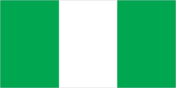
three equal vertical bands of green (hoist side), white, and green
Independence
1 October 1960 (from UK)
Judicial branch
Supreme Court, Federal Court of Appeal
Leaders
Chief of State and Head of Government--President and Commander in Chief of Armed Forces Gen. Ibrahim BABANGIDA (since 27 August 1985)
Legal system
based on English common law, Islamic, and tribal law
Legislative branch
National Assembly was dissolved after the military coup of 31 December 1983
Long-form name
Federal Republic of Nigeria
Member of
ACP, AfDB, APC, CCC, Commonwealth, ECA, ECOWAS, FAO, G-77, GATT, IAEA, IBRD, ICAO, ICO, IDA, IFAD, IFC, ILO, IMO, IMF, INTELSAT, INTERPOL, IRC, ISO, ITC, ITU, IWC--International Wheat Council, Lake Chad Basin Commission, Niger River Commission, NAM, OAU, OPEC, UN, UNESCO, UPU, WHO, WMO, WTO
National holiday
Independence Day, 1 October (1960)
Political parties and leaders
two political parties established by the government in 1989--Social Democratic Party (SDP) and National Republican Convention (NRC)
Suffrage
universal at age 21
Type
military government since 31 December 1983
Economy
Agriculture
accounts for 28% of GNP and half of labor force; inefficient small-scale farming dominates; once a large net exporter of food and now an importer; cash crops--cocoa, peanuts, palm oil, rubber; food crops--corn, rice, sorghum, millet, cassava, yams; livestock--cattle, sheep, goats, pigs; fishing and forestry resources extensively exploited
Aid
US commitments, including Ex-Im (FY70-88), $662 million; Western (non-US) countries, ODA and OOF bilateral commitments (1970-87), $1.9 billion; Communist countries (1970-88), $2.2 billion
Budget
revenues $6.5 billion; expenditures $7.4 billion, including capital expenditures of $1.9 billion (1988 est.)
Currency
naira (plural--naira); 1 naira (N) = 100 kobo
Electricity
4,737,000 kW capacity; 11,270 million kWh produced, 100 kWh per capita (1989)
Exchange rates
naira (N) per US$1--7.6221 (December 1989), 7.3647
Exports
$8.4 billion (f.o.b., 1989 est.); commodities--oil 95%, cocoa, palm kernels, rubber; partners--EC 51%, US 32%
External debt
$32 billion, medium and long-term (December 1989 est.)
Fiscal year
calendar year
GNP
$30.0 billion, per capita $270; real growth rate 4% (1989)
Illicit drugs
illicit heroin and some cocaine trafficking; marijuana cultivation for domestic consumption and export; major transit country for heroin en route from Southwest Asia via Africa to Western Europe and the US; growing transit route for cocaine from South America via West Africa to Western Europe and the US
Imports
$5.7 billion (c.i.f., 1989 est.); commodities--consumer goods, capital equipment, chemicals, raw materials; partners--EC, US
Industrial production
growth rate 5% (1987 est.)
Industries
mining--crude oil, natural gas, coal, tin, columbite; primary processing industries--palm oil, peanut, cotton, rubber, petroleum, wood, hides and skins; manufacturing industries--textiles, cement, building materials, food products, footwear, chemical, printing, ceramics, steel
Inflation rate (consumer prices)
47.5% (1989)
Overview
In 1989, despite rising oil prices, the economic performance failed to meet government expectations because of higher inflationary pressures fueled by a relatively poor agricultural performance. Agricultural production was up only 4% following a 10% decline in 1988, and manufacturing remained below the 1985 level with only a 6% increase. The government is continuing an economic adjustment program to reduce Nigeria's dependence on oil and to help create a basis for sustainable noninflationary growth.
Unemployment rate
7.5% (1988 est.)
Communications
Airports
84 total, 72 usable; 32 with permanent-surface runways; 1 with runways over 3,659 m; 13 with runways 2,440-3,659 m; 22 with runways 1,220-2,439 m
Civil air
76 major transport aircraft
Highways
107,990 km total 30,019 km paved (mostly bituminous-surface treatment); 25,411 km laterite, gravel, crushed stone, improved earth; 52,560 km unimproved
Inland waterways
8,575 km consisting of Niger and Benue Rivers and smaller rivers and creeks
Merchant marine
28 ships (1,000 GRT or over) totaling 428,116 GRT/680,343 DWT; includes 19 cargo, 1 refrigerated, 1 roll-on/roll-off cargo, 5 petroleum, oils, and lubricants (POL) tanker, 1 chemical tanker, 1 bulk
Pipelines
2,042 km crude oil; 500 km natural gas; 3,000 km refined products
Ports
Lagos, Port Harcourt, Calabar, Warri, Onne, Sapele
Railroads
3,505 km 1.067-meter gauge
Telecommunications
above-average system limited by poor maintenance; major expansion in progress; radio relay and cable routes; 155,000 telephones; stations--37 AM, 19 FM, 38 TV; 2 Atlantic Ocean INTELSAT, 1 Indian Ocean INTELSAT, domestic, with 19 stations; 1 coaxial submarine cable
Military and Security
Branches
Army, Navy, Air Force, paramilitary Police Force
Defense expenditures
1% of GNP, or $300 million (1990 est.)
Military manpower
males 15-49, 27,282,248; 15,587,485 fit for military service; 1,263,883 reach military age (18) annually