1985 Edition
CIA World Factbook 1985 (Internet Archive)
Geography
Agriculture
- commercial — cowpeas, groundnuts, cotton; main food crops — millet, sorghum, rice
- main crops — peanuts, cotton, cocoa, rubber, yams, cassava, sorghum, palm kernels, millet, corn, rice; livestock
Airfields
- 68 total, 62 usable^ 7 with permanent-surface runways; 1 with runways 2,4403,659 m, 19 with runways 1,220-2,439 m
- 87 total, 83 usable; 29 with permanent-surface runways; 1 with runways over 3,659 m, 14 with runways 2,440-3,659 m, 20 with runways 1,220-2,439 m
Branches
- Army, Air Force, paramilitary Gendarmerie, paramilitary Republican Guard
- ruling Supreme Military Council and Federal Executive Council (cabinet), advisory National Council of State
- Army, Navy, Air Force
Budget
- (1981/82 prov.) revenues, $234 million; current expenditures, $190 million; capital expenditures, $38 million; extrabudgetary expendituresss, $215 million
- (1984) revenues, $15.1 billion; current expenditures, $7.0 billion
Capital
Lagos
Civil air
- 3 major transport aircraft
- 72 major transport aircraft
Communists
the pro-Communist underground comprises a fraction of the small Nigerian left; leftist leaders are prominent in the country's central labor organization but have little influence on government
Elections
last national elections under civilian rule held August-September 1983 Political parties and leaders :a\\ political parties banned after 31 December 1983
Electric power
- 74,000 kW capacity (1984); 96 million kWh produced (1984), 15 kWh per capita
- 3,100,000 kW capacity (1984); 8. 1 46 billion k Wh produced (1984), 92 kWh per capita
Exports
- $362 million (f.o.b., 1982); about 75% uranium in 1982, rest livestock, cowpeas, onions, hides, skins; exports understated because much regional trade not recorded
- $10.5 billion (f.o.b., 1983); oil (98%), cocoa, palm products, rubber, timber, tin
Fiscal year
- 1 October-30 September Communications
- calendar year Communications
Fishing
catch 512,000 metric tons (1982); imports nonprocessed and processed fish
GDP
- $2.0 billion (1982), $425 per capita; annual real growth rate —0.8% (1970-1980)
- $67 billion (1982), $760 per capita; — 4.4% growth rate (1983 est.)
Government leader
Maj. Gen. Muhammadu BUHARI, Head of the Federal Military Government and Commander in Chief (since December 1983)
Highways
- 8,547 km total; 3,001 km paved bituminous, 2,658 km gravel, 2,888 km unimproved earth
- 107,990 km total 30,019 km paved (mostly bituminous surface treatment); 25,411 km laterite, gravel, crushed stone, improved earth; 52,560 km unimproved
Imports
- $438 million (f.o.b., 1982); petroleum products, primary materials, machinery, vehicles and parts, electronic equipment, Pharmaceuticals, chemical products, cereals, foodstuffs
- $12.1 billion (f.o.b., 1983); machinery and transport equipment, manufactured goods, chemicals
Inland waterways
- Niger River navigable 300 km from Niamey to Gaya on the Benin frontier from mid-December through March
- 8,575 km consisting of Niger and Benue rivers and smaller rivers and creeks
Labor force
est. 35-40 million (1983); 55% agriculture; 17% industry, commerce, and services; 15% government
Legal system
based on English common law, tribal law, and Islamic law
Major industries
- cement plant, brick factory, rice mill, small cotton gins, oil presses, slaughterhouse, and a few other small light industries; uranium production began in
- mining — crude oil, natural gas, coal, tin, columbite; processing industries— oil palm, peanut, cotton, rubber, petroleum, wood, hides, skins; manufacturing industries — textiles, cement, building materials, food products, footwear, chemical, printing, ceramics
Major trade partners
- France (about half), other EC countries, Nigeria, UDEAC countries; US (3.8%, 1981); preferential tariff to EC and franc zone countries
- UK, EC, US
Member of
AfDB, APC, Commonwealth, EGA, ECOWAS, FAO, G-77, GATT, IAEA, IBRD, ICAO, ICO, IDA, IFAD, IFC, ILO, IMO, IMF, INTELSAT, INTERPOL, IRC, ISO, ITC, ITU, IWC— International Wheat Council, Lake Chad Basin Commission, Niger River Commission, NAM, OAU, OPEC, UN, UNESCO, UPU, WHO, WMO, WTO Economy
Military manpower
- males 15-49, 1,408,000; 759,000 fit for military service; about 64,000 reach military age (18) annually Gulf of
- males 15-49, 19,548,000; 11,240,000 fit for military service; 935,000 reach military age ( 1 8) annually
Monetary conversion rate
- 422.25 Communaute Financiere Africaine (CFA) francs=US$l (February 1984)
- .8049 naira=US$l (December 1984)
National holiday
Independence Day, 1 October
Official name
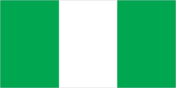
Federal Republic of Nigeria
Organized labor
3.52 million wage earners belong to one of 42 recognized trade unions, which are under a single national labor federation, the Nigerian Labor Congress (NLC) Government
Pipelines
2,042 km crude oil; 1 20 km natural gas; 3,000 km refined products
Political subdivisions
19 states, headed by appointed military governors
Ports
6 major (Lagos, Port Harcourt, Calabar, Warri, Onne, Sapele), 9 minor
Railroads
- none
- 3,505 km 1.067-meter gauge
Suffrage
none
Telecommunications
- small system of wire and radio-relay links concentrated in southwestern area; 9,800 telephones (0.2 per 100 popl.); 9 AM, 2 FM, 12 TV stations; 2 Atlantic Ocean satellite stations, 4 domestic antennas Defense Forces
- above-average system limited by poor maintenance; major expansion in progress; radiorelay and cable routes; 155,000 telephones (0.2 per 100 popl.); 37 AM, 9 FM, 34 TV stations; satellite station with Atlantic and Indian Ocean antennas, domestic satellite system with 19 stations; 1 coaxial submarine cable Defense Forces
Type
military government since 31 December 1983