1999 Edition
CIA World Factbook 1999 (Internet Archive)
Geography
Area
total: 1.267 million sq km land: 1,266,700 sq km water: 300 sq km
Area--comparative
slightly less than twice the size of Texas
Climate
desert; mostly hot, dry, dusty; tropical in extreme south
Coastline
0 km (landlocked)
Elevation extremes
lowest point: Niger River 200 m highest point: Mont Greboun 1,944 m
Environment--current issues
overgrazing; soil erosion; deforestation; desertification; wildlife populations (such as elephant, hippopotamus, giraffe, and lion) threatened because of poaching and habitat destruction
Environment--international agreements
party to: Biodiversity, Climate Change, Desertification, Endangered Species, Environmental Modification, Hazardous Wastes, Nuclear Test Ban, Ozone Layer Protection, Wetlands signed, but not ratified: Climate Change-Kyoto Protocol, Law of the Sea
Geographic coordinates
16 00 N, 8 00 E
Geography--note
landlocked
Irrigated land
660 sq km (1993 est.)
Land boundaries
total: 5,697 km border countries: Algeria 956 km, Benin 266 km, Burkina Faso 628 km, Chad 1,175 km, Libya 354 km, Mali 821 km, Nigeria 1,497 km
Land use
arable land: 3% permanent crops: 0% permanent pastures: 7% forests and woodland: 2% other: 88% (1993 est.)
Location
Western Africa, southeast of Algeria
Map references
Africa
Maritime claims
none (landlocked)
Natural hazards
recurring droughts
Natural resources
uranium, coal, iron ore, tin, phosphates, gold, petroleum
Terrain
predominately desert plains and sand dunes; flat to rolling plains in south; hills in north
People and Society
Age structure
0-14 years: 48% (male 2,445,536; female 2,346,844) 15-64 years: 50% (male 2,421,971; female 2,518,248) 65 years and over: 2% (male 121,253; female 108,390) (1999 est.)
Birth rate
52.31 births/1,000 population (1999 est.)
Death rate
22.78 deaths/1,000 population (1999 est.)
Ethnic groups
Hausa 56%, Djerma 22%, Fula 8.5%, Tuareg 8%, Beri Beri (Kanouri) 4.3%, Arab, Toubou, and Gourmantche 1.2%, about 1,200 French expatriates
Infant mortality rate
112.79 deaths/1,000 live births (1999 est.)
Languages
French (official), Hausa, Djerma
Life expectancy at birth
total population: 41.96 years male: 42.22 years female: 41.7 years (1999 est.)
Literacy
definition: age 15 and over can read and write total population: 13.6% male: 20.9% female: 6.6% (1995 est.)
Nationality
noun: Nigerien(s) adjective: Nigerien
Net migration rate
0 migrant(s)/1,000 population (1999 est.)
Population
9,962,242 (July 1999 est.)
Population growth rate
2.95% (1999 est.)
Religions
Muslim 80%, remainder indigenous beliefs and Christians
Sex ratio
at birth: 1.03 male(s)/female under 15 years: 1.04 male(s)/female 15-64 years: 0.96 male(s)/female 65 years and over: 1.12 male(s)/female total population: 1 male(s)/female (1999 est.)
Total fertility rate
7.24 children born/woman (1999 est.)
Government
Administrative divisions
7 departments (departements, singular--departement), and 1 capital district* (capitale district); Agadez, Diffa, Dosso, Maradi, Niamey*, Tahoua, Tillaberi, Zinder
Capital
Niamey
Constitution
the constitution of January 1993 was revised by national referendum on 12 May 1996
Country name
conventional long form: Republic of Niger conventional short form: Niger local long form: Republique du Niger local short form: Niger
Data code
NG
Executive branch
chief of state: President Ibrahim BARE Mainassara (since 28 January 1996); note--the president is both chief of state and head of government head of government: President Ibrahim BARE Mainassara (since 28 January 1996); note--Ibrahim MAYAKI (since 27 November 1997) was appointed prime minister by the president but does not exercise any executive authority and is only the implementor of the president's programs; the president is both chief of state and head of government note: President Ibrahim BARE was assasinated on the 9 April 1999 cabinet: Council of Ministers appointed by the president elections: president elected by popular vote for a five-year term; last held 7-8 July 1996 (next to be held NA 2001); note--Ibrahim BARE Mainassara initially became president when he ousted President Mahamane OUSMANE in a coup on 27 January 1996 and subsequently defeated him in the flawed election of July 1996 election results: percent of vote--Ibrahim BARE Mainassara 52.22%, Mahamane OUSMANE 19.75%, Tandja MAMADOU 15.65%, Mahamadou ISSOUFOU 7.60%, Moumouni AMADOU Djermakoye 4.77%
Flag description
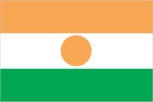
three equal horizontal bands of orange (top), white, and green with a small orange disk (representing the sun) centered in the white band; similar to the flag of India, which has a blue spoked wheel centered in the white band
Government type
republic
Independence
3 August 1960 (from France)
International organization participation
ACCT, ACP, AfDB, CCC, ECA, ECOWAS, Entente, FAO, FZ, G-77, IAEA, IBRD, ICAO, ICFTU, ICRM, IDA, IDB, IFAD, IFC, IFRCS, ILO, IMF, Intelsat, Interpol, IOC, ITU, MIPONUH, NAM, OAU, OIC, OPCW, UN, UNCTAD, UNESCO, UNIDO, UPU, WADB, WAEMU, WCL, WFTU, WHO, WIPO, WMO, WToO, WTrO Diplomatic representation in the US: chief of mission: Ambassador Joseph DIATTA chancery: 2204 R Street NW, Washington, DC 20008 Diplomatic representation from the US: chief of mission: Ambassador Charles O. CECIL embassy: Rue Des Ambassades, Niamey mailing address: B. P. 11201, Niamey
Judicial branch
State Court or Cour d'Etat; Court of Appeal or Cour d'Appel Political parties and leaders: Alliance for Democracy and TALBA, chairman]; Democratic and Social Convention-Rahama or MAMADOU, chairman]; National Union of Independents for Democratic Nigerien Party for Democracy and Socialism-Tarayya or PNDS-Tarayya Patriots, Democrats, and Progressives-Shamuwa or UPDP-Shamuwa NA]
Legal system
based on French civil law system and customary law; has not accepted compulsory ICJ jurisdiction
Legislative branch
two-chamber National Assembly; one chamber with 83 seats (members elected by popular vote for five-year terms); selection process for second chamber not established elections: last held 23 November 1996 (next to be held NA 2001) election results: percent of vote by party--NA; seats by party--UNIRD 59, ANDPS-Zaman Lahiya 8, UDPS-Amana 3, coalition of independents 3, MDP-Alkwali 1, UPDP-Shamuwa 4, DARAJA 3, PMT-Albarka 2
National holiday
Republic Day, 18 December (1958)
Suffrage
18 years of age; universal
Economy
Agriculture--products
cowpeas, cotton, peanuts, millet, sorghum, cassava (tapioca), rice; cattle, sheep, goats, camels, donkeys, horses, poultry
Budget
revenues: $370 million (including $160 million from foreign sources) expenditures: $370 million, including capital expenditures of $186 million (1998 est.)
Currency
1 Communaute Financiere Africaine franc (CFAF) = 100 centimes
Debt--external
$1.2 billion (1998 est.)
Economic aid--recipient
$222 million (1995)
Economy--overview
Niger is a poor, landlocked Sub-Saharan nation, whose economy centers on subsistence agriculture, animal husbandry, reexport trade, and increasingly less on uranium, its major export since the 1970s. The 50% devaluation of the West African franc in January 1994 boosted exports of livestock, cowpeas, onions, and the products of Niger's small cotton industry. The government relies on bilateral and multilateral aid for operating expenses and public investment and is strongly induced to adhere to structural adjustment programs designed by the IMF and the World Bank. Short-term prospects depend largely on upcoming negotiations on debt relief and extended aid.
Electricity--consumption
365 million kWh (1996)
Electricity--exports
0 kWh (1996)
Electricity--imports
195 million kWh (1996) note: imports electricity from Nigeria
Electricity--production
170 million kWh (1996)
Electricity--production by source
fossil fuel: 100% hydro: 0% nuclear: 0% other: 0% (1996)
Exchange rates
Communaute Financiere Africaine francs (CFAF) per US$1--560.01 (January 1999), 589.95 (1998), 583.67 (1997), 511.55 (1996), 499.15 (1995), 555.20 (1994)
Exports
$269 million (f.o.b., 1997)
Exports--commodities
uranium ore 50%, livestock products 20%, cowpeas, onions (1996 est.)
Exports--partners
Greece 21%, Canada 18%, France 12%, Nigeria 7% (1996 est.)
Fiscal year
calendar year
GDP
purchasing power parity--$9.4 billion (1998 est.)
GDP--composition by sector
agriculture: 40% industry: 18% services: 42% (1997)
GDP--per capita
purchasing power parity?$970 (1998 est.)
GDP--real growth rate
4.5% (1998 est.)
Household income or consumption by percentage share
lowest 10%: 3% highest 10%: 29.3% (1992)
Imports
$295 million (c.i.f., 1997)
Imports--commodities
consumer goods, primary materials, machinery, vehicles and parts, petroleum, cereals
Imports--partners
France 17%, Cote d'Ivoire 7%, US 5%, Belgium-Luxembourg 4%, Nigeria (1996 est.)
Industrial production growth rate
NA%
Industries
cement, brick, textiles, food processing, chemicals, slaughterhouses, and a few other small light industries; uranium mining
Inflation rate (consumer prices)
4.8% (1998)
Labor force
70,000 receive regular wages or salaries
Labor force--by occupation
agriculture 90%, industry and commerce 6%, government 4%
Population below poverty line
NA%
Unemployment rate
NA%
Communications
Radio broadcast stations
AM 15, FM 6, shortwave 0
Radios
620,000 (1995 est.)
Telephone system
small system of wire, radiotelephone communications, and microwave radio relay links concentrated in southwestern area domestic: wire, radiotelephone communications, and microwave radio relay; domestic satellite system with 3 earth stations and 1 planned international: satellite earth stations--2 Intelsat (1 Atlantic Ocean and 1 Indian Ocean)
Telephones
14,000 (1995 est.)
Television broadcast stations
10 (in addition, there are seven low-power repeaters) (1997)
Televisions
105,000 (1995 est.)
Transportation
Airports
27 (1998 est.) Airports--with paved runways: total: 9 2,438 to 3,047 m: 2 1,524 to 2,437 m: 6 914 to 1,523 m: 1 (1998 est.) Airports--with unpaved runways: total: 18 1,524 to 2,437 m: 1 914 to 1,523 m: 15 under 914 m: 2 (1998 est.)
Highways
total: 10,100 km paved: 798 km unpaved: 9,302 km (1996 est.)
Railways
0 km
Waterways
Niger river is navigable 300 km from Niamey to Gaya on the Benin frontier from mid-December through March Ports and harbors: none
Military and Security
Military branches
Army, Air Force, National Gendarmerie, Republican Guard, National Police
Military expenditures--dollar figure
$20 million (FY96/97)
Military expenditures--percent of GDP
1.1% (FY96/97)
Military manpower--availability
males age 15-49: 2,117,868 (1999 est.) Military manpower--fit for military service: males age 15-49: 1,143,355 (1999 est.)
Military manpower--military age
18 years of age
Military manpower--reaching military age annually
males: 102,762 (1999 est.)
Transnational Issues
Disputes--international
Libya claims about 19,400 sq km in northern Niger; delimitation of international boundaries in the vicinity of Lake Chad, the lack of which led to border incidents in the past, is completed and awaits ratification by Cameroon, Chad, Niger, and Nigeria