1994 Edition
CIA World Factbook 1994 (Project Gutenberg)
Introduction
Administrative divisions
- 7 departments (departements, singular - departement); Agadez, Diffa, Dosso, Maradi, Niamey, Tahoua, Zinder
- 30 states and 1 territory*; Abia, Abuja Capital Territory*, Adamawa, Akwa Ibom, Anambra, Bauchi, Benue, Borno, Cross River, Delta, Edo, Enugu, Imo, Jigawa, Kaduna, Kano, Katsina, Kebbi, Kogi, Kwara, Lagos, Niger, Ogun, Ondo, Osun, Oyo, Plateau, Rivers, Sokoto, Taraba, Yobe
Agriculture
- accounts for roughly 40% of GDP and 90% of labor force; cash crops - cowpeas, cotton, peanuts; food crops - millet, sorghum, cassava, rice; livestock - cattle, sheep, goats; self-sufficient in food except in drought years
- accounts for 35% of GDP and half of labor force; inefficient small-scale farming dominates; once a large net exporter of food and now an importer; cash crops - cocoa, peanuts, palm oil, rubber; food crops - corn, rice, sorghum, millet, cassava, yams; livestock - cattle, sheep, goats, pigs; fishing and forestry resources extensively exploited
Airports
- total: 30 usable: 28 with permanent-surface runways: 9 with runways over 3,659 m: with runways 2,440-3,659 m: 2 with runways 1,220-2,439 m: 14
- total: 80 usable: 67 with permanent-surface runways: 34 with runways over 3,659 m: 1 with runways 2,440-3,659 m: 15 with runways 1,220-2,439 m: 21
Area
- total area: 1.267 million sq km land area: 1,266,700 sq km comparative area: slightly less than twice the size of Texas
- total area: 923,770 sq km land area: 910,770 sq km comparative area: slightly more than twice the size of California
Birth rate
- 54.95 births/1,000 population (1994 est.)
- 43.52 births/1,000 population (1994 est.)
Branches
- Army, Air Force, Gendarmerie, National Police, Republican Guard
- Army, Navy, Air Force, paramilitary Police Force
Budget
- revenues: $193 million expenditures: $355 million, including capital expenditures of $106 million (1991 est.)
- revenues: $9 billion expenditures: $10.8 billion, including capital expenditures of $NA (1992 est.)
Capital
- Niamey
- Abuja note: on 12 December 1991 the capital was officially moved from Lagos to Abuja; many government offices remain in Lagos pending completion of facilities in Abuja
Climate
- desert; mostly hot, dry, dusty; tropical in extreme south
- varies; equatorial in south, tropical in center, arid in north
Coastline
- 0 km (landlocked)
- 853 km
Constitution
- approved by national referendum 16 December 1992; promulgated January 1993
- 1979 constitution still in force; plan for 1989 constitution to take effect in 1993 was not implemented
Currency
- 1 CFA franc (CFAF) = 100 centimes
- 1 naira (N) = 100 kobo
Death rate
- 21.32 deaths/1,000 population (1994 est.)
- 12.43 deaths/1,000 population (1994 est.)
Defense expenditures
- exchange rate conversion - $27 million, 1.3% of GDP (1989)
- exchange rate conversion - $172 million, about 1% of GDP (1992)
Digraph
- NG
- NI
Diplomatic representation in US
- chief of mission: Ambassador Adamou SEYDOU chancery: 2204 R Street NW, Washington, DC 20008 telephone: (202) 483-4224 through 4227
- chief of mission: Ambassador Zubair Mahmud KAZAURE chancery: 1333 16th Street NW, Washington, DC 20036 telephone: (202) 986-8400 consulate(s) general: New York
Economic aid
- recipient: US commitments, including Ex-Im (FY70-89), $380 million; Western (non-US) countries, ODA and OOF bilateral commitments (1970-89), $3.165 billion; OPEC bilateral aid (1979-89), $504 million; Communist countries (1970-89), $61 million
- recipient: US commitments, including Ex-Im (FY70-89), $705 million; Western (non-US) countries, ODA and OOF bilateral commitments (1970-89), $3 billion; Communist countries (1970-89), $2.2 billion
Electricity
- capacity: 105,000 kW production: 230 million kWh consumption per capita: 30 kWh (1991)
- capacity: 4,740,000 kW production: 8.3 billion kWh consumption per capita: 70 kWh (1991)
Environment
- current issues: overgrazing; soil erosion; deforestation; desertification; wildlife populations (such as elephant, hippopotamus, and lion) threatened because of poaching and habitat destruction natural hazards: recurrent droughts international agreements: party to - Endangered Species, Environmental Modification, Nuclear Test Ban, Ozone Layer Protection, Wetlands; signed, but not ratified - Biodiversity, Climate Change, Law of the Sea
- current issues: soil degradation; rapid deforestation; desertification; recent droughts in north severely affecting marginal agricultural activities natural hazards: periodic droughts international agreements: party to - Endangered Species, Hazardous Wastes, Law of the Sea, Marine Dumping, Marine Life Conservation, Nuclear Test Ban, Ozone Layer Protection; signed, but not ratified - Biodiversity, Climate Change
Ethnic divisions
- Hausa 56%, Djerma 22%, Fula 8.5%, Tuareg 8%, Beri Beri (Kanouri) 4.3%, Arab, Toubou, and Gourmantche 1.2%, about 4,000 French expatriates
- north: Hausa and Fulani southwest: Yoruba southeast: Ibos non-Africans 27,000 note: Hausa and Fulani, Yoruba, and Ibos together make up 65% of population
Exchange rates
- Communaute Financiere Africaine francs (CFAF) per US$1 - 592.05 (January 1994), 283.16 (1993), 264.69 (1992), 282.11 (1991), 272.26 (1990), 319.01 (1989) note: the official rate is pegged to the French franc, and beginning 12 January 1994, the CFA franc was devalued to CFAF 100 per French franc from CFAF 50 at which it had been fixed since 1948
- naira (N) per US$1 - 21.886 (November 1993), 17.298 (1992), 9.909 (1991), 8.038 (1990), 7.3647 (1989)
Executive branch
- chief of state: President Mahamane OUSMANE (since 16 April 1993) head of government: Prime Minister Mahamadou ISSOUFOU (since 17 April 1993) cabinet: Cabinet; appointed by the president on recommendation of the prime minister
- chief of state and head of government: Chairman of the Provisional Ruling Council and Commander in Chief of Armed Forces and Defense Minister Gen. Sani ABACHA (since 17 November 1993); Vice-Chairman of the Provisional Ruling Council Oladipo DIYA (since 17 November 1993) cabinet: Federal Executive Council
Exports
- $294 million (f.o.b., 1991) commodities: uranium ore 60%, livestock products 20%, cowpeas, onions partners: France 77%, Nigeria 8%, Cote d'Ivoire, Italy
- $11.9 billion (f.o.b., 1992) commodities: oil 95%, cocoa, rubber partners: US 54%, EC 23%
External debt
- $1.2 billion (December 1991 est.)
- $29.5 billion (1992)
FAX
- [227] 73-31-67
- [234] (1) 610257 consulate(s) general: Kaduna
Fiscal year
- 1 October - 30 September
- calendar year
Flag
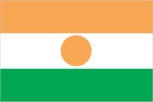
- three equal horizontal bands of orange (top), white, and green with a small orange disk (representing the sun) centered in the white band; similar to the flag of India, which has a blue spoked wheel centered in the white band
- three equal vertical bands of green (hoist side), white, and green
Highways
- total: 39,970 km paved: bituminous 3,170 km unpaved: gravel, laterite 10,330 km; earth 3,470 km; tracks 23,000 km
- total: 107,990 km paved: mostly bituminous-surface treatment 30,019 km unpaved: gravel, crushed stone, improved earth 25,411 km; unimproved earth 52,560 km
House of Representatives
suspended after coup of 17 November 1993
Illicit drugs
passenger and cargo air hub for West Africa; facilitates movement of heroin en route from Southeast and Southwest Asia to Western Europe and North America; increasingly a transit route for cocaine from South America intended for West European, East Asian, and North American markets
Imports
- $346 million (c.i.f., 1991) commodities: primary materials, machinery, vehicles and parts, electronic equipment, cereals, petroleum products, pharmaceuticals, chemical products, foodstuffs partners: Germany 26%, Cote d'Ivoire 11%, France 5%, Italy 4%, Nigeria 2%
- $8.3 billion (c.i.f., 1992) commodities: machinery and equipment, manufactured goods, food and animals partners: EC 64%, US 10%, Japan 7%
Independence
- 3 August 1960 (from France)
- 1 October 1960 (from UK)
Industrial production
- growth rate -2.7% (1991 est.); accounts for 13% of GDP
- growth rate 7.7% (1991); accounts for 43% of GDP, including petroleum
Industries
- cement, brick, textiles, food processing, chemicals, slaughterhouses, and a few other small light industries; uranium mining began in 1971
- crude oil and mining - coal, tin, columbite; primary processing industries - palm oil, peanut, cotton, rubber, wood, hides and skins; manufacturing industries - textiles, cement, building materials, food products, footwear, chemical, printing, ceramics, steel
Infant mortality rate
- 111 deaths/1,000 live births (1994 est.)
- 75 deaths/1,000 live births (1994 est.)
Inflation rate (consumer prices)
- 1.3% (1991 est.)
- 60% (1992 est.)
Inland waterways
- Niger River is navigable 300 km from Niamey to Gaya on the Benin frontier from mid-December through March
- 8,575 km consisting of Niger and Benue Rivers and smaller rivers and creeks
International disputes
- Libya claims about 19,400 sq km in northern Niger; demarcation of international boundaries in Lake Chad, the lack of which has led to border incidents in the past, is completed and awaiting ratification by Cameroon, Chad, Niger, and Nigeria; Burkina and Mali are proceeding with boundary demarcation, including the tripoint with Niger
- demarcation of international boundaries in Lake Chad, the lack of which has led to border incidents in the past, is completed and awaiting ratification by Cameroon, Chad, Niger, and Nigeria; boundary commission, created with Cameroon to discuss unresolved land and maritime boundaries, has not yet convened, but a commission was formed January 1994 to study a flare-up of the dispute
Irrigated land
- 320 sq km (1989 est.)
- 8,650 sq km (1989 est.)
Judicial branch
- State Court (Cour d'Etat), Court of Appeal (Cour d'Apel)
- Supreme Court, Federal Court of Appeal
Labor force
- 2.5 million wage earners (1982) by occupation: agriculture 90%, industry and commerce 6%, government 4% note: 51% of population of working age (1985)
- 42.844 million by occupation: agriculture 54%, industry, commerce, and services 19%, government 15% note: 49% of population of working age (1985)
Land boundaries
- total 5,697 km, Algeria 956 km, Benin 266 km, Burkina 628 km, Chad 1,175 km, Libya 354 km, Mali 821 km, Nigeria 1,497 km
- total 4,047 km, Benin 773 km, Cameroon 1,690 km, Chad 87 km, Niger 1,497 km
Land use
- arable land: 3% permanent crops: 0% meadows and pastures: 7% forest and woodland: 2% other: 88%
- arable land: 31% permanent crops: 3% meadows and pastures: 23% forest and woodland: 15% other: 28%
Languages
- French (official), Hausa, Djerma
- English (official), Hausa, Yoruba, Ibo, Fulani
Legal system
- based on French civil law system and customary law; has not accepted compulsory ICJ jurisdiction
- based on English common law, Islamic law, and tribal law
Legislative branch
- unicameral
- bicameral National Assembly
Life expectancy at birth
- total population: 44.61 years male: 43.01 years female: 46.26 years (1994 est.)
- total population: 55.33 years male: 54.11 years female: 56.59 years (1994 est.)
Literacy
- age 15 and over can read and write (1990 est.) total population: 28% male: 40% female: 17%
- age 15 and over can read and write (1990 est.) total population: 51% male: 62% female: 40%
Location
- Western Africa, between Algeria and Nigeria
- Western Africa, bordering the North Atlantic Ocean between Benin and Cameroon
Manpower availability
- males age 15-49 1,845,374; fit for military service 994,683; reach military age (18) annually 91,595 (1994 est.)
- males age 15-49 22,468,803; fit for military service 12,840,029; reach military age (18) annually 986,518 (1994 est.)
Map references
- Africa, Standard Time Zones of the World
- Africa, Standard Time Zones of the World
Maritime claims
- none; landlocked
- continental shelf: 200-m depth or to depth of exploitation exclusive economic zone: 200 nm territorial sea: 30 nm
Member of
- ACCT, ACP, AfDB, CCC, CEAO, ECA, ECOWAS, Entente, FAO, FZ, G-77, GATT, IAEA, IBRD, ICAO, IDA, IDB, IFAD, IFC, ILO, IMF, INTELSAT, INTERPOL, IOC, ITU, LORCS, NAM, OAU, OIC, UN, UNCTAD, UNESCO, UNIDO, UPU, WADB, WCL, WHO, WIPO, WMO, WTO
- ACP, AfDB, C, CCC, ECA, ECOWAS, FAO, G-15, G-19, G-24, G-77, GATT, IAEA, IBRD, ICAO, ICC, IDA, IFAD, IFC, ILO, IMO, IMF, INMARSAT, INTELSAT, INTERPOL, IOC, ITU, LORCS, MINURSO, NAM, OAU, OIC (observer), OPEC, PCA, UN, UNAVEM, UNCTAD, UNESCO, UNHCR, UNIDO, UNIKOM, UNPROFOR, UNTAC, UPU, WCL, WHO, WMO, WTO
Merchant marine
33 ships (1,000 GRT or over) totaling 432,704 GRT/686,718 DWT, bulk 1, cargo 18, chemical tanker 3, liquified gas 1, oil tanker 9, roll-on/roll-off cargo 1
Names
- conventional long form: Republic of Niger conventional short form: Niger local long form: Republique du Niger local short form: Niger
- conventional long form: Federal Republic of Nigeria conventional short form: Nigeria
National Assembly
elected by proportional representation for 5 year terms; elections last held 14 February 1993 (next election NA 1998); seats - (83 total) MNSD 29, CDS 22, PNDS 13, ANDP-Z 11, UPDP 2, PPN/RDA 2, UDFP 2, PSDN 1, UDPS 1
National holiday
- Republic Day, 18 December (1958)
- Independence Day, 1 October (1960)
National product
- GDP - purchasing power equivalent - $5.4 billion (1993 est.)
- GDP - purchasing power equivalent - $95.1 billion (1993 est.)
National product per capita
- $650 (1993 est.)
- $1,000 (1993 est.)
National product real growth rate
- 1.9% (1991 est.)
- 4.1% (1992)
Nationality
- noun: Nigerien(s) adjective: Nigerien
- noun: Nigerian(s) adjective: Nigerian
Natural resources
- uranium, coal, iron ore, tin, phosphates
- petroleum, tin, columbite, iron ore, coal, limestone, lead, zinc, natural gas
Net migration rate
- 0 migrant(s)/1,000 population (1994 est.)
- 0.36 migrant(s)/1,000 population (1994 est.)
Note
landlocked
Overview
- Niger's economy is centered on subsistence agriculture, animal husbandry, and re-export trade, and increasingly less on uranium, its major export throughout the 1970s and 1980s. Uranium revenues dropped by almost 50% between 1983 and 1990. Terms of trade with Nigeria, Niger's largest regional trade partner, have improved dramatically since the 50% devaluation of the African franc in January 1994; this devaluation boosted exports of livestock, peas, onions, and the products of Niger's small cotton industry. The government relies on bilateral and multilateral aid for operating expenses and public investment, and is strongly induced to adhere to structural adjustment programs designed by the IMF and the World Bank.
- The oil-rich Nigerian economy continues to be hobbled by poor macroeconomic management that has resulted in an average annual inflation rate of 60%, a growing foreign debt, and a worsening balance of payments. A deepening political crisis in 1993 has compounded the government's failure to reign in deficit spending, which prevents it from reaching an agreement with the IMF and its bilateral creditors on debt relief. Investment in both oil and non-oil sector industry has been undermined by corruption and squandered on white elephant projects that have failed to generate diversification or new employment.
Pipelines
crude oil 2,042 km; petroleum products 3,000 km; natural gas 500 km
Political parties and leaders
- National Movement of the Development Society (MNSD-NASSARA), Kada LABO, General Secretary; Democratic and Social Convention - Rahama (CDS- Rahama), Mahamane OUSMANE; Nigerien Party for Democracy and Socialism (PNDS), Mahamadou ISSOUFOU; Nigerien Alliance for Democracy and Progress - Zamanlahia (ANDP-Z), Moumouni Adamou DJERMAKOYE; Union of Patriots, Democrats, and Progressives (UPDP), Andre SALIFOU; Niger Progressive Party - African Democratic Rally (PPN-RDA), Harou KOUKA; Niger Social Democrat Party (PADN), Malam Adji WAZIRI; Union for Democracy and Social Progress (UDPS), Akoli DAOUEL
- note: two political party system suspended after the coup of 17 November 1993
Population
- 8,971,605 (July 1994 est.)
- 98,091,097 (July 1994 est.)
Population growth rate
- 3.36% (1994 est.)
- 3.15% (1994 est.)
Ports
Lagos, Port Harcourt, Calabar, Warri, Onne, Sapele
Railroads
3,505 km 1.067-meter gauge
Religions
- Muslim 80%, remainder indigenous beliefs and Christians
- Muslim 50%, Christian 40%, indigenous beliefs 10%
Senate
suspended after coup of 17 November 1993
Suffrage
- 18 years of age; universal
- 21 years of age; universal
Telecommunications
- small system of wire, radiocommunications, and radio relay links concentrated in southwestern area; 14,260 telephones; broadcast stations - 15 AM, 5 FM, 18 TV; satellite earth stations - 1 Atlantic Ocean INTELSAT, 1 Indian Ocean INTELSAT, and 3 domestic, with 1 planned
- above-average system limited by poor maintenance; major expansion in progress; radio relay microwave and cable routes; broadcast stations - 35 AM, 17 FM, 28 TV; satellite earth stations - 2 Atlantic Ocean INTELSAT, 1 Indian Ocean INTELSAT, 20 domestic stations; 1 coaxial submarine cable
Terrain
- predominately desert plains and sand dunes; flat to rolling plains in south; hills in north
- southern lowlands merge into central hills and plateaus; mountains in southeast, plains in north
Total fertility rate
- 7.35 children born/woman (1994 est.)
- 6.37 children born/woman (1994 est.)
Type
- republic
- military government since 31 December 1983; plans to institute a constitutional conference to prepare for a new transition to civilian rule after plans for a transition in 1993 were negated by General BABANGIDA
Unemployment rate
- NA%
- 28% (1992 est.)
US diplomatic representation
- chief of mission: Ambassador John DAVISON embassy: Rue Des Ambassades, Niamey mailing address: B. P. 11201, Niamey telephone: [227] 72-26-61 through 64
- chief of mission: Ambassador Walter CARRINGTON embassy: 2 Eleke Crescent, Lagos mailing address: P. O. Box 554, Lagos telephone: [234] (1) 610050