1993 Edition
CIA World Factbook 1993 (Project Gutenberg)
Geography
Area
total area: 1.267 million km2 land area: 1,266,700 km2 comparative area: slightly less than twice the size of Texas
Climate
desert; mostly hot, dry, dusty; tropical in extreme south
Coastline
0 km (landlocked)
Environment
recurrent drought and desertification severely affecting marginal agricultural activities; overgrazing; soil erosion
International disputes
Libya claims about 19,400 km2 in northern Niger; demarcation of international boundaries in Lake Chad, the lack of which has led to border incidents in the past, is completed and awaiting ratification by Cameroon, Chad, Niger, and Nigeria; Burkina and Mali are proceeding with boundary demarcation, including the tripoint with Niger
Irrigated land
320 km2 (1989 est.)
Land boundaries
total 5,697 km, Algeria 956 km, Benin 266 km, Burkina 628 km, Chad 1,175 km, Libya 354 km, Mali 821 km, Nigeria 1,497 km
Land use
arable land: 3% permanent crops: 0% meadows and pastures: 7% forest and woodland: 2% other: 88%
Location
Western Africa, between Algeria and Nigeria
Map references
Africa, Standard Time Zones of the World
Maritime claims
none; landlocked
Natural resources
uranium, coal, iron ore, tin, phosphates
Note
landlocked
Terrain
predominately desert plains and sand dunes; flat to rolling plains in south; hills in north
People and Society
Birth rate
57.35 births/1,000 population (1993 est.)
Death rate
22.44 deaths/1,000 population (1993 est.)
Ethnic divisions
Hausa 56%, Djerma 22%, Fula 8.5%, Tuareg 8%, Beri Beri (Kanouri) 4.3%, Arab, Toubou, and Gourmantche 1.2%, about 4,000 French expatriates
Infant mortality rate
112.8 deaths/1,000 live births (1993 est.)
Labor force
2.5 million wage earners (1982) by occupation: agriculture 90%, industry and commerce 6%, government 4% note: 51% of population of working age (1985)
Languages
French (official), Hausa, Djerma
Life expectancy at birth
total population: 44.15 years male: 42.6 years female: 45.75 years (1993 est.)
Literacy
age 15 and over can read and write (1990) total population: 28% male: 40% female: 17%
Nationality
noun: Nigerien(s) adjective: Nigerien
Net migration rate
0 migrant(s)/1,000 population (1993 est.)
Population
8,337,352 (July 1993 est.)
Population growth rate
3.49% (1993 est.)
Religions
Muslim 80%, remainder indigenous beliefs and Christians
Total fertility rate
7.35 children born/woman (1993 est.)
Government
Administrative divisions
7 departments (departements, singular - departement); Agadez, Diffa, Dosso, Maradi, Niamey, Tahoua, Zinder
Capital
Niamey
Chief of State
President Brig. Gen. Ali SAIBOU (since 14 November 1987); ceremonial post since national conference (1991)
Constitution
December 1989 constitution revised November 1991 by National Democratic Reform Conference
Digraph
NG
Diplomatic representation in US
chief of mission: Ambassador Adamou SEYDOU chancery: 2204 R Street NW, Washington, DC 20008 telephone: (202) 483-4224 through 4227
Executive branch
president (ceremonial), prime minister, Cabinet
FAX
[227] 73-31-67
Flag
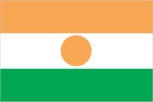
three equal horizontal bands of orange (top), white, and green with a small orange disk (representing the sun) centered in the white band; similar to the flag of India, which has a blue spoked wheel centered in the white band
Head of Government
Prime Minister Amadou CHEIFFOU (since NA November 1991)
Independence
3 August 1960 (from France)
Judicial branch
State Court (Cour d'Etat), Court of Appeal (Cour d'Apel)
Legal system
based on French civil law system and customary law; has not accepted compulsory ICJ jurisdiction
Legislative branch
unicameral National Assembly
Member of
ACCT, ACP, AfDB, CCC, CEAO, ECA, ECOWAS, Entente, FAO, FZ, G-77, GATT, IAEA, IBRD, ICAO, IDA, IDB, IFAD, IFC, ILO, IMF, INTELSAT, INTERPOL, IOC, ITU, LORCS, NAM, OAU, OIC, UN, UNCTAD, UNESCO, UNIDO, UPU, WADB, WCL, WHO, WIPO, WMO, WTO
Names
conventional long form: Republic of Niger conventional short form: Niger local long form: Republique du Niger local short form: Niger
National Assembly
last held 10 December 1989 (next to be held NA); results - MNSD was the only party; seats - (150 total) MNSD 150 (indirectly elected); note - Niger held a national conference from July to November 1991 to decide upon a transitional government and an agenda for multiparty elections
National holiday
Republic Day, 18 December (1958)
Political parties and leaders
National Movement of the Development Society (MNSD-NASSARA), Tandja MAMADOU; Niger Progressive Party - African Democratic Rally (PPN-RDA), Harou KOUKA; Union of Popular Forces for Democracy and Progress (UDFP-SAWABA), Djibo BAKARY; Niger Democratic Union (UDN-SAWABA), Mamoudou PASCAL; Union of Patriots, Democrats, and Progressives (UPDP), Andre SALIFOU; other parties forming
President
President Ali SAIBOU has been in office since December 1989, but the presidency is now a largely ceremonial position
Suffrage
18 years of age; universal
Type
transition government as of November 1991, appointed by national reform conference; scheduled to turn over power to democratically elected government in March 1993
US diplomatic representation
chief of mission: Ambassador Jennifer C. WARD embassy: Avenue des Ambassades, Niamey mailing address: B. P. 11201, Niamey telephone: [227] 72-26-61 through 64
Economy
Agriculture
accounts for roughly 40% of GDP and 90% of labor force; cash crops - cowpeas, cotton, peanuts; food crops - millet, sorghum, cassava, rice; livestock - cattle, sheep, goats; self-sufficient in food except in drought years
Budget
revenues $193 million; expenditures $355 million, including capital expenditures of $106 million (1991 est.)
Currency
1 CFA franc (CFAF) = 100 centimes
Economic aid
US commitments, including Ex-Im (FY70-89), $380 million; Western (non-US) countries, ODA and OOF bilateral commitments (1970-89), $3,165 million; OPEC bilateral aid (1979-89), $504 million; Communist countries (1970-89), $61 million
Electricity
105,000 kW capacity; 230 million kWh produced, 30 kWh per capita (1991)
Exchange rates
Communaute Financiere Africaine francs (CFAF) per US$1 - 274.06 (January 1993), 264.69 (1992), 282.11 (1991), 272.26 (1990), 319.01 (1989), 297.85 (1988)
Exports
$294 million (f.o.b., 1991) commodities: uranium ore 60%, livestock products 20%, cowpeas, onions partners: France 77%, Nigeria 8%, Cote d'Ivoire, Italy
External debt
$1.2 billion (December 1991 est.)
Fiscal year
1 October - 30 September
Imports
$346 million (c.i.f., 1991) commodities: primary materials, machinery, vehicles and parts, electronic equipment, cereals, petroleum products, pharmaceuticals, chemical products, foodstuffs partners: Germany 26%, Cote d'Ivoire 11%, France 5%, Italy 4%, Nigeria 2%
Industrial production
growth rate -2.7% (1991 est.); accounts for 13% of GDP
Industries
cement, brick, textiles, food processing, chemicals, slaughterhouses, and a few other small light industries; uranium mining began in 1971
Inflation rate (consumer prices)
1.3% (1991 est.)
National product
GDP - exchange rate conversion - $2.3 billion (1991 est.)
National product per capita
$290 (1991 est.)
National product real growth rate
1.9% (1991 est.)
Overview
About 90% of the population is engaged in farming and stock raising, activities that generate almost half the national income. The economy also depends heavily on exploitation of large uranium deposits. Uranium production grew rapidly in the mid-1970s, but tapered off in the early 1980s when world prices declined. France is a major customer, while Germany, Japan, and Spain also make regular purchases. The depressed demand for uranium has contributed to an overall sluggishness in the economy, a severe trade imbalance, and a mounting external debt.
Unemployment rate
NA%
Communications
Airports
total: 28 usable: 26 with permanent-surface runways: 9 with runways over 3,659 m: with runways 2,440-3,659 m: 2 with runways 1,220-2,439 m: 13
Highways
39,970 km total; 3,170 km bituminous, 10,330 km gravel and laterite, 3,470 km earthen, 23,000 km tracks
Inland waterways
Niger River is navigable 300 km from Niamey to Gaya on the Benin frontier from mid-December through March
Telecommunications
small system of wire, radiocommunications, and radio relay links concentrated in southwestern area; 14,260 telephones; broadcast stations - 15 AM, 5 FM, 18 TV; satellite earth stations - 1 Atlantic Ocean INTELSAT, 1 Indian Ocean INTELSAT, and 3 domestic, with 1 planned
Military and Security
Branches
Army, Air Force, Gendarmerie, National Police, Republican Guard
Defense expenditures
exchange rate conversion - $27 million, 1.3% of GDP (1989)
Manpower availability
males age 15-49 1,784,966; fit for military service 961,593; reach military age (18) annually 87,222 (1993 est.)