2013 Edition
CIA World Factbook 2013 Archive (HTML)
Introduction
Background
In 1951, the Nepali monarch ended the century-old system of rule by hereditary premiers and instituted a cabinet system of government. Reforms in 1990 established a multiparty democracy within the framework of a constitutional monarchy. An insurgency led by Maoist extremists broke out in 1996. The ensuing 10-year civil war between rebels and government forces witnessed the dissolution of the cabinet and parliament and assumption of absolute power by the king. Several weeks of mass protests in April 2006 were followed by several months of peace negotiations between the Maoists and government officials, and culminated in a November 2006 peace accord and the promulgation of an interim constitution. Following a nationwide election in April 2008, the newly formed Constituent Assembly (CA) declared Nepal a federal democratic republic and abolished the monarchy at its first meeting the following month. The CA elected the country's first president in July. Between 2008 and 2011 there have been four different coalition governments, led twice by the United Communist Party of Nepal-Maoist, which received a plurality of votes in the Constituent Assembly election, and twice by the Communist Party of Nepal-United Marxist-Leninist. In August 2011, Baburam BHATTARAI of the United Communist Party of Nepal-Maoist became prime minister. After the CA failed to draft a constitution by the May 2012 deadline, BHATTARAI dissolved the CA and called for new elections. Months of negotiations failed to produce a new election date. Finally, in March 2013, the chief justice of Nepal's Supreme Court, Khil Raj REGMI, was sworn in as Chairman of the Interim Council of Ministers for Elections to lead an interim government and charged with holding Constituent Assembly elections by December 2013.
Geography
Area
- 147,181 sq km 143,351 sq km 3,830 sq km
- total
- 147,181 sq km
- water
- 3,830 sq km
Area - comparative
slightly larger than Arkansas
Climate
varies from cool summers and severe winters in north to subtropical summers and mild winters in south
Coastline
0 km (landlocked)
Elevation extremes
- Kanchan Kalan 70 m Mount Everest 8,850 m (highest point in Asia)
- highest point
- Mount Everest 8,850 m (highest point in Asia)
- lowest point
- Kanchan Kalan 70 m
Environment - current issues
deforestation (overuse of wood for fuel and lack of alternatives); contaminated water (with human and animal wastes, agricultural runoff, and industrial effluents); wildlife conservation; vehicular emissions
Environment - international agreements
- Biodiversity, Climate Change, Climate Change-Kyoto Protocol, Desertification, Endangered Species, Hazardous Wastes, Law of the Sea, Ozone Layer Protection, Tropical Timber 83, Tropical Timber 94, Wetlands Marine Life Conservation
- party to
- Biodiversity, Climate Change, Climate Change-Kyoto Protocol, Desertification, Endangered Species, Hazardous Wastes, Law of the Sea, Ozone Layer Protection, Tropical Timber 83, Tropical Timber 94, Wetlands
- signed, but not ratified
- Marine Life Conservation
Freshwater withdrawal (domestic/industrial/agricultural)
- 9.5 cu km/yr (2%/0%/98%) 334.7 cu m/yr (2006)
- per capita
- 334.7 cu m/yr (2006)
- total
- 9.5 cu km/yr (2%/0%/98%)
Geographic coordinates
28 00 N, 84 00 E
Geography - note
landlocked; strategic location between China and India; contains eight of world's 10 highest peaks, including Mount Everest and Kanchenjunga - the world's tallest and third tallest - on the borders with China and India respectively
Irrigated land
11,680 sq km (2003)
Land boundaries
- 2,926 km China 1,236 km, India 1,690 km
- border countries
- China 1,236 km, India 1,690 km
- total
- 2,926 km
Land use
- 16% 0.8% 83.2% (2011)
- arable land
- 16%
- other
- 83.2% (2011)
- permanent crops
- 0.8%
Location
Southern Asia, between China and India
Map references
Asia
Maritime claims
none (landlocked)
Natural hazards
severe thunderstorms; flooding; landslides; drought and famine depending on the timing, intensity, and duration of the summer monsoons
Natural resources
quartz, water, timber, hydropower, scenic beauty, small deposits of lignite, copper, cobalt, iron ore
Terrain
Tarai or flat river plain of the Ganges in south, central hill region, rugged Himalayas in north
Total renewable water resources
210.2 cu km (2011)
People and Society
Age structure
- 32.6% (male 5,045,989/female 4,859,274) 22.6% (male 3,444,428/female 3,431,127) 34.9% (male 5,015,145/female 5,593,248) 5.5% (male 820,014/female 860,439) 4.5% (male 630,853/female 729,750) (2013 est.)
- 0-14 years
- 32.6% (male 5,045,989/female 4,859,274)
- 15-24 years
- 22.6% (male 3,444,428/female 3,431,127)
- 25-54 years
- 34.9% (male 5,015,145/female 5,593,248)
- 55-64 years
- 5.5% (male 820,014/female 860,439)
- 65 years and over
- 4.5% (male 630,853/female 729,750) (2013 est.)
Birth rate
21.48 births/1,000 population (2013 est.)
Child labor - children ages 5-14
- 2,467,549 34 % (2008 est.)
- percentage
- 34 % (2008 est.)
- total number
- 2,467,549
Children under the age of 5 years underweight
29.1% (2011)
Contraceptive prevalence rate
49.7% (2011)
Death rate
6.68 deaths/1,000 population (2013 est.)
Dependency ratios
- 66.1 % 57.6 % 8.5 % 11.7 (2013)
- elderly dependency ratio
- 8.5 %
- potential support ratio
- 11.7 (2013)
- total dependency ratio
- 66.1 %
- youth dependency ratio
- 57.6 %
Drinking water source
- urban: 93% of population rural: 88% of population total: 89% of population urban: 7% of population rural: 12% of population total: 11% of population (2010 est.)
- rural
- 12% of population
- total
- 11% of population (2010 est.)
- urban
- 7% of population
Education expenditures
4.7% of GDP (2010)
Ethnic groups
Chhettri 15.5%, Brahman-Hill 12.5%, Magar 7%, Tharu 6.6%, Tamang 5.5%, Newar 5.4%, Muslim 4.2%, Kami 3.9%, Yadav 3.9%, other 32.7%, unspecified 2.8% (2001 census)
Health expenditures
5.4% of GDP (2011)
HIV/AIDS - adult prevalence rate
0.4% (2009 est.)
HIV/AIDS - deaths
4,700 (2009 est.)
HIV/AIDS - people living with HIV/AIDS
64,000 (2009 est.)
Hospital bed density
4.7 beds/1,000 population (2009)
Infant mortality rate
- 41.76 deaths/1,000 live births 41.8 deaths/1,000 live births 41.71 deaths/1,000 live births (2013 est.)
- female
- 41.71 deaths/1,000 live births (2013 est.)
- total
- 41.76 deaths/1,000 live births
Languages
Nepali (official) 47.8%, Maithali 12.1%, Bhojpuri 7.4%, Tharu (Dagaura/Rana) 5.8%, Tamang 5.1%, Newar 3.6%, Magar 3.3%, Awadhi 2.4%, other 10%, unspecified 2.5% (2001 census) many in government and business also speak English (2001 est.)
Life expectancy at birth
- 66.86 years 65.57 years 68.19 years (2013 est.)
- female
- 68.19 years (2013 est.)
- total population
- 66.86 years
Literacy
- age 15 and over can read and write 57.4% 71.1% 46.7% (2011 est.)
- definition
- age 15 and over can read and write
- female
- 46.7% (2011 est.)
- male
- 71.1%
- total population
- 57.4%
Major infectious diseases
- high bacterial diarrhea, hepatitis A and E, and typhoid fever Japanese encephalitis, malaria, and dengue fever (2013)
- degree of risk
- high
- food or waterborne diseases
- bacterial diarrhea, hepatitis A and E, and typhoid fever
- vectorborne disease
- Japanese encephalitis, malaria, and dengue fever (2013)
Major urban areas - population
KATHMANDU (capital) 990,000 (2009)
Maternal mortality rate
170 deaths/100,000 live births (2010)
Median age
- 22.4 years 21.7 years 23.2 years (2013 est.)
- female
- 23.2 years (2013 est.)
- male
- 21.7 years
- total
- 22.4 years
Mother's mean age at first birth
20.1 Median age at first birth among women 25-29 (2011 est.)
Nationality
- Nepali (singular and plural) Nepali
- adjective
- Nepali
- noun
- Nepali (singular and plural)
Net migration rate
3.3 migrant(s)/1,000 population (2013 est.)
Obesity - adult prevalence rate
1.4% (2008)
Physicians density
0.21 physicians/1,000 population (2004)
Population
30,430,267 (July 2013 est.)
Population growth rate
1.81% (2013 est.)
Religions
Hindu 80.6%, Buddhist 10.7%, Muslim 4.2%, Kirant 3.6%, other 0.9% (2001 census)
Sanitation facility access
- urban: 48% of population rural: 27% of population total: 31% of population urban: 52% of population rural: 73% of population total: 69% of population (2010 est.)
- rural
- 73% of population
- total
- 69% of population (2010 est.)
- urban
- 52% of population
School life expectancy (primary to tertiary education)
- 9 years 10 years 8 years (2002)
- female
- 8 years (2002)
- male
- 10 years
- total
- 9 years
Sex ratio
- 1.04 male(s)/female 1.04 male(s)/female 1 male(s)/female 0.88 male(s)/female 0.95 male(s)/female 0.87 male(s)/female 0.96 male(s)/female (2013 est.)
- 0-14 years
- 1.04 male(s)/female
- 15-24 years
- 1 male(s)/female
- 25-54 years
- 0.88 male(s)/female
- 55-64 years
- 0.95 male(s)/female
- 65 years and over
- 0.87 male(s)/female
- at birth
- 1.04 male(s)/female
- total population
- 0.96 male(s)/female (2013 est.)
Total fertility rate
2.36 children born/woman (2013 est.)
Urbanization
- 17% of total population (2011) 3.62% annual rate of change (2010-15 est.)
- rate of urbanization
- 3.62% annual rate of change (2010-15 est.)
- urban population
- 17% of total population (2011)
Government
Administrative divisions
14 zones (anchal, singular and plural); Bagmati, Bheri, Dhawalagiri, Gandaki, Janakpur, Karnali, Kosi, Lumbini, Mahakali, Mechi, Narayani, Rapti, Sagarmatha, Seti
Capital
- Kathmandu 27 43 N, 85 19 E UTC+5.75 (10.75 hours ahead of Washington, DC during Standard Time)
- geographic coordinates
- 27 43 N, 85 19 E
- name
- Kathmandu
- time difference
- UTC+5.75 (10.75 hours ahead of Washington, DC during Standard Time)
Constitution
several previous; latest entered into force 15 January 2007 (interim); note -a Constituent Assembly elected in 2008 to draft and promulgate a new constitution was unsuccessful and was dismissed in mid-2012 (2013)
Country name
- Federal Democratic Republic of Nepal Nepal Sanghiya Loktantrik Ganatantra Nepal Nepal
- conventional long form
- Federal Democratic Republic of Nepal
- conventional short form
- Nepal
- local long form
- Sanghiya Loktantrik Ganatantra Nepal
- local short form
- Nepal
Diplomatic representation from the US
- Ambassador Peter W. BODDE (since 21 September 2012) Maharajgunj, Kathmandu use embassy street address [977] (1) 400-7200 [977] (1) 400-7272
- chief of mission
- Ambassador Peter W. BODDE (since 21 September 2012)
- embassy
- Maharajgunj, Kathmandu
- FAX
- [977] (1) 400-7272
- mailing address
- use embassy street address
- telephone
- [977] (1) 400-7200
Diplomatic representation in the US
- Ambassador Shankar Prasad SHARMA (since 18 November 2009) 2131 Leroy Place NW, Washington, DC 20008 [1] (202) 667-4550 [1] (202) 667-5534 New York
- chancery
- 2131 Leroy Place NW, Washington, DC 20008
- chief of mission
- Ambassador Shankar Prasad SHARMA (since 18 November 2009)
- consulate(s) general
- New York
- FAX
- [1] (202) 667-5534
- telephone
- [1] (202) 667-4550
Executive branch
- President Ram Baran YADAV (since 23 July 2008); Vice President Paramananda JHA (since 23 July 2008) note: on 14 March 2013, the chief justice of Nepal's Supreme Court, Khil Raj REGMI, was sworn in as Chairman of the Interim Council of Ministers for Elections to lead an interim government and charged with holding Constituent Assembly elections by December 2013 cabinet was formed in August-September 2011 by a majority coalition made up of the United Communist Party of Nepal-Maoist, Madhesi People's Rights Forum-Democratic, Madhesi People's Rights Forum-Republic, Madhesi People's Rights Forum-Nepal, Terai-Madhes Democratic Party, and several smaller parties president elected by Parliament; term extends until the new constitution is promulgated; president elected on 21 July 2008; date of next election NA Ram Baran YADAV elected president by the Constituent Assembly in a second round of voting on 21 July 2008; Ram Baran YADAV 308, Ram Jaja Prasad SINGH 282
- cabinet
- cabinet was formed in August-September 2011 by a majority coalition made up of the United Communist Party of Nepal-Maoist, Madhesi People's Rights Forum-Democratic, Madhesi People's Rights Forum-Republic, Madhesi People's Rights Forum-Nepal, Terai-Madhes Democratic Party, and several smaller parties
- chief of state
- President Ram Baran YADAV (since 23 July 2008); Vice President Paramananda JHA (since 23 July 2008)
- election results
- Ram Baran YADAV elected president by the Constituent Assembly in a second round of voting on 21 July 2008; Ram Baran YADAV 308, Ram Jaja Prasad SINGH 282
- elections
- president elected by Parliament; term extends until the new constitution is promulgated; president elected on 21 July 2008; date of next election NA
- head of government
- note: on 14 March 2013, the chief justice of Nepal's Supreme Court, Khil Raj REGMI, was sworn in as Chairman of the Interim Council of Ministers for Elections to lead an interim government and charged with holding Constituent Assembly elections by December 2013
Flag description
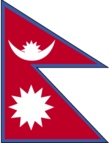
red with a blue border around the unique shape of two overlapping right triangles; the smaller, upper triangle bears a white stylized moon and the larger, lower triangle displays a white 12-pointed sun; the color red represents the rhododendron (Nepal's national flower) and is a sign of victory and bravery, the blue border signifies peace and harmony; the two right triangles are a combination of two single pennons (pennants) that originally symbolized the Himalaya Mountains while their charges represented the families of the king (upper) and the prime minister, but today they are understood to denote Hinduism and Buddhism, the country's two main religions; the moon represents the serenity of the Nepalese people and the shade and cool weather in the Himalayas, while the sun depicts the heat and higher temperatures of the lower parts of Nepal; the moon and the sun are also said to express the hope that the nation will endure as long as these heavenly bodies Nepal is the only country in the world whose flag is not rectangular or square
Government type
federal democratic republic
Independence
1768 (unified by Prithvi Narayan SHAH)
International law organization participation
has not submitted an ICJ jurisdiction declaration; non-party state to the ICCt
International organization participation
ADB, BIMSTEC, CD, CP, FAO, G-77, IAEA, IBRD, ICAO, ICC, ICRM, IDA, IFAD, IFC, IFRCS, ILO, IMF, IMO, Interpol, IOC, IOM, IPU, ISO (correspondent), ITSO, ITU, ITUC (NGOs), MIGA, MINURSO, MINUSTAH, MONUSCO, NAM, OPCW, SAARC, SACEP, UN, UNAMID, UNCTAD, UNESCO, UNIDO, UNIFIL, UNISFA, UNMIL, UNMISS, UNMIT, UNOCI, UNTSO, UNWTO, UPU, WCO, WFTU (NGOs), WHO, WIPO, WMO, WTO
Judicial branch
- Supreme Court (consists of the chief justice and up to 14 judges note - Nepal's judiciary was restructured under its 2007 Interim Constitution the Supreme Court chief justice appointed by the prime minister on the recommendation of the Constitutional Council; other judges are appointed by the prime minister on the recommendation of the Judicial Council; judges serve until age 65 appellate and district courts
- highest court(s)
- Supreme Court (consists of the chief justice and up to 14 judges
- judge selection and term of office
- the Supreme Court chief justice appointed by the prime minister on the recommendation of the Constitutional Council; other judges are appointed by the prime minister on the recommendation of the Judicial Council; judges serve until age 65
- subordinate courts
- appellate and district courts
Legal system
English common law and Hindu legal concepts
Legislative branch
- in May 2012 Prime Minister Baburam BHATTARAI dissolved the previous unicameral Constituent Assembly unicameral Constituent Assembly (601 seats; 240 members elected by direct popular vote, 335 by proportional representation, and 26 appointed by the Cabinet (Council of Ministers) last held on 10 April 2008; note - the Constituent Assembly failed to draft a new constitution by the 27 May 2012 deadline; as of early 2013, the parties were in negotiations to hold elections for a new Constituent Assembly percent of vote by party - CPN-M 38%, NC 19%, CPN-UML 18%, Madhesi People's Right Forum-Nepal 9%, other 11%; seats by party - CPN-M 229, NC 115, CPN-UML 108, Madhesi People's Rights Forum-Nepal 54, Terai Madhes Democratic Party 21, other smaller parties 74; note - 26 seats filled by the new Cabinet are included in the totals above
- election results
- percent of vote by party - CPN-M 38%, NC 19%, CPN-UML 18%, Madhesi People's Right Forum-Nepal 9%, other 11%; seats by party - CPN-M 229, NC 115, CPN-UML 108, Madhesi People's Rights Forum-Nepal 54, Terai Madhes Democratic Party 21, other smaller parties 74; note - 26 seats filled by the new Cabinet are included in the totals above
- elections
- last held on 10 April 2008; note - the Constituent Assembly failed to draft a new constitution by the 27 May 2012 deadline; as of early 2013, the parties were in negotiations to hold elections for a new Constituent Assembly
- note
- in May 2012 Prime Minister Baburam BHATTARAI dissolved the previous unicameral Constituent Assembly
National anthem
- "Sayaun Thunga Phool Ka" (Hundreds of Flowers) Pradeep Kumar RAI/Ambar GURUNG adopted 2007; after the abolition of the monarchy in 2006, a new anthem was required because of the previous anthem's praise for the king
- lyrics/music
- Pradeep Kumar RAI/Ambar GURUNG
- name
- "Sayaun Thunga Phool Ka" (Hundreds of Flowers)
National holiday
Republic Day, 29 May
National symbol(s)
rhododendron blossom
Political parties and leaders
Chure Bhawar Rastriya Ekata Party [Himalaya Bhakta PRADHANGA] Communist Party of Nepal-Marxist Leninist or CPN-ML [C.P. MAINALI] Communist Party of Nepal-Marxist Leninist Samaibadi [Jaqat Bahadur BOGATI] Communist Party of Nepal-Maoist or CPN-M [Mohan BAIDYA, also known as KIRAN] Communist Party of Nepal-Unified [Raj Singh SHRIS] Communist Party of Nepal-United [Chandra Dev JOSHI] Communist Party of Nepal-Unified Marxist-Leninist or CPN-UML [Jhalanath KHANAL] Dalit Janajati Party [Vishwendraman PASHWAN] Federal Democratic National Forum [Khagendra MAKHAIM] Federal Democratic National Forum - Tharuhat [Rukmini CHAUDHARY] Federal Democratic National Party [Ravindra THING] Federal Socialist Party [Ashok RAI] Federal Sadbhayana Party [Anil JHAL] Janta Dal United [Biswonath Prasad AGRAWAL] Madhesi People's Rights Forum-Democratic [Bijay Kumar GACHHADAR] Madhesi People's Rights Forum-Nepal [Upendra YADAV] Madhesi People's Rights Forum-Republic [Raj Kishore YADAV] National Madhes Socialist Party [Sharat Singh BHANDARI] Nepal Loktantrik Samajbadi Dal [Laxmi Lal CHAUDBARY] Nepal Pariwar Dal [Eknath DHAKAL] Nepal Workers and Peasants Party [Narayan Man BIJUKCHHE] Nepali Congress or NC [Sushil KOIRALA] Nepali Janata Dal [Hari Charan SAH] Newa Rastriya Party [Keshav Man SHAKYA] Rastriya Janamorcha [Chitra Bahadur K.C.] Rastriya Janamukti Party [Malwar Singh THAPA] Rastriya Janashakti Party or RJP [Surya Bahadur THAPA] Rastriya Prajantantra Party [Pashupati Shumsher RANA] Rastriya Prajantantra Party Nepal [Kamal THAPA] Sadbhavana Party [Rajendra MAHATO] Sadbhavana Party-Anandi Devi [Sarita GIRI] Samajbadi Prajatantrik Janata Party Nepal [Prem Bahadur SINGH] Social Democratic Party [Chaitanya SUBBA] Terai Madhes Democratic Party [Mahantha THAKUR] Terai Madhes Democratic Party-Nepal [Mahendra YADAVI] Unified Communist Party of Nepal (Maoist) [Pushpa Kamal DAHAL, also known as PRACHANDA]
Political pressure groups and leaders
- small armed groups along the southern border with India; a variety of groups advocating regional autonomy for individual ethnic groups
- other
- small armed groups along the southern border with India; a variety of groups advocating regional autonomy for individual ethnic groups
Suffrage
18 years of age; universal
Economy
Agriculture - products
pulses, rice, corn, wheat, sugarcane, jute, root crops; milk, water buffalo meat
Budget
- $3.5 billion $4.7 billion (FY11/12)
- expenditures
- $4.7 billion (FY11/12)
- revenues
- $3.5 billion
Budget surplus (+) or deficit (-)
-6.4% of GDP (FY11/12)
Central bank discount rate
6% (31 December 2010 est.) 6.5% (31 December 2009 est.)
Commercial bank prime lending rate
8% (31 December 2012 est.) 8% (31 December 2011 est.)
Current account balance
$283.9 million (2012 est.) $49 million (2011 est.)
Debt - external
$3.956 billion (31 December 2011 est.) $3.673 billion (31 December 2010 est.)
Distribution of family income - Gini index
32.8 (2010) 47.2 (2008 est.)
Economy - overview
Nepal is among the poorest and least developed countries in the world, with about one-quarter of its population living below the poverty line. Agriculture is the mainstay of the economy, providing a livelihood for three-fourths of the population and accounting for a little over one-third of GDP. Industrial activity mainly involves the processing of agricultural products, including pulses, jute, sugarcane, tobacco, and grain. Nepal has considerable scope for exploiting its potential in hydropower, with an estimated 42,000 MW of feasible capacity, but political instability hampers foreign investment. Additional challenges to Nepal's growth include its landlocked geographic location, civil strife and labor unrest, and its susceptibility to natural disaster.
Exchange rates
Nepalese rupees (NPR) per US dollar - 85.2 (2012 est.) 74.02 (2011 est.) 73.16 (2010 est.) 77.44 (2009) 65.21 (2008)
Exports
$1.004 billion (2012 est.) $998.9 million (2011 est.)
Exports - commodities
clothing, pulses, carpets, textiles, juice, pashima, jute goods
Exports - partners
India 59.1%, US 9.3%, Germany 4.1% (2012)
Fiscal year
16 July - 15 July
GDP - composition, by end use
- 76% 10.7% 20% 14.9% 10% -31.8% (2012 est.)
- exports of goods and services
- 10%
- government consumption
- 10.7%
- household consumption
- 76%
- imports of goods and services
- -31.8%
- investment in fixed capital
- 20%
- investment in inventories
- 14.9%
GDP - composition, by sector of origin
- 38.1% 15.3% 46.6% (2012 est.)
- agriculture
- 38.1%
- industry
- 15.3%
- services
- 46.6% (2012 est.)
GDP - per capita (PPP)
$1,500 (2012 est.) $1,400 (2011 est.) $1,400 (2010 est.) data are in 2012 US dollars
GDP - real growth rate
4.9% (2012 est.) 3.4% (2011 est.) 4.8% (2010 est.)
GDP (official exchange rate)
$18.7 billion (2012 est.)
GDP (purchasing power parity)
$40.03 billion (2012 est.) $38.17 billion (2011 est.) $36.91 billion (2010 est.) data are in 2012 US dollars
Household income or consumption by percentage share
- 3.2% 29.5% (2011)
- highest 10%
- 29.5% (2011)
- lowest 10%
- 3.2%
Imports
$5.951 billion (2012 est.) $5.665 billion (2011 est.)
Imports - commodities
petroleum products, machinery and equipment, gold, electrical goods, medicine
Imports - partners
India 52.3%, China 33.6% (2012)
Industrial production growth rate
3% (2012 est.)
Industries
tourism, carpets, textiles; small rice, jute, sugar, and oilseed mills; cigarettes, cement and brick production
Inflation rate (consumer prices)
9.5% (2012 est.) 9.5% (2011 est.)
Labor force
18 million severe lack of skilled labor (2009 est.)
Labor force - by occupation
- 75% 7% 18% (2010 est.)
- agriculture
- 75%
- industry
- 7%
- services
- 18% (2010 est.)
Market value of publicly traded shares
$4.529 billion (31 December 2011 est.) $4.843 billion (31 December 2010) $5.485 billion (31 December 2009 est.)
Population below poverty line
25.2% (2011 est.)
Reserves of foreign exchange and gold
$4.339 billion (31 December 2012 est.) $3.655 billion (31 December 2011 est.)
Stock of broad money
$12.12 billion (31 December 2011 est.) $12.14 billion (31 December 2010 est.)
Stock of direct foreign investment - abroad
$NA
Stock of direct foreign investment - at home
$NA
Stock of domestic credit
$11.88 billion (31 December 2012 est.) $10.67 billion (31 December 2011 est.)
Stock of narrow money
$3.104 billion (31 December 2012 est.) $2.723 billion (31 December 2011 est.)
Taxes and other revenues
18.7% of GDP (FY11/12)
Unemployment rate
46% (2008 est.) 42% (2004 est.)
Energy
Carbon dioxide emissions from consumption of energy
3.173 million Mt (2011 est.)
Crude oil - exports
0 bbl/day (2010 est.)
Crude oil - imports
0 bbl/day (2010 est.)
Crude oil - production
0 bbl/day (2012 est.)
Crude oil - proved reserves
0 bbl (1 January 2013 es)
Electricity - consumption
2.745 billion kWh (2010 est.)
Electricity - exports
30 million kWh (2010 est.)
Electricity - from fossil fuels
7.9% of total installed capacity (2010 est.)
Electricity - from hydroelectric plants
92.1% of total installed capacity (2010 est.)
Electricity - from nuclear fuels
0% of total installed capacity (2010 est.)
Electricity - from other renewable sources
0% of total installed capacity (2010 est.)
Electricity - imports
694 million kWh (2010 est.)
Electricity - installed generating capacity
721,000 kW (2010 est.)
Electricity - production
3.431 billion kWh (2012 est.)
Natural gas - consumption
0 cu m (2010 est.)
Natural gas - exports
0 cu m (2011 est.)
Natural gas - imports
0 cu m (2011 est.)
Natural gas - production
0 cu m (2011 est.)
Natural gas - proved reserves
0 cu m (1 January 2013 es)
Refined petroleum products - consumption
18,430 bbl/day (2011 est.)
Refined petroleum products - exports
0 bbl/day (2010 est.)
Refined petroleum products - imports
21,960 bbl/day (2010 est.)
Refined petroleum products - production
0 bbl/day (2010 est.)
Communications
Broadcast media
state operates 2 TV stations as well as national and regional radio stations; roughly 30 independent TV channels are registered with only about half in regular operation; nearly 400 FM radio stations are licensed with roughly 300 operational (2007)
Internet country code
.np
Internet hosts
41,256 (2012)
Internet users
577,800 (2009)
Telephone system
- poor telephone and telegraph service; fair radiotelephone communication service and mobile-cellular telephone network mobile-cellular telephone subscribership base is increasing with roughly 90% of the population living in areas covered by mobile carriers country code - 977; radiotelephone communications; microwave and fiber landlines to India; satellite earth station - 1 Intelsat (Indian Ocean) (2011)
- domestic
- mobile-cellular telephone subscribership base is increasing with roughly 90% of the population living in areas covered by mobile carriers
- general assessment
- poor telephone and telegraph service; fair radiotelephone communication service and mobile-cellular telephone network
- international
- country code - 977; radiotelephone communications; microwave and fiber landlines to India; satellite earth station - 1 Intelsat (Indian Ocean) (2011)
Telephones - main lines in use
834,000 (2013)
Telephones - mobile cellular
18.138 million (2013)
Transportation
Airports
47 (2013)
Airports - with paved runways
- 1 (2013)
- 1,524 to 2,437 m
- 3
- 914 to 1,523 m
- 6
- over 3,047 m
- 1
- total
- 11
- under 914 m
- 1 (2013)
Airports - with unpaved runways
- 29 (2013)
- 1,524 to 2,437 m
- 1
- 914 to 1,523 m
- 6
- total
- 36
Railways
- 59 km 59 km 0.762-m gauge (2008)
- total
- 59 km
Roadways
- 10,844 km 4,952 km 5,892 km (2010)
- total
- 10,844 km
- unpaved
- 5,892 km (2010)
Military and Security
Manpower available for military service
- 6,941,152 7,618,397 (2010 est.)
- females age 16-49
- 7,618,397 (2010 est.)
- males age 16-49
- 6,941,152
Manpower fit for military service
- 5,260,878 5,947,512 (2010 est.)
- females age 16-49
- 5,947,512 (2010 est.)
- males age 16-49
- 5,260,878
Manpower reaching militarily significant age annually
- 380,172 367,103 (2010 est.)
- female
- 367,103 (2010 est.)
- male
- 380,172
Military branches
Nepal Army (2012)
Military expenditures
1.3% of GDP (2012)
Military service age and obligation
18 years of age for voluntary military service; 15 years of age for military training; no conscription (2012)
Transnational Issues
Disputes - international
joint border commission continues to work on contested sections of boundary with India, including the 400 square kilometer dispute over the source of the Kalapani River; India has instituted a stricter border regime to restrict transit of Maoist insurgents and illegal cross-border activities
Illicit drugs
illicit producer of cannabis and hashish for the domestic and international drug markets; transit point for opiates from Southeast Asia to the West
Refugees and internally displaced persons
- 15,0000-20,000 (Tibet/China); about 43,000 (Bhutan) (2012) 50,000 (remaining from ten-year Maoist insurgency that officially ended in 2006; figure does not include people displaced since 2007 by inter-communal violence and insecurity in the Terai region) (2012) 800,000 (2011); note - in 2007-2008 the government distributed 2.6 million citizenship certificates to the 3.4 million people without one; the remaining 800,000 without citizenship certificates are not necessarily stateless, and the UNHCR is working with the Nepali Government to clarify their situation; lesser numbers of Bhutanese Hindu refugees of Nepali origin (the Lhotsampa) who were stripped of Bhutanese nationality and forced to flee their country in the late 1980s and early 1990s - and undocumented Tibetan refugees who arrived in Nepal prior to the 1990s - are considered stateless
- IDPs
- 50,000 (remaining from ten-year Maoist insurgency that officially ended in 2006; figure does not include people displaced since 2007 by inter-communal violence and insecurity in the Terai region) (2012)
- refugees (country of origin)
- 15,0000-20,000 (Tibet/China); about 43,000 (Bhutan) (2012)
- stateless persons
- 800,000 (2011); note - in 2007-2008 the government distributed 2.6 million citizenship certificates to the 3.4 million people without one; the remaining 800,000 without citizenship certificates are not necessarily stateless, and the UNHCR is working with the Nepali Government to clarify their situation; lesser numbers of Bhutanese Hindu refugees of Nepali origin (the Lhotsampa) who were stripped of Bhutanese nationality and forced to flee their country in the late 1980s and early 1990s - and undocumented Tibetan refugees who arrived in Nepal prior to the 1990s - are considered stateless