2008 Edition
CIA World Factbook 2008 (Project Gutenberg)
Introduction
Background
In 788, about a century after the Arab conquest of North Africa, successive Moorish dynasties began to rule in Morocco. In the 16th century, the Sa'adi monarchy, particularly under Ahmad AL-MANSUR (1578-1603), repelled foreign invaders and inaugurated a golden age. In 1860, Spain occupied northern Morocco and ushered in a half century of trade rivalry among European powers that saw Morocco's sovereignty steadily erode; in 1912, the French imposed a protectorate over the country. A protracted independence struggle with France ended successfully in 1956. The internationalized city of Tangier and most Spanish possessions were turned over to the new country that same year. Morocco virtually annexed Western Sahara during the late 1970s, but final resolution on the status of the territory remains unresolved. Gradual political reforms in the 1990s resulted in the establishment of a bicameral legislature, which first met in 1997. Improvements in human rights have occurred and there is a largely free press. Despite the continuing reforms, ultimate authority remains in the hands of the monarch.
Geography
Area
total: 446,550 sq km land: 446,300 sq km water: 250 sq km
Area - comparative
slightly larger than California
Climate
Mediterranean, becoming more extreme in the interior
Coastline
1,835 km
Elevation extremes
lowest point: Sebkha Tah -55 m highest point: Jebel Toubkal 4,165 m
Environment - current issues
land degradation/desertification (soil erosion resulting from farming of marginal areas, overgrazing, destruction of vegetation); water supplies contaminated by raw sewage; siltation of reservoirs; oil pollution of coastal waters
Environment - international agreements
party to: Biodiversity, Climate Change, Climate Change-Kyoto Protocol, Desertification, Endangered Species, Hazardous Wastes, Law of the Sea, Marine Dumping, Ozone Layer Protection, Ship Pollution, Wetlands, Whaling signed, but not ratified: Environmental Modification
Freshwater withdrawal (domestic/industrial/agricultural)
total: 12.6 cu km/yr (10%/3%/87%) per capita: 400 cu m/yr (2000)
Geographic coordinates
32 00 N, 5 00 W
Geography - note
strategic location along Strait of Gibraltar
Irrigated land
14,450 sq km (2003)
Land boundaries
total: 2,017.9 km border countries: Algeria 1,559 km, Western Sahara 443 km, Spain (Ceuta) 6.3 km, Spain (Melilla) 9.6 km
Land use
arable land: 19% permanent crops: 2% other: 79% (2005)
Location
Northern Africa, bordering the North Atlantic Ocean and the Mediterranean Sea, between Algeria and Western Sahara
Map references
Africa
Maritime claims
territorial sea: 12 nm contiguous zone: 24 nm exclusive economic zone: 200 nm continental shelf: 200 m depth or to the depth of exploitation
Natural hazards
northern mountains geologically unstable and subject to earthquakes; periodic droughts
Natural resources
phosphates, iron ore, manganese, lead, zinc, fish, salt
Terrain
northern coast and interior are mountainous with large areas of bordering plateaus, intermontane valleys, and rich coastal plains
Total renewable water resources
29 cu km (2003)
People and Society
Age structure
0-14 years: 30.5% (male 5,337,322/female 5,136,156) 15-64 years: 64.3% (male 11,015,409/female 11,069,038) 65 years and over: 5.2% (male 765,882/female 1,019,412) (2008 est.)
Birth rate
21.31 births/1,000 population (2008 est.)
Death rate
5.49 deaths/1,000 population (2008 est.)
Education expenditures
NA
Ethnic groups
Arab-Berber 99.1%, other 0.7%, Jewish 0.2%
HIV/AIDS - adult prevalence rate
0.1% (2001 est.)
HIV/AIDS - deaths
NA
HIV/AIDS - people living with HIV/AIDS
15,000 (2001 est.)
Infant mortality rate
total: 38.22 deaths/1,000 live births male: 41.74 deaths/1,000 live births female: 34.53 deaths/1,000 live births (2008 est.)
Languages
Arabic (official), Berber dialects, French often the language of business, government, and diplomacy
Life expectancy at birth
total population: 71.52 years male: 69.16 years female: 74 years (2008 est.)
Literacy
definition: age 15 and over can read and write total population: 52.3% male: 65.7% female: 39.6% (2004 census)
Median age
total: 24.7 years male: 24.1 years female: 25.2 years (2008 est.)
Nationality
noun: Moroccan(s) adjective: Moroccan
Net migration rate
-0.77 migrant(s)/1,000 population (2008 est.)
Population
34,343,220 (July 2008 est.)
Population growth rate
1.505% (2008 est.)
Religions
Muslim 98.7%, Christian 1.1%, Jewish 0.2%
School life expectancy (primary to tertiary education)
total: 10 years male: 11 years female: 9 years (2005)
Sex ratio
at birth: 1.05 male(s)/female under 15 years: 1.04 male(s)/female 15-64 years: 1 male(s)/female 65 years and over: 0.75 male(s)/female total population: 0.99 male(s)/female (2008 est.)
Total fertility rate
2.57 children born/woman (2008 est.)
Government
Administrative divisions
15 regions; Grand Casablanca, Chaouia-Ouardigha, Doukkala-Abda, Fes-Boulemane, Gharb-Chrarda-Beni Hssen, Guelmim-Es Smara, Laayoune-Boujdour-Sakia El Hamra, Marrakech-Tensift-Al Haouz, Meknes-Tafilalet, Oriental, Rabat-Sale-Zemmour-Zaer, Souss-Massa-Draa, Tadla-Azilal, Tanger-Tetouan, Taza-Al Hoceima-Taounate note: Morocco claims the territory of Western Sahara, the political status of which is considered undetermined by the US Government; portions of the regions Guelmim-Es Smara and Laayoune-Boujdour-Sakia El Hamra as claimed by Morocco lie within Western Sahara; Morocco claims another region, Oued Eddahab-Lagouira, which falls entirely within Western Sahara
Capital
name: Rabat geographic coordinates: 34 01 N, 6 49 W time difference: UTC 0 (5 hours ahead of Washington, DC during Standard Time)
Constitution
10 March 1972; revised 4 September 1992, amended (to create bicameral legislature) September 1996
Country name
conventional long form: Kingdom of Morocco conventional short form: Morocco local long form: Al Mamlakah al Maghribiyah local short form: Al Maghrib
Diplomatic representation from the US
chief of mission: Ambassador Thomas T. RILEY embassy: 2 Avenue de Mohamed El Fassi, Rabat mailing address: PSC 74, Box 021, APO AE 09718 telephone: [212] (37) 76 22 65
Diplomatic representation in the US
chief of mission: Ambassador Aziz MEKOUAR chancery: 1601 21st Street NW, Washington, DC 20009 telephone: [1] (202) 462-7979
Executive branch
chief of state: King MOHAMED VI (since 30 July 1999) head of government: Prime Minister Abbas EL FASSI (since 19 September 2007) cabinet: Council of Ministers appointed by the monarch elections: the monarch is hereditary; prime minister appointed by the monarch following legislative elections
FAX
- [1] (202) 265-0161 consulate(s) general: New York
- [212] (37) 76 56 61 consulate(s) general: Casablanca
Flag description
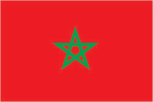
red with a green pentacle (five-pointed, linear star) known as Sulayman's (Solomon's) seal in the center of the flag; red and green are traditional colors in Arab flags, although the use of red is more commonly associated with the Arab states of the Persian gulf; design dates to 1912
Government type
constitutional monarchy
Independence
2 March 1956 (from France)
International organization participation
ABEDA, AfDB, AFESD, AMF, AMU, EBRD, FAO, G-77, IAEA, IBRD, ICAO, ICC, ICCt (signatory), ICRM, IDA, IDB, IFAD, IFC, IFRCS, IHO, ILO, IMF, IMO, IMSO, Interpol, IOC, IOM, IPU, ISO, ITSO, ITU, ITUC, LAS, MIGA, MONUC, NAM, OAS (observer), OIC, OIF, OPCW, OSCE (partner), PCA, UN, UNCTAD, UNESCO, UNHCR, UNIDO, UNOCI, UNWTO, UPU, WCL, WCO, WFTU, WHO, WIPO, WMO, WTO
Judicial branch
Supreme Court (judges are appointed on the recommendation of the Supreme Council of the Judiciary, presided over by the monarch)
Legal system
based on Islamic law and French and Spanish civil law systems; judicial review of legislative acts in Constitutional Chamber of Supreme Court; has not accepted compulsory ICJ jurisdiction
Legislative branch
bicameral Parliament consists of a Chamber of Counselors (or upper house) (270 seats; members elected indirectly by local councils, professional organizations, and labor syndicates for nine-year terms; one-third of the members are elected every three years) and Chamber of Representatives (or lower house) (325 seats; 295 members elected by multi-seat constituencies and 30 from national lists of women; members elected by popular vote for five-year terms) elections: Chamber of Counselors - last held 8 September 2006 (next to be held in 2009); Chamber of Representatives - last held 7 September 2007 (next to be held in 2012) election results: Chamber of Counselors - percent of vote by party - NA; seats by party - PI 17, MP 14, RNI 13, USFP 11, UC 6, PND 4, PPS 4, Al Ahd 4, other 17; Chamber of Representatives - percent of vote by party - NA; seats by party - PI 52, PJD 46, MP 41, RNI 39, USFP 38, UC 27, PPS 17, FFD 9, MDS 9, Al Ahd 8, other 39
National holiday
Throne Day (accession of King MOHAMED VI to the throne), 30 July (1999)
Political parties and leaders
Action Party or PA [Muhammad EL IDRISSI]; Alliance of Liberties or ADL [Ali BELHAJ]; Annahj Addimocrati or Annahj [Abdellah EL HARIF]; Avant Garde Social Democratic Party or PADS [Ahmed BENJELLOUN]; Citizen Forces or FC [Abderrahman LAHJOUJI]; Citizen's Initiatives for Development [Mohamed BENHAMOU]; Constitutional Union or UC [Mohamed ABIED]; Democratic and Independence Party or PDI [Abdelwahed MAACH]; Democratic and Social Movement or MDS [Mahmoud ARCHANE]; Democratic Forces Front or FFD; Democratic Socialist Party or PSD [Aissa OUARDIGHI]; Democratic Society Party or PSD [Zhor CHEKKAFI]; Democratic Union or UD [Bouazza IKKEN]; Environment and Development Party or PED [Ahmed EL ALAMI]; Front of Democratic Forces or FFD [Thami EL KHYARI]; Independence Party (Istiqlal) or PI [Abbas EL FASSI]; Justice and Development Party or PJD [Abdelilah BENKIRANE]; Labor Party [Abdelkrim BENATIK]; Moroccan Liberal Party or PML [Mohamed ZIANE]; National Democratic Party or PND [Abdallah KADIRI]; National Ittihadi Congress Party or CNI [Abdelmajid BOUZOUBAA]; National Rally of Independents or RNI [Mustapha EL MANSOURI]; National Union of Popular Forces or UNFP [Abdellah IBRAHIM]; Parti Al Ahd or Al Ahd [Najib EL OUAZZANI]; Party of Progress and Socialism or PPS [Ismail ALAOUI]; Party of Renewal and Equity or PRE [Chakir ACHABAR]; Party of the Unified Socialist Left or GSU [Mohamed Ben Said AIT IDDER]; Popular Movement or MP [Mohamed LAENSER]; Reform and Development Party or PRD [Abderrahmane EL KOUHEN]; Social Center Party or PSC [Lahcen MADIH]; Socialist Union of Popular Forces or USFP
Political pressure groups and leaders
Democratic Confederation of Labor or CDT [Noubir AMAOUI]; General Union of Moroccan Workers or UGTM [Abderrazzak AFILAL]; Moroccan Employers Association or CGEM [Hassan CHAMI]; National Labor Union of Morocco or UNMT [Abdelslam MAATI]; Union of Moroccan Workers or UMT [Mahjoub BENSEDDIK]
Suffrage
18 years of age; universal (as of January 2003)
Economy
Agriculture - products
barley, wheat, citrus, wine, vegetables, olives; livestock
Budget
revenues: $20.49 billion expenditures: $21.85 billion (2007 est.)
Central bank discount rate
3.25% (31 December 2007)
Commercial bank prime lending rate
NA (31 December 2007)
Currency (code)
Moroccan dirham (MAD)
Currency code
MAD
Current account balance
-$1.834 billion (2007 est.)
Debt - external
$19.91 billion (31 December 2007 est.)
Distribution of family income - Gini index
40 (2005 est.)
Economic aid - recipient
ODA, $651.8 million (2005)
Economy - overview
Moroccan economic policies brought macroeconomic stability to the country in the early 1990s but have not spurred growth sufficient to reduce unemployment - nearing 20% in urban areas - despite the Moroccan Government's ongoing efforts to diversify the economy. Morocco's GDP growth rate slowed to 2.1% in 2007 as a result of a draught that severely reduced agricultural output and necessitated wheat imports at rising world prices. Continued dependence on foreign energy and Morocco's inability to develop small and medium size enterprises also contributed to the slowdown. Moroccan authorities understand that reducing poverty and providing jobs are key to domestic security and development. In 2005, Morocco launched the National Initiative for Human Development (INDH), a $2 billion social development plan to address poverty and unemployment and to improve the living conditions of the country's urban slums. Moroccan authorities are implementing reform efforts to open the economy to international investors. Despite structural adjustment programs supported by the IMF, the World Bank, and the Paris Club, the dirham is only fully convertible for current account transactions. In 2000, Morocco entered an Association Agreement with the EU and, in 2006, entered a Free Trade Agreement (FTA) with the US. Long-term challenges include improving education and job prospects for Morocco's youth, and closing the income gap between the rich and the poor, which the government hopes to achieve by increasing tourist arrivals and boosting competitiveness in textiles.
Electricity - consumption
19.58 billion kWh (2006 est.)
Electricity - exports
0 kWh (2007 est.)
Electricity - imports
1.998 billion kWh (2006 est.)
Electricity - production
21.88 billion kWh (2006 est.)
Electricity - production by source
fossil fuel: 95.4% hydro: 4.6% nuclear: 0% other: 0% (2001)
Exchange rates
Moroccan dirhams (MAD) per US dollar - 8.3563 (2007), 8.7722 (2006), 8.865 (2005), 8.868 (2004), 9.574 (2003)
Exports
$12.75 billion f.o.b. (2007 est.)
Exports - commodities
clothing and textiles, electric components, inorganic chemicals, transistors, crude minerals, fertilizers (including phosphates), petroleum products, citrus fruits, vegetables, fish
Exports - partners
Spain 21.2%, France 19%, Italy 4.9%, UK 4.6%, India 4.2% (2007)
Fiscal year
calendar year
GDP - composition by sector
agriculture: 13.8% industry: 38.4% services: 47.8% (2007 est.)
GDP - per capita (PPP)
$3,700 (2007 est.)
GDP - real growth rate
2.2% (2007 est.)
GDP (official exchange rate)
$73.43 billion (2007 est.)
GDP (purchasing power parity)
$125 billion (2007 est.)
Household income or consumption by percentage share
lowest 10%: 2.6% highest 10%: 30.9% (1999)
Imports
$28.5 billion f.o.b. (2007 est.)
Imports - commodities
crude petroleum, textile fabric, telecommunications equipment, wheat, gas and electricity, transistors, plastics
Imports - partners
France 16.1%, Spain 13.6%, China 7.3%, Italy 6.7%, Saudi Arabia 6.4%, Germany 5.9%, US 4.5%, Netherlands 4.1% (2007)
Industrial production growth rate
5% (2007 est.)
Industries
phosphate rock mining and processing, food processing, leather goods, textiles, construction, tourism
Inflation rate (consumer prices)
2% (2007 est.)
Investment (gross fixed)
29.7% of GDP (2007 est.)
Labor force
11.39 million (2007 est.)
Labor force - by occupation
agriculture: 40% industry: 15% services: 45% (2003 est.)
Market value of publicly traded shares
$49.6 billion (2006)
Natural gas - consumption
60 million cu m (2006 est.)
Natural gas - exports
0 cu m (2007 est.)
Natural gas - imports
0 cu m (2007 est.)
Natural gas - production
60 million cu m (2006 est.)
Natural gas - proved reserves
1.557 billion cu m (1 January 2008 est.)
Oil - consumption
179,700 bbl/day (2006 est.)
Oil - exports
24,360 bbl/day (2005 est.)
Oil - imports
192,500 bbl/day (2005 est.)
Oil - production
3,746 bbl/day (2007 est.)
Oil - proved reserves
836,000 bbl (1 January 2008 est.)
Population below poverty line
15% (2007 est.)
Public debt
67.4% of GDP (2007 est.)
Reserves of foreign exchange and gold
$24.72 billion (31 December 2007 est.)
Stock of direct foreign investment - abroad
$882 million (2006 est.)
Stock of direct foreign investment - at home
$32.9 billion (2007 est.)
Stock of domestic credit
$71.9 billion (31 December 2007)
Stock of money
$67.42 billion (31 December 2007)
Stock of quasi money
$16.23 billion (31 December 2007)
Unemployment rate
9.8% (2007 est.)
Communications
Internet country code
.ma
Internet hosts
275,889 (2008)
Internet Service Providers (ISPs)
8 (2000)
Internet users
7.3 million (2007)
Radio broadcast stations
AM 27, FM 25, shortwave 6 (1998)
Radios
6.64 million (1997)
Telephone system
general assessment: modern system with all important capabilities; however, density is low with only 7 fixed lines available for each 100 persons; mobile-cellular subscribership is approaching 60 per 100 persons domestic: good system composed of open-wire lines, cables, and microwave radio relay links; Internet available but expensive; principal switching centers are Casablanca and Rabat; national network nearly 100% digital using fiber-optic links; improved rural service employs microwave radio relay international: country code - 212; landing point for the SEA-ME-WE-3 optical telecommunications submarine cable that provides connectivity to Asia, the Middle East, and Europe; satellite earth stations - 2 Intelsat (Atlantic Ocean) and 1 Arabsat; microwave radio relay to Gibraltar, Spain, and Western Sahara; coaxial cable and microwave radio relay to Algeria; participant in Medarabtel; fiber-optic cable link from Agadir to Algeria and Tunisia (2007)
Telephones - main lines in use
2.394 million (2007)
Telephones - mobile cellular
20.029 million (2007)
Television broadcast stations
35 (plus 66 repeaters) (1995)
Televisions
3.1 million (1997)
Transportation
Airports
60 (2007)
Airports - with paved runways
total: 27 over 3,047 m: 11 2,438 to 3,047 m: 6 1,524 to 2,437 m: 7 914 to 1,523 m: 1 under 914 m: 2 (2007)
Airports - with unpaved runways
total: 33 2,438 to 3,047 m: 2 1,524 to 2,437 m: 9 914 to 1,523 m: 11 under 914 m: 11 (2007)
Heliports
1 (2007)
Merchant marine
total: 35 by type: cargo 3, chemical tanker 6, container 8, passenger/cargo 13, petroleum tanker 1, roll on/roll off 4 foreign-owned: 16 (France 14, Germany 2) registered in other countries: 4 (Gibraltar 4) (2008)
Pipelines
gas 720 km; oil 439 km (2007)
Ports and terminals
Agadir, Casablanca, Mohammedia, Safi
Railways
total: 1,907 km standard gauge: 1,907 km 1.435-m gauge (1,003 km electrified) (2006)
Roadways
total: 57,625 km paved: 35,664 km (includes 639 km of expressways) unpaved: 21,961 km (2006)
Military and Security
Manpower available for military service
males age 16-49: 9,152,580 females age 16-49: 9,080,830 (2008 est.)
Manpower fit for military service
males age 16-49: 7,627,988 females age 16-49: 7,754,873 (2008 est.)
Manpower reaching militarily significant age annually
male: 355,479 female: 343,016 (2008 est.)
Military expenditures
5% of GDP (2003 est.)
Military service age and obligation
18 years of age for compulsory and voluntary military service; conscript service obligation - 18 months (2004)
Royal Armed Forces (Forces Armees Royales, FAR)
Royal Moroccan Army (includes Air Defense), Navy (includes Marines), Royal Moroccan Air Force (Al Quwwat al Jawyiya al Malakiya Marakishiya; Force Aerienne Royale Marocaine) (2008)
Transnational Issues
Disputes - international
claims and administers Western Sahara whose sovereignty remains unresolved - UN-administered cease-fire has remained in effect since September 1991, but attempts to hold a referendum have failed and parties thus far have rejected all brokered proposals; Morocco protests Spain's control over the coastal enclaves of Ceuta, Melilla, and Penon de Velez de la Gomera, the islands of Penon de Alhucemas and Islas Chafarinas, and surrounding waters; discussions have not progressed on a comprehensive maritime delimitation, setting limits on resource exploration and refugee interdiction, since Morocco's 2002 rejection of Spain's unilateral designation of a median line from the Canary Islands; Morocco serves as one of the primary launching areas of illegal migration into Spain from North Africa
Illicit drugs
one of the world's largest producers of illicit hashish; shipments of hashish mostly directed to Western Europe; transit point for cocaine from South America destined for Western Europe; significant consumer of cannabis This page was last updated on 18 December, 2008