2017 Edition
CIA World Factbook 2017 Archive (HTML)
Introduction
Background
Part of Romania during the interwar period, Moldova was incorporated into the Soviet Union at the close of World War II. Although the country has been independent from the USSR since 1991, Russian forces have remained on Moldovan territory east of the Nistru River supporting the breakaway region of Transnistria, composed of a Slavic majority population (mostly Ukrainians and Russians), but with a sizable ethnic Moldovan minority. Years of Communist Party rule post-independence ultimately ended with election-related violent protests and a rerun of parliamentary elections in 2009. Since then, a series of pro-European ruling coalitions have governed Moldova. As a result of the country's most recent legislative election in November 2014, the three pro-European parties that entered Parliament won a total of 55 of the body's 101 seats. Infighting among coalition members led to prolonged legislative gridlock and political instability, as well as the collapse of two governments, all ruled by pro-European coalitions centered around the Liberal Democratic Party (PLDM) and the Democratic Party (PDM). A political impasse ended in January 2016 when a new parliamentary majority led by PDM, joined by defectors from the Communists and PLDM, supported Pavel FILIP as prime minister. Moldova remains Europe's poorest economy; the country signed and ratified an Association Agreement with the EU in 2014, which fully entered into force in July 2016 after ratification by all EU member states.
Geography
Area
- 33,851 sq km 32,891 sq km 960 sq km
- land
- 32,891 sq km
- total
- 33,851 sq km
- water
- 960 sq km
Area - comparative
slightly larger than Maryland
Climate
moderate winters, warm summers
Coastline
0 km (landlocked)
Elevation
- 139 m lowest point: Dniester (Nistru) 2 m highest point: Dealul Balanesti 430 m
- elevation extremes
- lowest point: Dniester (Nistru) 2 m
- highest point
- Dealul Balanesti 430 m
- mean elevation
- 139 m
Environment - current issues
heavy use of agricultural chemicals, including banned pesticides such as DDT, has contaminated soil and groundwater; extensive soil erosion from poor farming methods
Environment - international agreements
- Air Pollution, Air Pollution-Persistent Organic Pollutants, Biodiversity, Climate Change, Climate Change-Kyoto Protocol, Desertification, Endangered Species, Hazardous Wastes, Ozone Layer Protection, Ship Pollution, Wetlands none of the selected agreements
- party to
- Air Pollution, Air Pollution-Persistent Organic Pollutants, Biodiversity, Climate Change, Climate Change-Kyoto Protocol, Desertification, Endangered Species, Hazardous Wastes, Ozone Layer Protection, Ship Pollution, Wetlands
- signed, but not ratified
- none of the selected agreements
Geographic coordinates
47 00 N, 29 00 E
Geography - note
landlocked; well endowed with various sedimentary rocks and minerals including sand, gravel, gypsum, and limestone
Irrigated land
2,283 sq km (2012)
Land boundaries
- 1,885 km Romania 683 km, Ukraine 1,202 km
- border countries (2)
- Romania 683 km, Ukraine 1,202 km
- total
- 1,885 km
Land use
- 74.9% arable land 55.1%; permanent crops 9.1%; permanent pasture 10.7% 11.9% 13.2% (2011 est.)
- agricultural land
- 74.9%
- forest
- 11.9%
- other
- 13.2% (2011 est.)
Location
Eastern Europe, northeast of Romania
Map references
Europe
Maritime claims
none (landlocked)
Natural hazards
landslides
Natural resources
lignite, phosphorites, gypsum, limestone, arable land
Population - distribution
pockets of agglomeration exist throughout the country, the largest being in the center of the country around the capital of Chisinau, followed by Tiraspol and Balti
Terrain
rolling steppe, gradual slope south to Black Sea
People and Society
Age structure
- 18.18% (male 325,501/female 305,931) 12.32% (male 221,582/female 206,458) 43.4% (male 760,511/female 747,352) 13.46% (male 214,565/female 252,924) 12.64% (male 171,347/female 267,950) (2017 est.)
- 0-14 years
- 18.18% (male 325,501/female 305,931)
- 15-24 years
- 12.32% (male 221,582/female 206,458)
- 25-54 years
- 43.4% (male 760,511/female 747,352)
- 55-64 years
- 13.46% (male 214,565/female 252,924)
- 65 years and over
- 12.64% (male 171,347/female 267,950) (2017 est.)
Birth rate
11.5 births/1,000 population (2017 est.)
Children under the age of 5 years underweight
2.2% (2012)
Contraceptive prevalence rate
59.5% (2012)
Death rate
12.6 deaths/1,000 population (2017 est.)
Dependency ratios
- 34.5 21.2 13.4 7.5 (2015 est.)
- elderly dependency ratio
- 13.4
- potential support ratio
- 7.5 (2015 est.)
- total dependency ratio
- 34.5
- youth dependency ratio
- 21.2
Drinking water source
- urban: 96.9% of population rural: 81.4% of population total: 88.4% of population urban: 3.1% of population rural: 18.6% of population total: 11.6% of population (2015 est.)
- rural
- 18.6% of population
- total
- 11.6% of population (2015 est.)
- urban
- 3.1% of population
Education expenditures
7.5% of GDP (2014)
Ethnic groups
Moldovan 75.1%, Romanian 7%, Ukrainian 6.6%, Gagauz 4.6%, Russian 4.1%, Bulgarian 1.9%, other 0.8% (2014 est.)
Health expenditures
10.3% of GDP (2014)
HIV/AIDS - adult prevalence rate
0.6% (2016 est.)
HIV/AIDS - people living with HIV/AIDS
15,000 (2016 est.)
Hospital bed density
6.2 beds/1,000 population (2012)
Infant mortality rate
- 12 deaths/1,000 live births 13.7 deaths/1,000 live births 10.1 deaths/1,000 live births (2017 est.)
- female
- 10.1 deaths/1,000 live births (2017 est.)
- male
- 13.7 deaths/1,000 live births
- total
- 12 deaths/1,000 live births
Languages
- Romanian 80.2% (official) (56.7% identify their mother tongue as Moldovan, which is virtually the same as Romanian; 23.5% identify Romanian as their mother tongue), Russian 9.7%, Gagauz 4.2% (a Turkish language), Ukrainian 3.9%, Bulgarian 1.5%, Romani 0.3%, other 0.2% (2014 est.) data represent mother tongue
- note
- data represent mother tongue
Life expectancy at birth
- 71 years 67.1 years 75.1 years (2017 est.)
- female
- 75.1 years (2017 est.)
- male
- 67.1 years
- total population
- 71 years
Literacy
- age 15 and over can read and write 99.4% 99.7% 99.1% (2015 est.)
- definition
- age 15 and over can read and write
- female
- 99.1% (2015 est.)
- male
- 99.7%
- total population
- 99.4%
Major urban areas - population
CHISINAU (capital) 725,000 (2015)
Maternal mortality rate
23 deaths/100,000 live births (2015 est.)
Median age
- 36.7 years 34.9 years 38.6 years (2017 est.)
- female
- 38.6 years (2017 est.)
- male
- 34.9 years
- total
- 36.7 years
Mother's mean age at first birth
24 years (2014 est.)
Nationality
- Moldovan(s) Moldovan
- adjective
- Moldovan
- noun
- Moldovan(s)
Net migration rate
-9.4 migrant(s)/1,000 population (2017 est.)
Obesity - adult prevalence rate
18.9% (2016)
Physicians density
2.54 physicians/1,000 population (2014)
Population
3,474,121 (July 2017 est.)
Population distribution
pockets of agglomeration exist throughout the country, the largest being in the center of the country around the capital of Chisinau, followed by Tiraspol and Balti
Population growth rate
-1.05% (2017 est.)
Religions
Orthodox 90.1%, other Christian 2.6%, other 0.1%, agnostic
Sanitation facility access
- urban: 87.8% of population rural: 67.1% of population total: 76.4% of population urban: 12.2% of population rural: 32.9% of population total: 23.6% of population (2015 est.)
- rural
- 32.9% of population
- total
- 23.6% of population (2015 est.)
- urban
- 12.2% of population
School life expectancy (primary to tertiary education)
- 12 years 11 years 12 years (2015)
- female
- 12 years (2015)
- male
- 11 years
- total
- 12 years
Sex ratio
- 1.06 male(s)/female 1.06 male(s)/female 1.07 male(s)/female 1.01 male(s)/female 0.85 male(s)/female 0.62 male(s)/female 0.95 male(s)/female (2016 est.)
- 0-14 years
- 1.06 male(s)/female
- 15-24 years
- 1.07 male(s)/female
- 25-54 years
- 1.01 male(s)/female
- 55-64 years
- 0.85 male(s)/female
- 65 years and over
- 0.62 male(s)/female
- at birth
- 1.06 male(s)/female
- total population
- 0.95 male(s)/female (2016 est.)
Total fertility rate
1.57 children born/woman (2017 est.)
Unemployment, youth ages 15-24
- 12.8% 12.4% 13.5% (2015 est.)
- female
- 13.5% (2015 est.)
- male
- 12.4%
- total
- 12.8%
Urbanization
- 45.2% of total population (2017) -0.36% annual rate of change (2015-20 est.)
- rate of urbanization
- -0.36% annual rate of change (2015-20 est.)
- urban population
- 45.2% of total population (2017)
Government
Administrative divisions
- 32 raions (raioane, singular - raion), 3 municipalities (municipii, singular - municipiul), 1 autonomous territorial unit (unitatea teritoriala autonoma), and 1 territorial unit (unitatea teritoriala) Anenii Noi, Basarabeasca, Briceni, Cahul, Cantemir, Calarasi, Causeni, Cimislia, Criuleni, Donduseni, Drochia, Dubasari, Edinet, Falesti, Floresti, Glodeni, Hincesti, Ialoveni, Leova, Nisporeni, Ocnita, Orhei, Rezina, Riscani, Singerei, Soldanesti, Soroca, Stefan Voda, Straseni, Taraclia, Telenesti, Ungheni Balti, Bender, Chisinau Gagauzia Stinga Nistrului (Transnistria)
- autonomous territorial unit
- Gagauzia
- municipalities
- Balti, Bender, Chisinau
- raions
- Anenii Noi, Basarabeasca, Briceni, Cahul, Cantemir, Calarasi, Causeni, Cimislia, Criuleni, Donduseni, Drochia, Dubasari, Edinet, Falesti, Floresti, Glodeni, Hincesti, Ialoveni, Leova, Nisporeni, Ocnita, Orhei, Rezina, Riscani, Singerei, Soldanesti, Soroca, Stefan Voda, Straseni, Taraclia, Telenesti, Ungheni
- territorial unit
- Stinga Nistrului (Transnistria)
Capital
- Chisinau in Romanian (Kishinev in Russian) pronounced KEE-shee-now (KIH-shi-nyov) 47 00 N, 28 51 E UTC+2 (7 hours ahead of Washington, DC, during Standard Time) +1hr, begins last Sunday in March; ends last Sunday in October
- daylight saving time
- +1hr, begins last Sunday in March; ends last Sunday in October
- geographic coordinates
- 47 00 N, 28 51 E
- name
- Chisinau in Romanian (Kishinev in Russian)
- note
- pronounced KEE-shee-now (KIH-shi-nyov)
- time difference
- UTC+2 (7 hours ahead of Washington, DC, during Standard Time)
Citizenship
- no at least one parent must be a citizen of Moldova no 10 years
- citizenship by birth
- no
- citizenship by descent only
- at least one parent must be a citizen of Moldova
- dual citizenship recognized
- no
- residency requirement for naturalization
- 10 years
Constitution
- previous 1978; latest adopted 29 July 1994, effective 27 August 1994 proposed by voter petition (at least 200,000 eligible voters), by one-third of Parliament members, or by the government; passage requires two-thirds majority vote of Parliament within one year of initial proposal; revisions to constitutional articles on sovereignty, independence, and neutrality require majority vote by referendum; articles on fundamental rights and freedoms cannot be amended; amended several times, last in 2010; note – in early 2016, the Moldovan Constitutional Court decision returned the country to direct presidential elections, reversing a 2000 constitutional amendment that allowed Parliament to select the president (2016)
- amendments
- proposed by voter petition (at least 200,000 eligible voters), by one-third of Parliament members, or by the government; passage requires two-thirds majority vote of Parliament within one year of initial proposal; revisions to constitutional articles on sovereignty, independence, and neutrality require majority vote by referendum; articles on fundamental rights and freedoms cannot be amended; amended several times, last in 2010; note – in early 2016, the Moldovan Constitutional Court decision returned the country to direct presidential elections, reversing a 2000 constitutional amendment that allowed Parliament to select the president (2016)
- history
- previous 1978; latest adopted 29 July 1994, effective 27 August 1994
Country name
- Republic of Moldova Moldova Republica Moldova Moldova Moldavian Soviet Socialist Republic, Moldovan Soviet Socialist Republic named for the Moldova River in neighboring eastern Romania
- conventional long form
- Republic of Moldova
- conventional short form
- Moldova
- etymology
- named for the Moldova River in neighboring eastern Romania
- former
- Moldavian Soviet Socialist Republic, Moldovan Soviet Socialist Republic
- local long form
- Republica Moldova
- local short form
- Moldova
Diplomatic representation from the US
- Ambassador James D. PETTIT (since 30 January 2015) 103 Mateevici Street, Chisinau MD-2009 use embassy street address [373] (22) 40-8300 [373] (22) 23-3044
- chief of mission
- Ambassador James D. PETTIT (since 30 January 2015)
- embassy
- 103 Mateevici Street, Chisinau MD-2009
- FAX
- [373] (22) 23-3044
- mailing address
- use embassy street address
- telephone
- [373] (22) 40-8300
Diplomatic representation in the US
- Ambassador Aureliu CIOCOI (since 8 September 2017) 2101 S Street NW, Washington, DC 20008 [1] (202) 667-1130 [1] (202) 667-1204
- chancery
- 2101 S Street NW, Washington, DC 20008
- chief of mission
- Ambassador Aureliu CIOCOI (since 8 September 2017)
- FAX
- [1] (202) 667-1204
- telephone
- [1] (202) 667-1130
Executive branch
- President Igor DODON (since 23 December 2016) Prime Minister Pavel FILIP (since 20 January 2016) Cabinet proposed by the prime minister-designate, nominated by the president, approved through a vote of confidence in Parliament president directly elected for a 4-year term (eligible for a second term); election last held on 13 November 2016 (next to be held in fall 2020); prime minister designated by the president upon consultation with Parliament; within 15 days from designation, the prime minister-designate must request a vote of confidence for his/her proposed work program from the Parliament Igor DODON elected president; percent of vote - Igor DODON (PSRM) 52.2%, Maia SANDU (PAS) 47.8%; Pavel FILIP (PDM) designated prime minister; Parliament vote - 57 of 101
- cabinet
- Cabinet proposed by the prime minister-designate, nominated by the president, approved through a vote of confidence in Parliament
- chief of state
- President Igor DODON (since 23 December 2016)
- election results
- Igor DODON elected president; percent of vote - Igor DODON (PSRM) 52.2%, Maia SANDU (PAS) 47.8%; Pavel FILIP (PDM) designated prime minister; Parliament vote - 57 of 101
- elections/appointments
- president directly elected for a 4-year term (eligible for a second term); election last held on 13 November 2016 (next to be held in fall 2020); prime minister designated by the president upon consultation with Parliament; within 15 days from designation, the prime minister-designate must request a vote of confidence for his/her proposed work program from the Parliament
- head of government
- Prime Minister Pavel FILIP (since 20 January 2016)
Flag description
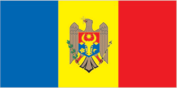
- three equal vertical bands of Prussian blue (hoist side), chrome yellow, and vermilion red; emblem in center of flag is of a Roman eagle of dark gold (brown) outlined in black with a red beak and talons carrying a yellow cross in its beak and a green olive branch in its right talons and a yellow scepter in its left talons; on its breast is a shield divided horizontally red over blue with a stylized aurochs head, star, rose, and crescent all in black-outlined yellow; based on the color scheme of the flag of Romania - with which Moldova shares a history and culture - but Moldova's blue band is lighter; the reverse of the flag displays a mirrored image of the coat of arms one of only three national flags that differ on their obverse and reverse sides - the others are Paraguay and Saudi Arabia
- note
- one of only three national flags that differ on their obverse and reverse sides - the others are Paraguay and Saudi Arabia
Government type
parliamentary republic
Independence
27 August 1991 (from the Soviet Union)
International law organization participation
has not submitted an ICJ jurisdiction declaration; accepts ICCt jurisdiction
International organization participation
BSEC, CD, CE, CEI, CIS, EAEC (observer), EAPC, EBRD, FAO, GCTU, GUAM, IAEA, IBRD, ICAO, ICC (NGOs), ICCt, ICRM, IDA, IFAD, IFC, IFRCS, ILO, IMF, IMO, Interpol, IOC, IOM, IPU, ISO (correspondent), ITU, ITUC (NGOs), MIGA, OIF, OPCW, OSCE, PFP, SELEC, UN, UNCTAD, UNESCO, UNHCR, UNIDO, Union Latina, UNMIL, UNMISS, UNOCI, UNWTO, UPU, WCO, WHO, WIPO, WMO, WTO
Judicial branch
- Supreme Court of Justice (consists of the chief judge, 3 deputy-chief judges, 45 judges, and 7 assistant judges); Constitutional Court (consists of the court president and 6 judges); note - the Constitutional Court is autonomous to the other branches of government; the Court interprets the Constitution and reviews the constitutionality of parliamentary laws and decisions, decrees of the president, and acts of the government Supreme Court of Justice judges appointed by the president of the republic upon the recommendation of the Superior Council of Magistracy (an 11-member body of judicial officials); all judges serve 4-year renewable terms; Constitutional Court judges appointed 2 each by Parliament, the Moldovan president, and the Higher Council of Magistracy; court president elected by other court judges for a 3-year term; other judges appointed for 6-year terms Courts of Appeal; Court of Business Audit; municipal courts
- highest court(s)
- Supreme Court of Justice (consists of the chief judge, 3 deputy-chief judges, 45 judges, and 7 assistant judges); Constitutional Court (consists of the court president and 6 judges); note - the Constitutional Court is autonomous to the other branches of government; the Court interprets the Constitution and reviews the constitutionality of parliamentary laws and decisions, decrees of the president, and acts of the government
- judge selection and term of office
- Supreme Court of Justice judges appointed by the president of the republic upon the recommendation of the Superior Council of Magistracy (an 11-member body of judicial officials); all judges serve 4-year renewable terms; Constitutional Court judges appointed 2 each by Parliament, the Moldovan president, and the Higher Council of Magistracy; court president elected by other court judges for a 3-year term; other judges appointed for 6-year terms
- subordinate courts
- Courts of Appeal; Court of Business Audit; municipal courts
Legal system
civil law system with Germanic law influences; Constitutional Court review of legislative acts
Legislative branch
- unicameral Parliament (101 seats; members directly elected in a single, nationwide constituency by proportional representation vote to serve 4-year terms) last held on 30 November 2014 (next to be held in November 2018) percent of vote by party - PSRM 20.5%, PLDM 20.2%, PCRM 17.5%, PDM 15.8%, PL 9.7%, other 16.3%; seats by party - PSRM 25, PLDM 23, PCRM 21, PDM 19, PL 13
- description
- unicameral Parliament (101 seats; members directly elected in a single, nationwide constituency by proportional representation vote to serve 4-year terms)
- election results
- percent of vote by party - PSRM 20.5%, PLDM 20.2%, PCRM 17.5%, PDM 15.8%, PL 9.7%, other 16.3%; seats by party - PSRM 25, PLDM 23, PCRM 21, PDM 19, PL 13
- elections
- last held on 30 November 2014 (next to be held in November 2018)
National anthem
- "Limba noastra" (Our Language) Alexei MATEEVICI/Alexandru CRISTEA adopted 1994
- lyrics/music
- Alexei MATEEVICI/Alexandru CRISTEA
- name
- "Limba noastra" (Our Language)
- note
- adopted 1994
National holiday
Independence Day, 27 August (1991)
National symbol(s)
- aurochs (a type of wild cattle); national colors: blue, yellow, red
- aurochs (a type of wild cattle); national colors
- blue, yellow, red
Political parties and leaders
Communist Party of the Republic of Moldova or PCRM [Vladimir VORONIN] Democratic Party of Moldova or PDM [Vladimir PLAHOTNIUC] Liberal Democratic Party of Moldova or PLDM [Viorel CIBOTARU] Liberal Party or PL [Mihai GHIMPU] Socialist Party of the Republic of Moldova or PSRM [Zinaida GRECEANII] Action and Solidarity Party or PAS [Maia SANDU] Anti-Mafia Movement or MPA [Sergiu MOCANU] Centrist Union of Moldova or UCM [Mihai PETRACHE] Christian Democratic People's Party or PPCD [Iurie ROSCA] Conservative Party or PC [Natalia NIRCA] Democracy at Home Party or PPDA [Vasile COSTIUC] Democratic Action Party or PAD [Mihai GODEA] Dignity and Truth Platform or PDA [Andrei NASTASE] Ecologist Green Party or PVE [Anatolie PROHNITCHI] European People’s Party of Moldova or EPPM [Iurie LEANCA] Law and Justice Party or PLD [Nicolae ALEXEI] "Motherland" Party or PP [Emilian CIOTU] National Liberal Party or PNL [Vitalia PAVLICENKO] Our Home Moldova or PCNM [Grigore PETRENCO] Our Party or PN [Renato USATII] People’s Party of Moldova or PPRM [Alexandru OLEINIC] Regions Party of Moldova or PRM [Alexandr KALININ] “Right” Party or PD [Ana GUTU] Shor Party or PS [Ilan SHOR] Socialist People’s Party of Moldova or PPSM [Victor STEPANIUC]
Political pressure groups and leaders
NA
Suffrage
18 years of age; universal
Economy
Agriculture - products
vegetables, fruits, grapes, grain, sugar beets, sunflower seeds, tobacco; beef, milk; wine
Budget
- $2.306 billion $2.431 billion National Public Budget (2016 est.)
- expenditures
- $2.431 billion
- note
- National Public Budget (2016 est.)
- revenues
- $2.306 billion
Budget surplus (+) or deficit (-)
-1.8% of GDP (2016 est.)
Central bank discount rate
- 9% (31 December 2016) 19.5% (31 December 2015) this is the basic rate on short-term operations
- note
- this is the basic rate on short-term operations
Commercial bank prime lending rate
14.28% (31 December 2016 est.) 14.15% (31 December 2015 est.)
Current account balance
$-258 million (2016 est.) $-414.8 million (2015 est.)
Debt - external
$6.138 billion (31 December 2016 est.) $6.338 billion (31 December 2015 est.)
Distribution of family income - Gini index
26.8 (2015 est.) 26.8 (2014 est.)
Economy - overview
Despite recent progress, Moldova remains one of the poorest countries in Europe. With a moderate climate and productive farmland, Moldova's economy relies heavily on its agriculture sector, featuring fruits, vegetables, wine, and tobacco. Moldova also depends on annual remittances of about $1.12 billion from the roughly one million Moldovans working in Europe, Russia, and other former Soviet Bloc countries. With few natural energy resources, Moldova imports almost all of its energy supplies from Russia and Ukraine. Moldova's dependence on Russian energy is underscored by a more than $5 billion debt to Russian natural gas supplier Gazprom, largely the result of unreimbursed natural gas consumption in the breakaway region of Transnistria. Moldova and Romania inaugurated the Ungheni-Iasi natural gas interconnector project in August 2014. The 43-kilometer pipeline between Moldova and Romania, allows for both the import and export of natural gas. Several technical and regulatory delays kept gas from flowing into Moldova until March 2015. Romanian gas exports to Moldova are largely symbolic. Moldova hopes to build a pipeline connecting Ungheni to Chisinau, bringing the gas to Moldovan population centers. The government's stated goal of EU integration has resulted in some market-oriented progress. Moldova experienced better than expected economic growth in 2014 due to increased agriculture production, to economic policies adopted by the Moldovan government since 2009, and to the receipt of EU trade preferences. During fall 2014, Moldova signed an Association Agreement and a Deep and Comprehensive Free Trade Agreement with the EU, connecting Moldovan products to the world’s largest market. Still, a $1 billion asset-stripping heist of Moldovan banks in late 2014 delivered a significant shock to the economy in 2015; a subsequent bank bailout increased inflationary pressures and contributed to the depreciation of the leu. Moldova’s growth has also been hampered by endemic corruption and a Russian import ban on Moldova’s agricultural products. The government’s push to restore stability and implement meaningful reform led to the approval of a $179 million three-year IMF program focused on improving the banking and fiscal environments. Over the longer term, Moldova's economy remains vulnerable to corruption, political uncertainty, weak administrative capacity, vested bureaucratic interests, higher fuel prices, Russian political and economic pressure, and unresolved separatism in Moldova's Transnistria region.
Exchange rates
Moldovan lei (MDL) per US dollar - 19.924 (2016 est.) 19.924 (2015 est.) 19.83 (2014 est.) 14.036 (2013 est.) 12.11 (2012 est.)
Exports
$1.547 billion (2016 est.) $1.507 billion (2015 est.)
Exports - commodities
foodstuffs, textiles, machinery
Exports - partners
Romania 25.5%, Russia 11.6%, Italy 9.9%, Germany 6.3%, UK 5.7%, Belarus 5.2% (2016)
Fiscal year
calendar year
GDP - composition, by end use
- 86.7% 19% 22.3% 0.1% 43.6% -71.8% (2016 est.)
- exports of goods and services
- 43.6%
- government consumption
- 19%
- household consumption
- 86.7%
- imports of goods and services
- -71.8% (2016 est.)
- investment in fixed capital
- 22.3%
- investment in inventories
- 0.1%
GDP - composition, by sector of origin
- 14.3% 20.9% 64.8% (2016 est.)
- agriculture
- 14.3%
- industry
- 20.9%
- services
- 64.8% (2016 est.)
GDP - per capita (PPP)
- $5,300 (2016 est.) $5,100 (2015 est.) $5,100 (2014 est.) data are in 2016 dollars
- note
- data are in 2016 dollars
GDP - real growth rate
4.3% (2016 est.) -0.4% (2015 est.) 4.8% (2014 est.)
GDP (official exchange rate)
$6.773 billion (2016 est.)
GDP (purchasing power parity)
- $18.96 billion (2016 est.) $17.96 billion (2015 est.) $17.84 billion (2014 est.) data are in 2016 dollars
- note
- data are in 2016 dollars
Gross national saving
18.6% of GDP (2016 est.) 18% of GDP (2015 est.) 20.8% of GDP (2014 est.)
Household income or consumption by percentage share
- 4.2% 22.1% (2014 est.)
- highest 10%
- 22.1% (2014 est.)
- lowest 10%
- 4.2%
Imports
$3.604 billion (2016 est.) $3.595 billion (2015 est.)
Imports - commodities
mineral products and fuel, machinery and equipment, chemicals, textiles
Imports - partners
Romania 13.7%, Russia 13.3%, China 9.8%, Ukraine 9.5%, Germany 7.9%, Italy 7%, Turkey 6.8% (2016)
Industrial production growth rate
2% (2016 est.)
Industries
sugar processing, vegetable oil, food processing, agricultural machinery; foundry equipment, refrigerators and freezers, washing machines; hosiery, shoes, textiles
Inflation rate (consumer prices)
6.4% (2016 est.) 9.7% (2015 est.)
Labor force
1.273 million (2016 est.)
Labor force - by occupation
- 33.7% 12.1% 54.2% (2016 est.)
- agriculture
- 33.7%
- industry
- 12.1%
- services
- 54.2% (2016 est.)
Market value of publicly traded shares
$9.723 million (31 December 2014 est.) $50.47 million (31 December 2014 est.) $65.29 million (31 December 2013 est.)
Population below poverty line
20.8% (2013 est.)
Public debt
43.3% of GDP (2016 est.) 44.2% of GDP (2015 est.)
Reserves of foreign exchange and gold
$2.206 billion (31 December 2016 est.) $1.757 billion (31 December 2015 est.)
Stock of broad money
$3.529 billion (31 December 2016 est.) $3.256 billion (31 December 2015 est.)
Stock of direct foreign investment - abroad
$206.1 million (31 December 2016) $197.1 million (31 December 2015)
Stock of direct foreign investment - at home
$3.581 billion (31 December 2016 est.) $3.466 billion (31 December 2015 est.)
Stock of domestic credit
$1.942 billion (31 December 2016 est.) $2.191 billion (31 December 2015 est.)
Stock of narrow money
$1.406 billion (31 December 2016 est.) $1.199 billion (31 December 2015 est.)
Taxes and other revenues
34.2% of GDP (2016 est.)
Unemployment rate
4.2% (2016 est.) 4.9% (2015 est.)
Energy
Carbon dioxide emissions from consumption of energy
4.976 million Mt (2013 est.)
Crude oil - exports
0 bbl/day (2014 est.)
Crude oil - imports
20 bbl/day (2014 est.)
Crude oil - production
0 bbl/day (2016 est.)
Crude oil - proved reserves
0 bbl (1 January 2017 es)
Electricity - consumption
4.611 billion kWh (2015 est.)
Electricity - exports
0 kWh (2016 est.)
Electricity - from fossil fuels
85.7% of total installed capacity (2015 est.)
Electricity - from hydroelectric plants
13.3% of total installed capacity (2015 est.)
Electricity - from nuclear fuels
0% of total installed capacity (2015 est.)
Electricity - from other renewable sources
1.2% of total installed capacity (2015 est.)
Electricity - imports
18 million kWh (2015 est.)
Electricity - installed generating capacity
- 483,000 kW excludes Transnistria (2015 est.)
- note
- excludes Transnistria (2015 est.)
Electricity - production
5.741 billion kWh (2015 est.)
Electricity access
- 100% (2016)
- electrification - total population
- 100% (2016)
Natural gas - consumption
- 3.48 billion cu m excludes breakaway Transnistria (2015 est.)
- note
- excludes breakaway Transnistria (2015 est.)
Natural gas - exports
0 cu m (2015 est.)
Natural gas - imports
- 2.72 billion cu m excludes breakaway Transnistria (2015 est.)
- note
- excludes breakaway Transnistria (2015 est.)
Natural gas - production
10 million cu m (2015 est.)
Natural gas - proved reserves
0 cu m (42370 est.)
Refined petroleum products - consumption
15,570 bbl/day (2016 est.)
Refined petroleum products - exports
261 bbl/day (2016 est.)
Refined petroleum products - imports
15,560 bbl/day (2016 est.)
Refined petroleum products - production
262 bbl/day (2016 est.)
Communications
Broadcast media
state-owned national radio-TV broadcaster operates 1 TV and 1 radio station; a total of nearly 70 terrestrial TV channels and some 50 radio stations are in operation; Russian and Romanian channels also are available (2017)
Internet country code
.md
Internet users
- 2,492,444 71.0% (July 2016 est.)
- percent of population
- 71.0% (July 2016 est.)
- total
- 2,492,444
Telephone system
- the mobile market has extended the reach of service to outside the cities and across most of the country competition among mobile telephone providers has spurred subscriptions; little interest in expanding fixed-line service; mobile-cellular teledensity exceeds 105 per 100 persons country code - 373; service through Romania and Russia via landline; satellite earth stations - at least 3 (Intelsat, Eutelsat, and Intersputnik) (2016)
- domestic
- competition among mobile telephone providers has spurred subscriptions; little interest in expanding fixed-line service; mobile-cellular teledensity exceeds 105 per 100 persons
- general assessment
- the mobile market has extended the reach of service to outside the cities and across most of the country
- international
- country code - 373; service through Romania and Russia via landline; satellite earth stations - at least 3 (Intelsat, Eutelsat, and Intersputnik) (2016)
Telephones - fixed lines
- 1,171,287 33 (July 2016 est.)
- subscriptions per 100 inhabitants
- 33 (July 2016 est.)
- total subscriptions
- 1,171,287
Telephones - mobile cellular
- 3,788,490 108 (July 2016 est.)
- subscriptions per 100 inhabitants
- 108 (July 2016 est.)
- total
- 3,788,490
Transportation
Airports
7 (2013)
Airports - with paved runways
- 2 (2017)
- 1,524 to 2,437 m
- 2 (2017)
- 2,438 to 3,047 m
- 2
- over 3,047 m
- 1
- total
- 5
Airports - with unpaved runways
- 1 (2013)
- 1,524 to 2,437 m
- 1
- total
- 2
- under 914 m
- 1 (2013)
Civil aircraft registration country code prefix
ER (2016)
Merchant marine
- bulk carrier 7, cargo 88, carrier 1, chemical tanker 3, passenger/cargo 7, petroleum tanker 2, refrigerated cargo 1, roll on/roll off 11, specialized tanker 1 63 (Bulgaria 1, Denmark 1, Egypt 5, Greece 1, Israel 2, Lebanon 1, Pakistan 1, Romania 2, Russia 5, Syria 5, Turkey 18, UK 3, Ukraine 14, Yemen 4) (2010)
- by type
- bulk carrier 7, cargo 88, carrier 1, chemical tanker 3, passenger/cargo 7, petroleum tanker 2, refrigerated cargo 1, roll on/roll off 11, specialized tanker 1
- foreign-owned
- 63 (Bulgaria 1, Denmark 1, Egypt 5, Greece 1, Israel 2, Lebanon 1, Pakistan 1, Romania 2, Russia 5, Syria 5, Turkey 18, UK 3, Ukraine 14, Yemen 4) (2010)
- total
- 121
National air transport system
- 1,005,942 489,630 mt-km (2015)
- annual freight traffic on registered air carriers
- 489,630 mt-km (2015)
- annual passenger traffic on registered air carriers
- 1,005,942
- inventory of registered aircraft operated by air carriers
- 12
- number of registered air carriers
- 3
Pipelines
gas 1,916 km (2014)
Railways
- 1,171 km 1,157 km 1.520-m gauge 14 km 1.435-m gauge (2014)
- broad gauge
- 1,157 km 1.520-m gauge
- standard gauge
- 14 km 1.435-m gauge (2014)
- total
- 1,171 km
Roadways
- 9,352 km 8,835 km 517 km (2012)
- paved
- 8,835 km
- total
- 9,352 km
- unpaved
- 517 km (2012)
Waterways
558 km (in public use on Danube, Dniester and Prut Rivers) (2011)
Military and Security
Military branches
- National Army: Land Forces Command, Air Forces Command (includes air defense unit); Carabinieri Troops: a component of the Ministry of Internal Affairs that also has official status as a service of the Armed Forces (2016)
- National Army
- Land Forces Command, Air Forces Command (includes air defense unit); Carabinieri Troops: a component of the Ministry of Internal Affairs that also has official status as a service of the Armed Forces (2016)
Military expenditures
0.44% of GDP (2016) 0.35% of GDP (2015) 0.35% of GDP (2014) 0.33% of GDP (2013) 0.33% of GDP (2012)
Military service age and obligation
18 years of age for compulsory or voluntary military service; male registration required at age 16; 1-year service obligation (2016)
Transnational Issues
Disputes - international
Moldova and Ukraine operate joint customs posts to monitor the transit of people and commodities through Moldova's break-away Transnistria region, which remains under the auspices of an Organization for Security and Cooperation in Europe-mandated peacekeeping mission comprised of Moldovan, Transnistrian, Russian, and Ukrainian troops
Illicit drugs
limited cultivation of opium poppy and cannabis, mostly for CIS consumption; transshipment point for illicit drugs from Southwest Asia via Central Asia to Russia, Western Europe, and possibly the US; widespread crime and underground economic activity
Refugees and internally displaced persons
- 6,779 applicants for forms of legal stay other than asylum (Ukraine) (2015) 4,776 (2016)
- refugees (country of origin)
- 6,779 applicants for forms of legal stay other than asylum (Ukraine) (2015)
- stateless persons
- 4,776 (2016)