2008 Edition
CIA World Factbook 2008 (Project Gutenberg)
Introduction
Background
After almost four decades under US administration as the easternmost part of the UN Trust Territory of the Pacific Islands, the Marshall Islands attained independence in 1986 under a Compact of Free Association. Compensation claims continue as a result of US nuclear testing on some of the atolls between 1947 and 1962. The Marshall Islands hosts the US Army Kwajalein Atoll (USAKA) Reagan Missile Test Site, a key installation in the US missile defense network.
Geography
Area
total: 181.3 sq km land: 181.3 sq km water: 0 sq km note: the archipelago includes 11,673 sq km of lagoon waters and includes the atolls of Bikini, Enewetak, Kwajalein, Majuro, Rongelap, and Utirik
Area - comparative
about the size of Washington, DC
Climate
tropical; hot and humid; wet season May to November; islands border typhoon belt
Coastline
370.4 km
Elevation extremes
lowest point: Pacific Ocean 0 m highest point: unnamed location on Likiep 10 m
Environment - current issues
inadequate supplies of potable water; pollution of Majuro lagoon from household waste and discharges from fishing vessels
Environment - international agreements
party to: Biodiversity, Climate Change, Climate Change-Kyoto Protocol, Desertification, Hazardous Wastes, Law of the Sea, Ozone Layer Protection, Ship Pollution, Wetlands, Whaling signed, but not ratified: none of the selected agreements
Geographic coordinates
9 00 N, 168 00 E
Geography - note
the Marshall Islands Bikini and Enewetak are former US nuclear test sites; Kwajalein atoll, famous as a World War II battleground, surrounds the world's largest lagoon and is used as a US missile test range; the island city of Ebeye is the second largest settlement in the Marshall Islands, after the capital of Majuro, and one of the most densely populated locations in the Pacific
Irrigated land
0 sq km
Land boundaries
0 km
Land use
arable land: 11.11% permanent crops: 44.44% other: 44.45% (2005)
Location
Oceania, two archipelagic island chains of 29 atolls, each made up of many small islets, and five single islands in the North Pacific Ocean, about half way between Hawaii and Australia
Map references
Oceania
Maritime claims
territorial sea: 12 nm contiguous zone: 24 nm exclusive economic zone: 200 nm
Natural hazards
infrequent typhoons
Natural resources
coconut products, marine products, deep seabed minerals
Terrain
low coral limestone and sand islands
People and Society
Age structure
0-14 years: 38.5% (male 12,404/female 11,946) 15-64 years: 58.6% (male 18,937/female 18,095) 65 years and over: 2.8% (male 869/female 923) (2008 est.)
Birth rate
31.52 births/1,000 population (2008 est.)
Death rate
4.57 deaths/1,000 population (2008 est.)
Education expenditures
11.8% of GDP (2004)
Ethnic groups
Marshallese 92.1%, mixed Marshallese 5.9%, other 2% (2006)
HIV/AIDS - adult prevalence rate
NA
HIV/AIDS - deaths
NA
HIV/AIDS - people living with HIV/AIDS
NA
Infant mortality rate
total: 26.36 deaths/1,000 live births male: 29.58 deaths/1,000 live births female: 22.98 deaths/1,000 live births (2008 est.)
Languages
Marshallese (official) 98.2%, other languages 1.8% (1999 census) note: English (official), widely spoken as a second language
Life expectancy at birth
total population: 70.9 years male: 68.88 years female: 73.03 years (2008 est.)
Literacy
definition: age 15 and over can read and write total population: 93.7% male: 93.6% female: 93.7% (1999)
Median age
total: 21 years male: 21 years female: 20.9 years (2008 est.)
Nationality
noun: Marshallese (singular and plural) adjective: Marshallese
Net migration rate
-5.52 migrant(s)/1,000 population (2008 est.)
Population
63,174 (July 2008 est.)
Population growth rate
2.142% (2008 est.)
Religions
Protestant 54.8%, Assembly of God 25.8%, Roman Catholic 8.4%, Bukot nan Jesus 2.8%, Mormon 2.1%, other Christian 3.6%, other 1%, none 1.5% (1999 census)
School life expectancy (primary to tertiary education)
total: 13 years male: 13 years female: 13 years (2003)
Sex ratio
at birth: 1.05 male(s)/female under 15 years: 1.04 male(s)/female 15-64 years: 1.05 male(s)/female 65 years and over: 0.94 male(s)/female total population: 1.04 male(s)/female (2008 est.)
Total fertility rate
3.68 children born/woman (2008 est.)
Government
Administrative divisions
33 municipalities; Ailinginae, Ailinglaplap, Ailuk, Arno, Aur, Bikar, Bikini, Bokak, Ebon, Enewetak, Erikub, Jabat, Jaluit, Jemo, Kili, Kwajalein, Lae, Lib, Likiep, Majuro, Maloelap, Mejit, Mili, Namorik, Namu, Rongelap, Rongrik, Toke, Ujae, Ujelang, Utirik, Wotho, Wotje
Capital
name: Majuro geographic coordinates: 7 06 N, 171 23 E time difference: UTC+12 (17 hours ahead of Washington, DC during Standard Time)
Constitution
1 May 1979
Country name
conventional long form: Republic of the Marshall Islands conventional short form: Marshall Islands local long form: Republic of the Marshall Islands local short form: Marshall Islands abbreviation: RMI former: Trust Territory of the Pacific Islands, Marshall Islands District
Diplomatic representation from the US
chief of mission: Ambassador Clyde BISHOP embassy: Oceanside, Mejen Weto, Long Island, Majuro mailing address: P. O. Box 1379, Majuro, Republic of the Marshall Islands 96960-1379 telephone: [692] 247-4011
Diplomatic representation in the US
chief of mission: Ambassador (vacant); Charge d'Affaires Charles A. PAUL chancery: 2433 Massachusetts Avenue NW, Washington, DC 20008 telephone: [1] (202) 234-5414
Executive branch
chief of state: President Litokwa TOMEING (since 7 January 2008); note - the president is both the chief of state and head of
FAX
- [1] (202) 232-3236 consulate(s) general: Honolulu
- [692] 247-4012
Flag description
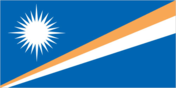
blue with two stripes radiating from the lower hoist-side corner - orange (top) and white; there is a white star with four large rays and 20 small rays on the hoist side above the two stripes
Government type
constitutional government in free association with the US; the Compact of Free Association entered into force 21 October 1986 and the Amended Compact entered into force in May 2004
Independence
21 October 1986 (from the US-administered UN trusteeship)
International organization participation
ACP, ADB, FAO, G-77, IAEA, IBRD, ICAO, ICCt, IDA, IFC, ILO, IMF, IMO, IMSO, Interpol, IOC, ITU, OPCW, PIF, Sparteca, SPC, UN, UNCTAD, UNESCO, WHO
Judicial branch
Supreme Court; High Court; Traditional Rights Court
Legal system
based on adapted Trust Territory laws, acts of the legislature, municipal, common, and customary laws; has not accepted compulsory ICJ jurisdiction
Legislative branch
unicameral legislature or Nitijela (33 seats; members elected by popular vote to serve four-year terms) elections: last held 19 November 2007 (next to be held by November 2011) election results: percent of vote by party - NA; seats by party - independents 4 note: the Council of Chiefs or Ironij is a 12-member body comprised of tribal chiefs that advises on matters affecting customary law and practice
National holiday
Constitution Day, 1 May (1979)
Political parties and leaders
traditionally there have been no formally organized political parties; what has existed more closely resembles factions or interest groups because they do not have party headquarters, formal platforms, or party structures; the following two "groupings" have competed in legislative balloting in recent years - Aelon Kein Ad Party [Michael KABUA] and United Democratic Party or UDP [Litokwa TOMEING]
Political pressure groups and leaders
NA
Suffrage
18 years of age; universal
Economy
Agriculture - products
coconuts, tomatoes, melons, taro, breadfruit, fruits; pigs, chickens
Budget
revenues: $42 million expenditures: $40 million (1999)
Currency (code)
US dollar (USD)
Currency code
USD
Debt - external
$86.5 million (FY99/00 est.)
Economic aid - recipient
$56.56 million (2005)
Economy - overview
US Government assistance is the mainstay of this tiny island economy. The Marshall Islands received more than $1 billion in aid from the US from 1986-2002. Agricultural production, primarily subsistence, is concentrated on small farms; the most important commercial crops are coconuts and breadfruit. Small-scale industry is limited to handicrafts, tuna processing, and copra. The tourist industry, now a small source of foreign exchange employing less than 10% of the labor force, remains the best hope for future added income. The islands have few natural resources, and imports far exceed exports. Under the terms of the Amended Compact of Free Association, the US will provide millions of dollars per year to the Marshall Islands (RMI) through 2023, at which time a Trust Fund made up of US and RMI contributions will begin perpetual annual payouts. Government downsizing, drought, a drop in construction, the decline in tourism, and less income from the renewal of fishing vessel licenses have held GDP growth to an average of 1% over the past decade.
Electricity - production by source
fossil fuel: 99% hydro: 0% nuclear: 0% other: 1% (solar)
Exchange rates
the US dollar is used
Exports
$9.1 million f.o.b. (2000)
Exports - commodities
copra cake, coconut oil, handicrafts, fish
Exports - partners
US, Japan, Australia, China (2006)
Fiscal year
1 October - 30 September
GDP - composition by sector
agriculture: 31.7% industry: 14.9% services: 53.4% (2004 est.)
GDP - per capita (PPP)
$2,900 (2005 est.)
GDP - real growth rate
3.5% (2005 est.)
GDP (official exchange rate)
$144 million (2005)
GDP (purchasing power parity)
$115 million (2001 est.)
Household income or consumption by percentage share
lowest 10%: NA% highest 10%: NA%
Imports
$54.7 million f.o.b. (2000)
Imports - commodities
foodstuffs, machinery and equipment, fuels, beverages and tobacco
Imports - partners
US, Japan, Australia, NZ, Singapore, Fiji, China, Philippines (2006)
Industrial production growth rate
NA%
Industries
copra, tuna processing, tourism, craft items (from seashells, wood, and pearls)
Inflation rate (consumer prices)
3% (2005 est.)
Labor force
14,680 (2000)
Labor force - by occupation
agriculture: 21.4% industry: 20.9% services: 57.7% (2000)
Population below poverty line
NA%
Unemployment rate
30.9% (2000 est.)
Communications
Internet country code
.mh
Internet hosts
3 (2008)
Internet Service Providers (ISPs)
1 (2002)
Internet users
2,200 (2006)
Radio broadcast stations
AM 1, FM 3, shortwave 0 (additionally, the US Armed Forces Radio and Television Services (Central Pacific Network) operate one FM and one AM station on Kwajalein) (2005)
Radios
NA
Telephone system
general assessment: digital switching equipment; modern services include telex, cellular, Internet, international calling, caller ID, and leased data circuits domestic: Majuro Atoll and Ebeye and Kwajalein islands have regular, seven-digit, direct-dial telephones; other islands interconnected by high frequency radiotelephone (used mostly for government purposes) and mini-satellite telephones international: country code - 692; satellite earth stations - 2 Intelsat (Pacific Ocean); US Government satellite communications system on Kwajalein (2005)
Telephones - main lines in use
4,500 (2004)
Telephones - mobile cellular
700 (2005)
Television broadcast stations
2 (both are US military stations; Marshalls Broadcasting Service, a cable company, operates on Majuro) (2005)
Televisions
NA
Transportation
Airports
15 (2007)
Airports - with paved runways
total: 4 1,524 to 2,437 m: 3 914 to 1,523 m: 1 (2007)
Airports - with unpaved runways
total: 11 914 to 1,523 m: 10 under 914 m: 1 (2007)
Merchant marine
total: 1,049 by type: barge carrier 1, bulk carrier 284, cargo 71, carrier 1, chemical tanker 191, combination ore/oil 4, container 188, liquefied gas 47, passenger 5, passenger/cargo 1, petroleum tanker 221, refrigerated cargo 13, roll on/roll off 14, specialized tanker 2, vehicle carrier 6 foreign-owned: 990 (Australia 1, Bermuda 4, Brazil 1, Canada 6, Chile 4, China 7, Croatia 6, Cyprus 37, Denmark 10, Germany 235, Greece 269, Hong Kong 4, Iceland 3, India 1, Ireland 1, Isle of Man 1, Italy 3, Japan 17, South Korea 10, Latvia 16, Malaysia 3, Mexico 4, Monaco 13, Netherlands 8, Norway 66, Pakistan 1, Panama 1, Romania 1, Russia 9, Saudi Arabia 5, Singapore 18, Slovenia 4, Spain 1, Sweden 1, Switzerland 12, Taiwan 1, Turkey 50, UAE 15, UK 9, UK 9, US 123) (2008)
Ports and terminals
Majuro
Roadways
total: 2,028 km (includes 75 km of expressways) (2007)
Military and Security
Manpower available for military service
males age 16-49: 15,708 (2008 est.)
Manpower fit for military service
males age 16-49: 12,864 (2008 est.)
Manpower reaching militarily significant age annually
male: 512 female: 494 (2008 est.)
Military - note
defense is the responsibility of the US
Military branches
no regular military forces; under the 1983 Compact of Free Association, the US has full authority and responsibility for security and defense of the Marshall Islands; Marshall Islands Police (2008)
Military expenditures
NA
Transnational Issues
Disputes - international
claims US territory of Wake Island This page was last updated on 18 December, 2008