2000 Edition
CIA World Factbook 2000 (Project Gutenberg)
Introduction
Background
Great Britain formally acquired possession of Malta in 1814. The island staunchly supported the UK through both World Wars and remained in the Commonwealth when it became independent in 1964. A decade later Malta became a republic. Over the last 15 years, the island has become a major freight transshipment point, financial center, and tourist destination. It is an official candidate for EU membership.
Geography
Area
- land
- 316 sq km
- total
- 316 sq km
- water
- 0 sq km
Area - comparative
slightly less than twice the size of Washington, DC
Climate
Mediterranean with mild, rainy winters and hot, dry summers
Coastline
140 km
Elevation extremes
- highest point
- Ta'Dmejrek 253 m (near Dingli)
- lowest point
- Mediterranean Sea 0 m
Environment - current issues
very limited natural fresh water resources; increasing reliance on desalination
Environment - international agreements
- party to
- Air Pollution, Climate Change, Desertification, Endangered Species, Law of the Sea, Marine Dumping, Nuclear Test Ban, Ozone Layer Protection, Ship Pollution, Wetlands signed, but not ratified: Biodiversity, Climate Change-Kyoto Protocol
Geographic coordinates
35 50 N, 14 35 E
Geography - note
the country comprises an archipelago, with only the three largest islands (Malta, Ghawdex or Gozo, and Kemmuna or Comino) being inhabited; numerous bays provide good harbors
Irrigated land
10 sq km (1993 est.)
Land boundaries
0 km
Land use
- arable land
- 38%
- forests and woodland
- 0%
- other
- 59% (1993 est.)
- permanent crops
- 3%
- permanent pastures
- 0%
Location
Southern Europe, islands in the Mediterranean Sea, south of Sicily (Italy)
Map references
Europe
Maritime claims
- contiguous zone
- 24 nm
- continental shelf
- 200-m depth or to the depth of exploitation
- exclusive fishing zone
- 25 nm
- territorial sea
- 12 nm
Natural hazards
NA
Natural resources
limestone, salt, arable land
Terrain
mostly low, rocky, flat to dissected plains; many coastal cliffs
People and Society
Age structure
0-14 years: 20% (male 41,046; female 38,273) 15-64 years: 67% (male 132,692; female 131,532) 65 years and over: 13% (male 20,091; female 28,036) (2000 est.)
Birth rate
12.75 births/1,000 population (2000 est.)
Death rate
7.7 deaths/1,000 population (2000 est.)
Ethnic groups
Maltese (descendants of ancient Carthaginians and Phoenicians, with strong elements of Italian and other Mediterranean stock)
Infant mortality rate
5.94 deaths/1,000 live births (2000 est.)
Languages
Maltese (official), English (official)
Life expectancy at birth
- female
- 80.62 years (2000 est.)
- male
- 75.49 years
- total population
- 77.94 years
Literacy
- definition
- age 10 and over can read and write
- female
- 88% (1985)
- male
- 88%
- total population
- 88%
Nationality
- adjective
- Maltese
- noun
- Maltese (singular and plural)
Net migration rate
2.39 migrant(s)/1,000 population (2000 est.)
Population
391,670 (July 2000 est.)
Population growth rate
0.74% (2000 est.)
Religions
Roman Catholic 91%
Sex ratio
- at birth
- 1.06 male(s)/female under 15 years: 1.07 male(s)/female 15-64 years: 1.01 male(s)/female 65 years and over: 0.72 male(s)/female
- total population
- 0.98 male(s)/female (2000 est.)
Total fertility rate
1.92 children born/woman (2000 est.)
Government
Administrative divisions
none (administered directly from Valletta)
Capital
Valletta
Constitution
1964 constitution substantially amended on 13 December 1974
Country name
- conventional long form
- Republic of Malta
- conventional short form
- Malta
- local long form
- Repubblika ta' Malta
- local short form
- Malta
Data code
MT
Diplomatic representation from the US
- chief of mission
- Ambassador Kathryn Haycock PROFFITT
- embassy
- 3rd Floor, Development House, Saint Anne Street, Floriana,
- mailing address
- P. O. Box 535, Valletta
- telephone
- 235960
Diplomatic representation in the US
- chancery
- 2017 Connecticut Avenue NW, Washington, DC 20008
- chief of mission
- Ambassador George SALIBA
- telephone
- (202) 462-3611, 3612
Executive branch
- cabinet
- Cabinet appointed by the president on the advice of the prime minister
- chief of state
- President Guido DE MARCO (since 4 April 1999)
- election results
- Guido DE MARCO elected president; percent of House of Representatives vote - NA
- elections
- president elected by the House of Representatives for a five-year term; election last held NA April 1999 (next to be held by NA April 2004); following legislative elections, the leader of the majority party or leader of a majority coalition is usually appointed prime minister by the president for a five-year term; the deputy prime minister is appointed by the president on the advice of the prime minister
- head of government
- Prime Minister Eddie FENECH ADAMI (since 6 September 1998); Deputy Prime Minister Lawrence GONZE (since 4 May 1999)
FAX
- (202) 387-5470
- 243229
- consulate(s)
- New York
Flag description
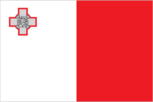
two equal vertical bands of white (hoist side) and red; in the upper hoist-side corner is a representation of the George Cross, edged in red
Government type
parliamentary democracy
Independence
21 September 1964 (from UK)
International organization participation
C, CCC, CE, EBRD, ECE, EU (applicant), FAO, G-77, IAEA, IBRD, ICAO, ICFTU, ICRM, IFAD, IFRCS, ILO, IMF, IMO, Inmarsat, Intelsat, Interpol, IOC, IOM (observer), ISO (correspondent), ITU, NAM, OPCW, OSCE, PCA, UN, UNCTAD, UNESCO, UNIDO, UPU, WCL, WHO, WIPO, WMO, WToO, WTrO
Judicial branch
Constitutional Court, judges are appointed by the president on the advice of the prime minister; Court of Appeal, judges are appointed by the president on the advice of the prime minister
Legal system
based on English common law and Roman civil law; has accepted compulsory ICJ jurisdiction, with reservations
Legislative branch
- unicameral House of Representatives (usually 65 seats; note - additional seats are given to the party with the largest popular vote to ensure a legislative majority; current total: 65 seats; members are elected by popular vote on the basis of proportional representation to serve five-year terms)
- election results
- percent of vote by party - PN 51.8%, MLP 46.9%, AD 1.2%; seats by party - PN 35, MLP 30
- elections
- last held 5 September 1998 (next to be held by September 2003)
National holiday
Independence Day, 21 September (1964)
Political parties and leaders
Alternativa Demokratika/Alliance for Social Justice or AD ; Malta Labor Party or MLP ; Nationalist Party or PN
Suffrage
18 years of age; universal
Economy
Agriculture - products
potatoes, cauliflower, grapes, wheat, barley, tomatoes, citrus, cut flowers, green peppers; pork, milk, poultry, eggs
Budget
- expenditures
- $1.76 billion, including capital expenditures of $NA (1998 est.)
- revenues
- $1.32 billion
Currency
1 Maltese lira (LM) = 100 cents
Debt - external
$130 million (1997)
Economic aid - recipient
$NA
Economy - overview
Major resources are limestone, a favorable geographic location, and a productive labor force. Malta produces only about 20% of its food needs, has limited freshwater supplies, and has no domestic energy sources. The economy is dependent on foreign trade, manufacturing (especially electronics and textiles), and tourism; the state-owned Malta drydocks employs about 3,800 people. In 1999, over 1 million tourists visited the island. Per capita GDP of $13,800 places Malta in the ranks of the less affluent EU countries. The island is divided politically over the question of joining the EU. The sizable budget deficit remains a key concern.
Electricity - consumption
1.507 billion kWh (1998)
Electricity - exports
0 kWh (1998)
Electricity - imports
0 kWh (1998)
Electricity - production
1.62 billion kWh (1998)
Electricity - production by source
- fossil fuel
- 100%
- hydro
- 0%
- nuclear
- 0%
- other
- 0% (1998)
Exchange rates
Maltese liri (LM) per US$1 - 0.4086 (January 2000), 0.3994 (1999), 0.3885 (1998), 0.3857 (1997), 0.3604 (1996), 0.3529 (1995)
Exports
$1.8 billion (f.o.b., 1998)
Exports - commodities
machinery and transport equipment, manufactures
Exports - partners
France 20.7%, US 18.1%, Germany 12.6%, UK 7.7%, Italy 4.8% (1998)
Fiscal year
1 April - 31 March
GDP
purchasing power parity - $5.3 billion (1999 est.)
GDP - composition by sector
- agriculture
- 3%
- industry
- 26%
- services
- 71% (1997 est.)
GDP - per capita
purchasing power parity - $13,800 (1999 est.)
GDP - real growth rate
4% (1999 est.)
Household income or consumption by percentage share
lowest 10%: NA% highest 10%: NA%
Imports
$2.7 billion (f.o.b., 1998)
Imports - commodities
machinery and transport equipment, manufactured goods; food, drink, and tobacco
Imports - partners
Italy 19.3%, France 17.8%, UK 12.4%, Germany 10.5%, US 8.9% (1998)
Industrial production growth rate
NA%
Industries
tourism; electronics, ship building and repair, construction; food and beverages, textiles, footwear, clothing, tobacco
Inflation rate (consumer prices)
1.8% (1999 est.)
Labor force
143,700 (October 1997)
Labor force - by occupation
industry 24%, services 71%, agriculture 5% (1999 est.)
Population below poverty line
NA%
Unemployment rate
5.5% (September 1999)
Communications
Internet Service Providers (ISPs)
4 (1999)
Radio broadcast stations
AM 1, FM 18, shortwave 6 (1999)
Radios
255,000 (1997)
Telephone system
- automatic system satisfies normal requirements
- domestic
- submarine cable and microwave radio relay between islands
- international
- 2 submarine cables; satellite earth station - 1 Intelsat (Atlantic Ocean)
Telephones - main lines in use
171,000 (1995)
Telephones - mobile cellular
15,650 (1999)
Television broadcast stations
6 (1999)
Televisions
280,000 (1997)
Transportation
Airports
1 (1999 est.)
Airports - with paved runways
- total
- 1 over 3,047 m: 1 (1999 est.)
Highways
- paved
- 1,677 km
- total
- 1,742 km
- unpaved
- 65 km (1997 est.)
Merchant marine
- note
- a flag of convenience registry; includes ships from 49 countries among which includes Greece 445, Russia 51, Switzerland 45, Italy 44, Norway 40, Croatia 26, Turkey 35, Germany 32, Georgia 23, and Monaco 24 (1998 est.)
- ships by type
- bulk 431, cargo 424, chemical tanker 54, combination bulk 16, combination ore/oil 14, container 64, liquified gas 2, livestock carrier 3, multi-functional large load carrier 4, passenger 7, petroleum tanker 331, refrigerated cargo 44, roll-on/roll-off 48, short-sea passenger 21, specialized tanker 5, vehicle carrier 16 (1999 est.)
- total
- 1,484 ships (1,000 GRT or over) totaling 28,083,952 GRT/46,772,146 DWT
Ports and harbors
Marsaxlokk, Valletta
Railways
0 km
Military and Security
Military branches
Armed Forces (including land forces, an air squadron, a maritime squadron, and the Revenue Security Corps), Maltese Police Force
Military expenditures - dollar figure
$201 million (FY98/99)
Military expenditures - percent of GDP
5.5% (FY98/99)
Military manpower - availability
males age 15-49: 98,850 (2000 est.)
Military manpower - fit for military service
males age 15-49: 78,677 (2000 est.)
Transnational Issues
Disputes - international
Malta and Tunisia are discussing the commercial exploitation of the continental shelf between their countries, particularly for oil exploration
Illicit drugs
- minor transshipment point for hashish from North Africa to Western Europe
- MAN
- MARSHALL ISLANDS