2005 Edition
CIA World Factbook 2005 (Project Gutenberg)
Introduction
Administrative divisions
8 regions (regions, singular - region); Gao, Kayes, Kidal, Koulikoro, Mopti, Segou, Sikasso, Tombouctou
Age structure
0-14 years: 47.1% (male 2,910,944/female 2,876,010) 15-64 years: 50% (male 2,955,496/female 3,185,666) 65 years and over: 3% (male 165,867/female 197,546) (2005 est.)
Agriculture - products
cotton, millet, rice, corn, vegetables, peanuts; cattle, sheep, goats
Airports
28 (2004 est.)
Airports - with paved runways
- total
- 9 2,438 to 3,047 m: 4 1,524 to 2,437 m: 4 914 to 1,523 m: 1 (2004 est.)
Airports - with unpaved runways
- total
- 19 2,438 to 3,047 m: 1 1,524 to 2,437 m: 5 914 to 1,523 m: 5 under 914 m: 8 (2004 est.) Military Mali
Area
- land
- 1.22 million sq km
- total
- 1.24 million sq km
- water
- 20,000 sq km
Area - comparative
slightly less than twice the size of Texas
Background
The Sudanese Republic and Senegal became independent of France in 1960 as the Mali Federation. When Senegal withdrew after only a few months, what formerly made up the Sudanese Republic was renamed Mali. Rule by dictatorship was brought to a close in 1991 with a transitional government and in 1992 when Mali's first democratic presidential election was held. After his reelection in 1997, President Alpha KONARE continued to push through political and economic reforms and to fight corruption. In keeping with Mali's two-term constitutional limit, he stepped down in 2002 and was succeeded by Amadou TOURE. Geography Mali
Birth rate
46.77 births/1,000 population (2005 est.)
Budget
- expenditures
- $828 million, including capital expenditures of NA (2002 est.)
- revenues
- $764 million
Capital
Bamako
Climate
subtropical to arid; hot and dry February to June; rainy, humid, and mild June to November; cool and dry November to February
Coastline
0 km (landlocked)
Constitution
adopted 12 January 1992
Country name
- conventional long form
- Republic of Mali
- conventional short form
- Mali
- former
- French Sudan and Sudanese Republic
- local long form
- Republique de Mali
- local short form
- Mali
Currency (code)
Communaute Financiere Africaine franc (XOF); note - responsible authority is the Central Bank of the West African States
Currency code
XOF
Death rate
19.05 deaths/1,000 population (2005 est.)
Debt - external
$3.3 billion (2000)
Diplomatic representation from the US
- chief of mission
- Ambassador Vicki HUDDLESTONE
- embassy
- Rue Rochester NY and Rue Mohamed V, Bamako
- FAX
- [223] (2) 223-712
- mailing address
- B. P. 34, Bamako
- telephone
- [223] (2) 223-833
Diplomatic representation in the US
- chancery
- 2130 R Street NW, Washington, DC 20008
- chief of mission
- Ambassador Abdoulaye DIOP
- FAX
- [1] (202) 332-6603
- telephone
- [1] (202) 332-2249, 939-8950
Disputes - international
none This page was last updated on 20 October, 2005 ======================================================================
Distribution of family income - Gini index
50.5 (1994)
Economic aid - recipient
$596.4 million (2001)
Economy - overview
Mali is among the poorest countries in the world, with 65% of its land area desert or semidesert and with a highly unequal distribution of income. Economic activity is largely confined to the riverine area irrigated by the Niger. About 10% of the population is nomadic and some 80% of the labor force is engaged in farming and fishing. Industrial activity is concentrated on processing farm commodities. Mali is heavily dependent on foreign aid and vulnerable to fluctuations in world prices for cotton, its main export, along with gold. The government has continued its successful implementation of an IMF-recommended structural adjustment program that is helping the economy grow, diversify, and attract foreign investment. Mali's adherence to economic reform and the 50% devaluation of the African franc in January 1994 have pushed up economic growth to a sturdy 5% average in 1996-2004. Worker remittances and external trade routes have been jeopardized by continued unrest in neighboring Cote d'Ivoire.
Electricity - consumption
651 million kWh (2002)
Electricity - exports
0 kWh; note - recent hydropower developments may be providing electricity to Senegal and Mauritania (2002)
Electricity - imports
0 kWh (2002)
Electricity - production
700 million kWh (2002)
Electricity - production by source
- fossil fuel
- 41.7%
- hydro
- 58.3%
- nuclear
- 0%
- other
- 0% (2001)
Elevation extremes
- highest point
- Hombori Tondo 1,155 m
- lowest point
- Senegal River 23 m
Environment - current issues
deforestation; soil erosion; desertification; inadequate supplies of potable water; poaching
Environment - international agreements
- party to
- Biodiversity, Climate Change, Climate Change-Kyoto Protocol, Desertification, Endangered Species, Hazardous Wastes, Law of the Sea, Ozone Layer Protection, Wetlands signed, but not ratified: none of the selected agreements
Ethnic groups
Mande 50% (Bambara, Malinke, Soninke), Peul 17%, Voltaic 12%, Songhai 6%, Tuareg and Moor 10%, other 5%
Exchange rates
Communaute Financiere Africaine francs (XOF) per US dollar - 528.29 (2004), 581.2 (2003), 696.99 (2002), 733.04 (2001), 711.98 (2000)
Executive branch
- cabinet
- Council of Ministers appointed by the prime minister
- chief of state
- President Amadou Toumani TOURE (since 8 June 2002)
- election results
- Amadou Toumani TOURE elected president; percent of vote - Amadou Toumani TOURE 64.4%, Soumaila CISSE 35.6%
- elections
- president elected by popular vote for a five-year term (two-term limit); election last held 12 May 2002 (next to be held May 2007); prime minister appointed by the president
- head of government
- Prime Minister Ousmane Issoufi MAIGA (since 30 April 2004)
Exports
$915 million f.o.b. (2002 est.)
Exports - commodities
cotton, gold, livestock
Exports - partners
China 31.6%, Pakistan 10%, Italy 6.9%, Thailand 5.8%, Germany 5.1%, India 4.8%, Bangladesh 4.5%, Taiwan 4% (2004)
Fiscal year
calendar year Communications Mali
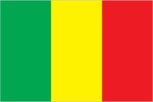
Flag description
three equal vertical bands of green (hoist side), yellow, and red; uses the popular pan-African colors of Ethiopia Economy Mali
GDP - composition by sector
- agriculture
- 45%
- industry
- 17%
- services
- 38% (2001 est.)
GDP - per capita
purchasing power parity - $900 (2004 est.)
GDP - real growth rate
4% (2004 est.)
GDP (purchasing power parity)
$11 billion (2004 est.)
Geographic coordinates
17 00 N, 4 00 W
Geography - note
landlocked; divided into three natural zones: the southern, cultivated Sudanese; the central, semiarid Sahelian; and the northern, arid Saharan People Mali
Government type
republic
Highways
- paved
- 1,827 km
- total
- 15,100 km
- unpaved
- 13,273 km (1999 est.)
HIV/AIDS - adult prevalence rate
1.9% (2003 est.)
HIV/AIDS - deaths
12,000 (2003 est.)
HIV/AIDS - people living with HIV/AIDS
140,000 (2003 est.)
Household income or consumption by percentage share
lowest 10%: 1.8% highest 10%: 40.4% (1994)
Imports
$927 million f.o.b. (2002 est.)
Imports - commodities
petroleum, machinery and equipment, construction materials, foodstuffs, textiles
Imports - partners
France 14.5%, Senegal 9.8%, Cote d'Ivoire 7.6% (2004)
Independence
22 September 1960 (from France)
Industrial production growth rate
NA (FY96/97)
Industries
food processing; construction; phosphate and gold mining
Infant mortality rate
- female
- 110.07 deaths/1,000 live births (2005 est.)
- male
- 123.32 deaths/1,000 live births
- total
- 116.79 deaths/1,000 live births
Inflation rate (consumer prices)
4.5% (2002 est.)
International organization participation
ACCT, ACP, AfDB, AU, ECOWAS, FAO, FZ, G-77, IAEA, IBRD, ICAO, ICCt, ICFTU, ICRM, IDA, IDB, IFAD, IFC, IFRCS, ILO, IMF, Interpol, IOC, IOM, ITU, MIGA, MONUC, NAM, OIC, ONUB, OPCW, UN, UNAMSIL, UNCTAD, UNESCO, UNIDO, UNMIL, UPU, WADB (regional), WAEMU, WCO, WFTU, WHO, WIPO, WMO, WToO, WTO
Internet country code
.ml
Internet hosts
187 (2003)
Internet Service Providers (ISPs)
13 (2001)
Internet users
25,000 (2002) Transportation Mali
Irrigated land
1,380 sq km (1998 est.)
Judicial branch
Supreme Court or Cour Supreme
Labor force
3.93 million (2001 est.)
Labor force - by occupation
agriculture and fishing 80% (2001 est.)
Land boundaries
- border countries
- Algeria 1,376 km, Burkina Faso 1,000 km, Guinea 858 km, Cote d'Ivoire 532 km, Mauritania 2,237 km, Niger 821 km, Senegal 419 km
- total
- 7,243 km
Land use
- arable land
- 3.82%
- other
- 96.15% (2001)
- permanent crops
- 0.03%
Languages
French (official), Bambara 80%, numerous African languages
Legal system
based on French civil law system and customary law; judicial review of legislative acts in Constitutional Court (which was formally established on 9 March 1994); has not accepted compulsory ICJ jurisdiction
Legislative branch
- unicameral National Assembly or Assemblee Nationale (147 seats; members are elected by popular vote to serve five-year terms)
- election results
- percent of vote by party - NA%; seats by party - Hope 2002 coalition 66, ADEMA 51, other 30
- elections
- last held 14 July and 28 July 2002 (next to be held July 2007)
Life expectancy at birth
- female
- 50.66 years (2005 est.)
- male
- 46.68 years
- total population
- 48.64 years
Literacy
- definition: age 15 and over can read and write
- female
- 39.6% (2003 est.) Government Mali
- male
- 53.5%
- total population
- 46.4%
Location
Western Africa, southwest of Algeria
Major infectious diseases
- degree of risk
- very high
- food or waterborne diseases
- bacterial and protozoal diarrhea, hepatitis A, and typhoid fever
- respiratory disease
- meningococcal meningitis (2004)
- vectorborne disease
- malaria is a high risk in some locations
- water contact disease
- schistosomiasis
Manpower available for military service
males age 18-49: 2,206,728 (2005 est.)
Manpower fit for military service
males age 18-49: 1,231,930 (2005 est.)
Map references
Africa
Maritime claims
none (landlocked)
Median age
- female
- 16.92 years (2005 est.)
- male
- 15.79 years
- total
- 16.35 years
Military branches
Army, Air Force, National Guard
Military expenditures - dollar figure
$22.4 million (2004)
Military expenditures - percent of GDP
0.4% (2004) Transnational Issues Mali
Military service age and obligation
18 years of age for compulsory and voluntary military service; conscript service obligation - 2 years (2004)
National holiday
Independence Day, 22 September (1960)
Nationality
- adjective
- Malian
- noun
- Malian(s)
Natural hazards
hot, dust-laden harmattan haze common during dry seasons; recurring droughts; occasional Niger River flooding
Natural resources
gold, phosphates, kaolin, salt, limestone, uranium, gypsum, granite, hydropower note: bauxite, iron ore, manganese, tin, and copper deposits are known but not exploited
Net migration rate
-0.33 migrant(s)/1,000 population (2005 est.)
Oil - consumption
4,000 bbl/day (2001 est.)
Oil - exports
NA
Oil - imports
NA
Oil - production
0 bbl/day (2001 est.)
Political parties and leaders
Alliance for Democracy or ADEMA [Diounconda TRAORE, party chairman]; Block of Alternative for the Renewal of Africa or BARA [Yoro DIAKITE]; Democratic and Social Convention or CDS [Mamadou Bakary SANGARE, chairman]; Hope 2002 [leader NA]; Movement for the Independence, Renaissance and Integration of Africa or MIRIA [Mohamed Lamine TRAORE, Mouhamedou DICKO]; National Congress for Democratic Initiative or CNID [Mountaga TALL, chairman]; Party for Democracy and Progress or PDP [Me Idrissa TRAORE]; Party for National Renewal or PARENA [Yoro DIAKITE, chairman; Tiebile DRAME, secretary general]; Rally for Democracy and Labor or RDT [Ali GNANGADO]; Rally for Democracy and Progress or RDP [Almamy SYLLA, chairman]; Rally for Mali or RPM [Ibrahim Boubacar KEITA, chairman]; Sudanese Union/African Democratic Rally or US/RDA [Mamadou Bamou TOURE, secretary general]; Union of Democratic Forces for Progress or UFDP [Youssouf TOURE, secretary general]; Union for Democracy and Development or UDD [Moussa Balla COULIBALY]; Union for Republic and Democracy or URD [Soumaila CISSE]
Political pressure groups and leaders
Patriotic Movement of the Ghanda Koye or MPGK; United Movement and Fronts of Azawad or MFUA
Population
12,291,529 (July 2005 est.)
Population below poverty line
64% average; 30% of the total population living in urban areas; 70% of the total population living in rural areas) (2001 est.)
Population growth rate
2.74% (2005 est.)
Ports and harbors
Koulikoro
Radio broadcast stations
AM 1, FM 28, shortwave 1 note: the shortwave station in Bamako has seven frequencies and five transmitters and relays broadcasts for China Radio International (2001)
Radios
570,000 (1997)
Railways
- narrow gauge
- 729 km 1.000-m gauge (2004)
- total
- 729 km
Religions
Muslim 90%, indigenous beliefs 9%, Christian 1%
Sex ratio
- at birth
- 1.03 male(s)/female under 15 years: 1.01 male(s)/female 15-64 years: 0.93 male(s)/female 65 years and over: 0.84 male(s)/female
- total population
- 0.96 male(s)/female (2005 est.)
Suffrage
18 years of age; universal
Telephone system
- domestic
- network consists of microwave radio relay, open-wire, and radiotelephone communications stations; expansion of microwave radio relay in progress
- general assessment
- domestic system unreliable but improving; provides only minimal service
- international
- country code - 223; satellite earth stations - 2 Intelsat (1 Atlantic Ocean and 1 Indian Ocean)
Telephones - main lines in use
56,600 (2002)
Telephones - mobile cellular
250,000 (2003)
Television broadcast stations
1 (plus repeaters) (2001)
Televisions
45,000 (1997)
Terrain
mostly flat to rolling northern plains covered by sand; savanna in south, rugged hills in northeast
Total fertility rate
6.5 children born/woman (2005 est.)
Unemployment rate
14.6% urban areas; 5.3% rural areas (2001 est.)
Waterways
1,815 km (2004)