2007 Edition
CIA World Factbook 2007 (Project Gutenberg)
Introduction
Administrative divisions
19 atolls (atholhu, singular and plural) and the capital city*; Alifu, Baa, Dhaalu, Faafu, Gaafu Alifu, Gaafu Dhaalu, Gnaviyani, Haa Alifu, Haa Dhaalu, Kaafu, Laamu, Lhaviyani, Maale* (Male), Meemu, Noonu, Raa, Seenu, Shaviyani, Thaa, Vaavu
Age structure
0-14 years: 43.4% (male 80,113/female 75,763) 15-64 years: 53.5% (male 98,040/female 94,029) 65 years and over: 3.1% (male 5,477/female 5,586) (2006 est.)
Area
- land
- 300 sq km
- total
- 300 sq km
- water
- 0 sq km
Area - comparative
about 1.7 times the size of Washington, DC
Background
The Maldives was long a sultanate, first under Dutch and then under British protection. It became a republic in 1968, three years after independence. Since 1978, President Maumoon Abdul GAYOOM - currently in his sixth term in office - has dominated the islands' political scene. Following riots in the capital Male in August 2004, the president and his government pledged to embark upon democratic reforms, including a more representative political system and expanded political freedoms. Progress has been slow, however, and many promised reforms have been delayed indefinitely. Tourism and fishing are being developed on the archipelago. Geography Maldives
Birth rate
34.81 births/1,000 population (2006 est.)
Capital
- geographic coordinates
- 4 10 N, 73 31 E
- name
- Male
- time difference
- UTC+5 (10 hours ahead of Washington, DC during Standard Time)
Climate
tropical; hot, humid; dry, northeast monsoon (November to March); rainy, southwest monsoon (June to August)
Coastline
644 km
Constitution
adopted 1 January 1998
Country name
- conventional long form
- Republic of Maldives
- conventional short form
- Maldives
- local long form
- Dhivehi Raajjeyge Jumhooriyyaa
- local short form
- Dhivehi Raajje
Death rate
7.06 deaths/1,000 population (2006 est.)
Elevation extremes
- highest point
- unnamed location on Wilingili island in the Addu Atoll 2.4 m
- lowest point
- Indian Ocean 0 m
Environment - current issues
depletion of freshwater aquifers threatens water supplies; global warming and sea level rise; coral reef bleaching
Environment - international agreements
- party to
- Biodiversity, Climate Change, Climate Change-Kyoto Protocol, Hazardous Wastes, Law of the Sea, Ozone Layer Protection
- signed, but not ratified
- none of the selected agreements
Ethnic groups
South Indians, Sinhalese, Arabs
Executive branch
- chief of state
- President Maumoon Abdul GAYOOM (since 11 November 1978); note - the president is both the chief of state and head of
Geographic coordinates
3 15 N, 73 00 E
Geography - note
1,190 coral islands grouped into 26 atolls (200 inhabited islands, plus 80 islands with tourist resorts); archipelago with strategic location astride and along major sea lanes in Indian Ocean People Maldives
Government type
republic
HIV/AIDS - adult prevalence rate
0.1% (2001 est.)
HIV/AIDS - deaths
NA
HIV/AIDS - people living with HIV/AIDS
less than 100 (2001 est.)
Independence
26 July 1965 (from UK)
Infant mortality rate
- female
- 55.8 deaths/1,000 live births (2006 est.)
- male
- 54.01 deaths/1,000 live births
- total
- 54.89 deaths/1,000 live births
Irrigated land
NA
Land boundaries
0 km
Land use
- arable land
- 13.33%
- other
- 56.67% (2005)
- permanent crops
- 30%
Languages
Maldivian Dhivehi (dialect of Sinhala, script derived from Arabic), English spoken by most government officials
Legal system
based on Islamic law with admixtures of English common law primarily in commercial matters; has not accepted compulsory ICJ jurisdiction
Life expectancy at birth
- female
- 65.8 years (2006 est.)
- male
- 63.08 years
- total population
- 64.41 years
Literacy
- definition
- age 15 and over can read and write
- female
- 97.3% (2003 est.) Government Maldives
- male
- 97.1%
- total population
- 97.2%
Location
Southern Asia, group of atolls in the Indian Ocean, south-southwest of India
Map references
Asia
Maritime claims
- measured from claimed archipelagic straight baselines
- contiguous zone
- 24 nm
- exclusive economic zone
- 200 nm
- territorial sea
- 12 nm
Median age
- female
- 18 years (2006 est.)
- male
- 17.8 years
- total
- 17.9 years
National holiday
Independence Day, 26 July (1965)
Nationality
- adjective
- Maldivian
- noun
- Maldivian(s)
Natural hazards
low level of islands makes them very sensitive to sea level rise
Natural resources
fish
Net migration rate
0 migrant(s)/1,000 population (2006 est.)
Population
359,008 (July 2006 est.)
Population growth rate
2.78% (2006 est.)
Religions
Sunni Muslim
Sex ratio
- at birth
- 1.05 male(s)/female
- total population
- 1.05 male(s)/female (2006 est.)
- under 15 years
- 1.06 male(s)/female 15-64 years: 1.04 male(s)/female 65 years and over: 0.98 male(s)/female
Suffrage
21 years of age; universal
Terrain
flat, with white sandy beaches
Total fertility rate
4.9 children born/woman (2006 est.)
Government
Agriculture - products
coconuts, corn, sweet potatoes; fish
Airports
5 (2006)
Airports - with paved runways
- over 3,047 m
- 1 2,438 to 3,047 m: 1 (2006)
- total
- 2
Airports - with unpaved runways
- total
- 3 914 to 1,523 m: 3 (2006)
Budget
- expenditures
- $671 million (2006 est.)
- revenues
- $508 million (including foreign grants)
Currency (code)
rufiyaa (MVR)
Currency code
MVR
Debt - external
$304 million (2004 est.)
Diplomatic representation from the US
the US does not have an embassy in Maldives; the US Ambassador to Sri Lanka is accredited to Maldives and makes periodic visits there
Diplomatic representation in the US
- chancery
- 800 2nd Avenue, Suite 400E, New York, NY 10017
- chief of mission
- Ambassador Mohamed LATHEEF
- telephone
- [1] (212) 599-6195
Disputes - international
none
Economic aid - recipient
$27.9 million (2004)
Economy - overview
Tourism, Maldives' largest industry, accounts for 28% of GDP and more than 60% of the Maldives' foreign exchange receipts. Over 90% of government tax revenue comes from import duties and tourism-related taxes. Fishing is the second leading sector. Agriculture and manufacturing continue to play a lesser role in the economy, constrained by the limited availability of cultivable land and the shortage of domestic labor. Most staple foods must be imported. Industry, which consists mainly of garment production, boat building, and handicrafts, accounts for about 7% of GDP. The Maldivian Government began an economic reform program in 1989 initially by lifting import quotas and opening some exports to the private sector. Subsequently, it has liberalized regulations to allow more foreign investment. Real GDP growth averaged over 7.5% per year for more than a decade. In late December 2004, a major tsunami left more than 100 dead, 12,000 displaced, and property damage exceeding $300 million. As a result of the tsunami, the GDP contracted by about 3.6% in 2005. A rebound in tourism, post-tsunami reconstruction, and development of new resorts helped boost GDP by nearly 18 percent in 2006. The trade deficit has expanded sharply as a result of high oil prices and imports of construction material. Diversifying beyond tourism and fishing is the major challenge facing the government. Over the longer term Maldivian authorities worry about the impact of erosion and possible global warming on their low-lying country; 80% of the area is one meter or less above sea level.
Electricity - consumption
139.4 million kWh (2004)
Electricity - exports
0 kWh (2004)
Electricity - imports
0 kWh (2004)
Electricity - production
149.9 million kWh (2004)
Electricity - production by source
- fossil fuel
- 100%
- hydro
- 0%
- nuclear
- 0%
- other
- 0% (2001)
Exchange rates
rufiyaa per US dollar - 12.8 (2006), 12.8 (2005), 12.8 (2004), 12.8 (2003), 12.8 (2002)
Exports
$123 million f.o.b. (2004 est.)
Exports - commodities
fish
Exports - partners
Japan 22.8%, Thailand 22.7%, Sri Lanka 16.4%, UK 12.6%, Singapore 5.8%, Germany 4.8%, France 4.3% (2005)
FAX
[1] (212) 661-6405
Fiscal year
calendar year Communications Maldives
Flag description
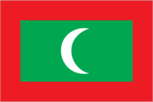
red with a large green rectangle in the center bearing a vertical white crescent; the closed side of the crescent is on the hoist side of the flag Economy Maldives
GDP - composition by sector
- agriculture
- 20%
- industry
- 18%
- services
- 62% (2000 est.)
GDP - per capita (PPP)
$3,900 (2002 est.)
GDP - real growth rate
-3.6% (2005 est.)
GDP (official exchange rate)
$817 million (2005 est.)
GDP (purchasing power parity)
$1.25 billion (2002 est.)
Household income or consumption by percentage share
- highest 10%
- NA%
- lowest 10%
- NA%
IDPs
10,000 (December 2004 tsunami victims) (2006) This page was last updated on 8 February, 2007
Imports
$567 million f.o.b. (2004 est.)
Imports - commodities
petroleum products, ships, foodstuffs, clothing, intermediate and capital goods
Imports - partners
Singapore 24.1%, UAE 15.7%, India 11.3%, Malaysia 7.2%, Sri Lanka 5.7%, UK 4.5% (2005)
Industrial production growth rate
-0.9% (2004 est.)
Industries
fish processing, tourism, shipping, boat building, coconut processing, garments, woven mats, rope, handicrafts, coral and sand mining
Inflation rate (consumer prices)
6% (2005 est.)
International organization participation
AsDB, C, CP, FAO, G-77, IBRD, ICAO, IDA, IDB, IFAD, IFC, IMF, IMO, Interpol, IOC, IPU, ITU, MIGA, NAM, OIC, OPCW, SAARC, SACEP, UN, UNCTAD, UNESCO, UNIDO, UNWTO, UPU, WCO, WHO, WIPO, WMO, WTO
Internet country code
.mv
Internet hosts
1,357 (2006)
Internet Service Providers (ISPs)
1 (2000)
Internet users
19,000 (2005) Transportation Maldives
Judicial branch
High Court
Labor force
88,000 (2000)
Labor force - by occupation
- agriculture
- 22%
- industry
- 18%
- services
- 60% (1995)
Legislative branch
- unicameral People's Council or Majlis (50 seats; 42 elected by popular vote, 8 appointed by the president; members serve five-year terms)
- election results
- percent of vote - NA; seats - independents 50
- elections
- last held 22 January 2005 (next to be held NA 2010)
Manpower available for military service
- females age 18-49
- 69,229 (2005 est.)
- males age 18-49
- 71,774
Manpower fit for military service
- females age 18-49
- 54,454 (2005 est.)
- males age 18-49
- 56,687
Merchant marine
- by type
- cargo 13, petroleum tanker 2, refrigerated cargo 2
- registered in other countries
- 1 (Panama 1) (2006)
- total
- 17 ships (1000 GRT or over) 67,149 GRT/87,220 DWT
Military expenditures - dollar figure
$45.07 million (2005 est.)
Military expenditures - percent of GDP
5.5% (2005 est.) Transnational Issues Maldives
Military service age and obligation
18 years of age (est.) (2004)
National Security Service
Security Branch (ground forces), Air Element, Coast Guard
Natural gas - consumption
0 cu m (2004 est.)
Natural gas - production
0 cu m (2004 est.)
Oil - consumption
7,200 bbl/day (2004 est.)
Oil - exports
NA bbl/day (2001)
Oil - imports
NA bbl/day (2001)
Oil - production
0 bbl/day (2004 est.)
Political parties and leaders
- political parties were allowed to register in June 2005; the first
- entrants are
- Adhaalath (Justice) Party or AP [Abdul Majeed Abdul BARI]; Dhivehi Rayyithunge Party (Maldivian People's Party) or DRP [Maumoon Abdul GAYOOM]; Islamic Democratic Party or IDP [Omar NASEER]; Maldivian Democratic Party or MDP [Mohamed NASHEED]
Political pressure groups and leaders
various unregistered political parties
Population below poverty line
21% (2004)
Ports and terminals
Male Military Maldives
Radio broadcast stations
AM 1, FM 1, shortwave 1 (1998)
Radios
35,000 (1999)
Roadways
- note
- village roads are mainly compacted coral (2006)
- paved roads
- 88 km - 60 km in Male; 14 km on Addu Atolis; 14 km on Laamu
- total
- 88 km
Telephone system
- domestic
- interatoll communication through microwave links; all inhabited islands and resorts are connected with telephone and fax service
- general assessment
- Telephone services have improved; each island now has at least one public telephone, and there are mobile cellular networks with expanding subscribership
- international
- country code - 960; satellite earth station - 3 Intelsat (Indian Ocean)
Telephones - main lines in use
32,181 (2006)
Telephones - mobile cellular
271,053 (2006)
Television broadcast stations
1 (2006)
Televisions
10,000 (1999)
Unemployment rate
NEGL% (2003 est.)