2022 Edition
CIA World Factbook 2022 (factbook.json @ 61dadec0c9c9)
Introduction
Background
Malaysia’s location has long made it an important cultural, economic, historical, social, and trade link between the islands of Southeast Asia and the mainland. Through the Strait of Malacca, which separates the Malay Peninsula from the archipelago, flowed maritime trade and with it influences from China, India, the Middle East, and the east coast of Africa. Prior to the 14th century, several powerful maritime empires existed in what is modern-day Malaysia, including the Srivijayan, which controlled much of the southern part of the peninsula between the 7th and 13th centuries, and the Majapahit Empire, which took control over most of the peninsula and the Malay Archipelago between the 13th and 14th centuries. The adoption of Islam between the 13th and 17th centuries also saw the rise of a number of powerful maritime states and sultanates on the Malay Peninsula and the island of Borneo, such as the port city of Malacca (Melaka), which at its height in the 15th century had a navy and hosted thousands of Chinese, Arab, Persian, and Indian merchants.The Portuguese in the 16th century and the Dutch in the 17th century were the first European colonial powers to establish themselves on the Malay Peninsula and Southeast Asia. However, it was the British who ultimately secured their hegemony across the territory and during the late 18th and 19th centuries established colonies and protectorates in the area that is now Malaysia. These holdings were occupied by Japan from 1942 to 1945. In 1948, the British-ruled territories on the Malay Peninsula except Singapore formed the Federation of Malaya, which became independent in 1957. Malaysia was formed in 1963 when the former British colonies of Singapore, as well as Sabah and Sarawak on the northern coast of Borneo, joined the Federation. The first several years of the country's independence were marred by a communist insurgency, Indonesian confrontation with Malaysia, Philippine claims to Sabah, and Singapore's expulsion in 1965. During the 22-year term of Prime Minister MAHATHIR Mohamad (1981-2003), Malaysia was successful in diversifying its economy from dependence on exports of raw materials to the development of manufacturing, services, and tourism. Prime Minister MAHATHIR and a newly-formed coalition of opposition parties defeated Prime Minister Mohamed NAJIB bin Abdul Razak's United Malays National Organization (UMNO) in May 2018, ending over 60 years of uninterrupted rule by UMNO. MAHATHIR resigned in February 2020 amid a political dispute. King ABDULLAH then selected Tan Sri MUHYIDDIN Yassin as the new prime minister. MUHYIDDIN resigned in August 2021 after losing a majority of support in parliament. King ABDULLAH next selected ISMAIL SABRI Yakoob as the successor prime minister.
Geography
Area
- land
- 328,657 sq km
- total
- 329,847 sq km
- water
- 1,190 sq km
Area - comparative
slightly larger than New Mexico
Climate
tropical; annual southwest (April to October) and northeast (October to February) monsoons
Coastline
4,675 km (Peninsular Malaysia 2,068 km, East Malaysia 2,607 km)
Elevation
- highest point
- Gunung Kinabalu 4,095 m
- lowest point
- Indian Ocean 0 m
- mean elevation
- 419 m
Geographic coordinates
2 30 N, 112 30 E
Geography - note
strategic location along Strait of Malacca and southern South China Sea
Irrigated land
4,420 sq km (2020)
Land boundaries
- border countries
- Brunei 266 km; Indonesia 1,881 km; Thailand 595 km
- total
- 2,742 km
Land use
- agricultural land
- 23.2% (2018 est.)
- agricultural land: arable land
- arable land: 2.9% (2018 est.)
- agricultural land: permanent crops
- permanent crops: 19.4% (2018 est.)
- agricultural land: permanent pasture
- permanent pasture: 0.9% (2018 est.)
- forest
- 62% (2018 est.)
- other
- 14.8% (2018 est.)
Location
Southeastern Asia, peninsula bordering Thailand and northern one-third of the island of Borneo, bordering Indonesia, Brunei, and the South China Sea, south of Vietnam
Map references
Southeast Asia
Maritime claims
- continental shelf
- 200-m depth or to the depth of exploitation; specified boundary in the South China Sea
- exclusive economic zone
- 200 nm
- territorial sea
- 12 nm
Natural hazards
flooding; landslides; forest fires
Natural resources
tin, petroleum, timber, copper, iron ore, natural gas, bauxite
Population distribution
a highly uneven distribution with over 80% of the population residing on the Malay Peninsula
Terrain
coastal plains rising to hills and mountains
People and Society
Age structure
- 0-14 years
- 26.8% (male 4,504,562/female 4,246,681)
- 15-24 years
- 16.63% (male 2,760,244/female 2,670,186)
- 25-54 years
- 40.86% (male 6,737,826/female 6,604,776)
- 55-64 years
- 8.81% (male 1,458,038/female 1,418,280)
- 65 years and over
- 6.9% (male 1,066,627/female 1,184,863) (2020 est.)
Alcohol consumption per capita
- beer
- 0.48 liters of pure alcohol (2019 est.)
- other alcohols
- 0.01 liters of pure alcohol (2019 est.)
- spirits
- 0.11 liters of pure alcohol (2019 est.)
- total
- 0.64 liters of pure alcohol (2019 est.)
- wine
- 0.04 liters of pure alcohol (2019 est.)
Birth rate
14.55 births/1,000 population (2022 est.)
Children under the age of 5 years underweight
14.1% (2019)
Contraceptive prevalence rate
52.2% (2014)
Current health expenditure
3.8% of GDP (2019)
Death rate
5.69 deaths/1,000 population (2022 est.)
Demographic profile
Malaysia’s multi-ethnic population consists of the bumiputera – Malays and other indigenous peoples – (62%), ethnic Chinese (21%), ethnic Indians (6%), and foreigners (10%). The majority of Malaysia’s ethnic Chinese and Indians trace their roots to the British colonialists’ recruitment of hundreds of thousands of Chinese and Indians as mine and plantation workers between the early-19th century and the 1930s. Most Malays have maintained their rural lifestyle, while the entrepreneurial Chinese have achieved greater wealth and economic dominance. In order to eradicate Malay poverty, the Malaysian Government in 1971 adopted policies that gave preference to the bumiputera in public university admissions, government jobs and contracts, and property ownership. Affirmative action continues to benefit well-off urban bumiputera but has done little to alleviate poverty for their more numerous rural counterparts. The policies have pushed ethnic Chinese and Indians to study at private or foreign universities (many do not return) and have created and sustained one of the world’s largest civil services, which is 85-90% Malay. The country’s age structure has changed significantly since the 1960s, as fertility and mortality rates have declined. Malaysia’s total fertility rate (TFR) has dropped from 5 children per woman in 1970, to 3 in 1998, to 2.1 in 2015 as a result of increased educational attainment and labor participation among women, later marriages, increased use of contraception, and changes in family size preference related to urbanization. The TFR is higher among Malays, rural residents (who are mainly Malay), the poor, and the less-educated. Despite the reduced fertility rate, Malaysia’s population will continue to grow, albeit at a decreasing rate, for the next few decades because of its large number of reproductive-age women. The youth population has been shrinking, and the working-age population (15-64 year olds) has been growing steadily. Malaysia’s labor market has successfully absorbed the increasing number of job seekers, leading to sustained economic growth. However, the favorable age structure is changing, and around 2020, Malaysia will start to become a rapidly aging society. As the population ages, Malaysia will need to better educate and train its labor force, raise productivity, and continue to increase the number of women workers in order to further develop its economy. More than 1.8 million Malaysians lived abroad as of 2015, including anywhere from 350,000 to 785,000 workers, more than half of whom have an advanced level of education. The vast majority of emigrants are ethnic Chinese, seeking better educational and job opportunities abroad because of institutionalized ethnic discrimination favoring the Malays. The primary destination country is nearby Singapore, followed by Bangladesh and Australia. Hundreds of thousands of Malaysians also commute across the causeway to Singapore daily for work. Brain drain is an impediment to Malaysia’s goal of becoming a high-income country. The situation is compounded by a migrant inflow that is composed almost entirely of low-skilled laborers who work mainly in manufacturing, agriculture, and construction. Officially, Malaysia had about 1.8 million legal foreign workers as of mid-year 2017 – largely from Indonesia, Nepal, the Philippines, and Bangladesh – but as many as 3 to 4 million are estimated to be in the country illegally. Immigrants outnumber ethnic Indians and could supplant the ethnic Chinese as Malaysia’s second largest population group around 2035.
Dependency ratios
- elderly dependency ratio
- 10.4
- potential support ratio
- 9.6 (2021 est.)
- total dependency ratio
- 43.3
- youth dependency ratio
- 32.9
Drinking water source
- improved: rural
- rural: 90.7% of population
- improved: total
- total: 97.5% of population
- improved: urban
- urban: 99.4% of population
- unimproved: rural
- rural: 9.3% of population
- unimproved: total
- total: 2.5% of population (2020 est.)
- unimproved: urban
- urban: 0.6% of population
Education expenditures
3.9% of GDP (2020 est.)
Ethnic groups
Bumiputera 62.5% (Malays and indigenous peoples, including Orang Asli, Dayak, Anak Negeri), Chinese 20.6%, Indian 6.2%, other 0.9%, non-citizens 9.8% (2019 est.)
HIV/AIDS - adult prevalence rate
0.3% (2021 est.)
Hospital bed density
1.9 beds/1,000 population (2017)
Infant mortality rate
- female
- 6.19 deaths/1,000 live births (2022 est.)
- male
- 6.97 deaths/1,000 live births
- total
- 6.59 deaths/1,000 live births
Languages
- Languages
- Bahasa Malaysia (official), English, Chinese (Cantonese, Mandarin, Hokkien, Hakka, Hainan, Foochow), Tamil, Telugu, Malayalam, Panjabi, Thai; note - Malaysia has 134 living languages - 112 indigenous languages and 22 non-indigenous languages; in East Malaysia, there are several indigenous languages; the most widely spoken are Iban and Kadazan
- major-language sample(s)
- Buku Fakta Dunia, sumber yang diperlukan untuk maklumat asas. (Bahasa Malaysia)The World Factbook, the indispensable source for basic information.
Life expectancy at birth
- female
- 77.87 years (2022 est.)
- male
- 74.5 years
- total population
- 76.13 years
Literacy
- definition
- age 15 and over can read and write
- female
- 93.6% (2019)
- male
- 96.2%
- total population
- 95%
Major infectious diseases
- degree of risk
- intermediate (2020)
- food or waterborne diseases
- bacterial diarrhea
- vectorborne diseases
- dengue fever
- water contact diseases
- leptospirosis
Major urban areas - population
8.622 million KUALA LUMPUR (capital), 1.086 million Johor Bahru, 857,000 Ipoh (2023)
Maternal mortality ratio
29 deaths/100,000 live births (2017 est.)
Median age
- female
- 29.6 years (2020 est.)
- male
- 28.9 years
- total
- 29.2 years
Nationality
- adjective
- Malaysian
- noun
- Malaysian(s)
Net migration rate
1.48 migrant(s)/1,000 population (2022 est.)
Obesity - adult prevalence rate
15.6% (2016)
Physicians density
1.54 physicians/1,000 population (2020)
Population
33,871,431 (2022 est.)
Population distribution
a highly uneven distribution with over 80% of the population residing on the Malay Peninsula
Population growth rate
1.03% (2022 est.)
Religions
Muslim (official) 61.3%, Buddhist 19.8%, Christian 9.2%, Hindu 6.3%, Confucianism, Taoism, other traditional Chinese religions 1.3%, other 0.4%, none 0.8%, unspecified 1% (2010 est.)
Sanitation facility access
- improved: rural
- rural: NA
- improved: total
- total: NA
- improved: urban
- urban: 99% of population
- unimproved: rural
- rural: NA
- unimproved: total
- total: (2020 est.) NA
- unimproved: urban
- urban: 0.1% of population
School life expectancy (primary to tertiary education)
- female
- 14 years (2020)
- male
- 13 years
- total
- 13 years
Sex ratio
- 0-14 years
- 1.06 male(s)/female
- 15-24 years
- 1.05 male(s)/female
- 25-54 years
- 1.07 male(s)/female
- 55-64 years
- 1 male(s)/female
- 65 years and over
- 1.14 male(s)/female
- at birth
- 1.07 male(s)/female
- total population
- 1.05 male(s)/female (2022 est.)
Tobacco use
- female
- 1.1% (2020 est.)
- male
- 43.8% (2020 est.)
- total
- 22.5% (2020 est.)
Total fertility rate
1.75 children born/woman (2022 est.)
Urbanization
- rate of urbanization
- 1.87% annual rate of change (2020-25 est.)
- urban population
- 78.7% of total population (2023)
Youth unemployment rate (ages 15-24)
- female
- 13% (2020 est.)
- male
- 11.4%
- total
- 12%
Government
Administrative divisions
13 states (negeri-negeri, singular - negeri); Johor, Kedah, Kelantan, Melaka, Negeri Sembilan, Pahang, Perak, Perlis, Pulau Pinang, Sabah, Sarawak, Selangor, Terengganu; and 1 federal territory (Wilayah Persekutuan) with 3 components, Kuala Lumpur, Labuan, and Putrajaya
Capital
- etymology
- the Malay word for "river junction or estuary" is kuala and lumpur means "mud"; together the words render the meaning of "muddy confluence"
- geographic coordinates
- 3 10 N, 101 42 E
- name
- Kuala Lumpur; note - nearby Putrajaya is referred to as a federal government administrative center but not the capital; Parliament meets in Kuala Lumpur
- time difference
- UTC+8 (13 hours ahead of Washington, DC, during Standard Time)
Citizenship
- citizenship by birth
- no
- citizenship by descent only
- at least one parent must be a citizen of Malaysia
- dual citizenship recognized
- no
- residency requirement for naturalization
- 10 out 12 years preceding application
Constitution
- amendments
- proposed as a bill by Parliament; passage requires at least two-thirds majority vote by the Parliament membership in the bill’s second and third readings; a number of constitutional sections are excluded from amendment or repeal; amended many times, last in 2019
- history
- previous 1948; latest drafted 21 February 1957, effective 27 August 1957
Country name
- conventional long form
- none
- conventional short form
- Malaysia
- etymology
- the name means "Land of the Malays"
- former
- British Malaya, Malayan Union, Federation of Malaya
- local long form
- none
- local short form
- Malaysia
Diplomatic representation from the US
- chief of mission
- Ambassador Brian D. McFEETERS (since 26 February 2021)
- email address and website
- KLACS@state.govhttps://my.usembassy.gov/
- embassy
- 376 Jalan Tun Razak, 50400 Kuala Lumpur
- FAX
- [60] (3) 2142-2207
- mailing address
- 4210 Kuala Lumpur, Washington DC 20521-4210
- telephone
- [60] (3) 2168-5000
Diplomatic representation in the US
- chancery
- 3516 International Court NW, Washington, DC 20008
- chief of mission
- ambassador (vacant); Charge d'Affaires Fairuz Adli Mohd ROZALI (since 28 August 2021)
- consulate(s) general
- Los Angeles, New York
- email address and website
- mwwashington@kln.gov.myhttps://www.kln.gov.my/web/usa_washington/home
- FAX
- [1] (202) 572-9882
- telephone
- [1] (202) 572-9700
Executive branch
- cabinet
- Cabinet appointed by the prime minister from among members of Parliament with the consent of the king
- chief of state
- King Sultan ABDULLAH Sultan Ahmad Shah (since 24 January 2019); note - King MUHAMMAD V (formerly known as TUANKU Muhammad FARIS Petra) (selected on 14 October 2016; installed on 13 December 2016) resigned on 6 January 2019; the position of the king is primarily ceremonial, but he is the final arbiter on the appointment of the prime minister
- elections/appointments
- king elected by and from the hereditary rulers of 9 states for a 5-year term; election is on a rotational basis among rulers of the 9 states; election last held on 24 January 2019 (next to be held in 2024); prime minister designated from among members of the House of Representatives; following legislative elections, the leader who commands support of the majority of members in the House becomes prime minister
- head of government
- Prime Minister ANWAR Ibrahim (since 25 November 2022)
Flag description
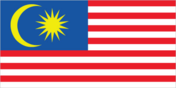
- 14 equal horizontal stripes of red (top) alternating with white (bottom); there is a dark blue rectangle in the upper hoist-side corner bearing a yellow crescent and a yellow 14-pointed star; the flag is often referred to as Jalur Gemilang (Stripes of Glory); the 14 stripes stand for the equal status in the federation of the 13 member states and the federal government; the 14 points on the star represent the unity between these entities; the crescent is a traditional symbol of Islam; blue symbolizes the unity of the Malay people and yellow is the royal color of Malay rulers
- note
- note: the design is based on the flag of the US
Government type
- federal parliamentary constitutional monarchy
- note
- note: all Peninsular Malaysian states have hereditary rulers (commonly referred to as sultans) except Melaka (Malacca) and Pulau Pinang (Penang); those two states along with Sabah and Sarawak in East Malaysia have governors appointed by government; powers of state governments are limited by the federal constitution; under terms of federation, Sabah and Sarawak retain certain constitutional prerogatives (e.g., right to maintain their own immigration controls)
Independence
31 August 1957 (from the UK)
International law organization participation
has not submitted an ICJ jurisdiction declaration; non-party state to the ICCt
International organization participation
ADB, APEC, ARF, ASEAN, BIS, C, CICA (observer), CP, D-8, EAS, FAO, G-15, G-77, IAEA, IBRD, ICAO, ICC (national committees), ICRM, IDA, IDB, IFAD, IFC, IFRCS, IHO, ILO, IMF, IMO, IMSO, Interpol, IOC, IPU, ISO, ITSO, ITU, ITUC (NGOs), MIGA, MINURSO, MONUSCO, NAM, OIC, OPCW, PCA, PIF (partner), UN, UNAMID, UNCTAD, UNESCO, UNHRC, UNIDO, UNIFIL, UNISFA, UNMIL, UNWTO, UPU, WCO, WFTU (NGOs), WHO, WIPO, WMO, WTO
Judicial branch
- highest court(s)
- Federal Court (consists of the chief justice, president of the Court of Appeal, chief justice of the High Court of Malaya, chief judge of the High Court of Sabah and Sarawak, 8 judges, and 1 "additional" judge); note - Malaysia has a dual judicial hierarchy of civil and religious (sharia) courts
- judge selection and term of office
- Federal Court justices appointed by the monarch on advice of the prime minister; judges serve until mandatory retirement at age 66 with the possibility of a single 6-month extension
- subordinate courts
- Court of Appeal; High Court; Sessions Court; Magistrates' Court
Legal system
mixed legal system of English common law, Islamic (sharia) law, and customary law; judicial review of legislative acts in the Federal Court at request of supreme head of the federation
Legislative branch
- description
- bicameral Parliament of Malaysia or Parlimen Malaysia consists of:Senate or Dewan Negara (70 seats; 44 members appointed by the king and 26 indirectly elected by 13 state legislatures; members serve 3-year terms)House of Representatives or Dewan Rakyat (222 seats; members directly elected in single-seat constituencies by simple majority vote to serve 5-year terms) (2019)
- election results
- Senate - appointed; composition - men 54, women 14, percent of women 20.6%2022: House of Representatives - percent of vote by party/coalition - PH 37.5%, PN 30.4%, BN 22.4%, GPS 4%, WARISAN 1.8%, GRS 1.3%, other 2.6%; seats by party/coalition - PH 81, PN 73, BN 30, GPS 23, GRS 6, WARISAN 3, PBM 1, KDM 1, MUDA 1, independents/unaffiliated 32018: House of Representatives - percent of vote by party/coalition - PH 45.6%, BN 33.8%, PAS 16.9%, WARISAN 2.3%, other 1.4%; seats by party/coalition - PH 113, BN 79, PAS 18, WARISAN 8, USA 1, independent 3; composition - men 199, women 23, percent of women 10.4%; note - total Parliament percent of women 12.8%
- elections
- Senate - appointedHouse of Representatives - last held on 19 Nov 2022 (next national elections scheduled for 2027)
- note
- note: as of May 2022, seats by party/coalition - PH 90, PN 50, BN 42, GPS 18, WARISAN 7, PEJUANG 4, PBM 3, PSB 1, MUDA 1, independent 4, vacant 2
National anthem
- lyrics/music
- collective, led by Tunku ABDUL RAHMAN/Pierre Jean DE BERANGER
- name
- "Negaraku" (My Country)
- note
- note: adopted 1957; full version only performed in the presence of the king; the tune, which was adopted from a popular French melody titled "La Rosalie," was originally the anthem of Perak, one of Malaysia's 13 states
National heritage
- selected World Heritage Site locales
- Gunung Mulu National Park (n); Kinabalu Park (n); Malacca and George Town, Historic Cities of the Straits of Malacca (c); Archaeological Heritage of the Lenggong Valley (c)
- total World Heritage Sites
- 4 (2 cultural, 2 natural)
National holiday
Independence Day (or Merdeka Day), 31 August (1957) (independence of Malaya); Malaysia Day, 16 September (1963) (formation of Malaysia)
National symbol(s)
tiger, hibiscus; national colors: gold, black
Political parties and leaders
National Front (Barisan Nasional) or BN:All Malaysian Indian Progressive Front or IPF [Loganathan THORAISAMY]Love Malaysia Party or PCM [Huan Cheng GUAN]Malaysian Chinese Association (Persatuan Cina Malaysia) or MCA [Wee Ka SIONG]Malaysian Indian Congress (Kongres India Malaysia) or MIC [Vigneswaran SANASEE]Malaysian Indian Muslim Congress or KIMMA [Datuk Seri Haji SYED]Malaysia Makkal Sakti Party or MMSP [R.S. THANENTHIRAN]United Malays National Organization (Pertubuhan Kebansaan Melayu Bersatu) or UNMO [Ahmad Zahid HAMIDI]United Sabah People's Party (Parti Bersatu Rakyat Sabah) or PBRS [Joseph KURUP]Coalition of Hope (Pakatan Harapan) or PH:Democratic Action Party (Parti Tindakan Demokratik) or DAP [LIM Guan Eng]National Trust Party (Parti Amanah Negara) or AMANAH [Mohamad SABU]People's Justice Party (Parti Keadilan Rakyat) or PKR [ANWAR Ibrahim]United Progressive Kinabalu Organization or UPKO [Wilfred Madius TANGAU]Coalition Perikatan Nasional (National Alliance) or PNHomeland Solidarity Party (Parti Solidariti Tanah Airku) or STAR [Datuk Seri Jeffrey Kitingan]Malaysian People's Movement Party (Parti Gerakan Rakyat Malaysia) or GERAKAN or PGRM [Dominic Lau Hoe CHAI]Malaysian United Indigenous Party (Parti Pribumi Bersatu Malaysia) or PPBM or BERSATU [Tan Sri MUHYIDDIN Yassin]Pan-Malaysian Islamic Party (Parti Islam se Malaysia) or PAS [Abdul HADI Awang]Parti Gerakan Rakyat Malaysia or GERAKAN [Dominic Lau Hoe CHAI] Sarawak Parties Alliance (Gabungan Parti Sarawak) or GPS [ABANG JOHARI Openg] Progressive Democratic Party or PDP [TIONG King Sing]Sarawak People's Party (Parti Rakyat Sarawak) or PRS [James MASING]Sarawak United People's Party (Parti Bersatu Rakyat Sarawak) or SUPP [Dr. SIM Kui Hian]United Traditional Bumiputera Party (Parti Pesaka Bumiputera Bersata) or PBB [Abang Abdul Rahman Johari Abang Openg or "Abang Jo"]Gabungan Rakya Sabah or GRS:Homeland Solidarity Party or STAR [Jeffrey KITINGAN]Malaysian United Indigenous Party (Parti Pribumi Bersatu Malaysia) or PPBM [Tan Sri MUHYIDDIN Yassin]Sabah Progressive Party or SAPP [Yong Teck LEE]United Sabah Party (Parti Bersatu Sabah) or PBS [Maximus ONGKILI]Others receiving votes in 2022 general election:Gerakan Tanah Air or GTA Party [Hajiji NOOR] (a coalition of parties in Sabah)Malaysian Nation Party (Parti Bangsa Malaysia) or PBM [Larry Sng Wei SHIEN] (formerly Sarawak Workers Party)Malaysian United Democratic Alliance or MUDA [Syed SADDIQ bin Syed Abdul Rahman]Perikatan Rakyat Bersatu Sarawak or PERKASA (coalition of Sarawak parties)Sabah Heritage Party (Parti Warisan Sabah) or WARISAN [SHAFIE Apdal]Social Democratic Harmony Party or KDM [Peter ANTHONY]Socialist Party of Malaysia or PSM [Michael Jeyakumar DEVARA]
Suffrage
18 years of age; universal (2019)
Economy
Agricultural products
oil palm fruit, rice, poultry, eggs, vegetables, rubber, coconuts, bananas, pineapples, pork
Budget
- expenditures
- 60.63 billion (2017 est.)
- revenues
- 51.25 billion (2017 est.)
Budget surplus (+) or deficit (-)
-3% (of GDP) (2017 est.)
Credit ratings
- Fitch rating
- BBB+ (2020)
- Moody's rating
- A3 (2004)
- note
- note: The year refers to the year in which the current credit rating was first obtained.
- Standard & Poors rating
- A- (2003)
Current account balance
- Current account balance 2018
- $8.027 billion (2018 est.)
- Current account balance 2019
- $12.295 billion (2019 est.)
Debt - external
- Debt - external 2018
- $226.901 billion (2018 est.)
- Debt - external 2019
- $224.596 billion (2019 est.)
Economic overview
Malaysia, an upper middle-income country, has transformed itself since the 1970s from a producer of raw materials into a multi-sector economy. Under current Prime Minister NAJIB, Malaysia is attempting to achieve high-income status by 2020 and to move further up the value-added production chain by attracting investments in high technology, knowledge-based industries and services. NAJIB's Economic Transformation Program is a series of projects and policy measures intended to accelerate the country's economic growth. The government has also taken steps to liberalize some services sub-sectors. Malaysia is vulnerable to a fall in world commodity prices or a general slowdown in global economic activity. The NAJIB administration is continuing efforts to boost domestic demand and reduce the economy's dependence on exports. Domestic demand continues to anchor economic growth, supported mainly by private consumption, which accounts for 53% of GDP. Nevertheless, exports - particularly of electronics, oil and gas, and palm oil - remain a significant driver of the economy. In 2015, gross exports of goods and services were equivalent to 73% of GDP. The oil and gas sector supplied about 22% of government revenue in 2015, down significantly from prior years amid a decline in commodity prices and diversification of government revenues. Malaysia has embarked on a fiscal reform program aimed at achieving a balanced budget by 2020, including rationalization of subsidies and the 2015 introduction of a 6% value added tax. Sustained low commodity prices throughout the period not only strained government finances, but also shrunk Malaysia’s current account surplus and weighed heavily on the Malaysian ringgit, which was among the region’s worst performing currencies during 2013-17. The ringgit hit new lows following the US presidential election amid a broader selloff of emerging market assets. Bank Negara Malaysia (the central bank) maintains adequate foreign exchange reserves; a well-developed regulatory regime has limited Malaysia's exposure to riskier financial instruments, although it remains vulnerable to volatile global capital flows. In order to increase Malaysia’s competitiveness, Prime Minister NAJIB raised possible revisions to the special economic and social preferences accorded to ethnic Malays under the New Economic Policy of 1970, but retreated in 2013 after he encountered significant opposition from Malay nationalists and other vested interests. In September 2013 NAJIB launched the new Bumiputra Economic Empowerment Program, policies that favor and advance the economic condition of ethnic Malays. Malaysia signed the 12-nation Trans-Pacific Partnership (TPP) free trade agreement in February 2016, although the future of the TPP remains unclear following the US withdrawal from the agreement. Along with nine other ASEAN members, Malaysia established the ASEAN Economic Community in 2015, which aims to advance regional economic integration.
Exchange rates
- Currency
- ringgits (MYR) per US dollar -
- Exchange rates 2013
- 3.27 (2013 est.)
- Exchange rates 2014
- 3.91 (2014 est.)
- Exchange rates 2018
- 4.166 (2018 est.)
- Exchange rates 2019
- 4.161 (2019 est.)
- Exchange rates 2020
- 4.064 (2020 est.)
Exports
- Exports 2018
- $245.89 billion (2018 est.) note: data are in current year dollars
- Exports 2019
- $237.83 billion (2019 est.) note: data are in current year dollars
- Exports 2020
- $207.37 billion (2020 est.) note: data are in current year dollars
Exports - commodities
integrated circuits, refined petroleum, natural gas, semiconductors, palm oil (2019)
Exports - partners
Singapore 13%, China 13%, United States 11%, Hong Kong 6%, Japan 6%, Thailand 5% (2019)
Fiscal year
calendar year
GDP - composition, by end use
- exports of goods and services
- 71.4% (2017 est.)
- government consumption
- 12.2% (2017 est.)
- household consumption
- 55.3% (2017 est.)
- imports of goods and services
- -64.4% (2017 est.)
- investment in fixed capital
- 25.3% (2017 est.)
- investment in inventories
- 0.3% (2017 est.)
GDP - composition, by sector of origin
- agriculture
- 8.8% (2017 est.)
- industry
- 37.6% (2017 est.)
- services
- 53.6% (2017 est.)
GDP (official exchange rate)
$364.631 billion (2019 est.)
Gini Index coefficient - distribution of family income
- Gini Index coefficient - distribution of family income 1997
- 49.2 (1997)
- Gini Index coefficient - distribution of family income 2015
- 41 (2015 est.)
Household income or consumption by percentage share
- highest 10%
- 34.7% (2009 est.)
- lowest 10%
- 1.8%
Imports
- Imports 2018
- $221.83 billion (2018 est.) note: data are in current year dollars
- Imports 2019
- $210.68 billion (2019 est.) note: data are in current year dollars
- Imports 2020
- $185.59 billion (2020 est.) note: data are in current year dollars
Imports - commodities
integrated circuits, refined petroleum, crude petroleum, broadcasting equipment, coal (2019)
Imports - partners
China 24%, Singapore 14%, Japan 6%, United States 6%, Taiwan 5%, Thailand 5% (2019)
Industrial production growth rate
5% (2017 est.)
Industries
Peninsular Malaysia - rubber and oil palm processing and manufacturing, petroleum and natural gas, light manufacturing, pharmaceuticals, medical technology, electronics and semiconductors, timber processing; Sabah - logging, petroleum and natural gas production;Sarawak - agriculture processing, petroleum and natural gas production, logging
Inflation rate (consumer prices)
- Inflation rate (consumer prices) 2017
- 3.8% (2017 est.)
- Inflation rate (consumer prices) 2018
- 0.9% (2018 est.)
- Inflation rate (consumer prices) 2019
- 0.6% (2019 est.)
- note
- note: approximately 30% of goods are price-controlled
Labor force
15.139 million (2020 est.)
Labor force - by occupation
- agriculture
- 11%
- industry
- 36%
- services
- 53% (2012 est.)
Population below poverty line
5.6% (2018 est.)
Public debt
- note
- note: this figure is based on the amount of federal government debt, RM501.6 billion ($167.2 billion) in 2012; this includes Malaysian Treasury bills and other government securities, as well as loans raised externally and bonds and notes issued overseas; this figure excludes debt issued by non-financial public enterprises and guaranteed by the federal government, which was an additional $47.7 billion in 2012
- Public debt 2016
- 56.2% of GDP (2016 est.)
- Public debt 2017
- 54.1% of GDP (2017 est.)
Real GDP (purchasing power parity)
- note
- note: data are in 2017 dollars
- Real GDP (purchasing power parity) 2018
- $868.85 billion (2018 est.)
- Real GDP (purchasing power parity) 2019
- $906.24 billion (2019 est.)
- Real GDP (purchasing power parity) 2020
- $855.6 billion (2020 est.)
Real GDP growth rate
- Real GDP growth rate 2017
- 5.81% (2017 est.)
- Real GDP growth rate 2018
- 4.77% (2018 est.)
- Real GDP growth rate 2019
- 4.31% (2019 est.)
Real GDP per capita
- note
- note: data are in 2017 dollars
- Real GDP per capita 2018
- $27,600 (2018 est.)
- Real GDP per capita 2019
- $28,400 (2019 est.)
- Real GDP per capita 2020
- $26,400 (2020 est.)
Reserves of foreign exchange and gold
- Reserves of foreign exchange and gold 31 December 2016
- $94.5 billion (31 December 2016 est.)
- Reserves of foreign exchange and gold 31 December 2017
- $102.4 billion (31 December 2017 est.)
Taxes and other revenues
16.4% (of GDP) (2017 est.)
Unemployment rate
- Unemployment rate 2018
- 3.33% (2018 est.)
- Unemployment rate 2019
- 3.3% (2019 est.)
Youth unemployment rate (ages 15-24)
- female
- 13% (2020 est.)
- male
- 11.4%
- total
- 12%
Energy
Carbon dioxide emissions
- from coal and metallurgical coke
- 81.726 million metric tonnes of CO2 (2019 est.)
- from consumed natural gas
- 78.104 million metric tonnes of CO2 (2019 est.)
- from petroleum and other liquids
- 94.934 million metric tonnes of CO2 (2019 est.)
- total emissions
- 254.764 million metric tonnes of CO2 (2019 est.)
Coal
- consumption
- 35.268 million metric tons (2020 est.)
- exports
- 17,000 metric tons (2020 est.)
- imports
- 37.295 million metric tons (2020 est.)
- production
- 2.977 million metric tons (2020 est.)
- proven reserves
- 226 million metric tons (2019 est.)
Electricity
- consumption
- 150.062 billion kWh (2019 est.)
- exports
- 669 million kWh (2019 est.)
- imports
- 19 million kWh (2019 est.)
- installed generating capacity
- 34.959 million kW (2020 est.)
- transmission/distribution losses
- 12.124 billion kWh (2019 est.)
Electricity access
- electrification - total population
- 100% (2020)
Electricity generation sources
- biomass and waste
- 1% of total installed capacity (2020 est.)
- fossil fuels
- 87.5% of total installed capacity (2020 est.)
- geothermal
- 0% of total installed capacity (2020 est.)
- hydroelectricity
- 10.9% of total installed capacity (2020 est.)
- nuclear
- 0% of total installed capacity (2020 est.)
- solar
- 0.7% of total installed capacity (2020 est.)
- tide and wave
- 0% of total installed capacity (2020 est.)
- wind
- 0% of total installed capacity (2020 est.)
Energy consumption per capita
- Total energy consumption per capita 2019
- 123.755 million Btu/person (2019 est.)
Natural gas
- consumption
- 39,586,915,000 cubic meters (2019 est.)
- exports
- 34,197,548,000 cubic meters (2020 est.)
- imports
- 4,008,073,000 cubic meters (2020 est.)
- production
- 74,985,350,000 cubic meters (2019 est.)
- proven reserves
- 1,189,306,000,000 cubic meters (2021 est.)
Petroleum
- crude oil and lease condensate exports
- 303,600 bbl/day (2018 est.)
- crude oil and lease condensate imports
- 182,300 bbl/day (2018 est.)
- crude oil estimated reserves
- 3.6 billion barrels (2021 est.)
- refined petroleum consumption
- 718,600 bbl/day (2019 est.)
- total petroleum production
- 593,800 bbl/day (2021 est.)
Refined petroleum products - exports
208,400 bbl/day (2015 est.)
Refined petroleum products - imports
304,600 bbl/day (2015 est.)
Refined petroleum products - production
528,300 bbl/day (2015 est.)
Communications
Broadband - fixed subscriptions
- subscriptions per 100 inhabitants
- 10 (2020 est.)
- total
- 3,358,800 (2020 est.)
Broadcast media
state-owned TV broadcaster operates 2 TV networks with relays throughout the country, and the leading private commercial media group operates 4 TV stations with numerous relays throughout the country; satellite TV subscription service is available; state-owned radio broadcaster operates multiple national networks, as well as regional and local stations; many private commercial radio broadcasters and some subscription satellite radio services are available; about 55 radio stations overall (2019)
Internet country code
.my
Internet users
- percent of population
- 90% (2020 est.)
- total
- 29,129,398 (2020 est.)
Telecommunication systems
- domestic
- fixed-line roughly 23 per 100 and mobile-cellular teledensity roughly 135 per 100 persons; domestic satellite system with 2 earth stations (2020)
- general assessment
- as part of a diverse range of initiatives designed to move the country from developing to developed status by 2025, Malaysia has enabled and encouraged open competition in its telecommunications market; the result is very high penetration levels in both the mobile (147%) and mobile broadband (127%) segments, and near-universal coverage of 4G LTE networks; steady growth is occurring as more fiber optic cable networks are being deployed around the country; consumers are the main beneficiaries of the highly competitive market; they enjoy widespread access to high-speed mobile services as well as attractive offers on bundles to keep data use up but prices low; the downside is that most of Malaysia’s MNOs and MVNOs have struggled to increase revenue in line with growth in subscriber numbers as well as demand for broadband data; while the operators have been very successful in moving a significant proportion (now over 30%) of customers from prepaid over to higher-value postpaid accounts, ARPU continues to fall year after year as a result of competitive pricing pressures; the mobile market, in particular, has become overcrowded and the government is keen to see further rationalization and consolidation with the operators; while customers will no doubt continue to enjoy high quality services at competitive rates, the new entity will be hopeful of squeezing better margins through improved economies of scale; the government’s next move is to encourage the private mobile operators to sign up to the country’s wholesale 5G network; this will develop and deploy the 5G infrastructure across the country; the government’s stated intent was to avoid duplication of networks and infrastructure, and thus reduce investment costs for the operators; to date, no MNO has agreed to the deal and are instead demanding the development of a dual wholesale network model (one that no doubt offers more flexible terms, at least in the eyes of the MNOs); Malaysia’s 5G rollout has, in effect, come to a standstill while the government tries to find a way to restart negotiations (2022)
- international
- country code - 60; landing points for BBG, FEA, SAFE, SeaMeWe-3 & 4 & 5, AAE-1, JASUKA, BDM, Dumai-Melaka Cable System, BRCS, ACE, AAG, East-West Submarine Cable System, SEAX-1, SKR1M, APCN-2, APG, BtoBe, BaSICS, and Labuan-Brunei Submarine and MCT submarine cables providing connectivity to Asia, the Middle East, Southeast Asia, Australia and Europe; satellite earth stations - 2 Intelsat (1 Indian Ocean, 1 Pacific Ocean); launch of Kacific-1 satellite in 2019 (2019)
- note
- note: the COVID-19 pandemic continues to have a significant impact on production and supply chains globally; since 2020, some aspects of the telecom sector have experienced a downturn, particularly in mobile device production; progress toward 5G implementation has resumed, as well as upgrades to infrastructure; consumer spending on telecom services has increased due to the surge in demand for capacity and bandwidth; the crucial nature of telecom services as a tool for work and school from home is still evident, and the spike in this area has seen growth opportunities for development of new tools and increased services
Telephones - fixed lines
- subscriptions per 100 inhabitants
- 23 (2020 est.)
- total subscriptions
- 7,467,900 (2020 est.)
Telephones - mobile cellular
- subscriptions per 100 inhabitants
- 135 (2020 est.)
- total subscriptions
- 43,723,600 (2020 est.)
Transportation
Airports
- total
- 114 (2021)
Airports - with paved runways
- 1,524 to 2,437 m
- 7
- 2,438 to 3,047 m
- 8
- 914 to 1,523 m
- 8
- over 3,047 m
- 8
- total
- 39
- under 914 m
- 8 (2021)
Airports - with unpaved runways
- 914 to 1,523 m
- 6
- total
- 75
- under 914 m
- 69 (2021)
Civil aircraft registration country code prefix
9M
Heliports
4 (2021)
Merchant marine
- by type
- bulk carrier 16, container ship 28, general cargo 174, oil tanker 153, other 1,398 (2021)
- total
- 1,769
National air transport system
- annual freight traffic on registered air carriers
- 1,404,410,000 (2018) mt-km
- annual passenger traffic on registered air carriers
- 60,481,772 (2018)
- inventory of registered aircraft operated by air carriers
- 270
- number of registered air carriers
- 13 (2020)
Pipelines
354 km condensate, 6,439 km gas, 155 km liquid petroleum gas, 1,937 km oil, 43 km oil/gas/water, 114 km refined products, 26 km water (2013)
Ports and terminals
- container port(s) (TEUs)
- Port Kelang (Port Klang) (13,580,717), Tanjung Pelepas (9,100,000) (2019)
- LNG terminal(s) (export)
- Bintulu (Sarawak)
- LNG terminal(s) (import)
- Sungei Udang
- major seaport(s)
- Bintulu, Johor Bahru, George Town (Penang), Pelabuhan Klang (Port Klang), Tanjung Pelepas
Railways
- narrow gauge
- 1,792 km (2014) 1.000-m gauge (339 km electrified)
- standard gauge
- 59 km (2014) 1.435-m gauge (59 km electrified)
- total
- 1,851 km (2014)
Roadways
- paved
- 116,169 km (2010) (includes 1,821 km of expressways)
- total
- 144,403 km (2010) (excludes local roads)
- unpaved
- 28,234 km (2010)
Waterways
7,200 km (2011) (Peninsular Malaysia 3,200 km; Sabah 1,500 km; Sarawak 2,500 km)
Military and Security
Maritime threats
the International Maritime Bureau reports the territorial and offshore waters in the South China Sea as high risk for piracy and armed robbery against ships; numerous commercial vessels have been attacked and hijacked both at anchor and while underway; hijacked vessels are often disguised and cargo diverted to ports in East Asia; crews have been murdered or cast adrift; the Singapore Straits saw 35 attacks against commercial vessels in 2021, a 50% increase over 2020 and the highest number of incidents reported since 1992; vessels were boarded in 33 of the 35 incidents, one crew was injured, another assaulted and two threatened during these incidents
Military - note
maritime security has long been a top priority for the Malaysian Armed Forces, but it has received even greater emphasis in the 2000s, particularly anti-piracy operations in the Strait of Malacca and countering Chinese naval incursions in Malaysia’s Economic Exclusion Zone, as well as addressing identified shortfalls in maritime capabilities; as such, it has undertaken modest efforts to procure more modern ships, improve air and maritime surveillance, expand the Navy’s support infrastructure (particularly bases/ports) and domestic ship-building capacities, restructure naval command and control, and increase naval cooperation with regional and international partners; as of 2022, for example, the Navy had 6 frigates fitting out or under construction and scheduled for completion by 2023, which will increase the number of operational frigates from 2 to 8; in addition, it began tri-lateral air and naval patrols with Indonesia and the Philippines in 2017; Malaysia also cooperates closely with the US military, including on maritime surveillance and participating regularly in bilateral and multilateral training exercisesMalaysia is a member of the Five Powers Defense Arrangements (FPDA), a series of mutual assistance agreements reached in 1971 embracing Australia, Malaysia, New Zealand, Singapore, and the UK; the FPDA commits the members to consult with one another in the event or threat of an armed attack on any of the members and to mutually decide what measures should be taken, jointly or separately; there is no specific obligation to intervene militarily (2022)
Military and security forces
- Malaysian Armed Forces (Angkatan Tentera Malaysia, ATM): Malaysian Army (Tentera Darat Malaysia), Royal Malaysian Navy (Tentera Laut Diraja Malaysia, TLDM), Royal Malaysian Air Force (Tentera Udara Diraja Malaysia, TUDM); Ministry of Home Affairs: Royal Malaysian Police (PRMD), Malaysian Maritime Enforcement Agency (MMEA; aka Malaysian Coast Guard) (2022)
- note
- note 1: the PRMD includes the General Operations Force, a paramilitary force with a variety of roles, including patrolling borders, counter-terrorism, maritime security, and counterinsurgencynote 2: Malaysia created a National Special Operations Force in 2016 for combating terrorism threats; the force is comprised of personnel from the Armed Forces, the Royal Malaysian Police, and the Malaysian Maritime Enforcement Agency
Military and security service personnel strengths
approximately 115,000 active duty troops (80,000 Army; 18,000 Navy; 17,000 Air Force) (2022)
Military deployments
830 Lebanon (UNIFIL) (May 2022)
Military equipment inventories and acquisitions
the military fields a diverse mix of mostly older imported weapons systems; since 2010, it has received military equipment from approximately 20 countries, with Germany and Spain being the leading suppliers (2021)
Military expenditures
- Military Expenditures 2018
- 1% of GDP (2018) (approximately $7.63 billion)
- Military Expenditures 2019
- 1% of GDP (2019) (approximately $7.84 billion)
- Military Expenditures 2020
- 1.1% of GDP (2020)
- Military Expenditures 2021
- 1% of GDP (2021)
- Military Expenditures 2022
- 1% of GDP (2022 est.)
Military service age and obligation
- 17 years 6 months of age for voluntary military service for men and women (younger with parental consent and proof of age); mandatory retirement age 60; no conscription (2021)
- note
- note - in 2020, the military announced a goal of having 10% of the active force comprised of women
Transnational Issues
Disputes - international
piracy remains a problem in the Malacca Strait Malaysia-Brunei: per Letters of Exchange signed in 2009, Malaysia in 2010 ceded two hydrocarbon concession blocks to Brunei; in 2009, the media reported that Brunei had dropped its claims to the Limbang corridor, but Brunei responded that the subject had never been discussed during recent talks between the two countries Malaysia-China-Philippines-Vietnam: while the 2002 "Declaration on the Conduct of Parties in the South China Sea" has eased tensions over the Spratly Islands, it is not the legally binding "code of conduct" sought by some parties, which is currently being negotiated between China and ASEAN; Malaysia was not party to the March 2005 joint accord among the national oil companies of China, the Philippines, and Vietnam on conducting marine seismic activities in the Spratly Islands Malaysia-Indonesia: land and maritime negotiations with Indonesia are ongoing, and disputed areas include the controversial Tanjung Datu and Camar Wulan border area in Borneo and the maritime boundary in the Ambalat oil block in the Celebes Sea Malaysia-Philippines: Philippines retains a dormant claim to the eastern part of Malaysia's Sabah State in northern Borneo Malaysia-Singapore: disputes continue over deliveries of fresh water to Singapore, Singapore's land reclamation, bridge construction, and maritime boundaries in the Johor and Singapore Straits; in 2008, the International Court of Justice awarded sovereignty of Pedra Branca (Pulau Batu Puteh/Horsburgh Island) to Singapore, and Middle Rocks to Malaysia but did not rule on maritime regimes, boundaries, or disposition of South Ledge Malaysia-Thailand: in 2008, separatist violence in Thailand's predominantly Muslim southern provinces prompts Malaysia to take measures to close and to monitor the border with Thailand to stem terrorist activities
Illicit drugs
methamphetamine is the most used and trafficked drug controlled by criminal organizations that produce it; crystal methamphetamine, MDMA (ecstasy), cannabis products, heroin, ketamine, and Erimin 5 (nimetazepam) are smuggled into the country; a transit point for trafficking cocaine and other drugs to the Australian market
Refugees and internally displaced persons
- refugees (country of origin)
- 120,126 (Burma) (mid-year 2021)
- stateless persons
- 112,003 (mid-year 2021); note - Malaysia's stateless population consists of Rohingya refugees from Burma, ethnic Indians, and the children of Filipino and Indonesian illegal migrants; Burma stripped the Rohingya of their nationality in 1982; Filipino and Indonesian children who have not been registered for birth certificates by their parents or who received birth certificates stamped "foreigner" are not eligible to attend government schools; these children are vulnerable to statelessness should they not be able to apply to their parents' country of origin for passports
Trafficking in persons
- tier rating
- Tier 2 Watch List — Malaysia does not fully meet the minimum standards for the elimination of trafficking but is making significant efforts to do so; the government identified more victims, increased the number of trafficking-specialist prosecutors, drafted victim identification standard operating procedures, identified two volunteer victim assistance specialists that worked with more than 100 victims, and co-hosted the first national conference on anti-trafficking; however, authorities prosecuted and convicted fewer traffickers and investigated few trafficking cases; despite the issue of corruption, insufficient efforts were made to prosecute officials’ complicity in trafficking-related crimes or to report the results of investigations into such crimes; insufficient interagency coordination and victim services discouraged foreign victims from participating in criminal proceedings; no resources were devoted to a written plan that, if implemented, would constitute significant efforts to meet the minimum standards; Malaysia was granted a waiver per the Trafficking Victims Protection Act from an otherwise required downgrade to Tier 3 (2020)
- trafficking profile
- Malaysia is a destination and, to a lesser extent, a source and transit country for women and children subjected to conditions of forced labor and women and children subjected to sex trafficking; Malaysia is mainly a destination country for foreign workers who migrate willingly from countries including Indonesia, Nepal, India, Thailand, China, the Philippines, Burma, Cambodia, Laos, Bangladesh, Pakistan, and Vietnam, but subsequently they encounter forced labor or debt bondage at the hands of their employers in the domestic, agricultural, construction, plantation, and industrial sectors; a small number of Malaysian citizens were reportedly trafficked internally and to Singapore, China, and Japan for commercial sexual exploitation; refugees are also vulnerable to trafficking; some officials are reportedly complicit in facilitating trafficking; traffickers lure Rohingya women and girls residing in refugee camps in Bangladesh to Malaysia, where they are coerced to engage in commercial sex
Terrorism
Terrorist group(s)
- Islamic State of Iraq and ash-Sham (ISIS); Jemaah Islamiyah (JI); Abu Sayyaf Group (ASG)
- note
- note: details about the history, aims, leadership, organization, areas of operation, tactics, targets, weapons, size, and sources of support of the group(s) appear(s) in Appendix-T
Environment
Air pollutants
- carbon dioxide emissions
- 248.29 megatons (2016 est.)
- methane emissions
- 51.51 megatons (2020 est.)
- particulate matter emissions
- 16.04 micrograms per cubic meter (2016 est.)
Climate
tropical; annual southwest (April to October) and northeast (October to February) monsoons
Environment - current issues
air pollution from industrial and vehicular emissions; water pollution from raw sewage; deforestation; smoke/haze from Indonesian forest fires; endangered species; coastal reclamation damaging mangroves and turtle nesting sites
Environment - international agreements
- party to
- Antarctic-Environmental Protection, Antarctic Treaty, Biodiversity, Climate Change, Climate Change-Kyoto Protocol, Climate Change-Paris Agreement, Comprehensive Nuclear Test Ban, Desertification, Endangered Species, Hazardous Wastes, Law of the Sea, Marine Life Conservation, Nuclear Test Ban, Ozone Layer Protection, Ship Pollution, Tropical Timber 2006, Wetlands
- signed, but not ratified
- none of the selected agreements
Land use
- agricultural land
- 23.2% (2018 est.)
- agricultural land: arable land
- arable land: 2.9% (2018 est.)
- agricultural land: permanent crops
- permanent crops: 19.4% (2018 est.)
- agricultural land: permanent pasture
- permanent pasture: 0.9% (2018 est.)
- forest
- 62% (2018 est.)
- other
- 14.8% (2018 est.)
Major infectious diseases
- degree of risk
- intermediate (2020)
- food or waterborne diseases
- bacterial diarrhea
- vectorborne diseases
- dengue fever
- water contact diseases
- leptospirosis
Revenue from coal
- coal revenues
- 0.02% of GDP (2018 est.)
Revenue from forest resources
- forest revenues
- 1.57% of GDP (2018 est.)
Total renewable water resources
580 billion cubic meters (2017 est.)
Total water withdrawal
- agricultural
- 2.505 billion cubic meters (2017 est.)
- industrial
- 1.641 billion cubic meters (2017 est.)
- municipal
- 1.342 billion cubic meters (2017 est.)
Urbanization
- rate of urbanization
- 1.87% annual rate of change (2020-25 est.)
- urban population
- 78.7% of total population (2023)
Waste and recycling
- municipal solid waste generated annually
- 12,982,685 tons (2014 est.)
- municipal solid waste recycled annually
- 2,271,970 tons (2016 est.)
- percent of municipal solid waste recycled
- 17.5% (2016 est.)